
With the ongoing development of the cast iron industry, although the proportion of ductile iron and compacted graphite iron continues to rise, mainstream gray iron, due to its advantages such as excellent castability, still holds the highest market share. Currently, the castings produced in our factory are also predominantly gray iron, with the main grades concentrated in high-strength specifications like HT280 and HT300. The production follows a high carbon equivalent alloying process route, where the addition of specific types and quantities of alloys is used to enhance the strength and hardness of the castings. In recent years, the prices of alloys have been continuously increasing, with ferro-molybdenum showing the most significant price surge. Ferro-molybdenum costs account for over 60% of the total alloy cost. Therefore, there is an urgent need to find an alternative method—specifically, utilizing a high silicon-to-carbon (Si/C) ratio—to reduce or eliminate the use of ferro-molybdenum while ensuring that the performance requirements of the gray iron castings are met.
1. Production Conditions and Baseline Process
1.1 Melting Equipment and Raw Materials
The melting process utilizes medium-frequency induction furnaces, typically of 8-ton capacity. The primary raw materials consist of pig iron, steel scrap, and returns (internal scrap). Additional charge materials include ferrosilicon, ferromanganese, and carburizers for adjusting the molten iron composition.
1.2 Furnace Melting Procedure
The standard charging practice is followed: 5-10% pig iron, 50-60% steel scrap, with the remainder being returns. The materials are charged into the furnace in the sequence: pig iron, returns, and then steel scrap. During the melting process, ferrosilicon, ferromanganese, carburizer, etc., are added to adjust the base iron composition to the target range, as shown in Table 1.
| C | Si | Mn | P | S |
|---|---|---|---|---|
| 3.20-3.30 | 1.50-1.65 | 0.40-0.80 | < 0.06 | 0.08-0.12 |
1.3 Ladle Treatment (Inoculation and Alloying)
After furnace melting is complete, ladle treatment is performed. Inoculant and certain alloys are added to the bottom of the ladle to ensure the properties meet the specifications for different grades. The tapping temperature is controlled between 1480°C and 1540°C to ensure effective absorption of the additives. The inoculant used is a silicon-barium type. The alloys include electrolytic copper, tin granules, ferro-molybdenum, and ferro-chromium. For grades HT280 and above, to guarantee performance across varying section thicknesses, all four alloys are typically added.
- Copper (Cu): Primarily refines and homogenizes the pearlite and graphite structure, reduces chill in thin sections, and improves the section sensitivity of heavy castings.
- Tin (Sn): Mainly reduces or eliminates ferrite, stabilizes and refines pearlite, and improves section sensitivity.
- Chromium (Cr): Refines graphite and also refines and stabilizes pearlite.
- Molybdenum (Mo): Refines graphite, increases and refines pearlite, promotes carbide formation, and improves the uniformity of the microstructure in heavy sections.
The final chemical composition control range for HT280 gray iron castings is shown in Table 2. Elements like C, S, Mn, and P are primarily controlled via the base iron composition and are not typically adjusted during the ladle treatment.
| Si | Cu | Cr | Sn | Mo |
|---|---|---|---|---|
| 1.70-2.00 | 0.30-0.50 | 0.20-0.40 | 0.03-0.05 | 0.10-0.20 |
1.4 Molding, Pouring, and Inoculation
Test bars and castings are produced using molds made with alkaline phenolic resin no-bake sand. During pouring, a stream inoculant is applied for secondary inoculation. A silicon-zirconium inoculant with a grain size of 0.4-0.8 mm is used at an addition rate of 0.08-0.12%. It is uniformly sprinkled onto the metal stream using a pneumatic dispensing device on the pouring unit to ensure effective absorption. The pouring temperature is typically controlled between 1360°C and 1400°C, ensuring complete mold filling.
2. High Silicon-Carbon Ratio Experimental Process Design
The core of the experiment is to switch from the standard Cu-Cr-Mo-Sn alloyed iron to a Cu-Cr-Sn alloyed iron under the same Carbon Equivalent (CE) condition. The Carbon Equivalent is a crucial parameter for predicting the solidification behavior and microstructure of cast irons, commonly calculated using the formula:
$$ CE = C + \frac{1}{3}(Si + P) $$
For simplicity in this study, focusing on C and Si, the approximate relationship is $ CE \approx C + \frac{1}{3}Si $. Maintaining a constant CE ensures comparable solidification characteristics (like degree of eutectic solidification) between the old and new compositions. To compensate for the strength contribution of the removed molybdenum, the Silicon-to-Carbon ratio ($Si/C$) is increased. This involves simultaneously lowering the carbon content and raising the silicon content.
The target was to increase the $Si/C$ ratio from approximately 0.55 to 0.70. On average, this translates to a reduction in carbon content by about 0.1% and an increase in final silicon content by about 0.4%. This adjustment eliminates the use of approximately 0.15% ferro-molybdenum, leading to an estimated cost saving of 600 CNY per ton of molten metal. The comparative composition ranges are detailed in Table 3.
| Material | Base Iron C | Base Iron Si | Final Si | Cu | Cr | Sn | Mo |
|---|---|---|---|---|---|---|---|
| Cu-Cr-Mo-Sn Alloy (Standard) | 3.20-3.30 | 1.50-1.65 | 1.70-2.00 | 0.30-0.50 | 0.20-0.40 | 0.03-0.05 | 0.10-0.20 |
| Cu-Cr-Sn Alloy (High Si/C ~0.70) | 3.10-3.20 | 1.50-1.65 | 2.10-2.20 | 0.30-0.50 | 0.20-0.40 | 0.03-0.05 | – |
Under a constant CE, an appropriately increased $Si/C$ ratio induces several changes in solidification characteristics, microstructure, and mechanical properties of gray iron castings:
- The amount of primary austenite increases, which can have a more pronounced strengthening effect on the matrix.
- The overall graphite quantity decreases due to the lower total carbon content, thereby reducing the notch effect and weakening caused by graphite flakes.
- The eutectoid transformation temperature increases slightly. Pearlite formed at higher temperatures tends to be coarser, which could negatively impact strength.
- The amount of silicon dissolved in ferrite increases, strengthening the ferrite, including the ferrite within the pearlite lamellae.
The net effect on the final properties of the gray iron castings depends on the balance of these competing factors.
3. Experimental Process and Results
3.1 Experimental Procedure
Following the experimental plan, the carbon content of the base iron was adjusted to the range of 3.10-3.20%, with other base composition elements kept unchanged. During ladle treatment, the amount of silicon-barium inoculant was increased, and the addition of ferro-molybdenum was completely eliminated. The additions of copper, chromium, and tin were maintained within their standard ranges.
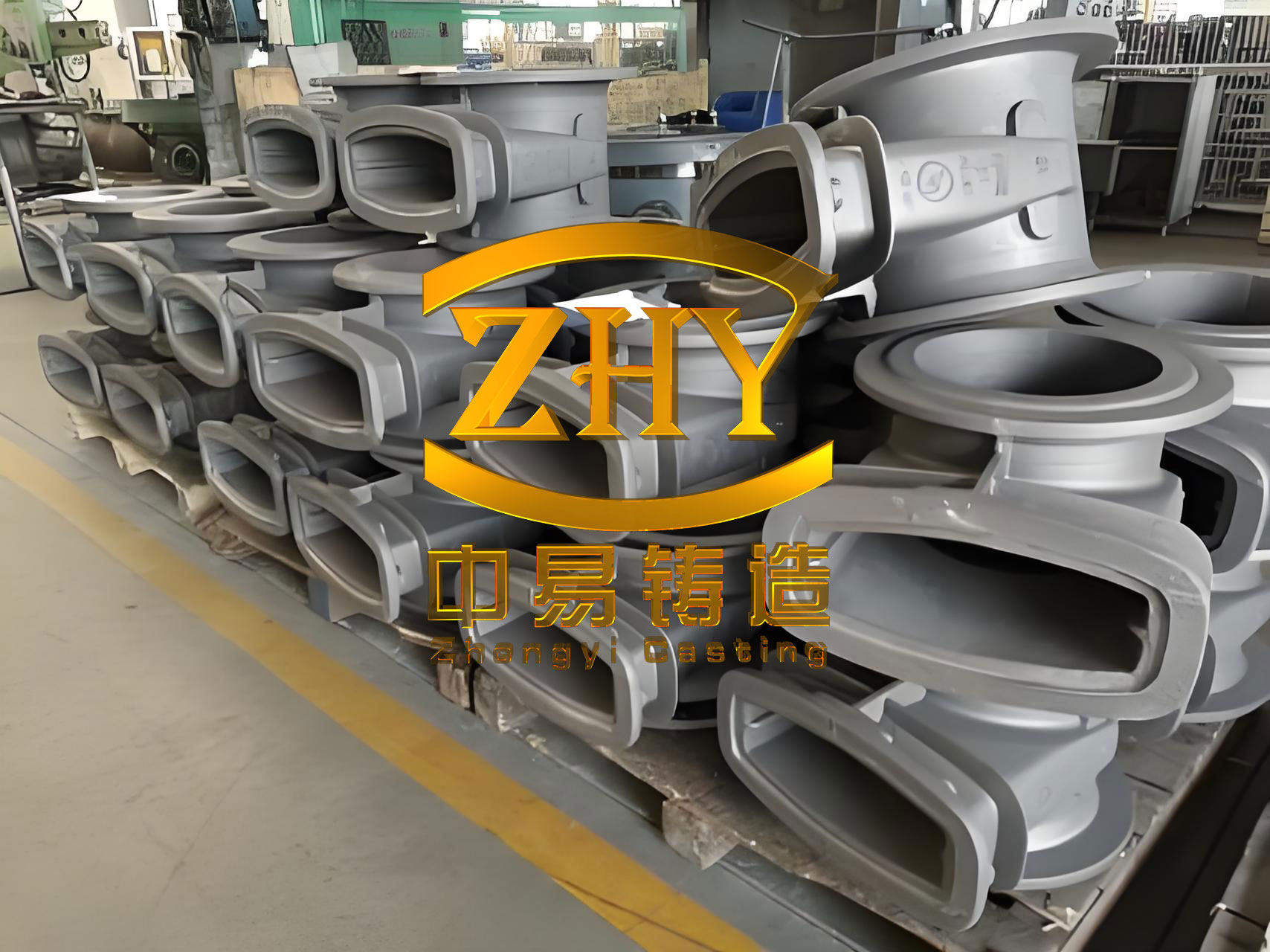
Using the standard ladle practice, one-ton heats were tapped to pour separately cast test bars and actual production castings. Pouring temperature was maintained between 1360°C and 1400°C. Four separate experimental trials were conducted. For each trial, the chemical composition, microstructure, and mechanical properties (tensile strength and Brinell hardness) of the separately cast test bars were evaluated. Furthermore, critical sections of the poured castings were sectioned to evaluate the microstructure and mechanical properties at the casting body itself.
3.2 Experimental Results
3.2.1 Separately Cast Test Bars: Composition, Microstructure, and Properties
The results for the Cu-Cr-Sn alloyed gray iron castings with the high $Si/C$ ratio (~0.70) are summarized in Table 4. All tested properties met the requirements for the HT280 grade. In our factory, HT280 (analogous to the national standard HT275) requires a minimum tensile strength of 280 MPa and a hardness range of 190-260 HBW.
| Grade | Si/C Ratio | Chemical Composition (mass fraction, %) | Microstructure | Mechanical Properties | ||||||
|---|---|---|---|---|---|---|---|---|---|---|
| C | Si | Cu | Cr | Sn | Graphite | Matrix | Tensile Strength (MPa) | Hardness (HBW) | ||
| HT280 | 0.70 | 3.11 | 2.18 | 0.47 | 0.29 | 0.047 | Type A, Size 4 | ~98% Pearlite | 295 | 209 |
| HT280 | 0.67 | 3.15 | 2.11 | 0.45 | 0.25 | 0.040 | Type A, Size 4 | ~98% Pearlite | 290 | 221 |
| HT280 | 0.68 | 3.18 | 2.17 | 0.43 | 0.30 | 0.043 | Type A, Size 4 | ~98% Pearlite | 300 | 211 |
| HT280 | 0.69 | 3.12 | 2.16 | 0.40 | 0.24 | 0.043 | Type A, Size 4 | ~98% Pearlite | 310 | 220 |
| Average | 0.69 | – | 2.15 | 0.44 | 0.27 | 0.043 | – | – | 299 | 215 |
3.2.2 Casting Body Properties (Sectioned Samples)
To verify the performance in actual castings, samples were taken from a critical location on a production casting—specifically, from the main bolt boss area of a bearing cap, which has a section thickness of approximately 50 mm. The results from the sectioned body samples, presented in Table 5, confirm that the properties within the actual gray iron castings also met the specified requirements.
| Sample ID | Grade | Microstructure | Mechanical Properties | ||
|---|---|---|---|---|---|
| Graphite | Matrix | Tensile Strength (MPa) | Hardness (HBW) | ||
| 1 | HT280 | Type A, Size 4 | ~98% Pearlite | 262 | 183 |
| 2 | HT280 | Type A, Size 4 | ~98% Pearlite | 245 | 193 |
4. Comparative Analysis and Discussion
4.1 Composition and Property Comparison
To establish a proper baseline, data from standard production Cu-Cr-Mo-Sn alloyed gray iron castings (with $Si/C$ ~0.55) are presented in Table 6. Additionally, to isolate the effect of molybdenum, supplementary trials were conducted where the standard $Si/C$ ratio (~0.55) was maintained but molybdenum was omitted (Cu-Cr-Sn alloy only). The iron from these verification trials was returned to the furnace after pouring test bars to prevent the production of potentially off-specification castings. The results are shown in Table 7.
| Grade | Si/C Ratio | Chemical Composition (mass fraction, %) | Microstructure | Mechanical Properties | |||||||
|---|---|---|---|---|---|---|---|---|---|---|---|
| C | Si | Cu | Cr | Sn | Mo | Graphite | Matrix | Tensile Strength (MPa) | Hardness (HBW) | ||
| HT280 | 0.58 | 3.25 | 1.89 | 0.46 | 0.25 | 0.046 | 0.15 | Type A, Size 4 | ~98% Pearlite | 335 | 246 |
| HT280 | 0.57 | 3.24 | 1.85 | 0.46 | 0.28 | 0.047 | 0.12 | Type A, Size 4 | ~98% Pearlite | 325 | 246 |
| HT280 | 0.55 | 3.26 | 1.79 | 0.47 | 0.29 | 0.045 | 0.12 | Type A, Size 4 | ~98% Pearlite | 285 | 263 |
| HT280 | 0.55 | 3.30 | 1.80 | 0.47 | 0.30 | 0.047 | 0.13 | Type A, Size 4 | ~98% Pearlite | 310 | 245 |
| Average | 0.56 | – | 1.83 | 0.47 | 0.28 | 0.046 | 0.13 | – | – | 314 | 250 |
| Grade | Si/C Ratio | Chemical Composition (mass fraction, %) | Microstructure | Mechanical Properties | ||||||
|---|---|---|---|---|---|---|---|---|---|---|
| C | Si | Cu | Cr | Sn | Graphite | Matrix | Tensile Strength (MPa) | Hardness (HBW) | ||
| HT280 | 0.57 | 3.25 | 1.85 | 0.48 | 0.26 | 0.045 | Type A, Size 4 | ~98% Pearlite | 275 | 200 |
| HT280 | 0.57 | 3.26 | 1.85 | 0.45 | 0.26 | 0.042 | Type A, Size 4 | ~98% Pearlite | 295 | 210 |
| HT280 | 0.54 | 3.30 | 1.79 | 0.45 | 0.25 | 0.041 | Type A, Size 4 | ~98% Pearlite | 280 | 208 |
| HT280 | 0.56 | 3.26 | 1.83 | 0.44 | 0.29 | 0.042 | Type A, Size 4 | ~98% Pearlite | 285 | 195 |
| Average | 0.56 | – | 1.83 | 0.46 | 0.27 | 0.043 | – | – | 284 | 203 |
The comparison reveals significant insights. At a similar $Si/C$ ratio of ~0.55, the Cu-Cr-Mo-Sn alloyed gray iron castings exhibit an average tensile strength that is approximately 10.6% higher than that of the Cu-Cr-Sn alloyed iron (314 MPa vs. 284 MPa). This underscores the potent strengthening effect of molybdenum, primarily through pearlite refinement. Directly eliminating molybdenum from the standard composition carries a tangible risk of failing to meet the tensile strength requirement for HT280 gray iron castings. The hardness values follow a similar trend, with the molybdenum-containing alloy being about 23% harder on average.
However, the results from the high $Si/C$ ratio trials demonstrate a successful workaround. By increasing the $Si/C$ ratio from ~0.55 to ~0.70 while maintaining the same Cu-Cr-Sn alloy base, the average tensile strength increased by approximately 5.3% (from 284 MPa to 299 MPa). Similarly, the average hardness increased by about 5.9% (from 203 HBW to 215 HBW). Crucially, the high $Si/C$ ratio Cu-Cr-Sn alloyed iron achieved an average tensile strength of 299 MPa, which is substantially above the 280 MPa minimum requirement for HT280 gray iron castings and provides a sufficient safety margin for production variability.
4.2 Microstructural Comparison
A comparative analysis of the microstructures provides the metallurgical basis for the property changes. The standard Cu-Cr-Mo-Sn alloyed iron (low $Si/C$) and the new Cu-Cr-Sn alloyed iron (high $Si/C$) both show a predominantly Type A graphite morphology with a matrix of over 95% pearlite, which is desirable. The key observable difference lies in the graphite characteristics and matrix grain refinement.
In the high $Si/C$ ratio gray iron castings, the graphite flakes appear shorter and somewhat more segmented compared to those in the standard, lower $Si/C$ material. This reduction in graphite length and continuity directly decreases the notch effect and the degree to which the graphite weakens the ferrous matrix. Furthermore, while the pearlite content remains similarly high, the prior austenite grain boundaries and the pearlite colonies themselves appear more refined in the high silicon material. This grain refinement contributes to the enhanced strength. This microstructural evolution is a direct consequence of the altered solidification path and increased silicon content, which promotes a larger fraction of primary austenite formation and alters the graphite growth conditions. The combination of refined graphite and a finer matrix structure effectively compensates for the absence of molybdenum’s strong pearlite-refining effect in these gray iron castings.
5. Conclusions
- The conventional Cu-Cr-Mo-Sn alloying composition for producing HT280 grade gray iron castings involves significant alloy usage, leading to high production costs. Simply reducing the alloy addition quantities, particularly molybdenum, poses a substantial risk of compromising mechanical properties.
- Maintaining a constant carbon equivalent and shifting to a Cu-Cr-Sn alloy system by eliminating molybdenum and simultaneously increasing the silicon-to-carbon ($Si/C$) ratio is a viable strategy to enhance mechanical properties and achieve cost reduction in gray iron castings.
- For the Cu-Cr-Sn alloyed iron, increasing the $Si/C$ ratio from approximately 0.55 to 0.70 resulted in an average tensile strength improvement of about 5%. The achieved average strength of 299 MPa comfortably meets the HT280 specification requirements. While the strengthening effect is not as pronounced as that provided directly by molybdenum addition, this approach offers a distinct advantage in reducing raw material costs.
- In the context of rising production costs for high-strength gray iron castings, the strategy of reducing expensive alloy additions (like molybdenum) while compensating for strength through an optimized high $Si/C$ ratio presents a practical and effective pathway for foundries to pursue cost savings without sacrificing product quality.
The successful application of this principle relies on precise control over the base iron composition, effective inoculation practices, and a thorough understanding of the solidification and transformation behavior of the iron. The relationship between Carbon Equivalent (CE), Silicon-Carbon Ratio ($Si/C$), and final properties can be modeled for process optimization:
$$ Target\ Strength(σ_t) \propto f(CE, Si/C, Alloy\_content, Inoculation\_Effect) $$
For the specific case of transitioning from a Mo-containing to a Mo-free iron at constant CE, the required increase in $Si/C$ to maintain strength can be considered a compensating factor $Δ(Si/C)_{comp}$:
$$ Δ(Si/C)_{comp} = k \cdot [Mo]_{removed} $$
where $k$ is a process-dependent factor. This exploration confirms that for the given production conditions, a $Δ(Si/C)_{comp}$ of ~0.15 (from 0.55 to 0.70) effectively compensated for the removal of ~0.13% Mo, enabling the production of sound, specification-compliant HT280 gray iron castings.