
As a casting engineer with extensive experience in the production of internal combustion engine parts, I have observed that the manufacturing of these components, such as cylinder blocks, cylinder heads, and pistons, involves intricate geometries and stringent technical requirements. The presence of casting defects can severely compromise engine performance, leading to economic losses and reputational damage for manufacturers. In this article, I will delve into the common casting defects encountered in engine components, analyze their root causes, and propose effective process countermeasures. My goal is to share insights that can enhance quality control and process optimization in foundries specializing in engine parts.
The internal combustion engine relies on precisely cast parts that must exhibit high wear resistance, dimensional stability, and thermal fatigue resistance. However, the casting process is prone to various defects, which I categorize based on my hands-on experience. Understanding and mitigating these casting defects is crucial for improving yield and ensuring reliability. Below, I discuss key casting defects and their solutions, incorporating tables and formulas for clarity.
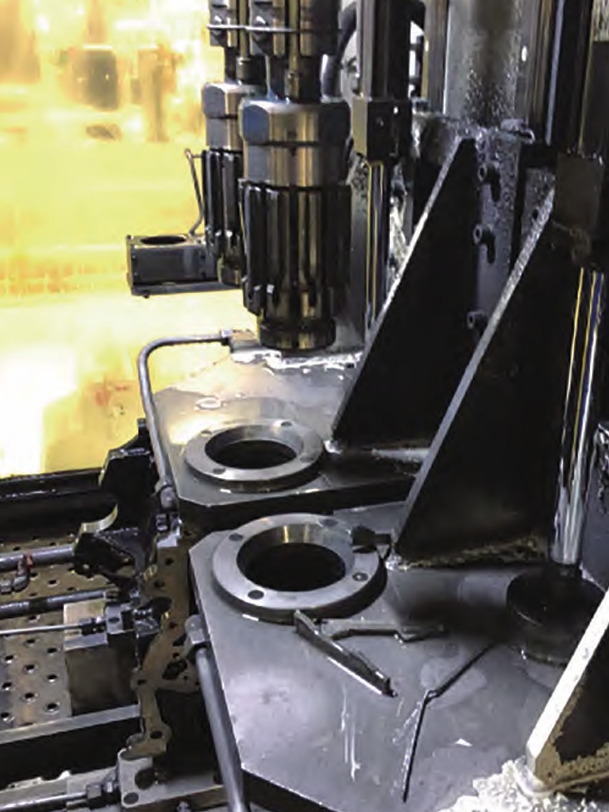
One prevalent casting defect in engine components is core shift, which occurs when the sand core moves during pouring, leading to wall thickness variations and internal cavity distortions. This casting defect is particularly problematic in cylinder blocks with complex water jackets. To address this, I recommend using core supports or chills designed with specific dimensions. For instance, the diameter of core supports should relate to the wall thickness to ensure proper fusion with the molten metal. A formula I often use is:
$$ d = \frac{1}{4} t $$
where \( d \) is the core support diameter and \( t \) is the wall thickness. This ratio minimizes stress concentrations and promotes integration. Additionally, the gating system should avoid direct impingement on core supports, and pouring temperature can be adjusted within optimal ranges to reduce turbulence.
Another critical casting defect is cracking, often observed in areas with abrupt thickness changes, such as the junction between cylinder head and valve seats. This casting defect arises from thermal stresses and inadequate material strength. My approach involves several strategies: First, I add reinforcement ribs at thick-thin transitions, which can be removed post-machining if necessary. For corner cracks, increasing the fillet radius helps distribute stress. Second, I apply inoculants to enhance the material’s tensile strength and resistance to this casting defect. The inoculation process can be quantified using the formula:
$$ S = S_0 + k \cdot I $$
where \( S \) is the final strength, \( S_0 \) is the base strength, \( k \) is a material constant, and \( I \) is the inoculant addition rate. Third, I design gating systems for simultaneous solidification, ensuring rapid filling to minimize temperature gradients. Fourth, extending mold cooling time can prevent cracking, but it must be optimized seasonally. Finally, stress-relief annealing is essential for prone components; I ensure uniform heating and cooling during this treatment to eliminate residual stresses that cause this casting defect.
Warping or distortion is a common casting defect in elongated engine parts like engine blocks, resulting from uneven cooling and mold constraints. To counteract this casting defect, I implement several measures. First, I apply a reverse camber or anti-deformation design, typically with a deflection factor between 2‰ and 4‰, calculated as:
$$ \delta = L \cdot \alpha $$
where \( \delta \) is the pre-set deformation, \( L \) is the part length, and \( \alpha \) is the camber factor (e.g., 0.002 to 0.004). Second, I ensure uniform clamping forces across the mold, especially for large castings produced in pit molds. Third, I use multiple gating points to enable simultaneous pouring from both ends, reducing thermal gradients. Fourth, for minor warping, I employ corrective heat treatment processes. The table below summarizes these countermeasures for distortion-related casting defects.
| Casting Defect Type | Root Cause | Process Countermeasure | Key Parameters |
|---|---|---|---|
| Warping | Uneven cooling, long aspect ratio | Reverse camber design | Camber factor: 0.002-0.004 |
| Warping | Mold restraint issues | Uniform clamping force | Force distribution > 90% uniformity |
| Warping | Thermal gradients during pouring | Multiple gating systems | Pouring time < 30 seconds for small parts |
| Warping | Residual stresses | Stress-relief annealing | Temperature: 500-550°C, time: 2-4 hours |
Shrinkage porosity and inadequate hardness are significant casting defects in critical areas like cylinder liners and crankshafts. These casting defects often stem from improper feeding and material composition. I address them by first selecting appropriate materials with controlled carbon equivalents, opting for high-silicon, low-carbon iron alloys to improve fluidity and reduce shrinkage. The carbon equivalent (CE) can be estimated using:
$$ CE = C + \frac{Si + P}{3} $$
where C, Si, and P are weight percentages. For hardness enhancement, I add low-alloy elements like chromium or molybdenum. Second, I control pouring temperature, avoiding immediate pouring after high-temperature tapping; instead, I allow a controlled cooling to a optimal range, typically 1350-1400°C for cast iron. Third, I use external chills to promote directional solidification. The chill thickness is determined as:
$$ t_{chill} = (0.3 \text{ to } 0.4) \times D_{hot spot} $$
where \( D_{hot spot} \) is the diameter of the thermal node. Chills are placed on sides or bottom surfaces, never on top, to avoid new casting defects. Their spacing is kept at 1.5-2.5 cm to ensure effective heat extraction.
Gas porosity and sand inclusions are frequent casting defects in engine components, especially when using resin-bonded sands for molds. Subsurface gas pores often appear after machining, while sand inclusions manifest on surfaces. To mitigate these casting defects, I focus on several aspects. First, I regulate the nitrogen content in resins, keeping it below 0.5%, and limit resin addition to 1% of sand weight to reduce gas generation. The gas evolution potential \( G \) can be modeled as:
$$ G = k_N \cdot N + k_R \cdot R $$
where \( k_N \) and \( k_R \) are constants, \( N \) is nitrogen content, and \( R \) is resin percentage. Second, for water-based coatings, I ensure thorough drying before pouring; in humid conditions, pre-heating the mold is necessary to eliminate moisture. Third, I design gating systems to minimize turbulence and slag entrapment, often positioning critical surfaces like cylinder bores at the bottom of the mold. The table below outlines key parameters for preventing these casting defects.
| Casting Defect | Process Factor | Optimal Range | Impact on Defect Reduction |
|---|---|---|---|
| Gas Porosity | Resin nitrogen content | < 0.5% | High: reduces gas formation by up to 40% |
| Gas Porosity | Pouring temperature | 1350-1400°C | Moderate: lowers gas solubility |
| Sand Inclusion | Gating system design | Bottom gating preferred | High: minimizes sand erosion |
| Sand Inclusion | Mold coating dryness | Moisture < 0.1% | Critical: prevents blistering |
In addition to these specific casting defects, I emphasize the importance of integrated process control. For instance, simulation software can predict defect formation, allowing pre-emptive adjustments. I often use finite element analysis to model solidification patterns, optimizing riser and chill placements. The heat transfer during casting can be described by Fourier’s law, adapted for foundry applications:
$$ q = -k \cdot \nabla T $$
where \( q \) is heat flux, \( k \) is thermal conductivity, and \( \nabla T \) is temperature gradient. By simulating this, I can identify hotspots prone to casting defects like shrinkage or cracking.
Moreover, material selection plays a pivotal role in mitigating casting defects. For aluminum engine blocks, I prefer alloys with good castability, such as A356, and employ grain refiners to enhance mechanical properties. The relationship between grain size and defect propensity is given by the Hall-Petch equation:
$$ \sigma_y = \sigma_0 + \frac{k_y}{\sqrt{d}} $$
where \( \sigma_y \) is yield strength, \( \sigma_0 \) and \( k_y \) are constants, and \( d \) is grain diameter. Finer grains reduce susceptibility to casting defects like hot tearing.
Quality assurance is another area I focus on to combat casting defects. Non-destructive testing methods, such as ultrasonic inspection, help detect internal flaws without damaging parts. I establish acceptance criteria based on industry standards, ensuring that only defect-free components proceed to assembly. The probability of detecting a casting defect can be expressed as:
$$ P_d = 1 – e^{-\lambda A} $$
where \( P_d \) is detection probability, \( \lambda \) is defect density, and \( A \) is inspected area. Regular calibration of equipment is essential to maintain sensitivity.
In my experience, training and continuous improvement are vital for reducing casting defects. I conduct workshops for foundry personnel on best practices, such as proper mold handling and temperature monitoring. By fostering a culture of quality, we can proactively address issues before they escalate into major casting defects. The table below provides a holistic view of common casting defects in engine components and their mitigation strategies.
| Casting Defect Category | Typical Locations in Engine | Primary Causes | Recommended Process Countermeasures |
|---|---|---|---|
| Core Shift | Water jackets, oil galleries | Inadequate core support, turbulent flow | Use core supports with d/t=1/4 ratio, optimize gating |
| Cracking | Junctions, corners | Thermal stresses, material brittleness | Add ribs, inoculate, simultaneous pouring, stress relief |
| Warping | Engine blocks, manifolds | Non-uniform cooling, mold constraints | Apply reverse camber, uniform clamping, multi-gating |
| Shrinkage Porosity | Cylinder liners, thick sections | Poor feeding, high pouring temperature | Use chills (30-40% of hot spot size), control CE |
| Gas Porosity | Subsurface regions | Resin gases, moisture | Limit nitrogen in resin, dry coatings, bottom gating |
| Sand Inclusion | Surface areas | Sand erosion, improper molding | Optimize gating design, maintain mold integrity |
To further illustrate the impact of process parameters on casting defects, I developed a formula that relates defect occurrence rate \( D \) to key variables such as pouring temperature \( T_p \), mold hardness \( H_m \), and cooling rate \( C_r \):
$$ D = \alpha \cdot (T_p – T_{opt})^2 + \beta \cdot \frac{1}{H_m} + \gamma \cdot \exp(-C_r / C_0) $$
where \( \alpha \), \( \beta \), and \( \gamma \) are coefficients determined from historical data, \( T_{opt} \) is optimal pouring temperature, and \( C_0 \) is a reference cooling rate. Minimizing \( D \) requires balancing these factors through rigorous process control.
In conclusion, addressing casting defects in internal combustion engine components demands a multifaceted approach. By understanding the root causes—whether related to design, material, or process—and implementing targeted countermeasures, foundries can significantly enhance product quality. I have shared my insights on common casting defects like core shift, cracking, warping, shrinkage, and gas porosity, emphasizing the use of tables and formulas for systematic analysis. Continuous innovation in casting technology, coupled with diligent practice, will enable the industry to produce more reliable engine parts, ultimately boosting performance and sustainability. The journey to minimize casting defects is ongoing, but with collaborative efforts, we can achieve excellence in manufacturing.
Reflecting on my career, I believe that proactive defect prevention is more effective than reactive fixes. By integrating simulation, material science, and hands-on expertise, we can turn challenges into opportunities for improvement. Every casting defect eliminated represents a step toward higher efficiency and customer satisfaction in the automotive sector. Let us continue to advance our craft, ensuring that internal combustion engines meet the demands of the future while upholding the highest standards of quality.