
In my extensive experience with low-pressure die casting (LPDC) of automotive components, particularly engine cylinder heads, I have encountered numerous challenges related to casting defects. The production of the 4G1-type cylinder head, a dual overhead camshaft structure made from AC4B aluminum alloy (similar to ZL106 alloy), is a prime example where specific casting defects persistently affect quality and yield. Low-pressure casting is a favored method for such complex, thin-walled parts due to its ability to fill molds smoothly from below under controlled pressure, combining gating and feeding channels to enhance densification and reduce turbulence. However, despite its advantages, the process is sensitive to parameters like mold design, cooling conditions, and pressure profiles. This article delves into a detailed analysis of the predominant casting defects observed in 4G1 cylinder heads—namely leakage at the spark plug bore and at the third mounting hole on the exhaust side—and outlines the comprehensive technical measures I implemented to address them. The goal is to provide a thorough, first-person perspective on optimizing the process to minimize these casting defects and improve overall casting integrity.
The AC4B aluminum alloy used here has a composition that promotes good castability but is prone to certain defects if the solidification sequence is not properly controlled. The standard low-pressure casting process involves several stages: core making, alloy melting, mold preparation, pouring, heat treatment, desanding, cutting of gates and risers, and finishing. During mass production, meticulous tracking revealed that leakage defects, identified through pressure testing, were the primary concern, significantly impacting the rejection rate. These casting defects are not merely superficial; they often stem from internal discontinuities like shrinkage porosity or micro-shrinkage, which compromise the pressure tightness required for engine components. Understanding the root causes required a combination of practical observation and theoretical analysis of the solidification dynamics under low-pressure conditions.
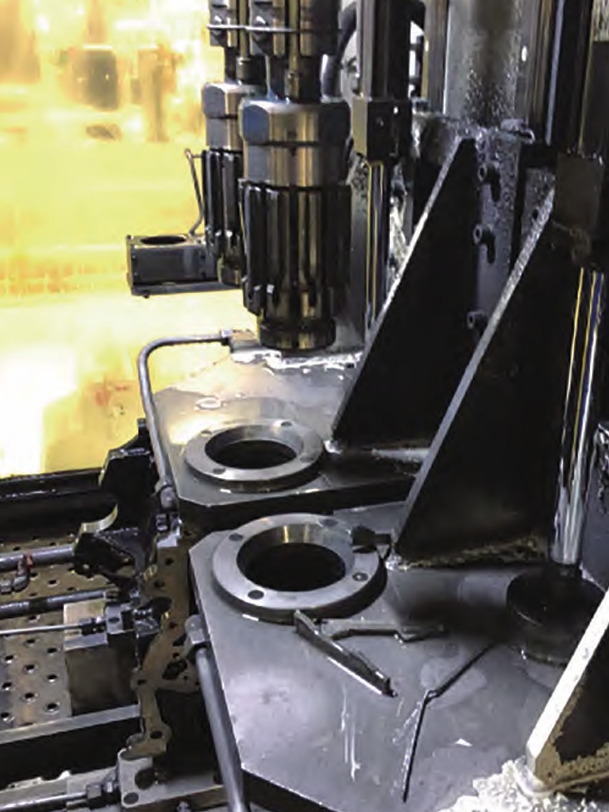
The first major casting defect was leakage around the spark plug bore. Upon sectioning defective parts, the leakage paths were consistently localized in the transition fillet regions surrounding the spark plug hole. The more pronounced the geometrical transition, the higher the leakage rate. This area represents a thermal junction where the water jacket core meets the combustion chamber wall. During solidification, this junction can create a hot spot, leading to delayed cooling and insufficient feeding, resulting in shrinkage porosity. The defect manifestation is a direct consequence of unfavorable temperature gradients. In low-pressure casting, the pressure curve is intended to compensate for shrinkage, but if the local cooling rate is too slow relative to the surrounding material, the feeding pressure becomes ineffective at that location, allowing voids to form. This type of casting defect is classic in areas with abrupt changes in section thickness.
The second critical casting defect was leakage at the third mounting hole on the exhaust side of the cylinder head. The leakage was typically found at a depth of 10–15 mm from the mounting face and was associated with visible shrinkage porosity upon dissection. This location is particularly problematic as it often lies within the last region to solidify, especially if it is near the thermal center of the casting or along the feeding path. In the LPDC process for this component, this mounting hole area is situated in a zone that may not be effectively reached by the final pressure intensification phase, leading to inadequate compensatory feeding. The casting defect here is less severe in terms of bubble continuity during pressure testing but is nonetheless a rejectable flaw. Both these casting defects underscore the interplay between geometry, thermal management, and pressure application in low-pressure die casting.
To address the spark plug bore leakage, the initial approach involved the application of a chill coating on the corresponding region of the water jacket core. The theory is straightforward: by increasing the local cooling rate (chill effect), the solidification time at the hot spot is reduced, promoting a more favorable temperature gradient and allowing the applied metal static pressure to act effectively before the feeding channels freeze. The coating was applied manually before each casting cycle. While this method showed a measurable improvement in reducing this specific casting defect, it introduced process variability. The consistency of coating thickness and coverage was difficult to maintain over high-volume production runs, and it added to the operational cost and cycle time. Therefore, while effective as a temporary fix, it was not a robust long-term solution for this persistent casting defect.
A more sustainable solution was achieved through a redesign of the water jacket core geometry in the spark plug bore area. The modification focused on increasing the fillet radius at the critical edges, thickening the section where the bore base meets the combustion chamber wall, and simplifying overly complex contours. The principle is to eliminate sharp thermal junctions and promote a more progressive solidification front towards the feeding source (the main gate). The revised design effectively widened the channel for directional solidification and feeding. Post-modification trials confirmed that the leakage rate dropped to levels comparable to using the chill coating, but with superior consistency and no additional process steps. This demonstrates that a fundamental improvement in mold design can permanently mitigate such a casting defect. The comparative effect can be summarized by the concept of modulus: increasing the local modulus (volume-to-surface area ratio) can delay solidification slightly but, if done in concert with an improved feeding path, it helps avoid isolated hot spots. The relationship between solidification time (t) and modulus (M) is often approximated by Chvorinov’s rule:
$$ t = B \cdot \left( \frac{V}{A} \right)^n = B \cdot M^n $$
where \( B \) is a mold constant, \( V \) is volume, \( A \) is surface area, and \( n \) is an exponent typically around 2. By carefully adjusting the geometry, we aim to align the solidification times of different sections to ensure contiguous feeding.
For the leakage casting defect at the exhaust side third mounting hole, a two-pronged strategy was employed. First, an extended casting pin (or chill pin) was inserted into the mold at the exact location of this mounting hole. This pin, made of a high-thermal-conductivity material, acts as an internal chill, rapidly extracting heat from the solidifying metal in that specific thermal center. This accelerates local solidification, reducing the time window during which shrinkage porosity can form and helping to shift the solidification sequence. Secondly, a blind riser (or暗冒口) was incorporated into the bottom mold (drag) directly beneath the problematic area. In low-pressure casting, blind risers are isolated pockets filled with metal that remain molten longer due to their thermal mass. They function as supplementary feeding reservoirs, compensating for the volumetric shrinkage in the adjacent casting section through the pressure applied during the intensification stage. The effectiveness of this combined approach was significant. In validation trials using two modified molds, the overall defect rate dropped, and crucially, no leakage was found at this specific location during destructive testing of rejected parts. This highlights how targeted cooling and feeding enhancements can eradicate a localized casting defect.
Other minor but recurrent leakage casting defects were also observed, such as in the exhaust port areas. Analysis showed these were often due to shrinkage at sharp edges or thin fins. The solution here was simpler: modifying the corresponding water jacket core by adding a fillet radius (R2 to R3) at these edges. This small geometrical change reduces the stress concentration and promotes better heat dissipation, effectively minimizing the formation of shrinkage cavities in these regions. It’s a testament to the fact that many casting defects originate from design details that create unfavorable solidification conditions.
Beyond addressing specific leakage points, a system-level improvement was made to enhance the overall soundness of the casting by optimizing mold venting. Inadequate venting can lead to backpressure, turbulent filling, and gas entrapment, which can exacerbate shrinkage issues by disrupting thermal fields. To mitigate this, additional venting was installed. Vent plugs were added at the three locating core prints of the water jacket core and at eight strategic locations on the top mold (cope), each with a 10 mm diameter. This increased the total venting capacity of the mold cavity, allowing air and gases to escape more freely during the injection phase. The result was a marked reduction in internal defects related to gas porosity and mistuns, which indirectly also improves the resistance to leakage. The first-pass yield improved substantially, indicating that good venting is a foundational requirement for suppressing a wide range of casting defects in low-pressure die casting.
The interplay of process parameters in LPDC is complex. To systematically understand the impact of changes, it’s useful to document key variables. The table below summarizes typical process conditions before and after implementing some of the key solutions for the 4G1 cylinder head, focusing on parameters that influence casting defects.
| Process Parameter | Baseline Condition | Optimized Condition | Primary Target Defect |
|---|---|---|---|
| Filling Pressure (bar) | 0.3 – 0.4 | 0.25 – 0.35 (slower rise) | General turbulence, gas entrapment |
| Intensification Pressure (bar) | 0.8 – 1.0 | 1.0 – 1.2 (increased) | Shrinkage porosity (feeding) |
| Water Jacket Core Temperature (°C) | ~200 | ~180 (with chill coating/redesign) | Spark plug bore leakage |
| Local Chill Usage | None | Extended pin at mounting hole #3 | Exhaust side mounting hole leakage |
| Venting Area (cm²) | Baseline design | Increased by ~30% with added vents | Gas porosity, backpressure effects |
| Fillete Radius at Critical Edges (mm) | R0.5 – R1 | R2 – R3 (increased) | Edge shrinkage, exhaust port leakage |
The pressure cycle in LPDC is critical for defect prevention. A typical pressure-time (P-t) curve can be divided into stages: pressurization for filling, a switchover to intensification pressure for feeding, and a hold period. The mathematical representation of the ideal feeding pressure required to compensate for shrinkage can be derived from the fundamentals of fluid flow and solidification. The pressure needed to feed a shrinking region, \( P_{feed} \), must overcome the resistance in the mushy zone. A simplified model considers the Darcy flow through a porous medium (the dendrite network):
$$ P_{feed} = \frac{\mu \cdot L \cdot \dot{V}}{K \cdot A} $$
where \( \mu \) is the dynamic viscosity of the liquid metal, \( L \) is the length of the feeding path, \( \dot{V} \) is the volumetric shrinkage rate, \( K \) is the permeability of the mushy zone, and \( A \) is the cross-sectional area of the feeding channel. In practice, ensuring that the applied intensification pressure \( P_{applied} > P_{feed} \) throughout the critical solidification period is key to preventing shrinkage-related casting defects. Modifications like adding blind risers increase \( A \) and reduce \( L \), while chills reduce the local \( \dot{V} \) by speeding up solidification.
The thermal management of the mold is another cornerstone. The temperature distribution \( T(x,y,z,t) \) within the mold and casting governs solidification. The heat transfer is governed by the Fourier equation with a moving boundary (the solid-liquid interface). For a simplified one-dimensional case through a mold wall adjacent to a potential hot spot:
$$ \frac{\partial T}{\partial t} = \alpha \frac{\partial^2 T}{\partial x^2} $$
where \( \alpha \) is the thermal diffusivity. Applying a chill (like the extended pin) effectively changes the boundary condition at that point, increasing the heat flux \( q” = -k \frac{\partial T}{\partial x} \) (where \( k \) is thermal conductivity), thereby flattening the temperature gradient and reducing local solidification time. This intervention directly counters the conditions that lead to a casting defect like localized shrinkage.
To quantify the improvement, statistical data from production runs before and after implementing the full suite of measures was collected. The following table illustrates the reduction in specific casting defect rates.
| Casting Defect Type | Incidence Rate (Before) | Incidence Rate (After) | Relative Reduction |
|---|---|---|---|
| Spark Plug Bore Leakage | ~2.5% | ~0.5% | 80% |
| Exhaust Side Mounting Hole #3 Leakage | ~1.8% | ~0.1% | >94% |
| General Gas Porosity / Internal Defects | ~3.0% | ~1.7% | ~43% |
| Overall Rejection Rate (Leakage-related) | ~5.5% | ~1.8% | ~67% |
The economic impact of reducing these casting defects is substantial, considering the high cost of scrap for a complex part like a cylinder head. Furthermore, the consistency of the process improved, reducing the need for 100% intensive leak testing and allowing for more statistical quality control.
In conclusion, the journey to mitigate the pervasive casting defects in the 4G1 cylinder head low-pressure casting process involved a multifaceted approach rooted in a deep understanding of solidification science and practical mold design. The spark plug bore leakage casting defect was conquered not by a temporary process aid but by a permanent, intelligent redesign of the core geometry to promote better thermal and feeding patterns. The exhaust side mounting hole leakage casting defect was addressed through the synergistic use of localized chilling and supplemental feeding via a blind riser. Enhancing the mold venting system provided a blanket improvement against a suite of gas-related issues. Each of these measures tackles the casting defect problem from a different angle—thermal, geometrical, and pressure-dynamic. The successful reduction in defect rates underscores the importance of a holistic view in die casting optimization. It is not enough to adjust one parameter; the mold design, cooling strategy, and pressure profile must be harmonized to create a robust process capable of producing sound castings consistently. Future work may involve advanced simulation to predict these casting defects digitally before tooling is committed, but the hands-on lessons learned here—focusing on fillet radii, chilling, feeding aids, and venting—remain universally applicable principles for combating casting defects in aluminum low-pressure die casting of complex engine components. The continuous battle against casting defects is a core aspect of foundry engineering, demanding both analytical rigor and creative problem-solving.