
In the realm of diesel engine production, the cylinder head stands as a paramount component, whose integrity dictates overall engine performance, efficiency, and cost. My involvement in a major joint venture project, focusing on the manufacture of a specific diesel engine model, highlighted the severe challenges posed by casting defects. This engine, a product of international collaboration, required the full adoption of advanced production lines and casting工艺工装. Achieving an annual capacity of 15,000 units and preparing for 25,000, the quality of cylinder head castings became a critical bottleneck. The geometry, surface finish, and particularly the pressure tightness and structural strength of the cylinder head are non-negotiable; any compromise directly impacts engine reliability and manufacturing economics. This narrative details our comprehensive journey in identifying, analyzing, and ultimately solving the pervasive casting defects that plagued our production, with a particular emphasis on gas porosity—the most dominant issue.
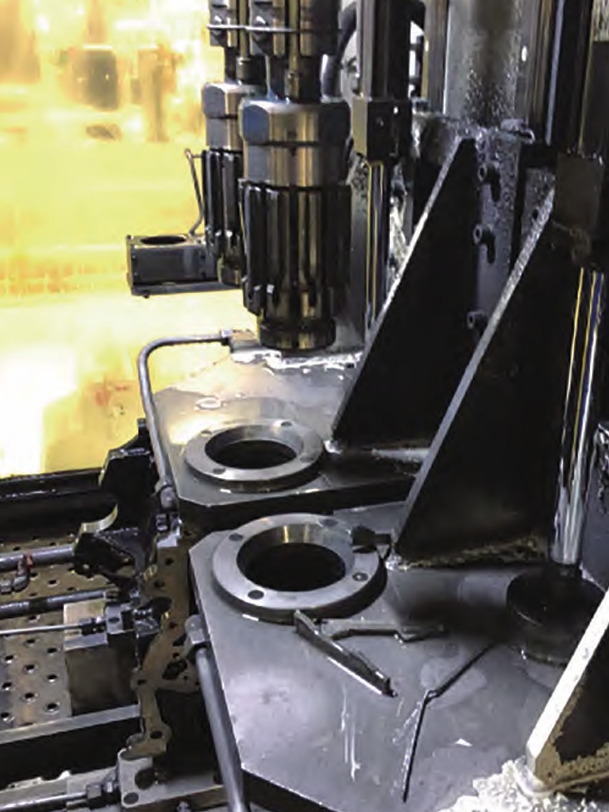
The foundation of any quality casting lies in its material composition and processing parameters. For our cylinder head, designated as a high-grade cast iron (akin to GG30Cu), the molten metal chemistry was stringently controlled. The primary chemical composition requirements are summarized in the table below, which was fundamental to achieving the desired microstructure and mechanical properties.
| Element | Target Composition (%) |
|---|---|
| Carbon (C) | 3.35 – 3.45 |
| Silicon (Si) | 1.9 – 2.1 |
| Manganese (Mn) | 0.7 – 0.9 |
| Sulfur (S) | ≤ 0.10 |
| Phosphorus (P) | ≤ 0.10 |
| Copper (Cu) | 0.8 – 1.0 |
| Chromium (Cr) | 0.2 – 0.3 |
| Molybdenum (Mo) | 0.3 – 0.4 |
Beyond chemistry, the pouring temperature emerged as a pivotal variable. For thin-walled castings like our cylinder head, where internal sections could be as slim as 4 mm, suboptimal pouring temperatures drastically increased defect rates. Empirical evidence dictated that temperatures below 1400°C led to a significant rise in casting defects. We established a controlled window between 1400°C and 1420°C, which minimized turbulence and promoted better fluidity, reducing initial defect formation. The relationship between defect probability and temperature can be conceptually modeled, though in practice it is multivariate. One can consider a simplified form where the propensity for certain defects, like misruns or cold shuts, increases as temperature drops below a critical threshold \( T_c \):
$$ P_{defect}(T) \propto \exp\left(-\frac{T – T_c}{k}\right) \quad \text{for} \quad T < T_c $$
where \( P_{defect} \) is the probability of a temperature-related defect, \( T \) is the pouring temperature, \( T_c \) is the critical temperature (approximately 1400°C in our case), and \( k \) is a process-specific constant. Maintaining \( T > T_c \) was therefore a primary operational rule.
The molding and core assembly process was a complex dance of precision. Adapted from the original imported tooling to suit our high-pressure molding lines, the process produced four castings per mold. A core assembly strategy was employed, grouping two castings together using a total of nine cores per set. Most cores were made via the hot-box process, with only the main outer “skin” core produced via the cold-box method. The assembly included the main skin core, upper and lower water jacket cores, and intake and exhaust port cores. After assembly, the entire core package was dipped in a refractory coating and oven-dried. The gating system was an open, single-side design with intermediate gating. The cope was made of green sand, and both core prints and the casting itself were fitted with vent rods to facilitate gas escape. This entire setup, while sophisticated, was where the seeds of the primary casting defect were sown.
The scourge of our production line was the gas porosity casting defect. This type of casting defect is notoriously common in cylinder head manufacture due to the extensive use of sand cores. During pouring, the vast majority of these cores become enveloped by molten iron, and the gases generated from their binder decomposition must escape through the core prints and the solidifying metal. The specific geometry of our cylinder head—compact, with thin walls and limited venting pathways primarily on one side—created a perfect storm for gas entrapment. The vent rods and the casting itself would solidify before all core gases could evacuate, leading to gas porosity cavities, particularly at the junction where vent rods were placed. This single casting defect accounted for a staggering 90% of our total scrap losses. The characteristic manifestation was porosity clusters on the side opposite the main process holes, near bolt boss areas, visible after the vent rods were removed.
Other significant casting defects compounded the challenge. These included: 1) Sand inclusions caused by core or mold erosion during mold closing—a direct sand-related casting defect; 2) Internal fins or flash within the water jacket passages, formed when molten iron penetrated between the upper and lower water jacket cores due to the melting and decomposition of the core assembly adhesive; 3) Core breakage or shifting due to the buoyant forces of the molten metal during pouring; and 4) Excessive parting line flash and poor surface finish stemming from wear and tear on the aging tooling. Each of these secondary casting defects contributed to increased cleaning, machining challenges, and potential functional failures.
The economic imperative to solve these casting defects became urgent with rising production targets and volatile prices for alloying elements like copper, chromium, and molybdenum. The high scrap rate was making the cost per ton of castings prohibitively expensive. Our systematic approach to mitigating these casting defects involved several interconnected工艺 modifications.
The most transformative intervention was the introduction of a top cover core. This additional core, produced two per box on a dedicated core shooter, was designed to sit atop the main skin core. It was coated separately and located using precision core prints. Crucially, the molding process was modified to incorporate a small riser or feeder at the location of the critical vent rods on the cope side. This modification served a dual purpose. First, it created an additional, optimized path for gas escape from the core package. Second, and more importantly, it effectively moved the thermal hotspot associated with the last-solidifying metal near the vent rod upward into the riser. This fundamentally altered the solidification dynamics, preventing gas entrapment at the critical location. The governing principle here relates to the pressure balance during solidification. The pressure \( P_g \) of gas trapped within the core must be less than the metallostatic pressure \( P_m \) plus the capillary pressure \( P_\sigma \) at the solidification front to prevent pore formation:
$$ P_g < P_m + P_\sigma = \rho g h + \frac{2\gamma \cos\theta}{r} $$
where \( \rho \) is the molten metal density, \( g \) is gravity, \( h \) is the height of the metal column above the point, \( \gamma \) is the surface tension, \( \theta \) is the contact angle, and \( r \) is the pore radius. By introducing the top core and riser, we effectively increased the local \( h \) for the problematic area and provided a low-pressure escape route, ensuring \( P_g \) could be relieved. This single change dramatically reduced the gas porosity casting defect. Furthermore, it also solved the related issues of sand erosion during closing and excessive flash, as the cover core provided better sealing and definition for the top surface of the casting. Surface quality improved markedly, reducing post-casting cleaning labor significantly.
Addressing the internal fin casting defect required a materials science solution. The standard commercial water-glass-based adhesive used for assembling the complex water jacket cores would melt and degrade under the intense heat of the incoming metal, allowing iron to seep into the microscopic gaps between cores. We embarked on a series of trials to develop a proprietary adhesive formulation with higher thermal stability and bonding strength. The new adhesive had to maintain integrity until the surrounding metal crust formed, sealing the interfaces. Its performance can be conceptually linked to its thermal decomposition profile. We needed an adhesive whose major decomposition temperature \( T_d \) was higher than the local metal temperature \( T_{local} \) during the critical filling and initial solidification phase:
$$ T_d > T_{local}(t) \quad \text{for} \quad 0 < t < t_{crust} $$
where \( t_{crust} \) is the time for a stable solid skin to form at the core interface. Our in-house developed adhesive met this criterion, leading to a substantial reduction in internal flash, a persistent and troublesome casting defect affecting cooling performance.
Process discipline was the third pillar of our improvement strategy. In the molding department, we enforced stringent procedures. Operators were required to ensure all vent passages in the molds and cores were completely clear and open before closing. A meticulous application of mold sealant (paste wash) around the top cover core was mandated. The application had to be uniform yet carefully placed away from vent holes to prevent blockage—a delicate balance to ensure sealing without creating new gas entrapment sites. This attention to detail ensured the designed ventilation pathways functioned optimally, a simple but critical step in combating the gas-related casting defect.
The cumulative impact of these measures on our casting defect statistics was profound. We transitioned from a state where the overall scrap rate for the cylinder head was around 10% to a consistently maintained rate of 4–5%. The table below summarizes the key performance indicators before and after the implementation of the solutions, highlighting the reduction in the dominant casting defect categories.
| Casting Defect Category | Approximate Scrap Rate (Before) | Approximate Scrap Rate (After) | Relative Reduction |
|---|---|---|---|
| Gas Porosity | 9.0% | 1.5% | ~83% |
| Sand Inclusions / Erosion | 0.5% | 0.1% | ~80% |
| Internal Fins / Flash | 0.3% | 0.1% | ~67% |
| Core Shift / Breakage | 0.2% | 0.1% | ~50% |
| Other Defects | 0.5% | 2.7% (including new minor issues) | — |
| Total Scrap Rate | ~10.5% | ~4.5% | ~57% |
The stability of quality was rigorously tested, even during summer months when humidity variations traditionally exacerbate gas-related casting defects. The process demonstrated remarkable robustness. While the addition of the top cover core did introduce an incremental cost per casting due to the extra core material and processing, the economic analysis was unequivocally positive. The reduction in scrap loss, savings in alloying elements, decreased grinding and rework labor, and improved throughput far outweighed the added cost. The net effect was a significant improvement in the cost per good casting and a stronger market position for the engine.
In conclusion, the journey to solve the persistent casting defects in high-performance cylinder head production is a testament to systematic problem-solving. It requires a deep understanding of the interplay between material properties, process parameters, and tooling design. Every casting defect, from the dominant gas porosity to the subtler internal flash, has a root cause that can be addressed through targeted engineering interventions—be it a design modification like an added core, a material innovation like a custom adhesive, or a rigor in operational practice. The economic implications of uncontrolled casting defects are severe, impacting direct costs, production capacity, and product reputation. Our experience underscores that continuous monitoring, analysis, and willingness to modify established processes are essential for achieving optimal综合经济效益 in foundry operations. The battle against casting defects is perpetual, but with a scientific approach, each victory enhances competitiveness and paves the way for manufacturing excellence.