
In the realm of modern foundry practices, Lost Foam Casting (LFC) stands out for its ability to produce complex, near-net-shape components with excellent dimensional accuracy and surface finish. However, achieving high-quality castings is a meticulous endeavor, requiring stringent control over every manufacturing step—from raw material procurement and molding to shakeout and cleaning. Any deviation in this chain can introduce various casting defects, compromising the integrity and performance of the final product. As a practitioner deeply involved in refining these processes, I have observed that a systematic understanding of defect genesis is paramount. This article delves into the common casting defects encountered in LFC, analyzing their root causes and proposing practical, data-driven solutions. The focus will be on three predominant issues: carbon defects, cold shuts, and slag inclusions. Throughout this discussion, the term ‘casting defect’ will be frequently examined to underscore its multifaceted nature. The goal is to provide a foundational framework that aids foundries in diagnosing and eliminating these quality detractors, thereby enhancing overall yield and component reliability.
The journey to mitigate casting defects begins with recognizing that the LFC process is an intricate interplay of thermal, hydraulic, and physicochemical phenomena. The pyrolysis of the expendable polystyrene pattern, the flow of molten metal through the foam-filled cavity, and the gas dynamics within the sand mold all contribute to the final casting quality. A minor imbalance in any of these factors can precipitate a defect. Therefore, a proactive approach, grounded in process parameter optimization and material science, is essential. In the following sections, I will dissect each major casting defect category, employing theoretical models, empirical data summarized in tables, and mathematical formulations to elucidate the mechanisms and control strategies.
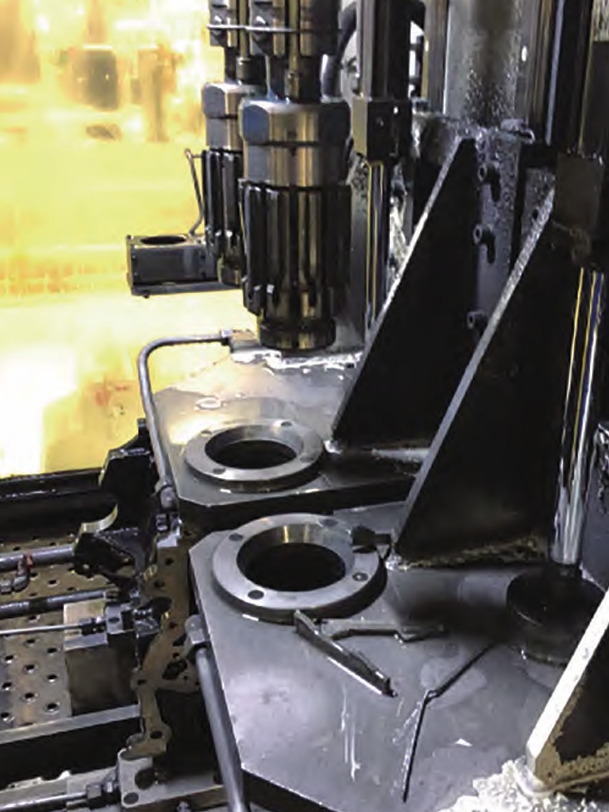
The image above exemplifies a critical component often produced via advanced casting methods, highlighting the precision required to avoid any casting defect that could compromise its function in demanding applications like internal combustion engines.
1. Carbon Defect: Formation Mechanisms and Corrective Actions
Among the various irregularities, the carbon defect is a particularly prevalent and challenging casting defect in LFC. It manifests as localized carbon enrichment or carbonaceous residues within the casting matrix, often appearing as black spots or streaks. This defect originates from the incomplete decomposition and evacuation of the polystyrene foam pattern. During pouring, the molten metal vaporizes the foam, ideally leaving a clean cavity. However, if the pyrolysis products (primarily gaseous and liquid hydrocarbons) are not swiftly removed, they can crack into solid carbon or become entrapped in the solidifying metal. The primary drivers for this casting defect are insufficient vacuum (negative pressure), poor coating permeability, inappropriate foam characteristics, and high base metal carbon content.
1.1 The Critical Role of System Negative Pressure
Inadequate vacuum is arguably the most common culprit behind the carbon casting defect. The applied negative pressure serves to evacuate pyrolysis gases rapidly, stabilize the mold, and prevent sand incursion. When the vacuum level falls below a critical threshold, gas removal becomes inefficient, allowing carbon-rich species to linger and infiltrate the metal. The vacuum system’s performance can be compromised in several ways, as detailed below.
The net vacuum pressure (\( P_{net} \)) effective at the pattern surface can be modeled by considering the system’s designed vacuum, leaks, and flow resistances:
$$ P_{net} = P_{set} – \Delta P_{leak} – \Delta P_{filter} – \Delta P_{pipe} $$
Where \( P_{set} \) is the set vacuum pressure at the pump, \( \Delta P_{leak} \) is the pressure drop due to system leaks, \( \Delta P_{filter} \) is the drop across clogged filters or screens, and \( \Delta P_{pipe} \) is the frictional loss in pipelines. A significant value for any loss term drastically reduces \( P_{net} \), promoting the carbon casting defect.
| Failure Mode | Manifestation & Impact on Casting Defect | Corrective Action |
|---|---|---|
| Insufficient Set Point | Low theoretical vacuum to prevent sand burn-on, leading to poor gas evacuation. | Re-evaluate and increase the process vacuum parameter based on gating design and coating permeability. |
| Flask Air Leak | Audible hissing; vacuum loss at source increases \( \Delta P_{leak} \). | Seal all flask joints, repair cracks, and ensure gasket integrity. |
| Clogged Filters/Screens | Reduced flow area increases \( \Delta P_{filter} \), hindering gas extraction. | Implement regular maintenance schedule; clean or replace filter screens and check for foreign object ingress. |
| Pipe/Valve Leaks or Undersized Ducts | Increased \( \Delta P_{pipe} \) or direct vacuum loss. | Inspect and seal all connections; redesign piping to have larger cross-sectional area \( A_{pipe} \) to reduce flow resistance \( (\Delta P_{pipe} \propto 1/A_{pipe}^2) \). |
| Insufficient Water Ring Pump Fluid | Compromised pump seal efficiency, reducing overall \( P_{set} \). | Maintain coolant/water level at prescribed mark; check pump performance regularly. |
| Misaligned Automatic Vacuum Coupler | Leak at the interface between flask and manifold. | Align and seal the coupling mechanism; use flexible, airtight seals. |
1.2 Coating Permeability and Foam Characteristics
The coating applied to the foam pattern must strike a balance between strength and permeability. A coating with low gas permeability acts as a barrier, trapping pyrolysis products and directly causing a carbon casting defect. The permeability \( K \) can be conceptually linked to the rate of gas evacuation. Furthermore, the foam itself is critical. Excessively fine foam beads, chosen for a smoother pattern surface, lead to higher foam density (\( \rho_{foam} \)). This higher density results in more mass to decompose per unit volume, generating a larger volume of gaseous products that must be evacuated, thereby exacerbating the risk of carbon defect formation.
The relationship between foam density and gas generation can be approximated. For a given pattern volume \( V \), the mass of foam \( m_{foam} = \rho_{foam} \cdot V \). The molar amount of pyrolysis gases produced is proportional to this mass. If the evacuation rate \( Q_{gas} \) is constant, the concentration \( C_{gas} \) of residual gases increases with higher \( \rho_{foam} \):
$$ C_{gas} \propto \frac{\rho_{foam}}{Q_{gas}} $$
A high \( C_{gas }\) elevates the probability of carbon deposition. Therefore, controlling pre-expanded bead size and achieving optimal, lower foam density is crucial in preventing this casting defect.
1.3 Metallurgical Factors: Base Metal Carbon Content
A less obvious but significant factor is the carbon content of the molten metal itself. In ferrous castings, if the base carbon equivalent is already high, the additional carbon from partial foam decomposition can push local carbon concentration beyond solubility limits upon solidification, leading to carbide precipitation or carbon segregation—another form of carbon casting defect. A simple equilibrium consideration suggests that the total carbon in a micro-volume \( C_{total} \) is the sum of base metal carbon \( C_{base} \) and potential carbon pickup \( C_{pickup} \) from the foam:
$$ C_{total} = C_{base} + f \cdot C_{pickup} $$
where \( f \) is a factor representing the efficiency of carbon transfer (0 < f < 1). To mitigate this, one must aim to reduce \( C_{base} \) where feasible, thereby lowering \( C_{total} \) and the propensity for this specific casting defect.
2. Cold Shut Defect: Thermal and Flow-Related Imperfections
The cold shut is a linear casting defect characterized by an incomplete fusion of separate metal streams or the premature freezing of metal before the mold cavity is completely filled. It appears as a crack or seam on the casting surface, often with oxide films, and severely undermines mechanical strength. This casting defect is fundamentally thermal, arising when the metal temperature falls below the fluidity limit before coalescence. The primary causes are low pouring temperature, poor gating system design, and suboptimal pouring practice.
2.1 Pouring Temperature and Thermal Dynamics
The single most influential parameter is the superheat temperature of the molten metal. If the pouring temperature \( T_{pour} \) is too close to the liquidus temperature \( T_{liq} \), the available thermal energy to maintain fluidity during mold filling is minimal. The metal’s ability to flow, or fluidity length \( L_f \), is exponentially dependent on superheat:
$$ L_f \propto \exp\left(-\frac{Q}{R \cdot (T_{pour} – T_{liq})}\right) $$
where \( Q \) is an activation energy and \( R \) the gas constant. A small decrease in \( T_{pour} \) can drastically reduce \( L_f \), making the casting highly susceptible to the cold shut casting defect. Maintaining a sufficiently high and consistent pouring temperature is the first line of defense.
2.2 Gating System Design
An improperly designed gating system can elongate flow paths, increase heat loss, and create metal streams that meet at unfavorable angles. The key is to ensure a rapid, laminar fill with minimal temperature drop. The design should account for the modulus of different sections and strategically place gates and risers. For instance, if metal must travel a long, thin section (\( L_{section} \)) before filling a cavity, the temperature drop \( \Delta T \) can be estimated using a simplified heat loss model:
$$ \Delta T = \frac{h \cdot A_{surface} \cdot (T_{metal} – T_{mold}) \cdot t_{fill}}{\rho_{metal} \cdot C_p \cdot V_{metal}} $$
where \( h \) is the heat transfer coefficient, \( A_{surface} \) is the contact area, \( t_{fill} \) is the fill time for that section, \( \rho_{metal} \) is density, and \( C_p \) is specific heat. A large \( \Delta T \) can cool the metal front below the coalescence temperature, creating a cold shut. Proper design involves shortening flow paths, increasing gating cross-sections to reduce \( t_{fill} \), and using chills or insulating sleeves to modulate cooling.
| Factor Category | Specific Cause | Impact on Casting Defect Formation | Preventive Measure |
|---|---|---|---|
| Pouring Practice | Slow Pouring Rate | Increases total fill time \( t_{total} \), allowing excessive heat loss from the leading flow front. | Maximize pouring speed without causing turbulence or mold erosion. |
| Foam Reaction (Back-pressure/Spray) | Disrupts smooth metal advance, causing hesitation and cooling. | Enhance coating permeability, extend pattern drying, reduce foam density to facilitate gas escape. | |
| Interrupted Pour (Flow Break) | Creates distinct, cold metal fronts that fail to fuse. | Ensure continuous pour from ladle; use automatic pouring systems for consistency. | |
| Gating Design | Poor Ingate Location & Long Flow Paths | Leads to excessive \( \Delta T \) as calculated above, reducing metal fluidity prematurely. | Use simulation software to optimize gating; employ multiple ingates for large castings; add flow aids like filters or surge risers. |
2.3 Mitigation Through Process Control
Preventing the cold shut casting defect is an exercise in thermal management. Beyond maintaining high pouring temperature, increasing coating permeability (as also advised for carbon defects) helps reduce back-pressure from foam decomposition gases, allowing faster, uninterrupted metal flow. Furthermore, preheating the foam pattern or using exothermic paints near thin sections can provide local heat input, countering the rapid heat loss that leads to this debilitating casting defect.
3. Slag Inclusion Defect: Origin and Filtration Strategies
Slag inclusions, or non-metallic entrappments, constitute a major class of casting defect that manifests as irregular voids or pockets filled with ceramic or oxide materials. They act as stress concentrators, severely degrading fatigue life and pressure tightness. In LFC, slag can originate from multiple sources: furnace slag, ladle refractories, covering flux, or the coating material itself. Each source produces a distinct type of inclusion, requiring tailored countermeasures.
3.1 Classification and Sources of Slag
Understanding the origin is key to eliminating this casting defect. The primary categories are:
- Furnace/Melting Slag: Oxides (e.g., SiO2, Al2O3) and refractory particles from the furnace lining. These often appear as dark, irregular inclusions.
- Ladle Slag: Eroded ladle refractory material, typically appearing as black, vitreous slag.
- Covering Flux Slag: Expanded perlite or other flux materials used for slag cover. These appear as light-colored, spherical inclusions.
- Coating Slag: Fragments of the ceramic coating dislodged due to mold collapse, poor pattern assembly, or direct冲刷 by metal flow. This is a process-specific casting defect in LFC.
The transport of slag particles into the mold cavity is governed by fluid dynamics. The critical velocity \( v_{crit} \) for entraining a particle of diameter \( d_p \) in a flowing metal stream can be derived from a balance of drag and buoyancy forces:
$$ v_{crit} \propto \sqrt{\frac{g \cdot d_p \cdot (\rho_p – \rho_{metal})}{\rho_{metal}}} $$
where \( \rho_p \) is the slag particle density. Turbulent flow or high velocity can easily exceed \( v_{crit} \), carrying slag deep into the casting and creating a slag inclusion casting defect.
3.2 Comprehensive Slag Control Measures
A multi-barrier approach is essential to combat this pervasive casting defect. The strategies span from melting and holding to gating design.
| Process Stage | Specific Method | Mechanism to Reduce Casting Defect |
|---|---|---|
| Metal Handling & Treatment | Use of Slag Coagulants (Effective Degassers) | Agglomerates fine slag particles for easier removal from melt surface. |
| Pouring from a Teapot Ladle | Physically separates slag floating on top from the metal drawn from the bottom. | |
| Ladle Skimming & Use of Ladle Mesh Filters | Removes slag prior to pouring; filters act as a mechanical barrier. | |
| Pre-pour Tapping/De-slagging | Dumping initial metal stream carries away accumulated slag at the spout. | |
| Gating System Design | Incorporation of Ceramic Foam or Fiber Mesh Filters | Intercepts slag particles within the runner system based on size exclusion. |
| Design of Slag Traps (Dross Bows) | Utilizes flow geometry (e.g., sudden expansion) to reduce velocity below \( v_{crit} \), allowing slag to float out. | |
| Use of Pouring Cups with Integral Filters | Filters metal at the entry point to the downsprue. | |
| LFC-Specific Controls | Ensuring Coating Integrity & Strong Pattern Assembly | Prevents coating spalling and ingress of coating fragments into the cavity. Maintaining adequate vacuum prevents mold wall collapse which can cause coating slag. |
3.3 Quantitative Model for Filtration Efficiency
The efficiency \( \eta \) of a filter in removing slag particles, thereby reducing the slag inclusion casting defect, can be modeled as a function of particle size, filter pore size, and metal flow conditions. A simple representation is:
$$ \eta = 1 – \exp\left(-\alpha \cdot \frac{L_{filter}}{d_{pore}} \cdot \frac{d_p}{d_{pore}}\right) $$
where \( \alpha \) is a capture coefficient, \( L_{filter} \) is the filter thickness, and \( d_{pore} \) is the mean filter pore diameter. This illustrates why selecting an appropriate filter grade (small \( d_{pore} \)) is critical for intercepting fine slag particles that could otherwise become a damaging casting defect.
4. Integrated Defect Prevention Framework
Addressing casting defects in Lost Foam Casting is not about isolated fixes but implementing an integrated process control system. Each defect often has interrelated causes. For instance, poor coating permeability can contribute to both carbon defects (by trapping gases) and cold shuts (by causing back-pressure). Therefore, a holistic view is necessary. Key parameters must be monitored and controlled within strict windows. A proposed set of critical process parameters (CPPs) and their target ranges for defect minimization is summarized below.
| Process Parameter | Symbol / Metric | Target Range / Optimal Value | Primary Defects Mitigated |
|---|---|---|---|
| Pattern Foam Density | \( \rho_{foam} \) | 18 – 25 kg/m³ (depends on alloy) | Carbon Defect, Cold Shut |
| Coating Permeability Number | \( K \) (e.g., AFS Permeability) | High, alloy-dependent (e.g., >30 for ferrous) | Carbon Defect, Cold Shut |
| Mold Vacuum Pressure | \( P_{net} \) (absolute pressure) | 0.3 – 0.5 bar (i.e., 0.5 – 0.7 bar vacuum) | Carbon Defect, Slag (from mold stability) |
| Pouring Temperature Superheat | \( T_{pour} – T_{liq} \) | Alloy-dependent (e.g., 100-150°C for cast iron) | Cold Shut |
| Pouring Time / Fill Velocity | \( t_{fill} \), \( v_{metal} \) | Minimized, but turbulent-free (use simulation) | Cold Shut, Slag Inclusion |
| Metal Treatment (Slag Control) | Filtration Efficiency \( \eta \) | >95% for particles >50 µm | Slag Inclusion |
The interplay of these parameters can be visualized through a defect susceptibility map. For example, one could plot foam density against vacuum pressure, with regions highlighting high risk for carbon casting defect. Similarly, a map of pouring temperature versus fill time would show the safe zone for avoiding cold shut casting defect. Developing such maps for specific alloys and casting geometries is a powerful tool for process engineers.
5. Conclusion and Future Perspectives
In conclusion, the pursuit of flawless Lost Foam Castings necessitates a deep and systematic understanding of defect formation mechanisms. The carbon defect, cold shut, and slag inclusion represent significant challenges, but each is controllable through precise manipulation of process physics and chemistry. As I have outlined, solutions range from straightforward equipment maintenance to sophisticated design principles underpinned by mathematical models of heat transfer, fluid flow, and filtration. The recurring theme is that a casting defect is seldom the result of a single failure; it is typically the consequence of a deviation in a linked chain of parameters. Therefore, implementing statistical process control (SPC) to monitor the CPPs listed in Table 4 is highly recommended. Future advancements will likely involve greater integration of real-time sensors and predictive simulation software, enabling closed-loop control that can anticipate and correct conditions leading to a casting defect before the metal is even poured. By embracing this data-driven, holistic approach, foundries can significantly reduce scrap rates, enhance product quality, and fully harness the potential of the Lost Foam Casting process for manufacturing critical, high-integrity components.
Ultimately, mastering the mitigation of these casting defects transforms the art of foundry work into a predictable science, ensuring that every casting produced meets the stringent demands of modern engineering applications.