
In my experience with the production of aluminum alloy cylinder heads, particularly for engines like the 4G1 series, managing and eliminating casting defects is the cornerstone of achieving high performance and reliability. The transition to Low-Pressure Die Casting (LPDC) represented a significant leap from traditional gravity casting methods, primarily due to its superior control over the filling and solidification sequence. The fundamental advantage lies in its ability to maintain a consistent pressure and thermal gradient, aligning the feeding channels with the gating system. This process can be conceptually described by the basic pressure relationship governing the ascent of molten metal:
$$ P = \rho g h + P_{applied} $$
Where \( P \) is the pressure at the ingate, \( \rho \) is the density of the molten aluminum, \( g \) is gravity, \( h \) is the height of the metal column in the riser tube, and \( P_{applied} \) is the additional gas pressure applied to the crucible. By carefully controlling \( P_{applied} \), we achieve a tranquil, non-turbulent fill and, crucially, sustained pressure for feeding during solidification. Despite these inherent advantages, the complex geometry of a modern cylinder head—featuring thin walls, integrated coolant jackets, and numerous ports—inevitably creates thermal hotspots and restricted feeding paths that lead to specific casting defects. The most persistent and critical among these in our production were leakage-related issues, primarily shrinkage porosity and micro-shrinkage.
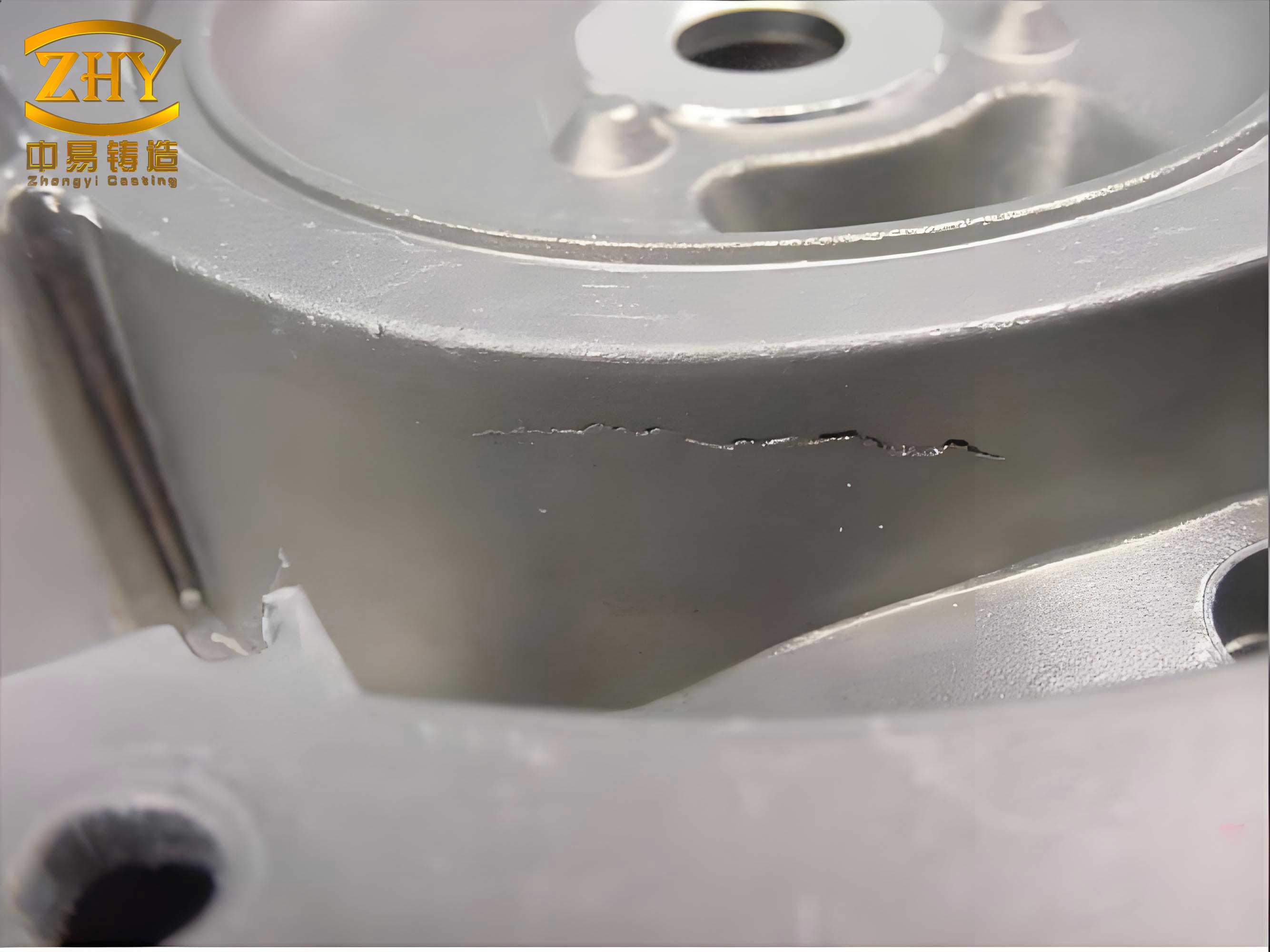
The journey to resolve these casting defects was systematic, involving a deep dive into the interplay between alloy characteristics, mold design, and process parameters. The alloy in question, AC4B (akin to ZL106), is a hypoeutectic Al-Si alloy with additions of Cu and Mg for enhanced strength via heat treatment. Its solidification behavior is key to understanding defect formation. The long solidification range of such alloys makes them particularly susceptible to shrinkage defects in isolated thermal centers if the solidification sequence is not properly directed. The primary casting defects we targeted are summarized below:
| Defect Location | Defect Type | Probable Cause | Impact |
|---|---|---|---|
| Spark Plug Bore Perimeter | Localized Shrinkage Porosity | Sharp thermal gradient, inadequate feeding at junction | High-pressure leakage from combustion chamber |
| Exhaust Side, Mounting Hole #3 | Subsurface Micro-Shrinkage Cluster | Late-solidifying thermal center, insufficient feeding pressure | Low-pressure coolant leakage |
| Exhaust Port Flange Edge | Edge Shrinkage | Sharp edge geometry acting as a local hot spot | Potential gas or water leak |
Comprehensive Analysis of Spark Plug Bore Leakage
The leakage around the spark plug bore was a critical failure mode. Upon sectioning defective parts, the casting defects were consistently found in the fillet radius area where the bore wall meets the combustion chamber roof. This junction creates a localized thermal mass. During solidification, this area remains liquid longer than the surrounding thinner sections. As it finally solidifies, it contracts and requires liquid metal feed. If the feeding path—often through the relatively thin deck—freezes prematurely, shrinkage porosity forms. This is a classic problem of an unfavorably oriented thermal gradient.
Our initial corrective action was a process-based solution: applying a chilling coating to the corresponding area of the water jacket sand core. This coating, typically a high-thermal-conductivity wash, accelerates heat extraction locally, effectively reducing the local solidification time (\( t_s \)) as approximated by Chvorinov’s rule:
$$ t_s = k \left( \frac{V}{A} \right)^n $$
Where \( V \) is volume, \( A \) is surface area, \( n \) is a constant (often ~2), and \( k \) is the mold constant which is influenced by the coating’s properties. By increasing the effective \( k \) at that spot, we reduced \( t_s \), helping the junction solidify earlier and in alignment with the feeding path. This method showed a marked improvement. However, it introduced process variability—coating thickness and consistency were hard to control in high-volume production—and added cost.
We therefore pursued a more robust, design-based solution by modifying the sand core geometry. The goal was to eliminate the sharp thermal concentration and improve feedability. The redesign focused on two aspects:
- Increasing Fillet Radii: We significantly enlarged the transitional fillet radius from the bore wall to the deck. This simple change reduces the stress concentration factor and, more importantly, modifies the \( V/A \) ratio, making the transition less prone to creating an isolated hot spot.
- Reinforcing the Feeding Path: We added material thickness at the base of the bore where it connects to the combustion chamber, effectively creating a more robust thermal bridge. This redesign aimed to ensure this area remained part of a continuous, directionally solidifying mass fed directly from the main ingate, rather than an isolated appendage.
The modified core design created a more favorable temperature gradient, promoting sequential solidification towards the feeder. The improvement was quantifiable, bringing the defect rate down to a level equivalent to using the chilling wash, but with superior consistency and lower cost, effectively eliminating this category of casting defects.
Addressing Subsurface Leakage at Exhaust Side Mounting Holes
The leakage at the third mounting hole on the exhaust side presented a different challenge. This location was not at an obvious external junction but within a thicker section of the casting wall. Sectioning revealed dispersed micro-shrinkage (casting defects appearing as a spongy structure) approximately 10-15mm from the deck face. This area was a classic “last-to-freeze” thermal center, situated in a region distant from direct feeding pressure as the casting solidified.
Our strategy here was twofold, targeting both localized cooling and enhanced feeding.
1. Implementation of Extended Cooling Pins (Chills): We replaced the standard ejector pin in the die at this location with an extended “casting pin” or chill. This pin, made from a high-thermal-conductivity material like copper alloy, protrudes into the mold cavity. Its function is to rapidly extract heat from this specific hotspot. The heat extraction rate can be modeled by considering it as a transient heat conduction problem. The increased heat flux (\( q \)) from the solidifying metal into the chill accelerates the local solidification front, effectively shrinking the size of the thermal center and reducing the amount of liquid that needs to be fed from a distance. The temperature gradient (\( \nabla T \)) is steepened locally.
2. Introduction of a Blind Riser (Feeder Head) in the Die: To actively feed this late-solidifying region, we machined a small, tapered blind riser into the die cavity directly beneath the problematic mounting hole. This riser acts as a localized reservoir of molten metal. During solidification, as the casting contracts, the still-liquid metal in this riser is forced by the applied low pressure (\( P_{applied} \)) to compensate for the shrinkage in the adjacent thermal center. The efficacy of a riser is governed by its ability to remain liquid longer than the casting section it feeds, which is a function of its modulus \( M = V/A \). We designed this blind riser to have a higher modulus than the affected section of the mounting boss. The feeding pressure available is the sum of the metallostatic pressure from the riser height and the applied system pressure:
$$ P_{feed} = \rho g h_{riser} + P_{applied} $$
This combination of an extended chill and an integrated blind riser proved highly effective. The chill accelerated solidification around the defect zone, while the riser provided the necessary liquid metal to fill the resulting shrinkage. A controlled production trial demonstrated a dramatic reduction in leakage at this location, validating our approach to mitigating these subsurface casting defects.
Optimizing Mold Venting and General Process Stability
Beyond these specific fixes, we recognized that overall process stability was key to preventing a wider array of potential casting defects, including gas porosity and mistuns. A critical factor in LPDC is the efficient evacuation of air from the mold cavity as molten metal fills it. Trapped air can lead to back-pressure, causing turbulence or incomplete filling, which manifests as surface defects or internal gas pockets that can exacerbate leakage paths.
We undertook a systematic enhancement of the mold’s venting system:
- Venting at Core Prints: We added permeable vent plugs at the three main location points (core prints) of the water jacket core. These areas are natural traps for air as the metal flows around the complex core.
- Strategic Upper Die Vents: We incorporated eight additional 10mm vent plugs in the upper die (cope) at strategic high points and areas prone to air entrapment based on flow simulation.
The improved venting reduced the counter-pressure during filling, allowing for a smoother, more lamellar fill. This not only reduced gas-related casting defects but also contributed to a more consistent thermal environment for solidification. The impact was measurable: the overall internal scrap rate for casting-related issues dropped significantly, from approximately 3% to 1.7%, highlighting how systemic improvements complement targeted fixes.
Systematic Approach to Low-Pressure Casting Optimization
The resolution of these casting defects in the 4G1 cylinder head underscores a holistic philosophy for LPDC optimization. It is not merely about adjusting a single parameter but about harmonizing the entire system—alloy behavior, mold design, and process control. The lessons learned are encapsulated in the following integrated table, which maps defect types to the underlying principles and corrective actions:
| Defect Mechanism | Governing Principle/Formula | Corrective Action | Intended Effect |
|---|---|---|---|
| Localized Hot Spot Shrinkage | Chvorinov’s Rule: \( t_s \propto (V/A)^n \) Inadequate Feeding Pressure |
1. Enlarge fillet radii (reduce V/A). 2. Add chilling coating/chill pins (increase local k). 3. Modify core geometry to improve feed path. |
Promote directional solidification; ensure thermal center is fed. |
| Last-to-Freeze Center Porosity | Feeding Pressure: \( P_{feed} = \rho g h + P_{applied} \) Riser Modulus: \( M_{riser} > M_{casting} \) |
1. Integrate blind risers in the die. 2. Use extended chills to shrink thermal center. 3. Optimize \( P_{applied} \) curve for prolonged feeding. |
Provide liquid metal reservoir with sufficient pressure and longer solidification time. |
| Gas Entrapment & Turbulence | Ideal Gas Law / Bernoulli’s Principle. Back-pressure impedes fill. | 1. Increase number and size of vent plugs. 2. Place vents at high points and core prints. 3. Optimize fill velocity profile to be laminar. |
Ensure air escapes freely, allowing smooth, complete cavity fill and reducing gas porosity. |
| Process Variability | Statistical Process Control. Unstable inputs lead to defect fluctuation. | 1. Automate and monitor pressure curves. 2. Control metal temperature and quality. 3. Standardize core and mold preparation. |
Minimize scatter in process parameters, yielding consistent thermal and pressure fields. |
In conclusion, the successful mitigation of casting defects in complex components like the 4G1 cylinder head is an engineering endeavor that requires moving from reactive fixes to proactive, physics-based design. By fundamentally understanding how geometry creates thermal signatures, how solidification proceeds under pressure, and how air is evacuated, we can design the mold and process to work with, rather than against, the natural behavior of the alloy. The use of extended chills, integrated blind risers, redesigned core geometries for improved feeding, and enhanced venting are all tools that manipulate the thermal and pressure gradients central to the LPDC process. This systematic approach, where every element from the sand core’s fillet radius to the timing of the pressure curve is considered part of an integrated system, is what ultimately transforms a casting prone to leakage into one of reliable, high-integrity performance. The continuous battle against casting defects is won through this depth of analysis and precision in execution.