
The shift from resin-bonded or sodium silicate-bonded sand molds to green sand molding for steel castings presents a unique set of challenges and opportunities. While driven by compelling economic and environmental benefits—such as superior sand reclamation, lower material costs, and reduced airborne emissions—this transition necessitates a profound understanding of the specific defect mechanisms inherent to the green sand process. The production of critical components like side frames, bolsters, and couplers demands stringent quality standards. Therefore, successfully implementing this technology hinges on systematically identifying the root causes of prevalent casting defects and implementing rigorous control measures across the entire production chain.
The fundamental advantages of green sand molding are well-documented: exceptional production flexibility, high productivity, short lead times, and ease of automation. The absence of organic binders eliminates the need for core ovens and reduces associated energy consumption. However, the very nature of the process, involving a moist, clay-bonded sand mold coming into direct contact with high-temperature steel, creates a propensity for certain types of casting defects. These defects, if not controlled, can negate the cost advantages by increasing cleaning, welding, and scrap rates. The primary casting defects encountered include sand inclusion (scabbing), gas porosity, shrinkage cavities, surface burn-on (penetration), hot tears, and mold wall movement (mold swell). A detailed understanding of each is the first step toward mitigation.
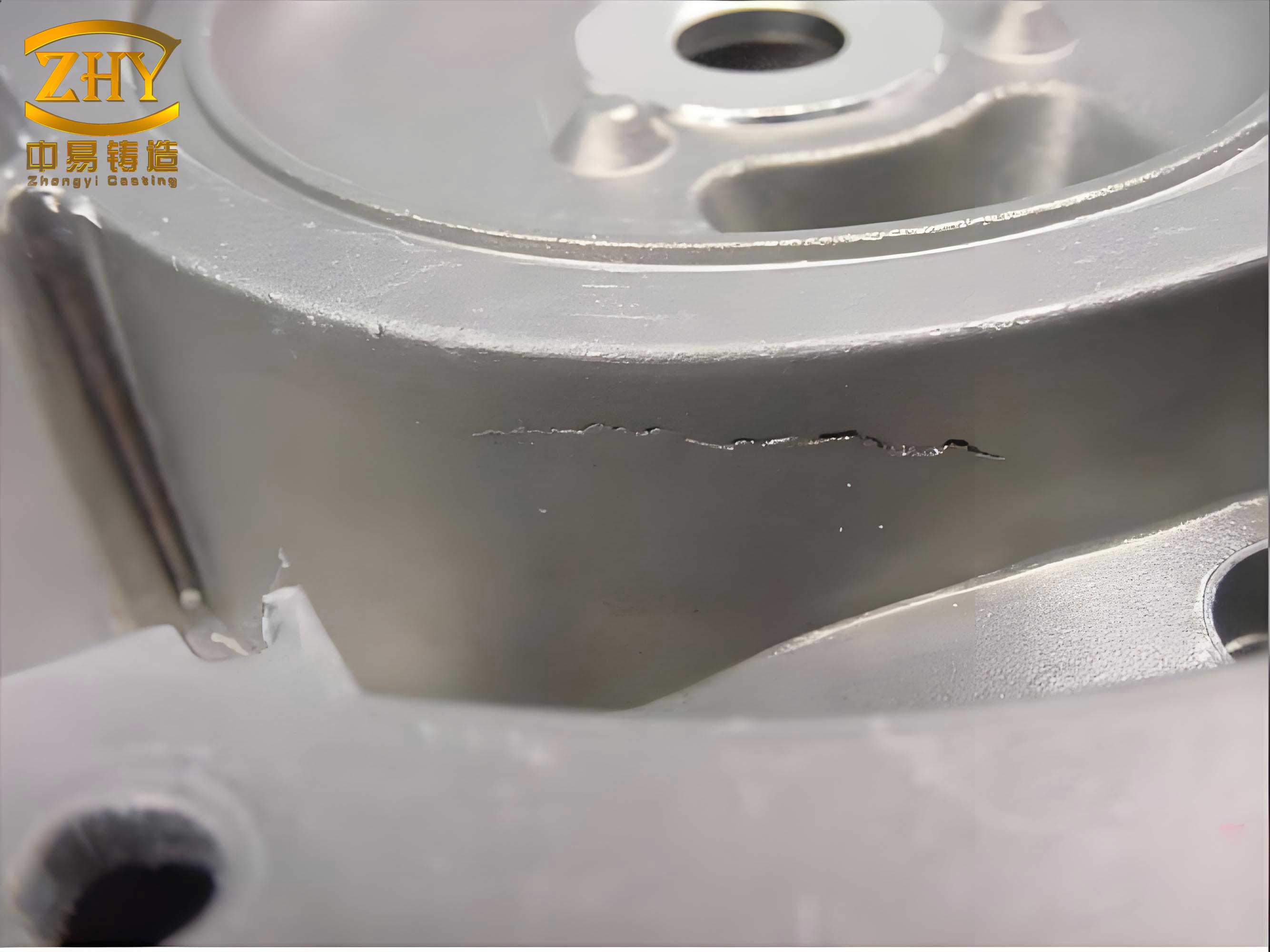
Sand Inclusion and Scabs: These are among the most common casting defects in green sand molding. They manifest as superficial layers of sand or metal-coated sand on the upper flat surfaces of castings. The root cause is thermo-mechanical failure of the sand mold surface. When molten steel contacts the mold, rapid heating creates a steep temperature gradient through the mold wall. The silica sand undergoes polymorphic transformation (e.g., α-quartz to β-quartz at 573°C), accompanied by significant and abrupt expansion. The moist sand layer immediately behind the dehydrated “skin” has lower strength and can yield, causing the stiff, heated surface layer to buckle and crack. Molten metal then penetrates these cracks, creating sand inclusion defects.
The stress ($\sigma_T$) induced by constrained thermal expansion can be conceptually related to the modulus of the sand ($E_s$), the coefficient of thermal expansion ($\alpha$), and the temperature gradient ($\Delta T$) by: $$\sigma_T \propto E_s \cdot \alpha \cdot \Delta T$$
Factors exacerbating these casting defects include low green strength and high moisture content of the sand, non-uniform mold compaction, improper venting, and turbulent gating that erodes the mold surface. The impact is direct: increased fettling and welding labor, consumption of grinding materials and energy, and potential scrap loss if the affected area is too extensive to repair. Controlling these casting defects requires enhancing the sand’s resistance to thermal stress.
Gas Porosity: This category of casting defects features smooth-walled cavities within the casting wall or near the surface. Two primary mechanisms are involved: involvement gas porosity and precipitation gas porosity. Involvement defects occur when gases from the mold or core are entrapped by the advancing metal front or invade the solidifying metal. The pressure of the generated gas ($P_g$) must overcome the metallostatic pressure ($P_m = \rho g h$) and the surface tension pressure at the pore tip to form a bubble: $$P_g > \rho g h + \frac{2\gamma}{r}$$ where $\rho$ is metal density, $g$ is gravity, $h$ is the effective metal head, $\gamma$ is surface tension, and $r$ is the pore radius. Common sources are high moisture content, organic contaminants, inadequate mold/core venting, or damp chills. Precipitation porosity, primarily from hydrogen, occurs when the gas solubility in the steel drops sharply upon solidification, leading to nucleation and growth of bubbles trapped between dendrites. This is often linked to damp or rusty charge materials, inadequate melt degassing, or high pouring temperatures. The consequences range from additional repair work for surface pores to catastrophic internal defects that compromise mechanical integrity and component safety, making the control of these casting defects critical.
Shrinkage Cavities and Porosity: These internal or surface-connected void casting defects result from inadequate compensation for liquid contraction and solidification shrinkage. The total volume deficit ($V_{shrinkage}$) that must be fed is a function of the casting volume ($V_c$) and the alloy’s shrinkage characteristics: $$V_{shrinkage} = V_{casting} \cdot (\beta_{liquid} + \beta_{solid})$$ where $\beta_{liquid}$ and $\beta_{solid}$ are the volumetric contraction coefficients for the liquid and solidification phases, respectively. In green sand molding, while the mold offers less resistance than some hardened molds, improper risering remains the primary cause. This includes undersized risers, insufficient riser feed paths (neck design), or the absence of necessary chilling to create directional solidification toward the riser. The presence of such casting defects, especially internal shrinkage, can severely degrade fatigue life and load-bearing capacity, often leading to outright rejection of the casting during non-destructive testing.
Surface Burn-on and Metal Penetration: These surface finish casting defects occur when molten steel interacts chemically and physically with the sand grains. Burn-on is a severe form where the metal fuses with the sand, forming a tenacious, glassy layer that is extremely difficult to remove. The primary drivers are the low refractoriness of the sand (high impurities like feldspar, mica, or iron oxides) and high thermal loading, especially in areas like large riser necks. Metal penetration involves the infiltration of metal into inter-sand voids without full chemical reaction, often resulting in a rough, gritty surface. The capillary pressure driving penetration is inversely proportional to the pore radius, highlighting the importance of fine, tightly packed sand surfaces. These casting defects dramatically increase cleaning costs, damage tooling during machining, and can mask other underlying defects.
Hot Tearing and Cracking: Although green sand generally has good collapsibility, reducing hot tear susceptibility, these cracking defects can still occur. They are solidification casting defects caused by tensile stresses developed in the fragile, semi-solid casting skeleton when its contraction is restricted by the rigid mold or core. The susceptibility increases with alloy characteristics (wide freezing range, high shrinkage), complex part geometry creating hot spots, and inadequate mold yielding. The high carbon equivalent in some steels also impairs weldability, making repair of these casting defects difficult and prone to re-cracking, posing a significant risk to in-service performance.
Mold Wall Movement (Mold Swell): This dimensional casting defect results in thicker-than-specified casting sections and overall weight increase. It is caused by the displacement of the mold wall under the metallostatic pressure of the liquid steel. The primary causes are insufficient mold hardness (low compaction) and inadequate mechanical support from the flask or molding equipment. This defect not only leads to material overuse and potential machining issues but can also cause mismatches and other associated flaws.
| Defect Type | Primary Root Causes | Major Adverse Impacts |
|---|---|---|
| Sand Inclusion/Scab | Thermal expansion of sand, low sand strength, high moisture, non-uniform compaction. | Increased cleaning/welding, potential scrap. |
| Gas Porosity | High sand moisture, poor venting, damp charge materials, high pouring temperature. | Reduced mechanical properties, repair costs, internal safety hazards. |
| Shrinkage Cavity | Inadequate riser design/sizing, lack of directional solidification control. | Significant weakening of structure, often leads to scrap. |
| Surface Burn-on/Penetration | Low sand refractoriness, coarse sand, high pouring temperature, insufficient coating. | Extremely high cleaning cost, poor surface finish. |
| Hot Tear | Restricted contraction, alloy susceptibility, design creating high stress concentration. | Difficult repair, risk of in-service failure. |
| Mold Wall Movement | Low mold hardness, inadequate flask support. | Dimensional inaccuracy, overweight castings. |
Controlling these casting defects requires a holistic approach targeting three key areas: sand system engineering, robust casting process design, and strict procedural control in foundry operations.
1. Engineering the Sand System: The properties of the prepared molding sand are the first line of defense against casting defects. A systematic specification is required.
| Property | Purpose & Target | Key Influencing Factors |
|---|---|---|
| Green Compressive Strength | Handleability, resist erosion. (Target: 180-250 kPa) | Bentonite content, moisture, mulling efficiency. |
| Green Shear Strength | Resist scabbing and cracking. (Target: High as possible) | Bentonite quality, additives like cereals. |
| Moisture Content | Bond activation. (Target: Optimized for strength, typically 2.8-3.8%) | Controlled addition, cooling efficiency. |
| Permeability | Allow gas escape. (Target: Adequate, not excessive) | Grain size and distribution, compaction. |
| Compactability | Indicator of consistency and mulling. (Target: 35-45%) | Moisture, bentonite activity, additive levels. |
| Loss on Ignition (LOI) | Measure of volatile content. (Target: Controlled & stable) | Carbonaceous additives, dead clay buildup. |
Specific measures to combat casting defects include: Using high-purity, fine silica sand (AFS GFN 70-90) to improve density and surface finish. Employing a blended binder system: Premium sodium bentonite for high-temperature strength combined with organic additives like corn flour or dextrine. The starch-based additives enhance flowability during molding, improve surface toughness, and create a protective gaseous atmosphere and carbonaceous layer at the metal-mold interface, reducing both sand expansion casting defects and burn-on. The beneficial effect can be modeled as an enhancement to the effective hot strength ($S_h$): $$S_h = S_{bentonite} + k_{starch} \cdot C_{starch}$$ where $k_{starch}$ is an efficiency coefficient. Adding inert, refractory supplements such as fine zircon or chromite flour to facing sand in critical areas (like around large risers) dramatically increases resistance to metal penetration and burn-on casting defects.
2. Robust Casting Process and Tooling Design: The design of the gating, feeding, and tooling system must acknowledge the specific behavior of green sand molds to prevent casting defects.
- Gating & Venting: Design gating systems for laminar fill to minimize erosion. Strategically place ample vents, particularly along the mold parting line and in upper sections of cores, to facilitate easy gas escape, directly countering gas porosity casting defects.
- Risering & Solidification Control: Use modulus-based calculations to size risers adequately. Employ insulating riser sleeves to improve feeding efficiency. Implement chills (internal or external) made of iron, graphite, or chromite sand to enforce directional solidification, eliminating shrinkage casting defects. The necessary chilling power can be approximated by comparing the moduli: $$M_{chill} \geq M_{casting\_hot\_spot}$$
- Mold & Flask Design: Ensure flasks are rigid and deep enough to allow for sufficient sand backing. Incorporate strong, closely spaced reinforcing ribs in the flask walls to support high mold hardness and resist mold wall movement casting defects.
3. Stringent Procedural and Operational Control: Consistent execution of established procedures is vital to minimize process variability and resultant casting defects.
| Process Stage | Critical Control Points | Objective |
|---|---|---|
| Mold Making | Achieve high, uniform mold hardness (85-90 on B-scale); smooth, careful pattern drawing; proper setting of vents and chills. | Prevent scabs, erosion, gas defects, and shrinkage. |
| Coating Application | Apply a high-refractoriness zircon-based coating uniformly to all mold & core surfaces; ensure proper drying. | Create barrier against metal penetration and chemical reaction. |
| Melting & Metal Treatment | Use clean, preheated charge materials; effective slag removal; proper degassing (e.g., argon purging); temperature control. | Reduce hydrogen content and non-metallic inclusions. |
| Pouring | Maintain optimal pouring temperature (avoid excessive superheat); pour quickly but smoothly to maintain a rising metal front. | Control solidification structure, minimize gas pickup and mold heating. |
| Sand System Management | Continuous monitoring and adjustment of key properties (see Table 2); effective cooling and aeration; controlled return sand addition. | Maintain consistent, defect-resistant sand performance. |
The successful production of high-integrity steel castings using green sand molding is an attainable goal, but it demands a disciplined and scientific approach. The economic and environmental incentives are significant, yet they can only be fully realized by proactively addressing the characteristic casting defects of the process. This requires a deep understanding of the mechanisms behind defects like sand inclusion, gas porosity, and shrinkage, and the implementation of a multi-faceted control strategy. This strategy rests on three pillars: formulating a high-performance, engineered sand mix with tailored additives; designing casting processes and tooling that account for green sand’s thermal and mechanical behavior; and enforcing rigorous procedural controls at every stage of molding, melting, and pouring. Through such a comprehensive system, the incidence of casting defects can be dramatically reduced, transforming green sand from a traditional method for simple parts into a viable, high-quality, and cost-effective production route for demanding steel castings.