
In my extensive experience with foundry practices, plate-like gray iron castings, despite their seemingly simple geometry, present unique challenges that demand careful consideration of gating system design. These castings, characterized by uniform structures and flat surfaces, are often assumed to be straightforward to produce. However, variations in size, thickness, shape, and machining requirements necessitate tailored approaches to avoid a range of casting defects. This article delves into the common casting defects encountered in such components and analyzes the various gating systems employed, emphasizing the critical role of system selection in mitigating these issues. The term ‘casting defects’ will be recurrently addressed, as understanding their origins is paramount to quality control.
The production of plate castings is susceptible to several casting defects, primarily stemming from improper gating, sand properties, and process parameters. A systematic breakdown is essential. Firstly, if the pouring time is excessively long, the continuous冲刷 of molten iron can cause scabbing and sand inclusions on the upper and lower surfaces of the casting, especially in green sand molding. This is a classic example of mold erosion-related casting defects. Secondly, inadequate sand properties, particularly poor permeability, often lead to gas entrapment, resulting in pinholes or blowholes on the upper surface—another pervasive set of casting defects. Thirdly, for large-area, thin-walled plates, improper gating location, low pouring temperature, or slow filling can cause misruns, cold shuts, and warping deformation. These defects directly compromise the integrity and dimensional accuracy of the castings. Fourthly, defects like lifted molds causing uneven wall thickness or distortion are common in green sand processes due to inadequate flask rigidity or improper clamping. Finally, the expansive flat areas of the mold are prone to inconsistent sand compaction and thermal gradients, frequently inducing scabbing on both casting surfaces. These casting defects collectively underscore the need for meticulous process control.
To organize these insights, the following table summarizes the primary casting defects, their causes, and typical manifestations in plate gray iron castings:
| Casting Defect Type | Primary Causes | Typical Manifestation in Plate Castings |
|---|---|---|
| Scabbing/Sand Inclusion | Long pouring time, mold erosion, thermal shock, inconsistent sand strength | Rough surfaces with embedded sand on upper/lower faces |
| Gas Porosity (Pinholes/Blowholes) | Low sand permeability, high moisture, inadequate venting | Small rounded cavities on or near the upper surface |
| Misrun/Cold Shut | Low pouring temperature, slow filling, improper gating distribution | Incomplete filling or visible seams where metal streams meet |
| Warping/Deformation | Non-uniform cooling, thermal stresses, mold restraint issues | Distorted flat geometry, deviation from intended shape |
| Mold Lift/Shift | Insufficient flask weight or clamping, ferrostatic pressure | Variation in wall thickness, overall casting distortion |
The prevention of these casting defects hinges significantly on the design of the gating system. The gating system governs the flow of molten metal into the mold cavity, influencing temperature distribution, turbulence, and pressure dynamics. Several gating system configurations are prevalent for plate castings, each with distinct advantages and drawbacks.
The most basic form is the end-gated, horizontal pouring system. Within this category, three variants exist based on ingate position. The first, with the ingate at the parting line, is widely used due to its simplicity in molding and cleaning. However, in green sand conditions, prolonged pouring can lead to severe erosion near the ingate, promoting sand-related casting defects. The second variant places the ingate in the upper mold half, which offers some slag-trapping benefit and protects the upper mold surface from direct冲刷. Yet, it intensifies冲击 on the lower mold at the ingate exit, risking defects there and making ingate removal difficult. The third variant has the ingate at the bottom of the mold cavity, ensuring calm metal entry and minimal mold damage, but it requires the casting to be in the upper box, complicating molding. The choice among these involves a trade-off between simplicity and the risk of specific casting defects.
For certain geometries, tilting the mold during pouring offers a solution. By inclining the mold at an angle (e.g., 10°),底注 is achieved even with an end gate. This promotes smoother metal flow, reduces冲刷 on the mold surface ahead of the gate, facilitates gas escape, and accelerates mold filling, thereby reducing the likelihood of cold shuts and misruns—common casting defects in thin sections. The effectiveness can be related to fluid dynamics. The pressure head \( H \) during tilted pouring is modified by the incline angle \( \theta \):
$$ H_{\text{effective}} = H_0 \cdot \sin(\theta) + L \cdot \cos(\theta) $$
where \( H_0 \) is the initial sprue height and \( L \) is the horizontal flow distance. This altered pressure profile can help maintain adequate flow velocity without excessive turbulence.
A highly effective system for large, thin plates is the shower or rain gate. Here, multiple small ingates are distributed across the upper surface of the casting. This ensures uniform metal distribution, minimizes thermal gradients, reduces flow distance for the metal, and decreases the risk of warping and cold shuts. Although pattern-making and molding are more complex, the reduction in casting defects is substantial. The number and size of ingates can be optimized using principles of fluid flow and heat transfer. For instance, to ensure simultaneous filling, the total ingate area \( A_g \) should relate to the mold cavity area \( A_c \) and desired fill time \( t \). A simplified relation considering Bernoulli’s principle is:
$$ A_g = \frac{V}{t \cdot v_g} $$
where \( V \) is the casting volume and \( v_g \) is the flow velocity at the ingates, approximated by \( v_g \approx \sqrt{2gH} \), with \( g \) being gravity and \( H \) the metallostatic head. This uniformity directly counters defects like misruns.
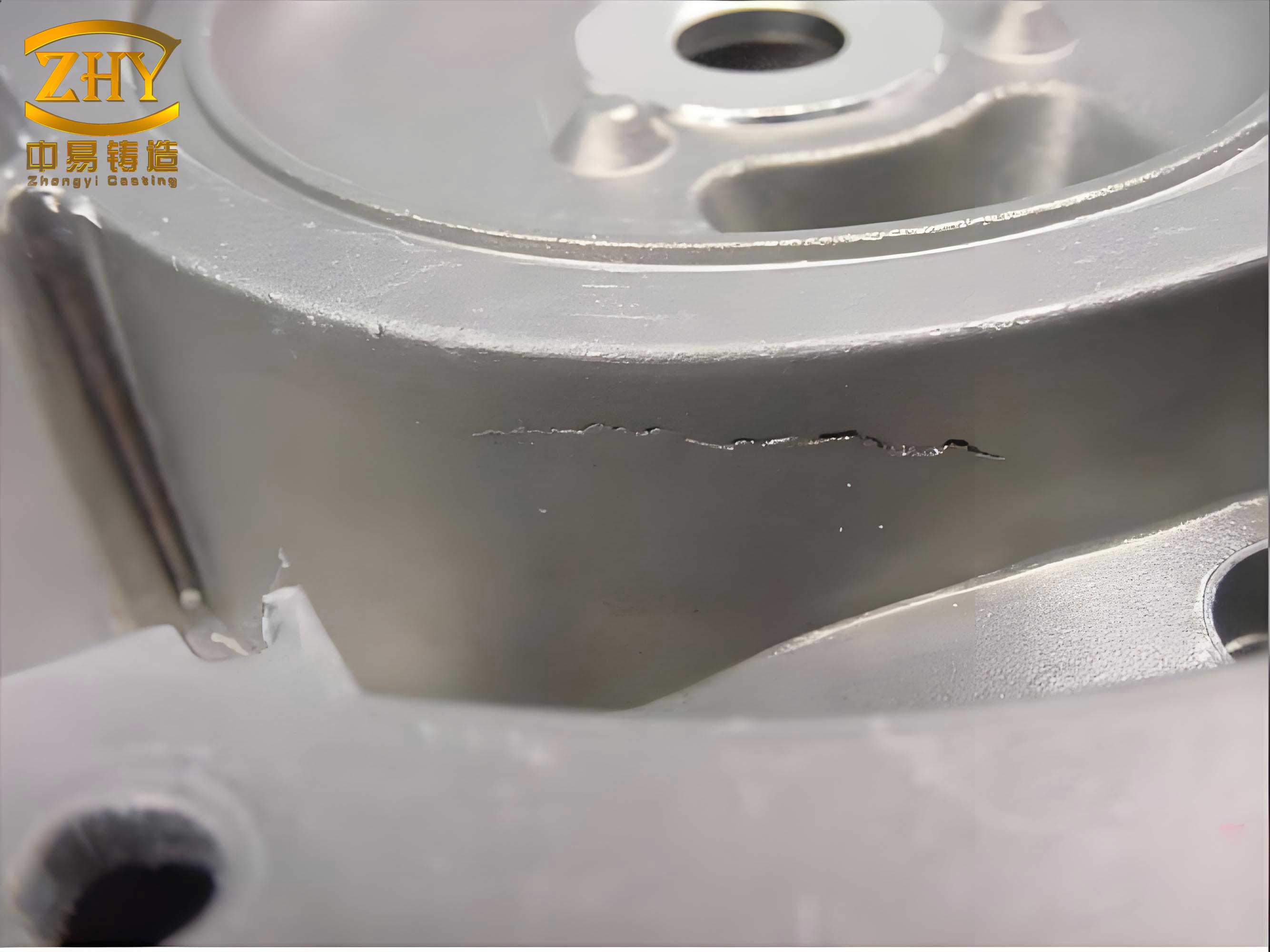
Other specialized gating systems include the kiss gate or edge gate for small, thick plates, where a small, constricted opening allows controlled feeding. The horizontal molding-vertical pouring system is used for small plates requiring full machining; it demands dry sand or sodium silicate-bonded sand and specialized flasks. For annular plates with large central holes, a circular runner with a central sprue can provide symmetrical filling, reducing turbulence and gas entrapment that lead to casting defects like porosity and scabbing.
To quantitatively compare these systems, the table below outlines their key characteristics, advantages, and associated risks concerning casting defects:
| Gating System Type | Typical Configuration | Advantages | Disadvantages & Potential Casting Defects |
|---|---|---|---|
| End-Gated, Horizontal Pour (Parting Line Ingate) | Straight runner along parting line, ingate at edge | Simple molding and cleaning, suitable for dry sand | Mold erosion risk, sand inclusions, scabbing (especially in green sand) |
| End-Gated, Horizontal Pour (Upper Ingate) | Ingate set in cope | Protects upper mold surface, some slag trapping | Lower mold冲击, sand defects at ingate exit, difficult cleaning |
| End-Gated, Horizontal Pour (Bottom Ingate) | Ingate at bottom of cavity | Calm metal entry, minimal mold damage | Complex molding (casting in cope), possible mistruns if head insufficient |
| Tilted Mold Pouring | Mold inclined,底注 via end gate | Smooth flow, faster fill, reduced冲刷, less gas entrapment | Requires tilting mechanism, careful setup to avoid mold shift |
| Rain Gate (Shower Gate) | Multiple small ingates distributed over casting top | Uniform filling, minimal thermal stress, reduces warping and cold shuts | Complex pattern and molding, higher cleaning effort |
| Kiss/Edge Gate | Small restricted opening at casting edge | Simple, good for thick sections, easy breaking | Not suitable for thin plates, risk of misruns if area too small |
| Horizontal Mold, Vertical Pour | Castings oriented vertically in mold, side gating | Good for fully machined small plates, minimizes surface defects on critical faces | Requires specialized equipment, dry sand molds, higher cost |
| Circular Runner with Central Sprue | Annular runner around central hole, sprue at center | Symmetrical filling, reduces turbulence and gas defects | Limited to annular geometries, pattern complexity |
The thermal aspects of solidification also play a crucial role in the formation of casting defects. Warping, for instance, results from uneven cooling and the development of thermal stresses. The temperature gradient \( \nabla T \) across the plate thickness during cooling can be modeled using the heat conduction equation. For a plate of thickness \( d \), the one-dimensional heat flow is governed by:
$$ \frac{\partial T}{\partial t} = \alpha \frac{\partial^2 T}{\partial x^2} $$
where \( \alpha \) is the thermal diffusivity of iron. Non-uniform cooling, often due to asymmetric gating that causes one side to solidify earlier, induces stress \( \sigma \) approximated by:
$$ \sigma \approx E \beta \Delta T $$
with \( E \) as Young’s modulus, \( \beta \) the coefficient of thermal expansion, and \( \Delta T \) the temperature difference across the section. Exceeding the material’s yield strength at elevated temperatures leads to plastic deformation and warping—a significant casting defect. Therefore, gating systems like rain gates that promote uniform temperature distribution are beneficial.
Furthermore, the prevention of gas-related casting defects involves understanding gas generation and escape. The amount of gas evolved from the mold sand can be related to its moisture content and the temperature of the metal. A simplified model for gas pressure buildup \( P_g \) is:
$$ P_g = \frac{nRT}{V} $$
where \( n \) is moles of gas generated, \( R \) the gas constant, \( T \) the temperature, and \( V \) the pore volume. If \( P_g \) exceeds the metallostatic pressure \( \rho g h \) (with \( \rho \) as metal density and \( h \) the metal head), gas can penetrate the metal, causing porosity. Thus, gating systems that facilitate venting or maintain sufficient metallostatic pressure are crucial.
In practice, the selection of a gating system must integrate these theoretical considerations with empirical foundry knowledge. For instance, for a large thin plate requiring a machined upper surface, a rain gate system, despite its complexity, may be the only way to achieve defect-free castings consistently. Conversely, for a small, thick bracket, a simple edge gate suffices. Computational simulation tools now allow for virtual testing of filling and solidification, predicting areas prone to casting defects like cold shuts or porosity based on gating design.
In conclusion, the production of high-quality plate gray iron castings is a nuanced process where gating system design is a critical lever for minimizing casting defects. Each type of gating system—from basic end gates to sophisticated rain gates—carries specific benefits and risks. The prevalence of defects such as scabbing, porosity, misruns, and warping can be dramatically reduced by matching the gating system to the casting’s geometry, size, and production conditions. Foundries must balance simplicity, cost, and reliability, always keeping in mind the fundamental goal: to control the flow and solidification of metal in a way that precludes the formation of casting defects. Continuous advancement in modeling and material science further empowers foundry engineers to optimize these systems, ensuring that even the simplest-shaped castings meet the highest quality standards.