
In my extensive experience within the foundry industry, particularly in the production of complex engine components like cylinder heads, addressing casting defects is paramount to achieving high-quality, reliable castings. The transition to vertically-cast, fully assembled core molds for Cummins engine cylinder heads on GF high-pressure molding lines presented a significant technological challenge. While this method offers advantages in precision and complexity, it inherently introduces specific vulnerabilities to certain casting defects. This article, drawn from my first-hand involvement in process development and troubleshooting, delves deeply into the most prevalent casting defects encountered: sand inclusion, slag inclusion, leakage, and blow holes. I will systematically analyze their root causes, detail the investigative approaches and corrective measures implemented, and present summarized data and theoretical models to encapsulate the learning. The persistent occurrence of these casting defects initially threatened project viability, necessitating a methodical, data-driven response to bring rejection rates under control.
The cylinder head in question, material grade HT250, with dimensions 550 x 375 x 113 mm and a weight of 60 kg per piece, was produced two per mold with a total metal weight of 170 kg. The mold consisted entirely of assembled cores: a base core, cover core, intake and exhaust port cores (cold-box), and upper/lower water jacket cores (shell sand). This full core assembly was vertically poured. The initial gating system was a combination of closed and open types, with the intake manifold facing downward. Despite careful planning, the initial production phase was plagued by a high incidence of casting defects, prompting a rigorous analysis campaign.
1. Sand Inclusion and Slag Inclusion: Diagnosis and Filtration Strategy
The most frequent and initially confounding issues were cavity-type defects, often generically classified as sand holes or slag holes. Visual inspection post-shot blasting and annealing made precise differentiation difficult. Early assumptions pointed towards core erosion or loose sand from the molding process. However, initial countermeasures like using more compact shell sand for the gating cores and ensuring core integrity showed only marginal improvement. This hinted that the core issue was not the primary source. We then pivoted to consider the possibility of slag entrainment within the molten iron.
To test the gating system’s efficacy in slag removal, we experimented with radically different pouring designs. A bottom-gating system (Figure 3) and a top-gating system (Figure 4) were both trialed. Interestingly, both resulted in high rejection rates for these defects—23.02% and 16.55% respectively—and introduced new problems like top-surface blow holes. The slight variation in defect location between the two systems suggested the flow dynamics and aspiration zones of the ingates were merely redistributing the contaminants, not eliminating them. This solidified the hypothesis that the defects were primarily slag-related, potentially aggravated by embedded sand particles.
Microscopic examination of the defect sites provided conclusive evidence. We observed quartz sand particles surrounded by a glassy, fused matrix. Chemical microanalysis of the area surrounding the defect showed elevated levels of Silicon (Si), Manganese (Mn), and Sulfur (S) compared to sound metal areas. This confirmed the defect was a composite slag inclusion, where non-metallic inclusions (likely eutectic slag) had agglomerated with quartz sand particles, either from inadequately cleaned returns or from minor core surface erosion. The formation can be conceptually related to the entrapment probability during filling. The efficiency of slag removal can be modeled by considering the buoyancy force versus the drag force on an inclusion. The terminal velocity of a spherical inclusion can be approximated by Stokes’ law for small particles in a viscous fluid:
$$ v_t = \frac{2}{9} \frac{(\rho_m – \rho_i) g r^2}{\eta} $$
where \( v_t \) is the terminal rising velocity, \( \rho_m \) is the density of molten iron, \( \rho_i \) is the density of the inclusion (slag/sand), \( g \) is gravity, \( r \) is the inclusion radius, and \( \eta \) is the dynamic viscosity of the iron. For typical slag densities around 2500 kg/m³ and iron at 7000 kg/m³, the upward velocity is positive, but turbulent flow during mold filling can easily trap particles. Our goal was to minimize turbulence and provide effective filtration.
The integrated solution we developed targeted both the source and the transport of these inclusions. The key actions are summarized in the table below:
| Root Cause Category | Specific Issue | Corrective Measure Implemented | Impact on Casting Defects |
|---|---|---|---|
| Molten Metal Cleanliness | Slag formation from reactions | Overheating to 1530-1550°C in medium-frequency furnace with 20-30 min holding for slag aggregation and removal. | Significant reduction in endogenous slag content. |
| Slag carry-over from furnace/tundish | Rigorous slag skimming from furnace, transfer ladle, and pouring ladle before casting. | ||
| Sand from returns | Strict control and cleaning of recirculated scrap to remove adherent sand. | Eliminated exogenous sand particles. | |
| Inadequate filtration | Redesign of gating system with improved slag-trapping geometry (step-gating). | Enhanced mechanical and physical slag removal. | |
| Poor filtration media | Installation of high-quality ceramic foam filters (pore size 2×2 mm) on both sides of the runner bar. |
The synergistic effect of these measures was dramatic. The rejection rate due to sand/slag inclusion plummeted from over 23% to a stable level of approximately 1.40%. This underscored that for vertically-poured, complex core assemblies, metal purity is not just desirable but critical. The filters, in particular, acted as a final barrier, capturing remnants that survived the prior cleaning stages. The effectiveness \( E \) of a filter can be considered as a function of pore size \( d_p \), metal velocity \( u \), and inclusion size distribution. A simplified capture model for particles larger than the pore size is \( E \approx 1 \) for \( d_i > d_p \), but for our small inclusions, depth filtration mechanisms were at play.
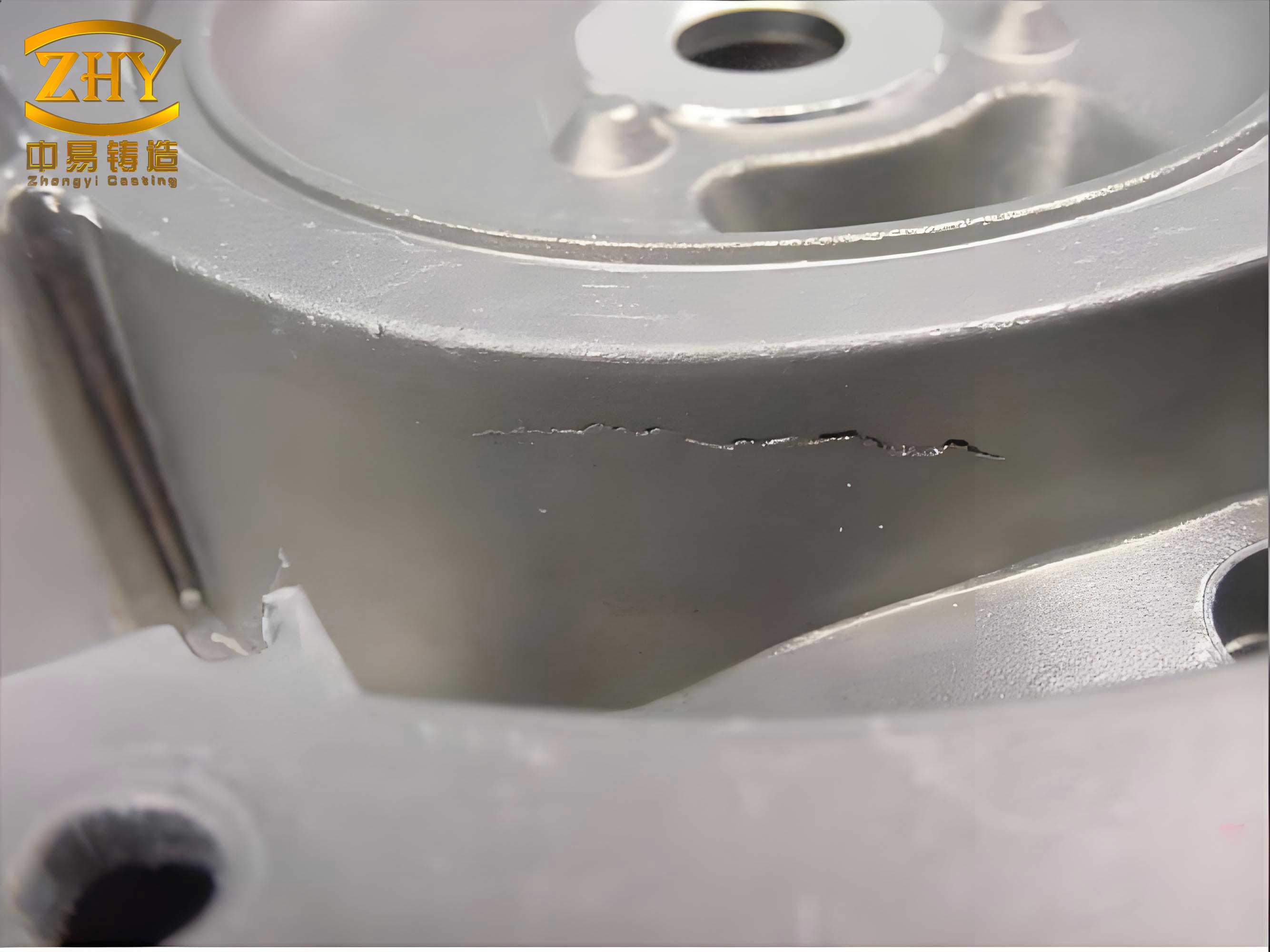
Understanding and controlling these casting defects related to inclusions set the stage for tackling the next major category: leakage, a defect that directly compromises the component’s functional integrity.
2. Leakage Defects: The Challenge of Microshrinkage and Microstructural Coarseness
Leakage during pressure testing, especially in the water jacket areas, emerged as a severe and persistent form of casting defects. Initial suspicions fell on macro-shrinkage porosity in thick sections like boss areas and valve guides. Traditional chilling methods, such as applying tellurium-based paint or inserting chill inserts, proved ineffective. Increasing the size of top chills (risers) to enhance feeding pressure also failed and even created new shrinkage cavities at the chill roots due to contact hot spots. Altering the mold joint to increase metallostatic pressure yielded no significant benefit either.
Metallographic investigation of leak-prone sections revealed the true nature of the problem. While occasional minor shrinkage was visible macroscopically, the microscopic structure showed a more telling story: not large voids, but interconnected microshrinkage channels and coarse dendrites with inter-dendritic porosity. This indicated that the defect was less about gross feeding failure and more about the solidification mode leading to a mushy zone and consequent microstructural coarseness. In the thick sections of a core-assembly mold, the cooling rate is significantly slower, promoting a pasty, long-range mushy solidification. This environment is prone to forming dispersed microporosity and enlarging the secondary dendrite arm spacing (SDAS), which is inversely related to cooling rate: \( \lambda_2 = k \cdot (t_f)^{-n} \), where \( \lambda_2 \) is SDAS, \( t_f \) is local solidification time, and \( k, n \) are material constants.
Our strategy shifted from mere thermal management to metallurgical control aimed at refining the microstructure and promoting a more directional solidification front. The core initiatives focused on enhancing nucleation and ensuring consistent, non-fading inoculation. The table below outlines the multi-pronged approach:
| Objective | Previous State | Improved Process | Technical Rationale |
|---|---|---|---|
| Increase Graphite Nucleation Sites | Standard charge with pig iron. | Implementation of carbon raiser addition to final melt, increasing final C by 0.01-0.02%. Use of granular, high-quality raiser. | Introduces fine, undissolved graphite particles that act as heterogeneous nuclei for flake graphite during eutectic solidification. |
| Enhance & Stabilize Inoculation | 0.35% total inoculation (0.25% ladle + 0.1% stream). Use of 75% FeSi for ladle treatment. | Total inoculation increased to 0.40% (0.25% ladle + 0.15% stream). Ladle inoculation switched to Strontium-bearing FeSi (SiBaFe). | Sr is a potent anti-fading inoculant. Increased stream inoculation compensates for potential loss. This maximizes eutectic cell count \( N \), where shrinkage tendency often decreases as \( N \) increases: \( P_{shrink} \propto 1/N \). |
| Improve Mold Rigidity | Two bolts securing cover core. | Four corner bolts with specified torque. Tamping of core gaps at mold joint and addition of squeeze bars in the cope. | Prevents mold wall movement (mold dilation) during the graphite expansion phase of eutectic solidification, which can create space for microporosity formation. |
| Optimize Thermal History | Standard pouring temperature. | Strict control of pouring temperature between 1400-1420°C and total pouring time under 8 minutes from tap to finish. | Prevents inoculation fade and controls the thermal gradient. The solidification time \( t_s \) for a plate-like section is given by Chvorinov’s rule: \( t_s = B \cdot (V/A)^2 \), where B is the mold constant. A steeper gradient reduces mushy zone length. |
The results were transformative. The leakage rejection rate, which had fluctuated wildly from 1% to over 30% (especially sensitive to seasonal conditions affecting fading), stabilized below 1.2%. This demonstrated that for these casting defects related to sealing, a holistic approach combining nucleation control, consistent inoculation, and constrained solidification is essential. The effectiveness of the strontium inoculation in reducing undercooling and increasing eutectic cells can be modeled by the growth undercooling \( \Delta T \): a higher nuclei count reduces the necessary \( \Delta T \) for nucleation, leading to finer, more uniform structure.
3. Blow Holes: Managing Gas Evolution in Complex Core Assemblies
The third major category of casting defects was blow holes, predominantly appearing as large, smooth-walled cavities near the top of the casting, especially on the exhaust port side. Given the mold’s construction—six assorted cores creating an intricate internal cavity with a tall cope (400 mm) and a long metal rise height—the predisposition to gas entrapment was high. The effective metallostatic pressure \( P_{eff} \) at the top of the casting is reduced: \( P_{eff} = \rho_m g h – P_{atm} – \Delta P_{loss} \), where \( h \) is the height of the sprue above the casting top, and \( \Delta P_{loss} \) accounts for friction. If the gas pressure from core outgassing \( P_{gas} \) exceeds \( P_{eff} \), an侵入性气孔 (invasive blow hole) can form. The gas pressure buildup follows an ideal gas law approximation related to heating rate: \( P_{gas} \propto \frac{T_{gas}}{V_{cavity}} \), where \( T_{gas} \) rises rapidly as metal heats the binder.
Our counter-strategy targeted every aspect of gas generation, venting, and metal flow to prevent gas pressure buildup. The measures were comprehensive, as detailed in the following table:
| Control Parameter | Action Taken | Mechanism of Defect Prevention |
|---|---|---|
| Core Gas Generation | Optimized resin addition for cold-box cores to 1.8-2.0% total. Ensured complete curing. | Minimizes the total volatile content (V) per core, reducing the maximum possible gas pressure \( P_{max} = nRT/V \). |
| Core Drying & Handling | Strict control of core drying parameters. Mandatory secondary drying on line if cores stored >48 hours. | Eliminates residual moisture, a significant source of steam gas. The drying rate follows a diffusion law: \( \frac{\partial M}{\partial t} = D \nabla^2 M \), where M is moisture content. |
| Mold Venting | Design of dedicated vent holes in all core prints. Use of vent pins in the cope above water jacket cores connected to atmosphere. Sealing of vent inlets to prevent metal intrusion. | Provides low-resistance escape paths for gas, ensuring \( P_{gas} \) in the mold cavity never reaches critical levels. Vent flow can be approximated by Darcy’s law for porous media or orifice flow for channels. |
| Core Coating | Application of high-quality zircon-based water-borne coating via dipping. | Creates a barrier that reduces initial gas evolution rate and protects the core surface from rapid heating. |
| Pouring Parameters | Controlled pour temperature (1400-1420°C) and designed gating for a fill rate of ~10 kg/s. | Optimal fill rate balances smooth, non-turbulent filling (reducing air entrainment) with fast enough filling to outrun gas evolution. The fill time \( t_{fill} = M_{casting} / \dot{m} \). A moderate \( \dot{m} \) prevents excessive temperature loss and turbulence. |
The success of this integrated gas control protocol was immediate and sustained. In trial batches of 100 castings, no blow holes were detected. In high-volume production, the rejection rate for this type of casting defects has been consistently maintained below 0.5%. This highlights that in vertically-cast, fully cored molds, managing the gas dynamics is as critical as managing the metal chemistry and thermal aspects.
4. Synthesis and Foundry Engineering Principles
Reflecting on the journey to mitigate these casting defects, several overarching engineering principles emerge. The interaction between process variables is complex and non-linear. For instance, the same measure to reduce one defect could exacerbate another. Therefore, a systems approach is vital. We can model the overall casting quality \( Q \) as a function of multiple variables:
$$ Q = f(P, M, T, G) $$
where \( P \) represents process parameters (pour temp, speed, gating design), \( M \) represents metallurgical factors (composition, inoculation, cleanliness), \( T \) represents thermal factors (cooling rates, gradients), and \( G \) represents gas-related factors (core gas, venting). The optimization problem is to find the set of parameters that maximizes \( Q \) (minimizes total defects).
To quantify the improvement, consider the following summary table of Key Performance Indicators (KPIs) before and after the comprehensive process optimization:
| Casting Defects Type | Initial Rejection Rate (%) | Stabilized Rejection Rate (%) | Key Contributing Factor(s) Addressed | Theoretical Basis for Improvement |
|---|---|---|---|---|
| Sand/Slag Inclusion | 23.02 | ~1.40 | Metal Cleanliness, Filtration | Stokes’ Law, Filtration Efficiency Models |
| Leakage (Microshrinkage) | 10-30 (variable) | <1.20 | Microstructure Refinement, Mold Rigidity | Chvorinov’s Rule, Nucleation Theory, Expansion Constraint |
| Blow Holes | >10 | <0.50 | Gas Evolution Control, Venting, Pouring Rate | Ideal Gas Law, Darcy’s Law, Fluid Dynamics |
The economic impact was substantial. Reducing the combined defect rate from potentially over 50% in worst-case scenarios to a stable total under 3% represented a dramatic increase in yield and operational efficiency. Furthermore, the consistency achieved meant reliable supply chains and reduced costs associated with scrap handling and rework.
In conclusion, the successful production of high-integrity vertically-cast cylinder heads via full core assembly is a testament to a deep, analytical approach to solving casting defects. It requires moving beyond symptomatic fixes to fundamental process controls. The three major casting defects—inclusions, leakage, and blow holes—each demanded a unique but interconnected set of solutions rooted in physics, chemistry, and mechanical engineering principles. From ensuring molten metal purity through overheating and filtration, to refining microstructure via controlled inoculation and carbon addition, to meticulously managing gas evolution and mold venting, every step was critical. The formulas and models presented, while simplified, provide a framework for understanding the underlying phenomena. This experience underscores that in modern foundry practice, robust process design and relentless attention to detail are the most effective tools for conquering the persistent challenge of casting defects.