
In my experience working on the production of diesel engine intake and exhaust valve seats, I have encountered significant challenges related to casting defects. These casting defects, primarily gas pores and shrinkage cavities, along with micro-shrinkage, led to a high rejection rate and substantial economic losses. The material used was copper-chromium alloy cast iron, melted in a medium-frequency induction furnace. The molding process involved a green sand outer mold and a core made of bonded sand with合脂 (a binder), using a vertical cylindrical pouring method. This article details the investigation into these casting defects and the工艺措施 implemented to resolve them, with a focus on using tables and formulas for clarity and总结.
The casting defects manifested as internal wall气孔 (gas holes) and缩孔 (shrinkage cavities), as well as extensive micro-shrinkage in the central region of the castings. These casting defects not only compromised the structural integrity but also affected the performance and durability of the valve seats. Understanding the root causes was crucial for developing effective solutions. Through systematic analysis, we identified two primary factors contributing to these casting defects: excessive gas evolution from the cores and low carbon equivalent in the molten iron. Below, I elaborate on these causes and the corresponding corrective actions, emphasizing how工艺 controls can mitigate such casting defects.
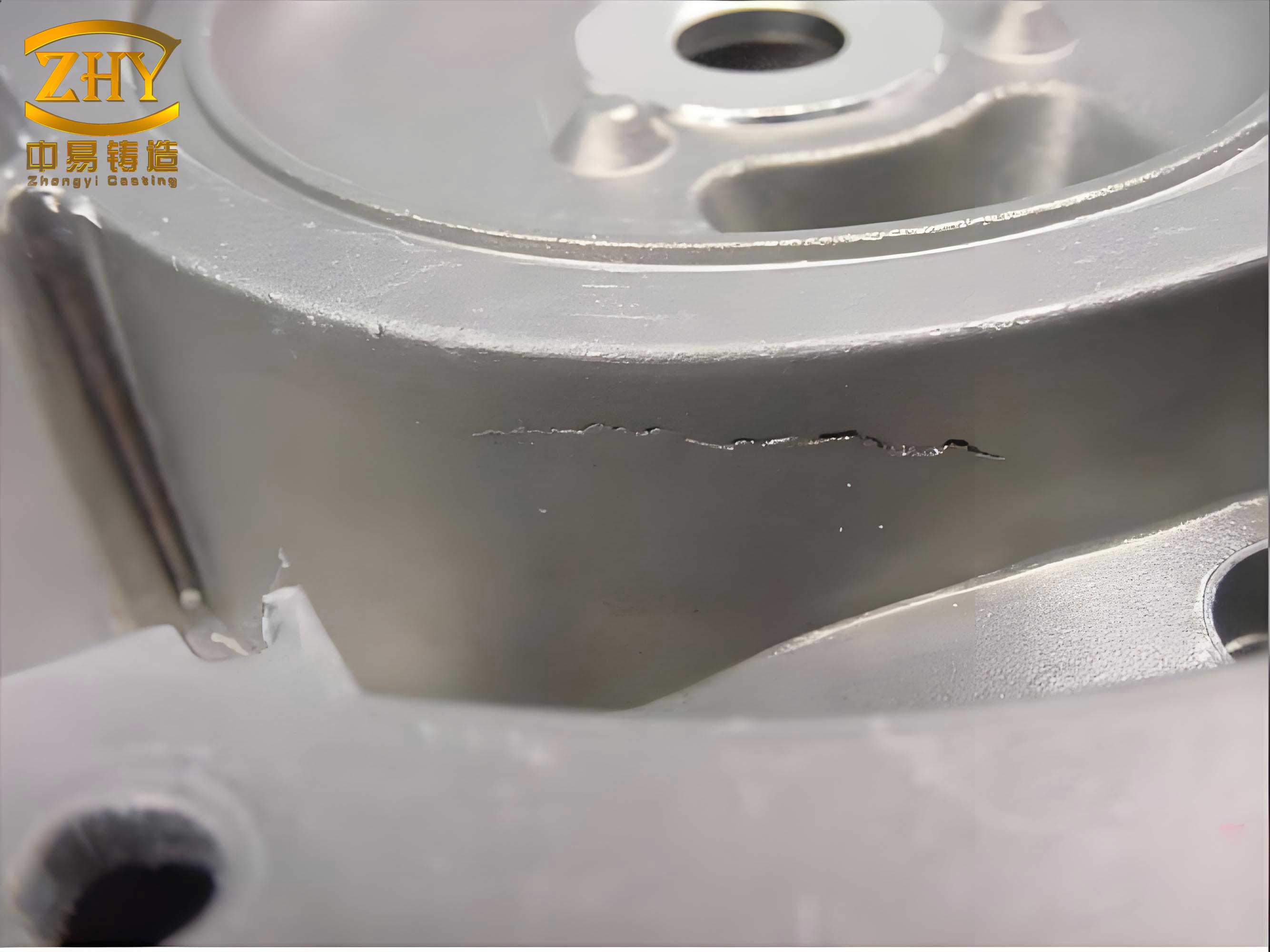
First, let’s discuss the issue of core gas evolution. We had recently installed a new infrared core drying oven, but the drying工艺 was not optimized. Initially, the oven temperature was set at 200–220°C with a drying time of 2 hours. However, due to uneven temperature distribution in the new oven, some cores became over-dried or charred. In response, operators擅自 reduced the temperature to 180°C and shortened the drying time to 1.5 hours, followed by air cooling. This resulted in cores that were superficially dry but retained unvolatilized合脂 and solvent (煤油) internally. When high-temperature metal was poured into the mold, these substances rapidly volatilized, causing a sudden increase in gas within the mold. The gas diffused outward and, since the metal surface had not yet formed a solid shell, easily invaded the molten metal. Under conditions of low pouring temperature and high viscosity, the invading gas could not float out and remained trapped, forming spherical or elliptical gas pores. Thus, excessive core gas evolution was a major cause of gas-related casting defects.
To quantify this, we can consider the gas generation rate, which can be modeled using the Arrhenius equation for thermal decomposition: $$G = A \cdot e^{-E_a/(R T)}$$ where \(G\) is the gas generation rate, \(A\) is the pre-exponential factor, \(E_a\) is the activation energy, \(R\) is the gas constant, and \(T\) is the temperature in Kelvin. Inadequate drying led to higher residual solvent, increasing \(A\) and thus \(G\), exacerbating casting defects. Table 1 summarizes the core drying parameters before and after optimization, highlighting how improper工艺 contributed to casting defects.
| Parameter | Initial Process | Optimized Process | Effect on Casting Defects |
|---|---|---|---|
| Temperature (°C) | 180-220 (uneven) | 200 (controlled) | Reduced gas evolution, minimized casting defects |
| Drying Time (hours) | 1.5 | 2.0 | Ensured complete drying, lowering casting defects risk |
| Cooling Method | Air cooling | Gradual cooling in oven | Prevented moisture reabsorption, reducing casting defects |
Second, the low carbon equivalent of the molten iron was another critical factor behind these casting defects. The chemical composition specification for the valve seats was: Carbon (C) 2.8–3.2%, Silicon (Si) 1.8–2.2%, Manganese (Mn) 0.6–0.9%, Phosphorus (P) ≤0.15%, Sulfur (S) ≤0.12%, Copper (Cu) 0.8–1.2%, and Chromium (Cr) 0.2–0.4%. The carbon equivalent (CE) is a key parameter influencing fluidity and shrinkage behavior in cast iron. It is calculated using the formula: $$CE = C + \frac{1}{3}Si$$ where C and Si are the weight percentages of carbon and silicon, respectively. Ideally, the CE should be controlled within the range of 3.8–4.2 to接近共晶成分 (near eutectic composition), which minimizes shrinkage and enhances补缩 (feeding). However, recent analysis showed that the actual CE was around 3.4–3.6, significantly below the desired range. This low CE increased the volumetric shrinkage率, making the castings prone to shrinkage-related casting defects like micro-shrinkage and cavities.
The relationship between CE and shrinkage can be expressed using the following empirical formula for shrinkage tendency: $$S_t = k \cdot (CE_{eutectic} – CE)$$ where \(S_t\) is the shrinkage tendency, \(k\) is a material constant, and \(CE_{eutectic}\) is the eutectic carbon equivalent (approximately 4.3 for cast iron). A lower CE increases \(S_t\), leading to more severe casting defects. Table 2 presents the chemical composition data from recent production batches, illustrating how deviations contributed to casting defects.
| Batch | C (%) | Si (%) | CE | Observed Casting Defects |
|---|---|---|---|---|
| 1 | 2.9 | 1.9 | 3.53 | Severe micro-shrinkage, gas pores |
| 2 | 3.0 | 2.0 | 3.67 | Moderate shrinkage, some gas pores |
| 3 | 2.8 | 1.8 | 3.40 | High rejection due to casting defects |
| Specification | 2.8-3.2 | 1.8-2.2 | 3.8-4.2 | Minimal casting defects |
Additionally, the lack of real-time chemical analysis compounded the issue. We relied on三角试片 (wedge test samples) for on-the-spot assessment, but inconsistent sample preparation led to misjudgments by furnace operators. This resulted in化学成分不符要求, further aggravating casting defects such as hardness variations and undesirable microstructures. The importance of accurate CE control cannot be overstated in preventing these casting defects.
Based on this analysis, we implemented several工艺措施 to address these casting defects. The goal was to reduce gas evolution and optimize the molten iron composition to minimize shrinkage-related casting defects. Here, I detail each measure with supporting tables and formulas.
1. Strict Control of Core Drying Quality: To mitigate gas-related casting defects, we standardized the core drying工艺. After thorough testing, we adjusted the oven temperature to 200°C and maintained a drying time of 2 hours, ensuring uniform and complete drying. This reduced the residual solvent content, lowering the gas generation rate. The gas evolution volume \(V_g\) can be estimated as: $$V_g = \int_{0}^{t} G(T(t)) \, dt$$ where \(T(t)\) is the temperature profile over time \(t\). By optimizing \(T(t)\) through controlled drying, we minimized \(V_g\), thus reducing the incidence of gas pores. Table 3 compares the gas evolution before and after optimization, showing a significant decrease in casting defects.
| Core Condition | Residual Solvent (%) | Gas Evolution (ml/g) | Casting Defects Rate (%) |
|---|---|---|---|
| Before Optimization | 5.2 | 12.5 | 25 |
| After Optimization | 1.8 | 4.3 | 5 |
2. Adjusting Carbon Equivalent: To combat shrinkage-related casting defects, we increased the CE to around 4.0. This was achieved by controlling the carbon content to 3.1–3.3% and silicon content to 2.0–2.3%, yielding a CE of approximately 4.0. The higher CE improves fluidity, enhances feeding capacity, and promotes graphite expansion during solidification, which helps offset shrinkage and eliminate micro-shrinkage. The fluidity index \(F\) can be related to CE by: $$F = \alpha \cdot CE + \beta$$ where \(\alpha\) and \(\beta\) are constants. Increasing CE boosts \(F\), reducing the risk of casting defects like cold shuts and misruns. Moreover, a higher CE prevents the formation of free carbides, ensuring better mechanical properties. Table 4 outlines the adjusted composition ranges and their impact on casting defects.
| Element | Original Range (%) | Optimized Range (%) | Effect on Casting Defects |
|---|---|---|---|
| Carbon (C) | 2.8-3.2 | 3.1-3.3 | Reduces shrinkage, improves fluidity |
| Silicon (Si) | 1.8-2.2 | 2.0-2.3 | Increases CE, minimizes casting defects |
| Carbon Equivalent (CE) | 3.4-3.6 | 3.9-4.1 | Lowers shrinkage tendency, reduces casting defects |
3. Controlling Molten Iron Temperature: Pouring temperature plays a crucial role in mitigating casting defects.经验表明 that适当提高浇注温度 enhances the补缩 ability of the gating system and promotes graphite化, which helps eliminate gas pores. However, excessive temperature increases液态收缩, aggravating shrinkage casting defects. We optimized the pouring temperature to 1380–1400°C, with a tapping temperature of 1450–1480°C. The relationship between pouring temperature \(T_p\) and shrinkage volume \(V_s\) can be approximated by: $$V_s = \gamma \cdot (T_p – T_s)$$ where \(\gamma\) is the coefficient of thermal contraction and \(T_s\) is the solidus temperature. By keeping \(T_p\) within an optimal range, we balanced fluidity and contraction, reducing both gas and shrinkage casting defects. Table 5 shows the temperature parameters and their effects.
| Temperature Parameter | Initial Value | Optimized Value | Impact on Casting Defects |
|---|---|---|---|
| Tapping Temperature (°C) | 1420-1450 | 1450-1480 | Improves fluidity, reduces gas entrapment |
| Pouring Temperature (°C) | 1350-1370 | 1380-1400 | Enhances feeding, lowers shrinkage casting defects |
4. Standardizing Testing and Analysis: To ensure consistency, we规范了三角试片 preparation and implemented regular chemical analysis for each melt. This allowed furnace operators to make accurate adjustments, preventing compositional deviations that lead to casting defects. The use of statistical process control (SPC) charts helped monitor CE variations, with control limits set at ±0.1 for CE. The process capability index \(C_pk\) for CE was improved from 0.8 to 1.5, indicating better control over casting defects. The formula for \(C_pk\) is: $$C_pk = \min\left(\frac{USL – \mu}{3\sigma}, \frac{\mu – LSL}{3\sigma}\right)$$ where \(USL\) and \(LSL\) are the upper and lower specification limits, \(\mu\) is the mean, and \(\sigma\) is the standard deviation. Higher \(C_pk\) correlates with fewer casting defects.
After implementing these工艺措施, we observed a dramatic reduction in casting defects. The rejection rate due to gas pores, shrinkage cavities, and micro-shrinkage dropped from 25% to below 5%. The mechanical properties and microstructure of the valve seats also improved, meeting all specifications. Regular audits confirmed that the optimized工艺 was sustainable, effectively minimizing casting defects in long-term production.
In conclusion, addressing casting defects in valve seats required a holistic approach focusing on core drying and molten iron composition. By严格控制型芯烘干质量 and adjusting the carbon equivalent, we significantly reduced gas-related and shrinkage-related casting defects. Temperature control and standardized testing further reinforced these improvements. The key takeaway is that casting defects can be systematically mitigated through data-driven工艺措施, as summarized in the tables and formulas above. This experience underscores the importance of continuous monitoring and optimization in foundry processes to combat casting defects. Future work could explore advanced simulation tools to predict casting defects, but for now, these practical measures have proven highly effective in resolving the casting defects we faced.
To generalize, the principles discussed here apply to other casting applications where casting defects are prevalent. For instance, the relationship between CE and shrinkage can be adapted for different铸铁 grades. Similarly, core drying optimization is relevant for any bonded sand process. By prioritizing these factors, foundries can enhance quality and reduce losses associated with casting defects. I encourage practitioners to document their own experiences with casting defects and share insights, as collective knowledge is vital for advancing casting technology. Remember, casting defects are not inevitable—they can be controlled with the right工艺措施.