
In the field of hydropower generation, Francis turbines are widely utilized due to their efficiency and adaptability. Among these, the crown component of the runner is critical, as it supports the blades and forms the flow passage. However, the casting process for large crowns, often exceeding 8 meters in diameter and 90 tons in weight, presents significant challenges. From my experience in casting engineering, I have observed that these components are prone to various casting defects, particularly cracks and shrinkage, which can lead to costly failures. This article delves into the analysis of casting processability, numerical simulation results, and practical solutions to mitigate these issues, with a focus on predicting and preventing casting defects.
The material commonly used for large Francis turbine crowns is a martensitic stainless steel, such as ZG06Cr13Ni4Mo, which offers excellent corrosion and erosion resistance in sediment-laden water. However, its casting properties are problematic. The steel has poor fluidity due to chromium oxide films, leading to potential cold shuts and inclusions. Additionally, it exhibits high shrinkage and thermal stress, making it susceptible to cracks. The phase transformation characteristics further complicate matters, with a martensite start temperature (Ms) around 280–300°C, causing volume expansion that can offset some contraction. Key material properties are summarized in the tables below.
| Element | C | Si | Mn | P | S | Cr | Ni | Mo | Al | Cu | V | Total Residuals |
|---|---|---|---|---|---|---|---|---|---|---|---|---|
| Content | ≤0.04 | ≤0.6 | ≤1.0 | ≤0.028 | ≤0.008 | 12.0–13.5 | 3.8–5.0 | 0.4–0.6 | ≤0.06 | ≤0.5 | ≤0.03 | ≤0.5 |
| Yield Strength (Rp0.2, N/mm²) | Tensile Strength (Rm, N/mm²) | Elongation (A, %) | Reduction of Area (Z, %) | Impact Energy KV2 (0°C, J) | Hardness (HBW) | Cold Bend Test |
|---|---|---|---|---|---|---|
| ≥580 | ≥780 | ≥20 | ≥55 | ≥100 | 220–285 | No cracks (d=2a, α=90°) |
| Hydrogen (H) | Oxygen (O) | Nitrogen (N) |
|---|---|---|
| ≤3 | ≤80 | ≤150 |
The casting performance can be quantified through shrinkage calculations. The free linear shrinkage is approximately 2.5%, but during martensitic transformation, a volume expansion of 0.54% occurs, reducing the net linear shrinkage to about 2.0%. The volumetric shrinkage is around 0.85%. These values are critical for understanding stress development. The stress state during solidification can be modeled using the following relationship for thermal stress: $$\sigma = E \cdot \alpha \cdot \Delta T$$ where $\sigma$ is the stress, $E$ is Young’s modulus, $\alpha$ is the coefficient of thermal expansion, and $\Delta T$ is the temperature gradient. For this steel, high thermal gradients exacerbate stress concentration, leading to potential casting defects like hot tears.
Structurally, the crown is a large, thin-walled rotational part with a complex geometry that includes a central flange, flow channels, and mounting points. This design impedes free contraction, causing stress accumulation. Through numerical simulation using Magma software, I analyzed the stress and deformation patterns. The results indicate that stress is highly concentrated near the central flange region, denoted as point A in the simulation, with values decreasing outward. This concentration leads to significant deformation at point B, highlighting the need for careful process control to avoid distortion and cracking. The stress distribution can be approximated by: $$\sigma_{\text{max}} = k \cdot \frac{E \cdot \Delta L}{L}$$ where $k$ is a geometric factor, $\Delta L$ is the contraction length, and $L$ is the characteristic dimension. For large crowns, $\Delta L$ can be substantial, increasing the risk of casting defects.
To optimize the pouring process, I conducted fluid flow and pressure simulations using Magma. The gating system was designed to ensure smooth filling, with results showing stable velocity and pressure fields. The velocity during mold filling remained low, typically below 0.5 m/s in critical regions, minimizing turbulence and inclusion formation. The pressure distribution indicated high values in the gating system but uniform patterns in the casting itself, reducing the likelihood of mold erosion. These simulations help predict flow-related casting defects, such as cold shuts or misruns. The pressure $P$ at any point can be expressed as: $$P = \rho g h + \frac{1}{2} \rho v^2$$ where $\rho$ is the molten steel density (approximately 7.8 g/cm³), $g$ is gravity, $h$ is the metallostatic head, and $v$ is the flow velocity. By maintaining low $v$, we can control $P$ and prevent mold damage.
Despite optimized designs, practical production often reveals casting defects, particularly internal cracks that manifest after heat treatment. These cracks, ranging from 200 mm to 4000 mm in length, typically occur at the junction between the central flange and the flow surface. They are initiated during solidification due to restrained contraction and exacerbated by prolonged cooling in the mold. The primary cause is the叠加 stress from thermal gradients, phase transformations, and mechanical constraints. For instance, the stress intensity factor $K_I$ for such cracks can be estimated as: $$K_I = Y \sigma \sqrt{\pi a}$$ where $Y$ is a geometry factor, $\sigma$ is the applied stress, and $a$ is the crack length. When $K_I$ exceeds the material’s fracture toughness, crack propagation occurs, leading to severe casting defects.
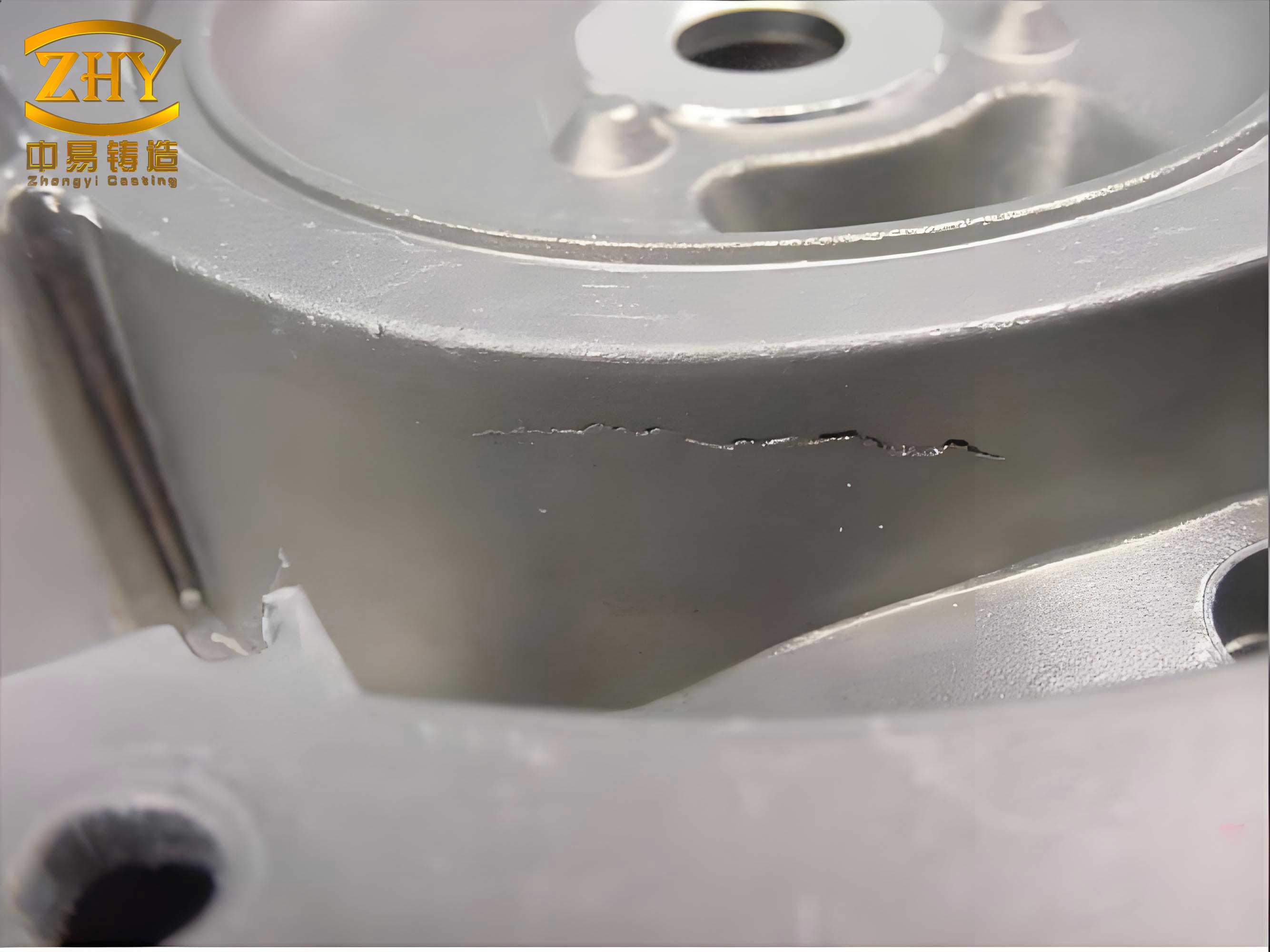
In real-world scenarios, these casting defects result in significant economic losses, including scrap costs exceeding $300,000 per piece and delays of over 40 days. To address this, I have developed several mitigation strategies. First, the timing of weight removal from the mold is crucial. Using simulation, I calculate the safe loosening time based on the buoyancy force of the riser. The buoyancy force $F_b$ is given by: $$F_b = S \times H \times \rho$$ where $S$ is the maximum projected area of the molten steel, $H$ is the effective height of riser metal, and $\rho$ is the density. For a typical crown, $S$ might be 11.38 m², $H$ 1.5 m, yielding $F_b \approx 133.2$ tons. The core weight $G_c$ must satisfy $G_c \geq 1.3 F_b$ to prevent premature movement, which can induce stress. Early loosening reduces restraint and minimizes casting defects.
Second, strengthening weak sections through design modifications, such as adding anti-crack ribs or increasing fillet radii, can distribute stress more evenly. The stress concentration factor $K_t$ for a notch is: $$K_t = 1 + 2\sqrt{\frac{a}{\rho}}$$ where $a$ is the depth and $\rho$ is the radius. By increasing $\rho$, we reduce $K_t$, thereby lowering the risk of crack initiation. Third, enhancing mold yieldability by incorporating materials like sawdust or foam boards into the sand improves accommodation of contraction, reducing tensile stresses that cause casting defects.
Fourth, controlled heat treatment is essential. Heating and cooling rates must be kept below 40°C/h and 20°C/h, respectively, with sufficient soaking time (e.g., 1 hour per inch of thickness). This minimizes thermal gradients and residual stresses. The heat treatment cycle can be modeled using the Larsen-Miller parameter for creep, but for our purpose, ensuring slow transitions prevents crack propagation from existing flaws. Additionally, welding repairs for minor defects should use austenitic filler wires to avoid hard zones, though this is a remedial measure rather than a prevention strategy.
Through comprehensive analysis, I conclude that predicting and preventing casting defects in large Francis turbine crowns requires an integrated approach combining material science, numerical simulation, and practical process controls. The use of Magma software enables accurate prediction of flow and stress patterns, guiding design optimizations. Key measures include timely mold loosening, geometric reinforcements, improved mold yieldability, and precise heat treatment. By implementing these strategies, we can significantly reduce the incidence of cracks and other casting defects, enhancing product reliability and economic efficiency. Future work should focus on advanced simulations for multi-phase transformations and real-time monitoring during solidification to further mitigate these challenging casting defects.