
In my extensive experience in foundry engineering, I have consistently encountered the challenge of eliminating casting defects in complex ductile iron components, such as oil cylinders used in hydraulic machinery. These casting defects, including shrinkage porosity, nodularization degradation, and black spots, often arise from improper solidification control and gating system design. The traditional approach of directional solidification with large risers can exacerbate these issues, leading to reduced mechanical properties and high scrap rates. This article delves into the application of the proportional solidification modulus method to design a feeding gating system that effectively mitigates casting defects in QT500-7 ductile iron oil cylinders. Through detailed analysis, mathematical modeling, and practical implementation, I demonstrate how this methodology not only eliminates common casting defects but also enhances process efficiency and product quality.
Casting defects are a pervasive concern in the production of ductile iron castings, particularly for thick-section components like oil cylinders. These defects often manifest as black spots, shrinkage cavities, or deteriorated graphite structures, which compromise mechanical integrity and pressure tightness. In the case of the Q12Y-20×2500B plate shear oil cylinder, the original process relied on directional solidification, placing the thermal section at the top with a massive riser. This approach resulted in severe casting defects, including under-nodularization and spheroidal graphite degradation, leading to tensile strength as low as 383 MPa and elongation of only 1.55%. The root cause was prolonged solidification time, which induced孕育衰退 and球化衰退, highlighting the critical need for an optimized solidification strategy to prevent such casting defects.
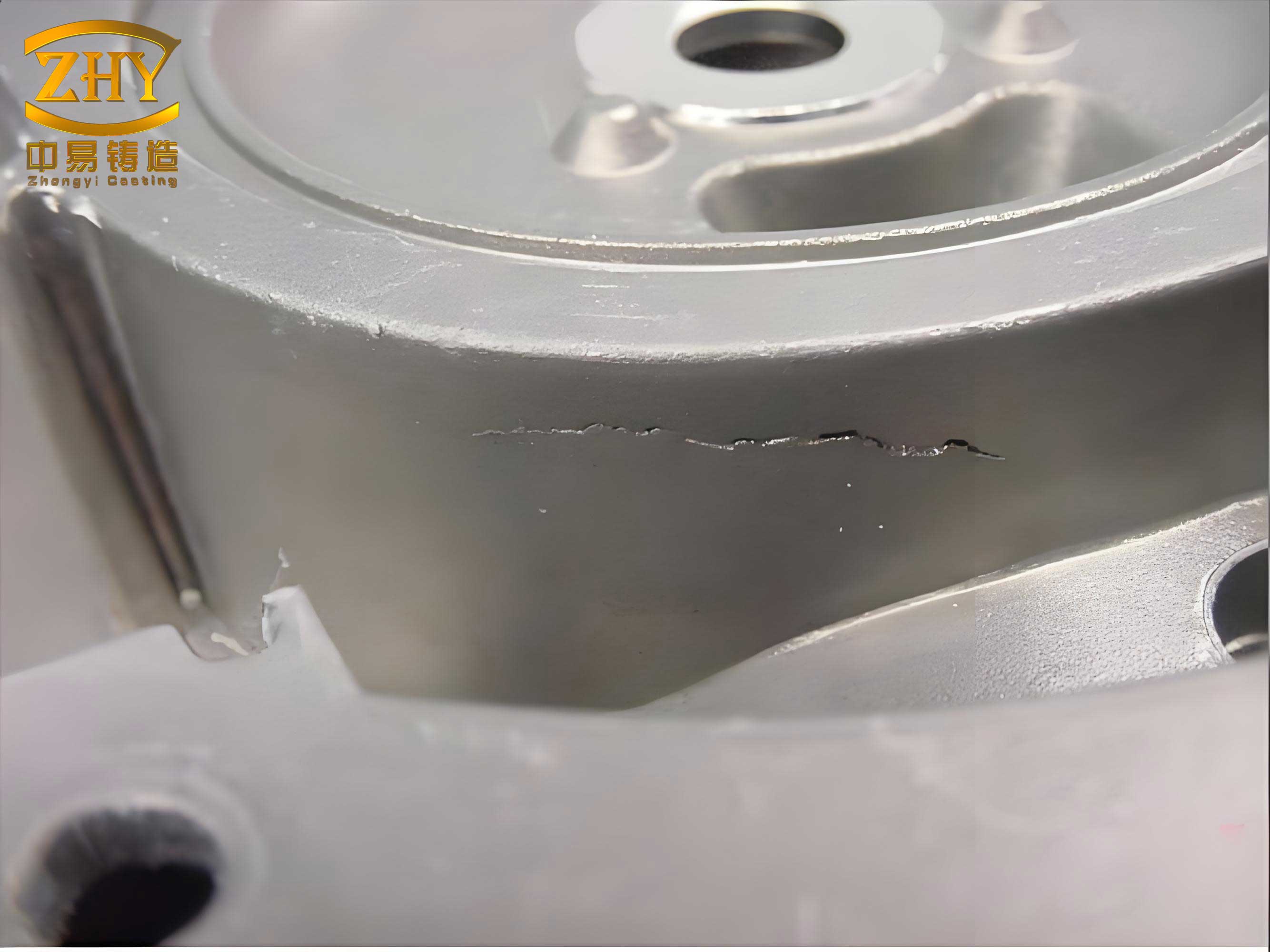
The proportional solidification principle offers a robust alternative to traditional methods by leveraging the graphitization expansion of ductile iron for self-feeding, thereby minimizing reliance on external risers. This technique emphasizes top pouring, dispersed multi-gate systems, and the use of gating systems for feeding, which aligns with the natural solidification behavior of ductile iron to reduce casting defects. For the oil cylinder, with a total length of 740 mm and weight of 325 kg, I reconfigured the casting orientation by placing the thin-walled sleeve section at the top and the thick cylindrical section at the bottom, enhanced with chill inserts. This setup facilitates controlled cooling and utilizes a feeding rain gating system for both filling and compensation, effectively addressing the casting defects observed in the original process.
To design the rain gating system, I employed the shrinkage modulus method, which calculates the moduli of various gating components based on the casting’s thermal characteristics. The key steps involve determining the actual modulus of the thermal section after chilling, the shrinkage time fraction, and the contraction modulus, all crucial for preventing casting defects. The geometric modulus of the thick cylindrical section (ø310 mm × 220 mm) is given by:
$$M_{\text{热几何}} = \frac{V}{A_0} = \frac{16596 \text{ cm}^3}{3122 \text{ cm}^2} = 5.32 \text{ cm}$$
where \(V\) is the volume and \(A_0\) is the surface area. With chill inserts (ø270 mm × 70 mm), the equivalent cooling surface area \(A_s\) increases:
$$A_s = A_0 + 2A_{\text{ch}} = 3122 + 2 \times 754 = 4630 \text{ cm}^2$$
where \(A_{\text{ch}}\) is the chill surface area. Thus, the actual modulus of the casting section becomes:
$$M_{\text{件}} = \frac{V}{A_s} = \frac{16596}{4630} = 3.58 \text{ cm}$$
The thin-walled sleeve section has a modulus \(M_{\text{薄}} = 3.5 \text{ cm}\). The mass boundary quotient \(Q_m\) is calculated as:
$$Q_m = \frac{G}{M_{\text{件}}^3} = \frac{325}{3.58^3} = 7 \text{ kg/cm}^3$$
where \(G\) is the casting weight. The shrinkage time fraction \(P_c\) is derived from:
$$P_c = \frac{1.0}{e^{(0.65M_{\text{件}} + 0.01Q_m)}} = 0.09$$
leading to the shrinkage modulus coefficient \(f_2 = \sqrt{P_c} = 0.3\). The shrinkage modulus \(M_s\) is:
$$M_s = f_2 M_{\text{件}} = 1.07 \text{ cm}$$
Using these parameters, I designed the gating system components as feeding risers to combat casting defects. The sprue modulus \(M_{\text{直}}\) is:
$$M_{\text{直}} = f_1 f_2 f_3 f_{\text{直流}} M_{\text{件}}$$
with \(f_1 = 1.0\) (riser balance coefficient), \(f_3 = 1.0\) (pressure coefficient), and \(f_{\text{直流}} = 0.75\) (sprue flow coefficient). Thus, \(M_{\text{直}} = 0.8 \text{ cm}\), corresponding to a sprue diameter of 40 mm (adjusted to 45 mm for practicality). The cross-section area \(A_{\text{直}} = 16 \text{ cm}^2\). Similarly, the runner modulus \(M_{\text{横}}\) is:
$$M_{\text{横}} = f_1 f_2 f_3 f_{\text{横流}} M_{\text{件}}$$
where \(f_{\text{横流}} = 0.8\), yielding \(M_{\text{横}} = 0.85 \text{ cm}\). I selected a runner size of 40/50 mm × 50 mm, with area \(A_{\text{横}} = 22.5 \text{ cm}^2\) and total \(\sum A_{\text{横}} = 45 \text{ cm}^2\). The ingates (rain holes) are designed as riser necks:
$$M_{\text{内}} = f_p f_2 f_4 M_{\text{件}}$$
with \(f_p = 0.45\) (flow effect coefficient) and \(f_4 = 0.7\) (length coefficient), giving \(M_{\text{内}} = 0.33 \text{ cm}\). The diameter \(D_{\text{内}} = 4M_{\text{内}} = 13 \text{ mm}\), so I used 20 rain holes of ø12/ø18 × 50 mm, with total area \(\sum A_{\text{内}} = 23 \text{ cm}^2\). The gating ratio is:
$$A_{\text{直}} : \sum A_{\text{横}} : \sum A_{\text{内}} = 16 : 45 : 23 = 1 : 2.8 : 1.4$$
To ensure proper filling and minimize turbulence-related casting defects, I verified the molten metal rise velocity in the mold cavity. The effective pressure head \(h_p\) for the rain holes is computed using flow coefficients: \(\mu_1 = \mu_2 = 0.55\) for sprue and runner, and \(\mu_3 = 0.5\) for ingates. The effective cross-section ratios are:
$$k_1 = \frac{\mu_1 A_{\text{直}}}{\mu_2 \sum A_{\text{横}}} = 0.36, \quad k_2 = \frac{\mu_1 A_{\text{直}}}{\mu_3 \sum A_{\text{内}}} = 0.77$$
Then,
$$h_p = \frac{k_2^2}{1 + k_1^2 + k_2^2} H = 12.33 \text{ cm}$$
where \(H = 36 \text{ cm}\) is the total height of the cope and pouring basin. The pouring time \(\tau\) is:
$$\tau = \frac{G}{0.31 \mu_3 \sum A_{\text{内}} \sqrt{h_p}} = 26 \text{ s}$$
and the average rise velocity \(V_L\) is:
$$V_L = \frac{\text{Casting height}}{\tau} = 28 \text{ mm/s}$$
This falls within the recommended range of 15–30 mm/s for rain gating systems, ensuring smooth filling and reducing the risk of casting defects like gas entrapment or cold shuts.
In addition to process design, metallurgical measures are essential to prevent graphite distortion and associated casting defects. Key strategies include optimizing residual magnesium content and enhancing inoculation. For ductile iron, maintaining a residual magnesium level (\(Mg_{\text{残}}\)) of 0.05% and residual rare earths (\(RE_{\text{残}}\)) of 0.025% is critical to avoid球化衰退. Inoculation with 75SiFe, totaling 1.30% of the melt weight, improves graphite nucleation and delays衰退. The composition control is summarized in the table below, highlighting how proper alloying minimizes casting defects.
| Element | Base Iron (wt%) | After Treatment (wt%) |
|---|---|---|
| C | 3.35 | 3.38 |
| Si | 1.25 | 2.18 |
| Mn | 0.56 | 0.54 |
| P | 0.046 | 0.047 |
| S | 0.085 | 0.030 |
| Mg残 | – | 0.05 |
| RE残 | – | 0.025 |
The effectiveness of the proportional solidification approach is evident in the comparative results between the original and new processes. The table below outlines key parameters, demonstrating a significant reduction in casting defects and improvement in mechanical properties.
| Parameter | Original Process (Directional Solidification) | New Process (Proportional Solidification) |
|---|---|---|
| Modulus at Thermal Section (cm) | 7.01 | 3.58 |
| Solidification Time (min) | 290–300 | 70–80 |
| Process Yield (%) | 59.0 | 85.4 |
| Tensile Strength σb (MPa) | 383 | 512 |
| Elongation δ (%) | 1.55 | 15.60 |
| Graphite Morphology | Dendritic, fragmented | Spheroidal,团状 |
| Macroscopic Fracture | Black spots (casting defects) | Silvery, defect-free |
The new process eliminated black spots and other casting defects, achieving QT500-7 specifications. The microstructure showed spherical graphite with a matrix of 15% pearlite and balance ferrite, ensuring superior pressure tightness. After machining, the oil cylinders passed a 32 MPa pressure test for 30 minutes without leakage, confirming the absence of internal casting defects like shrinkage porosity. Moreover, the process yield increased from 59% to 85.4%, saving 190 kg of molten iron per casting by eliminating the large riser, which directly reduces energy consumption and material waste associated with casting defects.
From a broader perspective, the shrinkage modulus method provides a systematic framework for designing gating systems that act as feeding risers, which is particularly advantageous for ductile iron where graphitization expansion contributes to self-feeding. The modulus calculations ensure that each gating component compensates for contraction during solidification, thereby preventing casting defects. The general formula for modulus \(M\) is:
$$M = \frac{V}{A}$$
where \(V\) is volume and \(A\) is cooling surface area. For complex geometries, this can be extended using shape factors or numerical simulations. In practice, the modulus method helps optimize chill placement, gating dimensions, and pouring parameters to mitigate casting defects. For instance, the contraction modulus \(M_s\) can be related to the casting modulus \(M_{\text{件}}\) through empirical coefficients that account for alloy properties and process conditions, as shown in the earlier derivation.
Furthermore, the role of inoculation in reducing casting defects cannot be overstated. Inoculants like 75SiFe promote graphite nucleation, reducing undercooling and improving graphite morphology. The inoculant addition strategy—covering球化剂, adding to the trough, and using瞬时浮硅—ensures uniform distribution and effectiveness. This metallurgical control, combined with the proportional solidification design, creates a synergistic effect that minimizes casting defects across various ductile iron applications.
In conclusion, the application of the proportional solidification modulus method to design feeding gating systems offers a reliable solution for eliminating casting defects in ductile iron oil cylinders. By integrating thermal modulus calculations, optimized gating ratios, and metallurgical enhancements, this approach addresses the root causes of defects such as black spots, shrinkage, and graphite degradation. The success in producing defect-free castings with high mechanical properties and pressure tightness validates the technical robustness of this methodology. As foundries continue to seek efficiency and quality improvements, adopting such principles can significantly reduce scrap rates and enhance competitiveness, making it a cornerstone for modern casting practices aimed at eradicating casting defects.