
My research focuses on addressing a critical wear part challenge in the power generation industry: the grinding segments (or grinding table liners) for medium-speed MPS-type coal pulverizers. Numerous units of this imported mill design are in operation. The original equipment utilized nickel-hard white cast iron, a material dependent on scarce nickel resources. My work centered on developing a domestically sourced, high-chromium wear-resistant white cast iron that not only eliminates the need for nickel but also significantly enhances mechanical properties and service life, thereby successfully resolving the localization of this crucial spare part. This article details the wear failure analysis, material design, microstructural characteristics, and key manufacturing processes for this advanced white cast iron.
Operating Principle and Failure Analysis of Grinding Segments
The grinding segments are assembled into a circle on the rotating grinding table. The grinding rollers, under pressure, roll over the bed of coal on these segments, utilizing a combination of compression and shear to pulverize the coal. The coal is then dried and transported by hot air for combustion. This creates a complex three-body wear condition involving high-stress cyclic rolling contact (Hertzian stress), micro-cutting and gouging from hard coal constituents, and moderate impact loading.
Analysis of segments after several thousand hours of service reveals a transition in wear mechanism from the inner to the outer radial zones. The inner zone primarily exhibits deformation-induced fatigue, while the outer zone, with higher relative sliding velocities, shows predominant micro-cutting. Scanning Electron Microscopy (SEM) examination of worn surfaces confirms this, showing features from plastic deformation, crack formation, spalling pits, and abrasive grooves.
Sub-surface observation further reveals fatigue cracks propagating parallel to the surface, fracture of hard carbides, and selective wear causing carbides to protrude. This failure analysis clearly indicates that to improve wear resistance, the material must possess high hardness—particularly from its hard phase—to resist abrasion, coupled with sufficient toughness to withstand deformation fatigue and impact. This understanding directly informed the selection and design of the new white cast iron.
Material Design: From Nickel-Hard to High-Chromium White Cast Iron
Nickel-hard white cast iron, representing a second-generation wear material, offers the advantage of an as-cast martensitic-austenitic matrix with carbide. However, its reliance on nickel and the relatively lower hardness of its network-like M3C-type carbides are limitations. The solution was found in high-chromium white cast irons, often termed third-generation wear materials. By increasing the chromium content and, more critically, the chromium-to-carbon ratio (Cr/C), the carbide type changes from M3C to harder, more discontinuous M7C3.
The key compositional parameters for the new white cast iron were carefully determined. The carbon content is chosen to balance hardness and toughness, typically in the range of 2.8-3.3%. The chromium content is set to achieve a Cr/C ratio between 7 and 10, ensuring the formation of M7C3 carbides. The hardness of these carbides can exceed 1700 HV, significantly higher than the ~1200 HV of M3C. The volume fraction of carbides (CVF) is a critical parameter calculated as:
$$ CVF = 12.33(C) + 0.55(Cr) – 15.2 $$
For optimal performance in pulverizer applications, a CVF of approximately 30% is targeted. However, while chromium in white cast iron primarily forms carbides, the remaining chromium in the matrix is low. To ensure sufficient hardenability for heavy-section castings like grinding segments, additional alloying elements are necessary. Molybdenum and a small amount of copper or nickel are added to enhance淬透性 and toughness without resorting to high nickel levels. A comparative composition table illustrates the shift:
| Material | C | Cr | Ni | Mo | Mn | Si |
|---|---|---|---|---|---|---|
| Ni-Hard IV (Typical) | 3.0-3.6 | 8.0-10.0 | 4.5-6.5 | ≤1.0 | ≤2.0 | ≤2.0 |
| Developed High-Cr White Iron | 2.8-3.3 | 18.0-22.0 | 0-1.5* | 1.5-2.5 | 0.5-1.5 | ≤1.0 |
* Nickel content can be minimized or sourced from recycled scrap.
Microstructure, Critical Points, and Heat Treatment
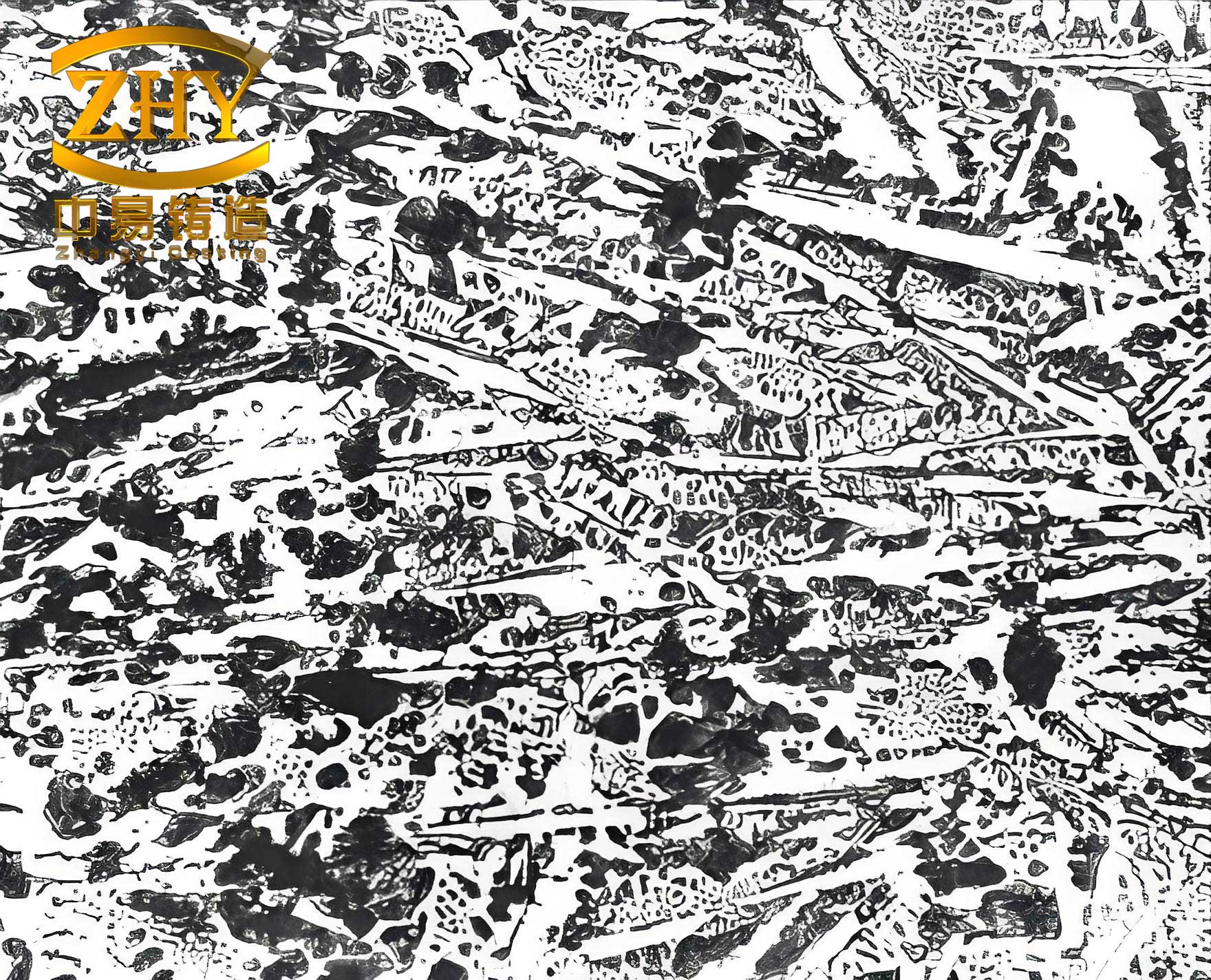
The as-cast microstructure of this high-chromium white cast iron consists of primary austenite dendrites and eutectic colonies of austenite and M7C3 carbides. The carbides exhibit a rod-like or isolated hexagonal morphology, which is less continuous and detrimental to toughness than the network carbides in nickel-hard white iron. The matrix is typically highly alloyed, supersaturated austenite.
To achieve the desired mechanical properties, heat treatment is essential. The goal is to transform the austenitic matrix into martensite while precipitating secondary carbides and minimizing retained austenite. Determination of critical transformation temperatures (Ac1 and Ac3) is vital. For the designed composition, Ac1 is approximately 800°C, and Ac3 is around 950°C.
The heat treatment process involves austenitizing in the range of 950-1050°C. At this temperature, secondary carbides precipitate from the supersaturated austenite, reducing its carbon and alloy content and raising the Martensite Start (Ms) temperature. A carefully controlled holding time ensures adequate diffusion without excessive carbide dissolution or grain growth. Subsequent air quenching or forced air cooling transforms the conditioned austenite into a fine martensitic matrix containing dispersed secondary carbides. A final tempering at 200-300°C relieves stresses and enhances toughness. A schematic of the process is shown below:
$$ \text{Austenitize (950-1050°C, hold)} \rightarrow \text{Quench (Air)} \rightarrow \text{Temper (200-300°C)} $$
The final optimized microstructure consists of hard M7C3 primary carbides (≈30 vol%), a martensitic matrix with fine secondary carbides, and a low percentage of retained austenite. This structure provides an excellent balance, yielding a macro-hardness of 62-68 HRC alongside significantly improved fracture toughness compared to nickel-hard white iron.
Key Production Process Parameters
Manufacturing these high-integrity white cast iron segments requires careful control of melting and casting processes. Electric arc or induction furnaces are suitable. An oxidizing slag practice in an arc furnace can effectively control phosphorus and sulfur levels.
The casting characteristics of high-chromium white iron differ from lower-alloy irons. Key parameters for foundry practice include:
| Parameter | Value / Characteristic |
|---|---|
| Liquidus Temperature | ≈1250-1300°C |
| Solidus Temperature | ≈1200-1250°C |
| Pouring Temperature | 1350-1450°C |
| Shrinkage (Volumetric) | ≈3-4% |
| Pattern Draft | ≥3° |
Riser and gating design must accommodate the substantial shrinkage. Sand molds with good refractoriness are typically used. After shakeout and cleaning, the castings undergo the precise heat treatment cycle described earlier to develop their optimal wear-resistant properties.
Performance, Economics, and Conclusion
The developed high-chromium white cast iron demonstrates superior performance in service. Field trials and widespread adoption have confirmed that the service life of grinding segments made from this material meets or exceeds that of the original nickel-hard parts. The enhanced wear resistance stems directly from the harder M7C3 carbides and the supportive tough martensitic matrix.
The economic benefit is substantial. By eliminating nickel as a primary alloying element and using domestically abundant chromium, the material cost is significantly reduced. The cost saving can be quantified as a reduction of several thousand units per ton of cast material compared to nickel-hard white iron. This has led to the successful production of hundreds of sets of grinding segments, representing substantial national savings and securing the supply chain for critical power plant spares.
In conclusion, the systematic study—from failure analysis to compositional design, microstructure control, and process optimization—has successfully developed a high-chromium anti-wear white cast iron perfectly suited for the demanding application of MPS mill grinding segments. This chromium-series white cast iron provides an excellent combination of high hardness, improved toughness, and outstanding wear resistance, effectively solving the localization problem while offering superior technical and economic benefits over traditional nickel-hard white iron. The success of this material underscores the importance of designing wear-resistant white cast irons based on specific service conditions and available resources.