
In my extensive research and experience with wear-resistant materials, I have found that the performance of white cast iron, particularly high-chromium variants, is profoundly influenced by its chemical composition, specifically the carbon equivalent. White cast iron has long been valued for its exceptional hardness and abrasion resistance, but its inherent brittleness often limits applications. However, the introduction of chromium transforms this material, and understanding the role of carbon equivalent is crucial for optimizing its service life in demanding environments. This article delves into how carbon equivalent affects the microstructure and, consequently, the abrasion resistance of high-chromium white cast iron, drawing from experimental data and metallurgical principles. I will explore both high-stress and low-stress abrasion conditions, using formulas and tables to summarize key findings, and emphasize the repeated importance of proper composition in white cast iron design.
The fundamental distinction between ordinary white cast iron and high-chromium white cast iron lies in their eutectic microstructures. Ordinary white cast iron, based on the Fe-Fe3C system, has a eutectic composition where cementite (M3C) constitutes approximately 48% of the eutectic structure. According to the lever rule in the Fe-Fe3C phase diagram, this high volume fraction makes the carbide phase continuous, essentially forming a brittle matrix that embeds the transformed austenite. This structure renders ordinary eutectic white cast iron highly brittle. In contrast, high-chromium white cast iron exhibits a different eutectic carbide, M7C3, which typically occupies only about 25-26% of the eutectic structure. This results in a microstructure where the austenitic matrix is continuous, and the carbides are dispersed as isolated rods or plates, significantly enhancing toughness. The carbon equivalent (CE) is a critical parameter that determines whether the white cast iron is hypoeutectic, eutectic, or hypereutectic. The formula for carbon equivalent in high-chromium white cast iron is given by:
$$ CE = \%C + 0.05(\%Cr) + 0.33(\%Si) $$
For high-chromium white cast iron, the eutectic point corresponds to a CE of approximately 4.3%. When CE = 4.3%, the alloy is eutectic; when CE < 4.3%, it is hypoeutectic with primary austenite; and when CE > 4.3%, it is hypereutectic with primary M7C3 carbides. This classification directly impacts the volume fraction, size, and distribution of carbides, which are the primary determinants of abrasion resistance in white cast iron.
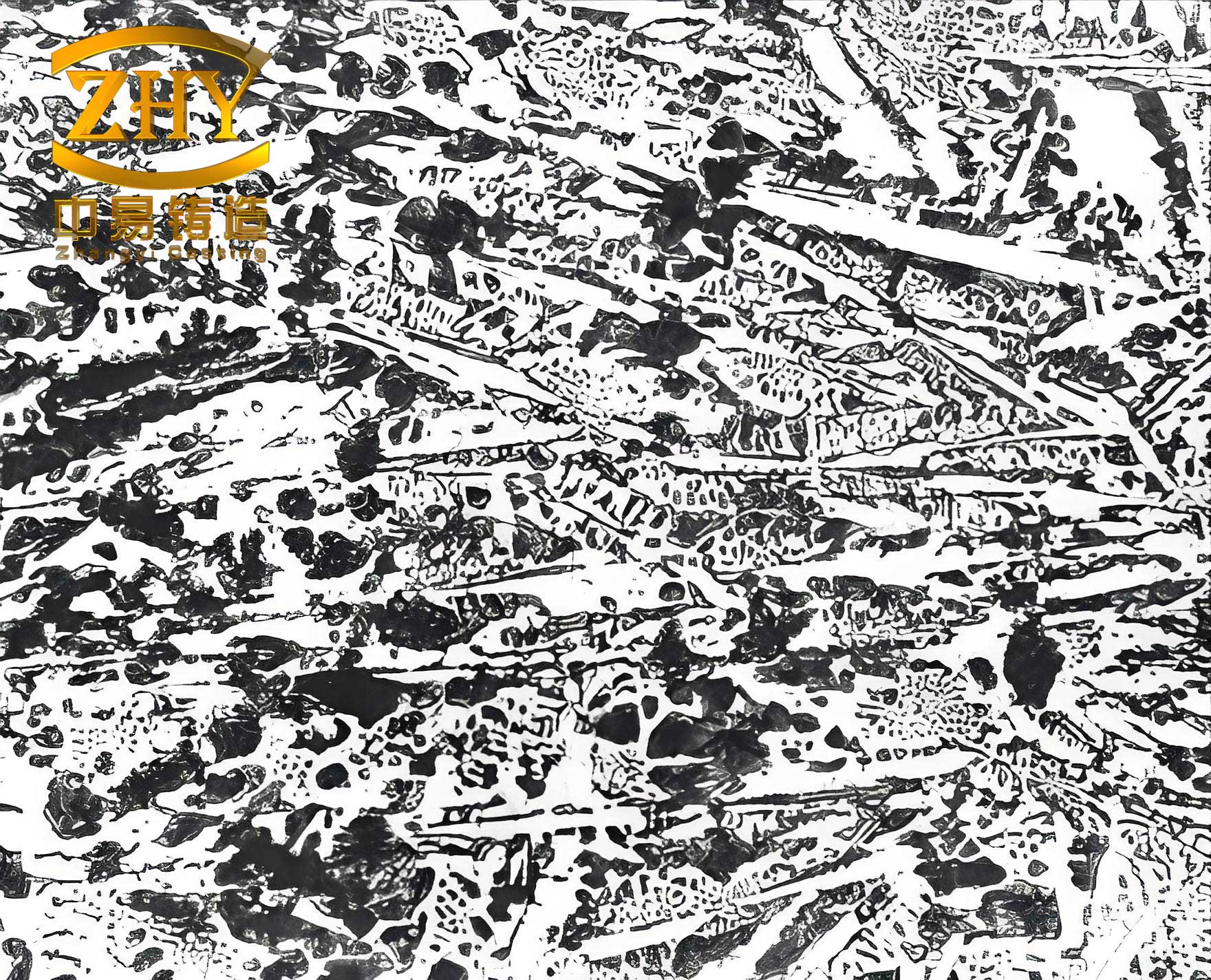
To quantify the microstructural differences, let’s consider the volume fraction of carbides. In ordinary white cast iron, the eutectic carbide volume can be calculated using the lever rule from the phase diagram. For a eutectic composition with 4.3% C, the fraction of Fe3C is:
$$ \text{Fraction of Fe}_3\text{C} = \frac{4.3 – 2.11}{6.69 – 2.11} \approx 0.48 \text{ or } 48\% $$
In high-chromium white cast iron, with say 15% Cr, the eutectic carbide is M7C3, and its volume fraction is typically around 25-26%, as derived from empirical studies. This reduction in carbide volume and change in morphology is why high-chromium white cast iron offers better toughness compared to ordinary white cast iron, making it suitable for more severe applications. The design of white cast iron for abrasion resistance thus hinges on balancing carbide content and matrix properties through carbon equivalent control.
In high-stress abrasion environments, such as in grinding mills for coal or cement, components like rolls, balls, and liners experience significant normal and tangential forces from abrasive particles. Here, the presence of large, blocky primary carbides in hypereutectic white cast iron (CE > 4.3%) provides superior resistance to fracture and cutting. The carbides act as hard barriers that protect the softer matrix. Conversely, hypoeutectic white cast iron (CE < 4.3%) contains primary austenite, which is softer and more easily gouged by abrasives, leading to higher wear rates. To illustrate, I have compiled data from pin-on-drum wear tests that simulate high-stress conditions. The test involves a pin specimen pressed against a rotating drum covered with abrasive cloth, and wear rate is measured as volume loss per meter of sliding. The results for various high-chromium white cast iron alloys are summarized in Table 1 below.
| Alloy ID | C (%) | Cr (%) | Si (%) | Mn (%) | Mo (%) | CE (%) | Microstructure State | Carbide Vol. (%) | Hardness (HB) | Wear Rate (mm³/m) |
|---|---|---|---|---|---|---|---|---|---|---|
| 1 | 3.10 | 24.5 | 0.29 | 0.50 | 1.00 | 4.52 | As-cast | 32 | 600 | 0.149 |
| 2 | 2.76 | 26.2 | 0.38 | 0.42 | 0.93 | 4.16 | As-cast | 29 | 509 | 0.114 |
| 3 | 3.07 | 26.2 | 0.28 | 0.43 | 1.02 | 4.50 | As-cast | 33 | 556 | 0.091 |
| 4 | 3.66 | 26.0 | 0.22 | 0.79 | 0.92 | 5.20 | As-cast | 40 | 592 | 0.084 |
| 5 | 3.10 | 15.3 | 0.40 | 0.40 | 0.90 | 4.07 | As-cast | 22 | 420 | 0.268 |
| 6 | 2.20 | 18.4 | 0.40 | 0.30 | 0.00 | 3.32 | As-cast | 14 | 410 | 0.266 |
From Table 1, it is evident that Alloy 4, with a CE of 5.20% (hyperetectic), exhibits the lowest wear rate of 0.084 mm³/m, followed by Alloy 3 with a CE of 4.50% (near-eutectic). Alloys 5 and 6, with lower CE values (hypoeutectic), show significantly higher wear rates due to lower carbide volume fractions. This confirms that in high-stress abrasion, hypereutectic white cast iron with large primary carbides offers the best performance. The carbide volume fraction can be estimated from composition, but in practice, it is measured metallographically. The relationship between wear resistance and carbide volume in white cast iron often follows a trend where increased carbide content reduces wear, but only up to a point where brittleness may become detrimental.
In low-stress abrasion conditions, such as in slurry pumps, sand handling equipment, or brick molds, the abrasive particles cause scratching and ploughing without high impact forces. Here, the uniformity and fineness of carbide distribution are more critical than carbide size. Eutectic or slightly hypereutectic white cast iron (CE around 4.3-4.5%) provides an optimal microstructure where the eutectic carbides are finely dispersed, minimizing the inter-carbide spacing and effectively protecting the matrix. Additionally, the matrix hardness plays a key role; a martensitic matrix generally offers better abrasion resistance than an austenitic one. Data from dry and wet rubber wheel abrasion tests, which simulate low-stress conditions, support this. In dry tests, the wear volume loss after 2000 wheel revolutions is measured, as shown in Table 2.
| Alloy ID | C (%) | Cr (%) | Si (%) | Mn (%) | CE (%) | Microstructure State | Carbide Vol. (%) | Hardness (HB) | Volume Loss (mm³) |
|---|---|---|---|---|---|---|---|---|---|
| A | 2.76 | 26.2 | 0.42 | 0.93 | 4.16 | As-cast | 29 | 509 | 13.1 |
| B | 3.07 | 26.2 | 0.43 | 1.02 | 4.50 | As-cast | 33 | 556 | 10.1 |
| C | 3.66 | 26.0 | 0.79 | 0.92 | 5.20 | As-cast | 40 | 592 | 10.5 |
| D (Steel Ref.) | 0.30 | 0.00 | 0.25 | 1.00 | 0.33 | Quenched | 0 | 270 (HV) | 128.5 |
Alloy B in Table 2, with a CE of 4.50% (eutectic), shows the lowest volume loss of 10.1 mm³, indicating superior abrasion resistance in low-stress conditions. The near-eutectic composition ensures a fine, uniform dispersion of carbides that shield the matrix effectively. This is further corroborated by wet rubber wheel tests, where the wear volume after 5000 revolutions is plotted against carbide volume fraction. Data from multiple heats of white cast iron reveal that the minimum wear occurs for alloys with CE close to 4.3%, such as heats with CE values of 4.06% and 4.03%. The relationship can be expressed empirically: for low-stress abrasion, wear resistance in white cast iron is maximized when the carbon equivalent approaches the eutectic point, provided the matrix is hardened to martensite through heat treatment.
The effect of heat treatment on the matrix of white cast iron cannot be overstated. As-cast high-chromium white cast iron often contains retained austenite, which can transform to martensite upon cooling or through specific heat treatments. Martensite, being harder than austenite, enhances the overall abrasion resistance. The transformation can be controlled by austenitizing followed by air quenching or subcritical treatments. For instance, in high-stress tests, alloys subjected to heat treatments that produce martensitic matrices (e.g., austenitizing at 1000°C and air cooling) show improved wear resistance compared to as-cast conditions with high retained austenite. The volume fraction of martensite (M) and retained austenite (RA) can be estimated using empirical relations based on composition and cooling rate, but often, it is measured using X-ray diffraction. The hardness of white cast iron is a composite of carbide and matrix hardness, approximated by:
$$ H_{\text{composite}} = f_c \cdot H_c + (1 – f_c) \cdot H_m $$
where \( f_c \) is the carbide volume fraction, \( H_c \) is the carbide hardness (around 1500-1800 HV for M7C3), and \( H_m \) is the matrix hardness (200-800 HV depending on structure). This equation highlights why both high carbide content and hard matrix are essential for abrasion-resistant white cast iron.
To delve deeper, let’s consider the role of other alloying elements in white cast iron. Chromium not only forms M7C3 carbides but also increases hardenability and corrosion resistance. Molybdenum and nickel are often added to enhance hardenability and stabilize austenite, respectively, influencing the matrix transformation. Silicon, while included in the CE formula, also affects graphitization and should be controlled to prevent pearlite formation in white cast iron. The optimal composition for a given application depends on the specific wear mechanism. For high-stress abrasion, I recommend a hypereutectic white cast iron with CE around 4.8-5.2% and high chromium (20-30%), ensuring large primary carbides. For low-stress abrasion, a eutectic white cast iron with CE of 4.3-4.5% and moderate chromium (15-20%) is ideal, followed by heat treatment to achieve a martensitic matrix. The selection of white cast iron grade should always balance wear resistance and toughness to prevent catastrophic failure.
In industrial practice, white cast iron components are often cast into complex shapes, and the cooling rate affects carbide size and distribution. Rapid cooling can refine the eutectic structure, improving toughness without sacrificing wear resistance. However, for hypereutectic white cast iron, controlled cooling is necessary to avoid excessive carbide segregation. The foundry process for white cast iron involves careful melting and inoculation to achieve desired microstructure. Post-cast heat treatments, such as stress relieving or austempering, can further optimize properties. The versatility of white cast iron makes it a material of choice for mining, cement, and power generation industries.
To summarize the interplay between carbon equivalent, microstructure, and abrasion resistance in white cast iron, I have developed a conceptual model. Let \( R_w \) represent wear resistance, which can be inversely proportional to wear rate. It depends on carbide volume fraction \( V_c \), carbide size \( S_c \), matrix hardness \( H_m \), and carbide-matrix interface strength \( \sigma_i \). For high-stress abrasion:
$$ R_w^{\text{high-stress}} \propto V_c \cdot S_c \cdot H_m \cdot \sigma_i $$
where larger \( S_c \) (from hypereutectic compositions) is beneficial. For low-stress abrasion:
$$ R_w^{\text{low-stress}} \propto \frac{V_c}{S_c} \cdot H_m \cdot \sigma_i $$
where finer carbides (from eutectic compositions) are advantageous. The carbon equivalent CE directly influences \( V_c \) and \( S_c \) through the phase diagram. Empirical data from various studies on white cast iron support these relationships, as seen in the tables above.
In conclusion, the carbon equivalent is a pivotal parameter in designing high-chromium white cast iron for abrasion-resistant applications. My analysis shows that for high-stress abrasion, hypereutectic white cast iron with high carbon equivalent (above 4.3%) and large primary carbides offers the best performance by resisting fracture under heavy loads. For low-stress abrasion, eutectic or slightly hypereutectic white cast iron with carbon equivalent near 4.3% provides optimal carbide distribution and matrix protection, especially when heat-treated to a martensitic structure. The repeated emphasis on white cast iron in this discussion underscores its importance in industrial wear solutions. Future work could explore nano-structured carbides or composite approaches to further enhance white cast iron properties. Ultimately, a deep understanding of carbon equivalent allows engineers to tailor white cast iron for specific wear conditions, extending component life and reducing maintenance costs in harsh environments.