
The pursuit of durable and cost-effective materials for wear-resistant components, such as liner plates for grinding mills, is a perpetual challenge in industrial mineral processing. While austenitic manganese steel offers high toughness, its work-hardening capability is often insufficient under certain impact-abrasive conditions, leading to rapid wear. On the other hand, high-chromium and nickel-hard white cast irons, renowned for their exceptional abrasion resistance due to a high volume fraction of hard eutectic carbides, are often plagued by inherent brittleness. This brittleness can lead to catastrophic fracture when these materials are subjected to significant impact loads, posing safety risks and operational downtime. Composite casting techniques offer a solution but introduce manufacturing complexity. Therefore, developing a white cast iron variant that balances excellent wear resistance with improved fracture resistance through a simpler, more economical process is highly desirable.
Tungsten-alloyed white cast iron has emerged as a promising candidate within this context. Leveraging domestic resource availability, this material demonstrates high hardness and promising wear performance. In this alloy system, tungsten partitions between the matrix and the carbide phase, influencing the carbide’s morphology and distribution. High-tungsten variants can exhibit favorable carbide structures, but the associated cost is prohibitive for widespread adoption. Conversely, low-tungsten white cast iron is more economical, but typically suffers from a continuous, coarse network of eutectic carbides, resulting in unacceptable brittleness and limiting its application. The key to unlocking the potential of low-tungsten white cast iron for demanding applications like liner plates lies in fundamentally altering the morphology of its eutectic carbides from a continuous network to a more isolated, refined configuration.
The goal of spheroidizing or fragmenting the carbide network in white cast iron has long been a metallurgical objective. Pioneering work on low-chromium white cast irons and rare-earth-treated cast irons indicated that alkali metals like potassium (K) and sodium (Na) could promote the nodularization of carbides and graphite, respectively. This insight forms the foundation of our investigation. We have conducted a comprehensive study on the influence of K and Na inoculation on the microstructure and mechanical properties of low-tungsten white cast iron. Our research encompasses the development of a practical inoculant containing these active elements, a detailed analysis of their effects on solidification and phase transformation, and an evaluation of the resulting performance enhancements. The findings demonstrate that alkali metal inoculation can effectively modify the carbide morphology, leading to a material with significantly improved impact toughness and wear resistance, making it a viable and superior alternative for mill liner applications.
1. Development and Implementation of the Alkali Metal Inoculant
Direct addition of pure potassium or sodium to molten metal is impractical due to their low melting points, high reactivity, and rapid oxidation. Therefore, a carrier alloy must be engineered. The principle relies on metallothermic reduction, where a more reactive metal can be displaced from its salt at elevated temperatures due to differences in volatility, shifting the equilibrium as described in the reaction: $$2K_2CO_3 + 3Si + 6CaO \rightarrow 4K + 2C + 3(2CaO\cdot SiO_2)$$ This reaction, occurring between 900–1050°C, shows that silicon can act as a reducer for potassium carbonate. Similarly, carbon or calcium carbide can be used. We successfully developed a proprietary inoculant alloy using a rare-earth-silicon-iron base as a carrier. This alloy incorporates between 6% to 15% of active K and Na elements. The use of rare earths may enhance the reduction efficiency and the stability of the inoculant. This composite inoculant exhibits good handling properties and reacts smoothly when introduced into the molten white cast iron, ensuring reproducible modification effects.
2. Experimental Methodology: From Melting to Testing
The entire experimental process was designed to simulate industrial conditions and provide robust, quantifiable data.
2.1 Base Alloy Composition and Melting Practice
The base chemical composition of the tungsten-alloyed white cast iron was selected to represent a cost-effective, low-alloy grade. The target ranges are summarized in Table 1.
| Element | C | W | Mn | Si | P | S |
|---|---|---|---|---|---|---|
| Content | 2.8 – 3.2 | 2.5 – 3.5 | 0.5 – 1.0 | 0.6 – 0.9 | < 0.05 | < 0.05 |
Melting was conducted in a 20 kg medium-frequency induction furnace. The molten metal was superheated to 1450°C, measured using a Pt-Rh thermocouple coupled with an XT-204 automatic recorder, before tapping.
2.2 Inoculation Treatment and Casting
Inoculation was performed using the ladle addition method. The pre-heated inoculant was placed at the bottom of the treatment ladle, and the molten white cast iron was poured over it at approximately 1450°C. The sample designations and corresponding inoculant addition amounts are listed in Table 2. Sample W0 serves as the uninoculated reference.
| Sample ID | W0 | W1 | W2 | W3 | W4 | W5 | W6 | W7 |
|---|---|---|---|---|---|---|---|---|
| Active Element | None | K | K | K | K | Na | Na | Na |
| Inoculant Addition (wt.%) | 0 | 0.7 | 1.4 | 2.1 | 2.8 | 0.6 | 1.2 | 1.8 |
After a brief holding period for reaction and homogenization, the metal was cast at 1350°C into dry sand molds to produce standard un-notched impact test bars (22 mm x 22 mm x 115 mm).
2.3 Heat Treatment and Specimen Preparation
To evaluate both the as-cast and heat-treated conditions, specimens from each batch were divided into two groups. The heat treatment regimen was designed to develop a hardened martensitic matrix: austenitizing at 950°C for 1.5 hours followed by air cooling (normalizing), and then tempering at 300°C for 2 hours. This process aims to transform the austenitic matrix to martensite while allowing some relief of residual stresses and potentially further spheroidizing the carbides.
The hardened specimens were then machined to final dimensions for mechanical testing. The hardness was measured on a Rockwell scale. Impact toughness was determined using a standard impact tester on un-notched bars. For wear testing, segments were cut from the broken impact samples using wire EDM to create blocks of 10 mm x 10 mm x 30 mm. Wear resistance was evaluated under impact-abrasive conditions using an MLD-10 dynamic impact wear testing machine, with mass loss serving as the measure of wear performance.
2.4 Microstructural and Thermal Analysis
Metallographic samples were prepared from each condition, etched to reveal the carbide and matrix structure, and examined using optical and scanning electron microscopy. Thermal analysis was conducted during solidification to record the liquidus and eutectic reaction temperatures, providing critical data on the effect of inoculation on undercooling.
3. Results and Analysis: A Transformation in Structure and Property
3.1 Profound Modification of Carbide Morphology
The microstructural analysis revealed a dramatic transformation. The uninoculated white cast iron (W0) in the as-cast state exhibited the typical, undesirable structure: a coarse, continuous network of eutectic carbides enveloping the prior austenite dendrites. This structure is a primary source of brittleness.
Upon inoculation with optimal amounts of K or Na, the as-cast microstructure was radically altered. The continuous carbide network was effectively fragmented. The carbides appeared as isolated blocks or aggregates, with a significantly refined size and a more uniform distribution throughout the matrix. The degree of isolation and refinement generally increased with inoculant addition up to an optimum level (W3/W6), beyond which no further benefit was observed.
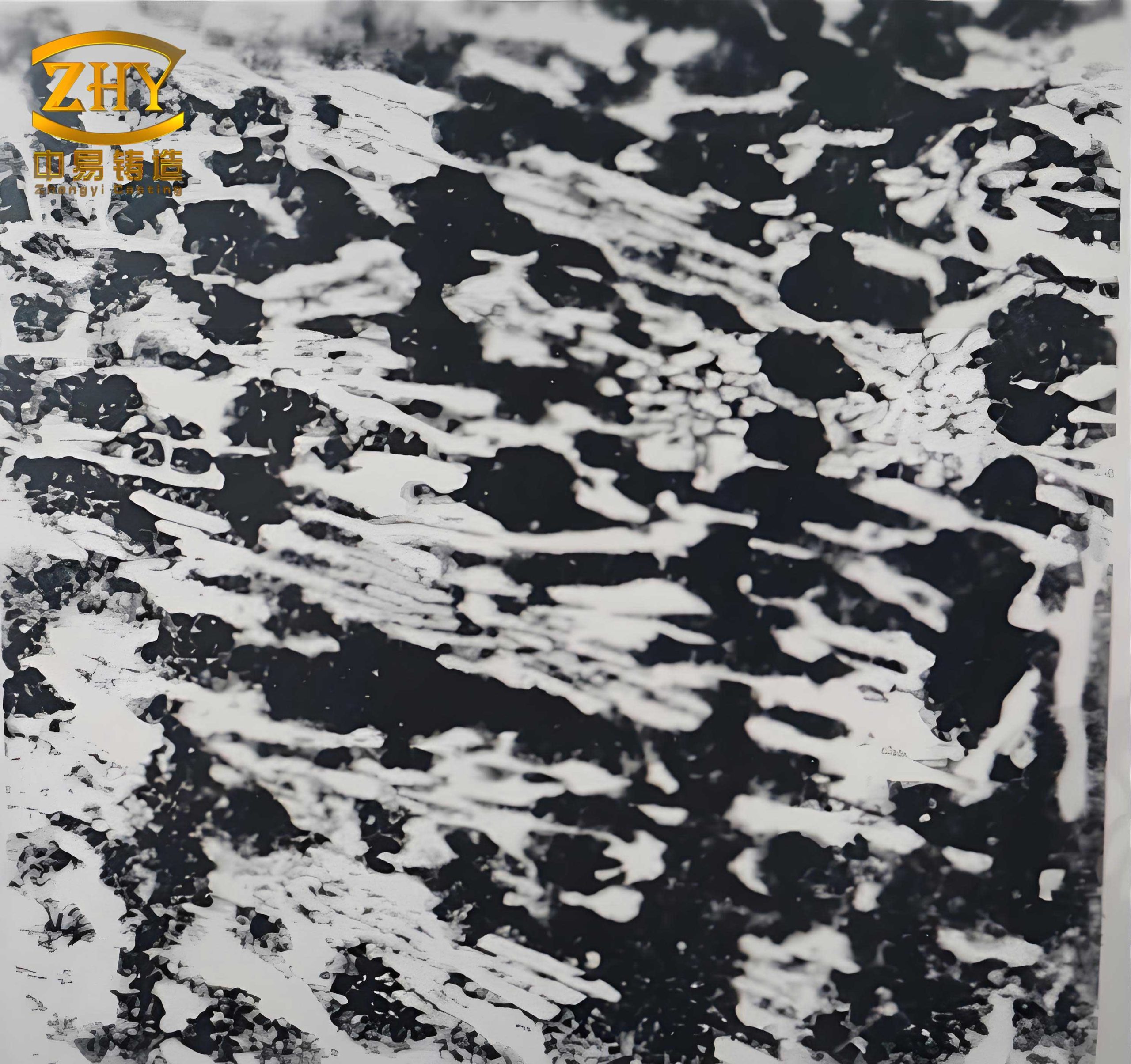
The heat-treated microstructure of all samples consisted of eutectic carbides, secondary carbides, martensite, and retained austenite. For the uninoculated white cast iron, heat treatment only slightly modified the carbide morphology; it remained primarily as a broken but still interconnected network. In striking contrast, the inoculated white cast iron samples after heat treatment showed a progression towards a spheroidal carbide morphology. The carbide edges were rounded, and the particles were more uniformly dispersed. This suggests that the initial refinement and isolation provided by inoculation create a favorable starting condition for spheroidization during high-temperature austenitizing, a process driven by the reduction of interfacial energy described by the Gibbs-Thomson effect. The driving force $\Delta G$ for spheroidization is related to the reduction in surface area: $$\Delta G = \gamma \cdot \Delta A$$ where $\gamma$ is the interfacial energy and $\Delta A$ is the change in surface area. Finer, blocky carbides have a higher total surface energy, providing a greater thermodynamic driving force for spheroidization during diffusion-controlled heat treatment.
Thermal analysis curves provided crucial insight into the mechanism. Compared to the uninoculated melt, the K/Na-inoculated white cast iron showed a distinct depression in both the liquidus temperature (by 8–20°C) and the eutectic temperature (by 8–15°C). This indicates that inoculation induces a significant constitutional undercooling ($\Delta T$) in the melt ahead of the solidification front. According to classical solidification theory, increased undercooling enhances the nucleation rate ($I$), often described by relationships such as: $$I \propto \exp\left(-\frac{\Delta G^*}{k_B T}\right) \cdot \exp\left(-\frac{Q}{k_B T}\right)$$ where $\Delta G^*$ is the critical nucleation energy barrier, which decreases with undercooling, $Q$ is the activation energy for diffusion, $k_B$ is Boltzmann’s constant, and $T$ is temperature. The increased nucleation rate leads to a finer grain structure for the primary austenite.
The refined austenite dendrites subsequently compartmentalize the remaining liquid more effectively during the later stages of solidification. During the eutectic reaction, the “divorced” eutectic austenite preferentially grows on the existing austenite dendrites, further isolating the remaining liquid pools. This physical separation is the primary reason for the fragmentation of the continuous carbide network. Furthermore, surface-active elements like K and Na are believed to selectively adsorb onto the fast-growing crystallographic planes (e.g., [010]) of the eutectic carbide. This adsorption forms a thin film that impedes the attachment of Fe, C, and W atoms to these planes, effectively poisoning their growth. This selective growth inhibition reduces the anisotropy of carbide growth, favoring a more isotropic, blocky morphology and promoting twin formation, which also contributes to the irregular, rounded shapes observed.
3.2 Enhanced Mechanical and Tribological Performance
The microstructural improvements directly translated to superior macroscopic properties. The data for hardness, impact toughness, and relative wear loss are consolidated in Table 3 for selected optimal conditions.
| Sample & Condition | Hardness (HRC) | Impact Toughness (J/cm²) | Relative Wear Loss (%) |
|---|---|---|---|
| W0 (As-Cast) | 52 | 4.8 | 100.0 (Reference) |
| W0 (Heat-Treated) | 58 | 5.1 | 92.5 |
| W3 (K-Inoculated, As-Cast) | 53 | 6.3 | 67.0 |
| W3 (K-Inoculated, Heat-Treated) | 59 | 6.8 | 58.5 |
| W6 (Na-Inoculated, As-Cast) | 53 | 6.1 | 71.0 |
| W6 (Na-Inoculated, Heat-Treated) | 58 | 6.5 | 62.0 |
Hardness: The hardness of white cast iron is predominantly determined by the volume fraction and intrinsic hardness of the carbides and the hardness of the matrix (martensite vs. austenite). Since inoculation does not significantly alter the overall chemistry or carbide volume fraction, its effect on bulk hardness is minimal. The observed increase in hardness after heat treatment is attributable to the formation of martensite in the matrix, a change common to all samples.
Impact Toughness: This property showed the most dramatic improvement. The impact toughness of the inoculated white cast iron increased by approximately 25-30% in the as-cast state and by over 33% in the heat-treated state compared to the uninoculated material. This can be explained through fracture mechanics. Brittle fracture in white cast iron involves crack initiation and propagation. Crack propagation is critically dependent on the size, shape, and distribution of the carbides, which act as stress concentrators and easy crack paths. The continuous carbide network in uninoculated material provides a low-energy pathway for crack propagation. In the inoculated material, the isolated, rounded carbides and the refined microstructure force cracks to deviate and traverse through the tougher metallic matrix, absorbing significantly more energy. The effective fracture toughness ($K_{IC}$) can be conceptually related to the mean free path ($\lambda$) in the matrix: a smaller, more uniform $\lambda$ between isolated carbides generally leads to higher toughness as crack tip plasticity is constrained over shorter distances, requiring more energy to link microvoids.
Wear Resistance: Under impact-abrasive conditions, the wear resistance improved remarkably. The mass loss for inoculated samples was reduced by 21% to 49% compared to the uninoculated white cast iron. The enhancement stems from the modified carbide morphology. During abrasion, hard abrasive particles interact with the microstructure. With a continuous network, carbides can be undermined and fractured out in large chunks. When carbides are isolated and spheroidal, they are more firmly anchored in the matrix. Furthermore, the ratio of the inter-carbide spacing ($\lambda$) to the average abrasive particle size ($d_a$) becomes crucial. When $\lambda / d_a$ is small, the hard carbides can effectively “support” the abrasive particles, preventing them from deeply penetrating and gouging the softer matrix. The rounded shape also reduces stress concentration at the carbide-matrix interface under impact, minimizing the likelihood of carbide pull-out. Thus, the matrix is better protected, and material removal is significantly reduced. The wear volume $V$ according to abrasive wear models often relates to material properties: $$V \propto \frac{P \cdot L}{H}$$ where $P$ is the load, $L$ is the sliding distance, and $H$ is the hardness. While hardness is similar, the improved integrity of the carbide-matrix interface and the load-supporting effect of well-dispersed carbides in the inoculated white cast iron effectively increase the material’s resistance to micro-fracture and gouging, leading to lower effective wear volume.
4. Discussion: Synthesis of Mechanisms and Broader Implications
The successful modification of tungsten-alloyed white cast iron via alkali metal inoculation is a result of coupled chemical, thermal, and microstructural phenomena. The process can be summarized in a sequential mechanism:
- Undercooling Induction: Dissolution of K/Na or their compounds creates a constitutional undercooling zone, elevating the nucleation rate for primary austenite.
- Grain Refinement: The increased nucleation leads to a finer austenitic dendritic structure.
- Liquid Isolation: Fine dendrites physically partition the remaining liquid, preventing the formation of a continuous eutectic colony.
- Growth Modification: Adsorbed K/Na atoms on specific carbide crystal faces inhibit anisotropic growth, promoting isotropic, blocky carbide formation.
- Thermodynamic Stabilization: The resulting fine, blocky carbides have high interfacial energy, driving spheroidization during subsequent heat treatment to minimize total system energy.
This mechanism transforms the white cast iron from a brittle, network-strengthened composite into a more ductile, particle-strengthened one. The implications extend beyond liner plates. Any application where high abrasion resistance is needed but where component integrity under occasional impact is a concern could benefit from this technology. This includes components in slurry pumps, crusher parts, and wear plates in various mining and material handling equipment.
The choice between K and Na appears to have subtle differences in optimal addition levels and effectiveness, likely tied to their specific vapor pressures, adsorption energies, and reactivity with other elements in the melt. Further research could optimize the dual addition of these elements or combine them with other mild spheroidizers like titanium or nitrogen for synergistic effects.
5. Conclusion and Industrial Validation
This investigation conclusively demonstrates that alkali metal inoculation is a powerful and practical method for enhancing the performance of low-tungsten white cast iron. The key outcomes are:
- A viable K/Na-bearing inoculant was developed using a rare-earth-silicon carrier, enabling safe and effective addition to molten white cast iron.
- Inoculation fundamentally alters solidification, inducing undercooling and refining the primary structure. This, combined with surface adsorption effects, transforms the eutectic carbides from a continuous network into refined, isolated blocks that further spheroidize during heat treatment.
- The microstructural refinement yields a substantial improvement in impact toughness (over 30% increase) and a dramatic boost in impact-abrasion wear resistance (over 40% reduction in wear loss in optimal cases), while maintaining the high hardness characteristic of white cast iron.
- The improved fracture resistance unlocks the use of this cost-effective white cast iron for high-stress, wear-prone components. Field trials in ball mill operations have confirmed that liner plates made from this inoculated tungsten-alloyed white cast iron operate safely and reliably, with service life exceeding that of traditional high-manganese steel liners by a factor of three or more. Additionally, the increased hardness and integrity of the liners can contribute to a slight increase in mill processing efficiency.
In summary, the inoculation of tungsten-alloyed white cast iron with alkali metals represents a significant advancement in wear material technology. It provides a straightforward, economically attractive route to achieve a superior combination of toughness and wear resistance, bridging the gap between ductile but less wear-resistant steels and wear-resistant but brittle high-alloy white cast irons. This makes inoculated white cast iron a highly competitive and reliable choice for demanding industrial applications.