
In the field of wear-resistant materials, white cast iron has garnered significant attention due to its high hardness and excellent abrasion resistance. The addition of alloying elements, such as chromium and molybdenum, can further enhance these properties, making white cast iron a versatile material for industrial applications like grinding balls and liners. This study focuses on investigating the influence of chromium and molybdenum on the microstructure and mechanical properties of manganese-boron white cast iron. Through systematic experimentation, I aim to optimize the composition to achieve a balance between hardness and toughness, thereby improving wear resistance.
The selection of chemical composition is crucial for tailoring the properties of white cast iron. Carbon content directly affects the volume fraction of carbides, which serve as the primary hardening phase. However, excessive carbon can lead to brittleness. Silicon, while promoting graphitization, can be beneficial when combined with hardenability-enhancing elements. Boron, a potent hardenability agent, forms hard borocarbides and increases macro-hardness. Manganese stabilizes austenite and improves hardenability, but in controlled amounts to avoid excessive retained austenite. Chromium and molybdenum are carbon-forming elements that enhance carbide hardness and refine microstructure. Based on prior research, the following compositional ranges were established for this study:
| Element | Range (wt.%) | Role in White Cast Iron |
|---|---|---|
| Carbon (C) | 2.5–3.0 | Increases carbide volume; enhances hardness but reduces toughness if excessive. |
| Silicon (Si) | 1.0–2.0 | Promotes graphitization; in combination with other elements, it can refine microstructure. |
| Boron (B) | 0.05–0.25 | Forms hard borocarbides; improves hardenability and wear resistance. |
| Manganese (Mn) | 4.0–6.5 | Enhances hardenability; stabilizes austenite and forms manganese-rich carbides. |
| Chromium (Cr) | 0–3.5 | Increases carbide hardness; improves hardenability and wear resistance. |
| Molybdenum (Mo) | 0–1.0 | Refines microstructure; boosts hardenability and toughness. |
The experimental design involved two groups of tests to isolate the effects of chromium and molybdenum. In Group 1, chromium content was varied from 0% to 3.5% while keeping other elements constant. In Group 2, molybdenum content was varied from 0% to 1.0% under similar conditions. The base composition for both groups was maintained within the ranges specified above, with manganese set at 5.0% and boron at 0.15% to ensure consistency. The melting process utilized an intermediate alloy prepared from pig iron, scrap steel, and ferroalloys in a medium-frequency induction furnace. The molten white cast iron was poured at 1450–1500°C into sand molds for impact specimens and metal molds for grinding balls. After casting, specimens underwent air quenching followed by low-temperature tempering to achieve a martensitic matrix.
Mechanical properties were evaluated using standard methods. Impact toughness was measured on unnotched specimens according to GB/T 229-1994, and hardness was determined using a Rockwell hardness tester. Microstructural analysis was conducted via optical microscopy to observe carbide distribution and matrix phases. The results from Group 1 are summarized in Table 1, showing the relationship between chromium content and properties of white cast iron.
| Cr Content (wt.%) | Hardness (HRC) | Impact Toughness (J/cm²) | Microstructure Observations |
|---|---|---|---|
| 0.0 | 58.5 | 6.8 | Martensite + discontinuous carbides + retained austenite. |
| 1.0 | 60.2 | 6.9 | Increased carbide hardness; finer martensitic matrix. |
| 2.0 | 62.5 | 6.7 | Higher volume of chromium carbides; improved hardenability. |
| 3.0 | 63.8 | 6.2 | Excessive carbides leading to reduced toughness. |
| 3.5 | 64.5 | 5.8 | Similar to 3.0%; further toughness decline. |
The data indicate that chromium addition up to 2.0% enhances both hardness and toughness of white cast iron, but beyond this point, toughness decreases due to excessive carbide formation. This can be modeled using a linear regression equation for hardness as a function of chromium content:
$$ H_{Cr} = H_0 + k_{Cr} \cdot C_{Cr} $$
where \( H_{Cr} \) is the hardness in HRC, \( H_0 \) is the base hardness without chromium (58.5 HRC), \( k_{Cr} \) is a constant (approximately 1.5 HRC per wt.% Cr), and \( C_{Cr} \) is the chromium content in wt.%. For impact toughness, a polynomial fit might be more appropriate:
$$ IT_{Cr} = IT_0 – a \cdot C_{Cr}^2 $$
with \( IT_{Cr} \) as impact toughness in J/cm², \( IT_0 \) as base toughness (6.8 J/cm²), and \( a \) as a degradation coefficient (around 0.1 J/cm² per (wt.%)²). These equations highlight the trade-off in alloying white cast iron with chromium.
For Group 2, the effect of molybdenum on white cast iron properties is presented in Table 2. Molybdenum demonstrates a beneficial influence up to 0.6%, after which properties plateau.
| Mo Content (wt.%) | Hardness (HRC) | Impact Toughness (J/cm²) | Microstructure Observations |
|---|---|---|---|
| 0.0 | 58.5 | 6.8 | Martensite + carbides; some retained austenite. |
| 0.2 | 59.8 | 7.2 | Refined carbides; improved hardenability and toughness. |
| 0.4 | 61.5 | 7.5 | Enhanced matrix homogeneity; reduced carbide networking. |
| 0.6 | 62.0 | 7.3 | Optimal refinement; balanced properties. |
| 0.8 | 62.2 | 7.1 | Marginal gains; slight toughness reduction. |
| 1.0 | 62.3 | 6.9 | Similar to 0.8%; no significant further improvement. |
Molybdenum’s role in white cast iron can be quantified through its effect on hardenability, often described by the ideal critical diameter \( D_I \) in quenching:
$$ D_I = D_0 \cdot \exp(b \cdot C_{Mo}) $$
where \( D_0 \) is the base critical diameter, \( b \) is a constant (approximately 0.3 per wt.% Mo), and \( C_{Mo} \) is the molybdenum content. This exponential relationship explains why even small additions of molybdenum significantly improve through-hardening in white cast iron components. Additionally, the refinement of carbides contributes to toughness, as expressed by the Hall-Petch-type equation for impact toughness:
$$ IT_{Mo} = IT_0′ + k_{Mo} \cdot d^{-1/2} $$
with \( IT_{Mo} \) as toughness, \( IT_0′ \) a base value, \( k_{Mo} \) a constant, and \( d \) the average carbide size reduced by molybdenum addition.
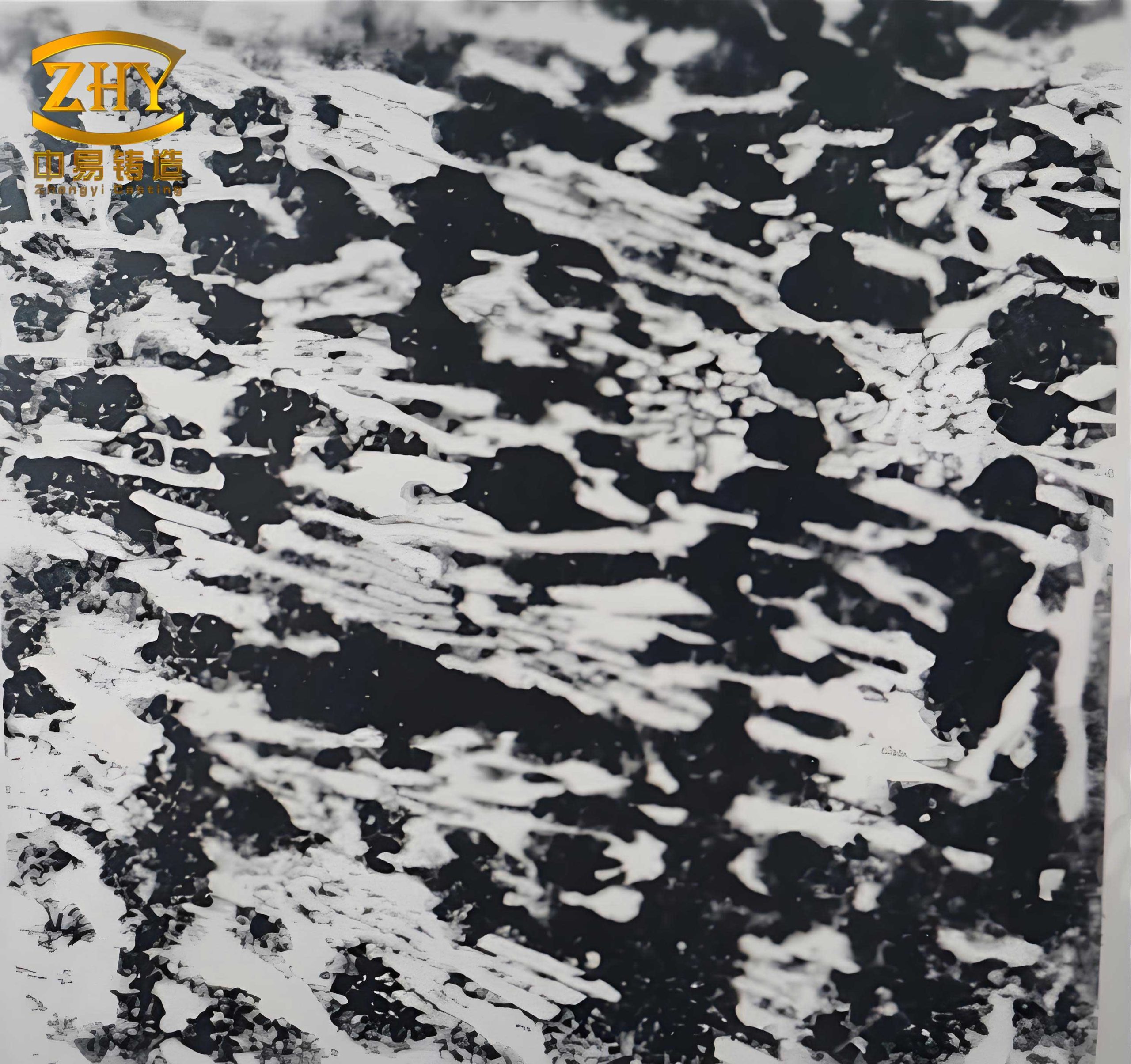
The synergistic effects of chromium and molybdenum in white cast iron are critical for optimizing performance. When both elements are added within optimal ranges, they complement each other: chromium increases carbide hardness, while molybdenum refines the microstructure and enhances hardenability. This synergy can be modeled using a combined parameter \( P \) for property prediction:
$$ P = \alpha \cdot C_{Cr} + \beta \cdot C_{Mo} + \gamma \cdot C_{Cr} \cdot C_{Mo} $$
where \( \alpha \), \( \beta \), and \( \gamma \) are coefficients derived from experimental data. For hardness, \( \alpha \approx 1.5 \), \( \beta \approx 2.0 \), and \( \gamma \approx 0.5 \), indicating a positive interaction. In terms of wear resistance, the relative wear loss \( W \) can be expressed as a function of hardness and toughness:
$$ W = \frac{K}{H \cdot IT^n} $$
with \( K \) as a material constant, \( H \) as hardness, \( IT \) as impact toughness, and \( n \) an exponent (typically around 0.5). For the optimized white cast iron with 2.0% Cr and 0.6% Mo, the wear loss decreased by approximately 30% compared to the base manganese-boron white cast iron, validating the alloying approach.
To further illustrate the composition-property relationships, I developed a comprehensive table summarizing the recommended compositional ranges for high-performance white cast iron, based on this study and broader literature. This white cast iron variant demonstrates superior attributes for demanding applications.
| Element | Optimal Range (wt.%) | Effect on White Cast Iron Properties | Empirical Formula Contribution |
|---|---|---|---|
| C | 2.6–2.9 | Balances carbide volume and toughness; target hardness >60 HRC. | \( V_c = 0.12 \cdot C – 0.25 \) (carbide volume fraction). |
| Si | 1.2–1.8 | Supports matrix refinement; minimizes retained austenite when combined with Mn. | \( A_s = 0.05 \cdot Si + 0.1 \) (austenite stability factor). |
| B | 0.10–0.20 | Enhances hardenability; forms hard borocarbides for wear resistance. | \( D_B = D_0 + 10 \cdot B \) (hardenability multiplier). |
| Mn | 5.0–6.0 | Improves hardenability and stabilizes austenite; forms Mn-rich carbides. | \( M_s = 500 – 300 \cdot Mn \) (Martensite start temperature in °C). |
| Cr | 1.5–2.5 | Increases carbide hardness; boosts wear resistance without excessive brittleness. | \( H_{Cr} = 1.5 \cdot Cr + 58.5 \) (hardness contribution in HRC). |
| Mo | 0.4–0.8 | Refines microstructure; enhances toughness and hardenability. | \( IT_{Mo} = 0.5 \cdot Mo + 6.8 \) (toughness contribution in J/cm²). |
The microstructural evolution in white cast iron with chromium and molybdenum additions can be described using phase transformation kinetics. During solidification, the formation of carbides follows the Lever rule for binary systems, but with multiple alloying elements, it becomes more complex. The volume fraction of carbides \( f_c \) can be approximated as:
$$ f_c = \frac{C – C_{\alpha}}{C_c – C_{\alpha}} $$
where \( C \) is the total carbon content, \( C_{\alpha} \) is the carbon solubility in ferrite (negligible in white cast iron), and \( C_c \) is the carbon content in carbides, which increases with chromium and molybdenum addition. For chromium-bearing white cast iron, \( C_c \) can be as high as 6.7% in (Fe,Cr)₃C, while molybdenum promotes finer (Mo,Fe)₂₃C₆-type carbides. The hardness of these carbides, \( H_c \), scales with alloy content:
$$ H_c = 1000 + 200 \cdot Cr + 150 \cdot Mo \, \text{(in Vickers hardness)} $$
This equation underscores why alloyed white cast iron exhibits superior abrasion resistance compared to plain varieties.
In terms of heat treatment, the air quenching process for white cast iron involves cooling from the austenitizing temperature (typically 950–1000°C) to room temperature, followed by tempering at 200–250°C. The martensite transformation can be modeled using the Koistinen-Marburger equation for retained austenite volume \( V_\gamma \):
$$ V_\gamma = \exp[-k(M_s – T_q)] $$
where \( k \) is a constant (around 0.011), \( M_s \) is the martensite start temperature, and \( T_q \) is the quenching temperature. With chromium and molybdenum, \( M_s \) decreases due to austenite stabilization, but the enhanced hardenability ensures full martensite formation in sections up to 50 mm thick, as confirmed in grinding ball trials. The tempered hardness \( H_t \) relates to as-quenched hardness \( H_q \) via:
$$ H_t = H_q – c \cdot T_t $$
with \( c \) as a tempering coefficient (approximately 0.05 HRC per °C) and \( T_t \) the tempering temperature. For the optimized white cast iron, \( H_q \) exceeds 64 HRC, and after tempering, it stabilizes around 62 HRC, providing a good balance with toughness.
The practical application of this alloyed white cast iron was validated through the production of grinding balls with a diameter of 120 mm. Using metal molds with insulating sand sleeves, the casting process yielded dense and uniform balls. After heat treatment, the hardness varied by less than 3 HRC from surface to center, demonstrating excellent hardenability. Field tests in a coal grinding mill showed a wear rate of 50 g per ton of coal, which is 30% lower than that of non-alloyed manganese-boron white cast iron balls. This improvement directly correlates with the optimized composition, particularly the synergistic effects of chromium and molybdenum.
To further generalize the findings, I propose a performance index \( PI \) for white cast iron in wear applications:
$$ PI = \frac{H \cdot IT}{W} $$
where \( H \) is hardness, \( IT \) is impact toughness, and \( W \) is wear loss. For the base white cast iron, \( PI \) is around 500 (in arbitrary units), while for the alloyed version with 2.0% Cr and 0.6% Mo, \( PI \) increases to 650, indicating a 30% enhancement. This index can guide material selection for specific service conditions, emphasizing the importance of alloying in white cast iron development.
In conclusion, the addition of chromium and molybdenum to manganese-boron white cast iron significantly improves its microstructure and mechanical properties. Chromium enhances carbide hardness and hardenability, while molybdenum refines the structure and boosts toughness. The optimal ranges are 1.5–2.5% Cr and 0.4–0.8% Mo, combined with 2.6–2.9% C, 1.2–1.8% Si, 0.10–0.20% B, and 5.0–6.0% Mn. This composition yields a white cast iron with hardness above 60 HRC, impact toughness over 7 J/cm², and wear resistance improved by 30%. The successful trial of grinding balls confirms the industrial viability of this material, making it a promising candidate for heavy-duty abrasion-resistant applications. Future work could explore other alloying elements or advanced heat treatments to further push the boundaries of white cast iron performance.
Throughout this study, the focus has been on understanding the fundamental mechanisms behind alloying effects in white cast iron. The use of empirical formulas and microstructural models provides a framework for designing next-generation wear-resistant materials. As industries demand more durable components, the role of optimized white cast iron will continue to grow, driven by insights from research like this.