
White cast iron is renowned for its exceptional hardness and wear resistance, making it a preferred material in industries such as mining, metallurgy, construction, and machinery. However, the inherent brittleness of conventional white cast iron, primarily due to the continuous network of carbides, limits its broader application. To overcome this, researchers have focused on modifying the carbide morphology—transforming it from a continuous network to isolated or fragmented distributions—thereby enhancing toughness while retaining high hardness. One approach involves altering the carbide type, such as transitioning from M3C to MC or M7C3 carbides, as seen in high-chromium white cast iron. Alternatively, thermomechanical processes like hot forging or hot rolling have emerged as effective methods to break the carbide network, leading to improved mechanical properties. This study explores the use of manganese as a cost-effective alloying element in white cast iron, investigating the effects of manganese content, forging temperature, and reduction ratio on the microstructure and performance of forged white cast iron. The goal is to optimize these parameters to achieve a balance of high hardness, improved toughness, and superior wear resistance.
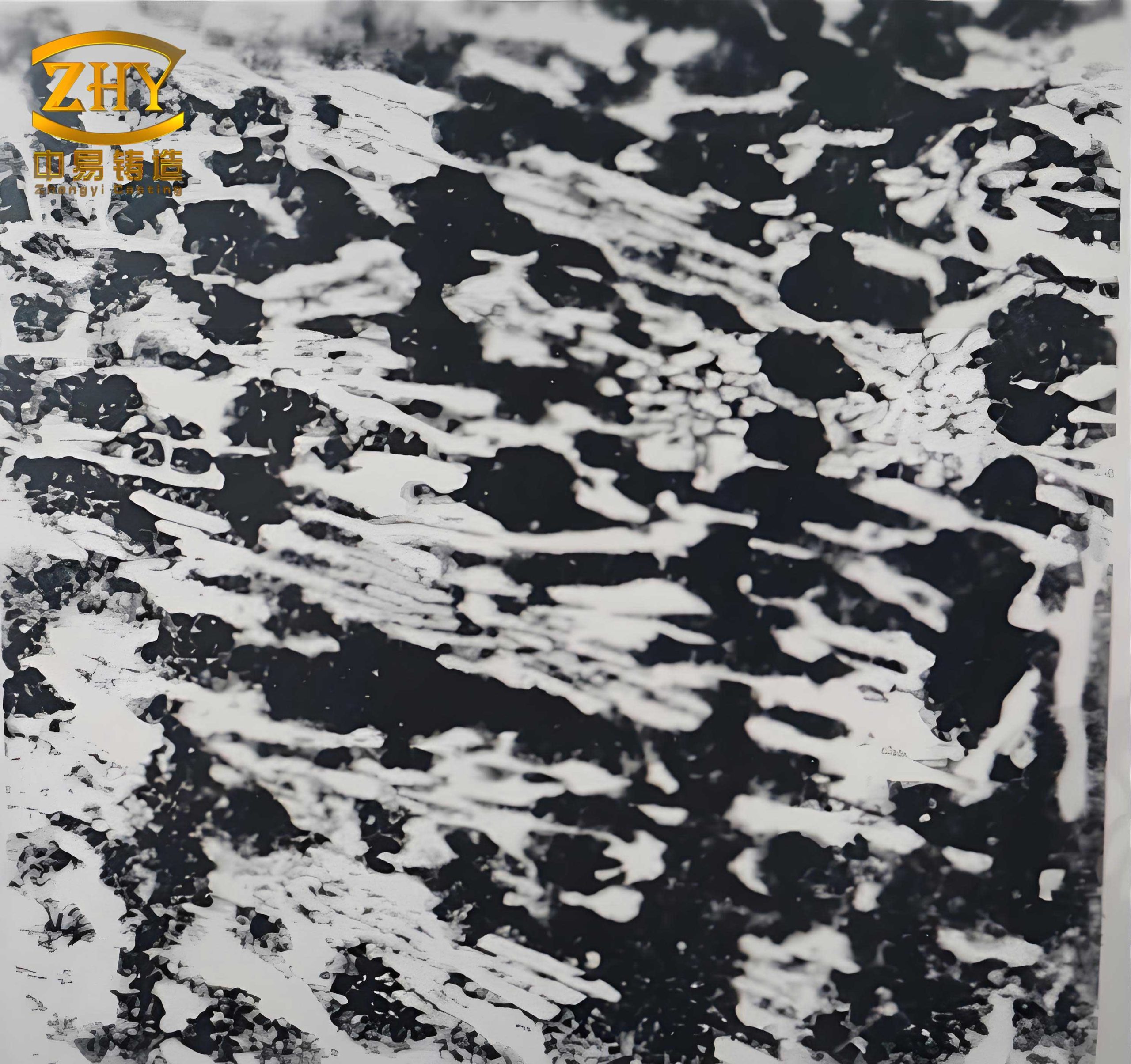
In this work, I conducted a comprehensive analysis of forged manganese white cast iron, emphasizing the interplay between processing conditions and material behavior. White cast iron, characterized by its high carbon content primarily in the form of cementite (Fe3C), exhibits excellent abrasion resistance but poor impact strength. The brittle nature stems from the interconnected carbide network that acts as stress concentrators. By introducing plastic deformation through forging, this network can be disrupted, leading to a more ductile matrix. Manganese is chosen as an alloying element due to its ability to stabilize austenite, influence carbide formation, and enhance hardenability. The study delves into how varying manganese levels, combined with controlled forging parameters, affect phase transformations, carbide distribution, and ultimately, the mechanical and tribological properties of white cast iron.
The experimental methodology involved melting white cast iron in a medium-frequency induction furnace, with charges of approximately 25 kg. The molten metal was cast into bar-shaped specimens with cross-sectional dimensions ranging from 15 mm × 15 mm to 40 mm × 40 mm and a length of 120 mm. The chemical compositions of the specimens were meticulously controlled, as summarized in Table 1. Key elements included carbon, manganese, silicon, molybdenum, chromium, phosphorus, and sulfur, with manganese content varied systematically to assess its impact.
| Specimen ID | C | Mn | Si | Mo | Cr | P | S |
|---|---|---|---|---|---|---|---|
| 21# | 2.67 | 4.33 | 0.98 | 0.40 | – | 0.02 | 0.006 |
| 22# | 2.63 | 5.56 | 0.98 | – | – | 0.02 | 0.006 |
| 23# | 2.62 | 6.31 | 0.98 | – | – | 0.02 | 0.006 |
| 41# | 2.65 | 4.75 | 0.92 | – | – | 0.02 | 0.006 |
| 42# | 2.65 | 4.75 | 0.92 | 0.41 | – | 0.02 | 0.006 |
| 43# | 2.65 | 4.75 | 0.92 | 0.83 | – | 0.02 | 0.006 |
| 44# | 2.65 | 5.18 | 0.92 | – | – | 0.02 | 0.006 |
| 45# | 2.65 | 5.18 | 0.92 | 0.41 | – | 0.02 | 0.006 |
| 46# | 2.65 | 5.18 | 0.92 | 0.83 | – | 0.02 | 0.006 |
| 51# | 2.49 | 6.92 | 0.92 | – | – | 0.02 | 0.006 |
| 52# | 2.49 | 7.46 | 0.92 | – | – | 0.02 | 0.006 |
| 53# | 2.49 | 8.51 | 0.92 | – | – | 0.02 | 0.006 |
| 61# | 3.39 | 14.35 | 0.92 | – | – | 0.02 | 0.006 |
The forging process was carried out by heating the specimens in a resistance furnace for 20 minutes at temperatures ranging from 1020°C to 1100°C. Subsequently, they were forged using a hammer to a thickness of about 12 mm in a single stroke, with a finishing temperature around 900°C, followed by air cooling. The reduction ratio, denoted as ε, was calculated using the formula:
$$ \epsilon = \frac{H – h}{H} \times 100\% $$
where H and h represent the initial and final thicknesses of the specimen, respectively. For the various specimen sizes, reduction ratios of 20%, 40%, 50%, 60%, and 70% were achieved. Post-forging, samples were prepared for mechanical testing. Impact specimens with dimensions of 10 mm × 10 mm × 55 mm were machined using electrical discharge machining. Wear testing was performed on an Amsler wear tester, with samples taken from the impact specimens. The counterface was a quenched steel disk with a hardness of 53 HRC. Quartz sand of 40 mesh was continuously fed as abrasive, under a load of 25 kg, resulting in a pressure of approximately 0.25 kg/mm². The disk rotated at 100 rpm, and wear was assessed over 1 minute, with mass loss averaged over three trials to determine wear rate.
The as-cast microstructure of hypoeutectic manganese white cast iron consists of pearlite, martensite, and austenite, with the relative amounts varying based on manganese content. The cementite appears as a continuous network, often extending across grains, contributing to brittleness. Forging induces significant changes: at a reduction ratio of 40%, the carbide network is largely broken, though carbides remain aligned with the metal flow direction. At 60% reduction, carbides are fragmented into blocks and uniformly dispersed within the matrix. This microstructural evolution is critical for enhancing the toughness of white cast iron.
During forging, austenite undergoes high-temperature mechanical deformation, absorbing energy that influences subsequent phase transformations upon cooling. The resulting forged structure is complex, comprising several phases: (1) secondary cementite, which precipitates as thin plates due to decreased carbon solubility in austenite during cooling—higher forging temperatures can lead to a networked precipitation, detrimental to toughness; (2) pearlite, present in most specimens except those with high manganese, nucleating at austenite-carbide interfaces; (3) martensite, including both acicular and blocky types with microhardness values between 410 HV and 570 HV; and (4) large blocks of retained austenite, with microhardness ranging from 200 HV to 400 HV, depending on the degree of forging deformation. Additionally, voids may form if the metal matrix fails to fill gaps created by carbide fracture during deformation; increasing the reduction ratio and forging temperature helps minimize such defects by softening both matrix and carbides.
The effect of manganese content on hardness is pronounced. In the as-cast condition, hardness increases with manganese up to about 6%, due to pearlite refinement and increased martensite content. Beyond this, retained austenite dominates, causing hardness to decline. For forged white cast iron, with manganese below 5%, the matrix is primarily pearlitic. At 6.5% Mn, the matrix consists mainly of martensite and retained austenite, with minor pearlite at interfaces, resulting in peak hardness. Exceeding 7% Mn suppresses both pearlite and martensite transformations, leading to a structure of austenite and networked secondary cementite, which drastically reduces hardness below that of the as-cast state. This behavior underscores the importance of manganese in controlling phase stability in white cast iron.
Molybdenum was also investigated for its role in enhancing hardenability. Even a small addition of 0.41 wt% Mo strongly inhibits pearlite formation and promotes martensite, thereby increasing as-cast hardness. However, at 0.83% Mo, the as-cast structure becomes fully austenitic, reducing hardness. Similar trends are observed in forged specimens, indicating that molybdenum’s influence persists through thermomechanical processing. The interaction between manganese and molybdenum in white cast iron is crucial for achieving desired microstructures, particularly in suppressing graphitization during forging, which can otherwise degrade hardness.
Forging temperature significantly impacts the microstructure and hardness of white cast iron. For a specimen with 4.75% Mn, forging at 1020°C yields a matrix of martensite with minor pearlite and large retained austenite blocks, exhibiting a hardness of 602 HV—slightly higher than the as-cast value. At 1040°C, retained austenite decreases further, and hardness peaks at 621 HV. However, at 1060°C, retained austenite content rises sharply, pearlite diminishes, and hardness drops substantially. At 1080°C and 1100°C, the structure is predominantly retained austenite and secondary cementite, with hardness similar to that at 1060°C; the austenite shows no strain hardening, with microhardness around 204-207 HV. For high-manganese specimens (7.46% and 8.51% Mn), forging between 900°C and 1040°C results in retained austenite structures regardless of temperature, highlighting the austenite-stabilizing effect of manganese in white cast iron.
The reduction ratio, or forging ratio, is another critical parameter. At 20% reduction, no austenite-to-martensite transformation occurs, and hardness is lower than the as-cast state. At 40% reduction, martensite transformation is promoted, and hardness rises rapidly to a maximum. Further increase to 50% reduction leads to more retained austenite, causing a slight hardness drop. At 60-80% reduction, hardness recovers somewhat. This pattern is consistent across different specimen compositions, emphasizing that optimal deformation is essential for maximizing the benefits of forging on white cast iron properties.
Impact toughness was evaluated using unnotched specimens. The results, summarized in Table 2, show that impact energy increases with both manganese content and reduction ratio. Manganese contributes by increasing retained austenite content, which enhances ductility. Notably, rolled specimens exhibit significantly higher impact values compared to forged ones, likely due to fewer void defects in the rolling process. This comparison underscores the importance of defect minimization in thermomechanical processing of white cast iron.
| Specimen ID | As-Cast (J) | Forged (J) | Rolled (J) |
|---|---|---|---|
| 21# | – | 4.7 | – |
| 22# | – | 6.1 | – |
| 23# | – | 6.8 | – |
| 41# | – | 7.5 | – |
| 42# | – | 6.8 | – |
| 43# | – | 6.1 | – |
| 44# | – | 6.8 | – |
| 45# | – | 7.5 | – |
| 46# | – | 7.5 | – |
| 51# | – | 7.5 | 13.6 |
| 52# | – | 6.8 | 14.9 |
| 53# | – | – | – |
Wear resistance under high-stress abrasive conditions was assessed via mass loss measurements. Wear rate decreases with increasing reduction ratio, except at 50% reduction where a sudden increase occurs, possibly linked to higher retained austenite content. At reduction ratios above 60%, wear rate is minimized, and surface hardness reaches 634 HV, indicating significant strain hardening of retained austenite during wear. This demonstrates that forged white cast iron can maintain high hardness while improving wear performance through microstructural optimization.
To quantify the relationship between manganese content and hardness, a polynomial model can be derived from the data. For as-cast white cast iron, hardness (Hac) as a function of manganese content (Mn) in weight percent can be approximated by:
$$ H_{ac} = a \cdot \text{Mn}^2 + b \cdot \text{Mn} + c $$
where a, b, and c are constants determined empirically. Similarly, for forged white cast iron, the hardness (Hf) depends on manganese, forging temperature (T in °C), and reduction ratio (ε in %):
$$ H_f = \alpha \cdot \text{Mn} + \beta \cdot T + \gamma \cdot \epsilon + \delta $$
with α, β, γ, and δ as coefficients. These equations highlight the multifactorial influence on the properties of white cast iron. Furthermore, the wear rate (W) can be expressed as a function of hardness and retained austenite content (Ar):
$$ W = k_1 \cdot \frac{1}{H_f} + k_2 \cdot A_r $$
where k1 and k2 are wear constants. This formulation underscores that both high hardness and controlled austenite levels are crucial for wear resistance in white cast iron.
The microstructural changes induced by forging in white cast iron can also be described using phase transformation kinetics. The martensite start temperature (Ms) is affected by manganese content and deformation. An empirical relation is:
$$ M_s = M_{s0} – \theta \cdot \text{Mn} – \lambda \cdot \epsilon $$
where Ms0 is the martensite start temperature for pure iron-carbon alloys, and θ and λ are constants. Lower Ms temperatures due to high manganese or deformation can lead to more retained austenite, impacting hardness and toughness. This interplay is vital for tailoring the properties of forged white cast iron.
In summary, this study demonstrates that forging manganese-alloyed white cast iron can significantly enhance its mechanical and tribological properties. The optimal conditions involve manganese contents of 5-7 wt%, forging temperatures below 1040°C, and reduction ratios greater than 40%. Under these parameters, forging promotes martensite transformation, increases hardness, and improves toughness by breaking the continuous carbide network. Additionally, wear resistance under high-stress abrasion improves with higher manganese content, due to strain hardening of retained austenite. These findings provide a framework for developing cost-effective, high-performance white cast iron components for demanding applications. Future work could explore other alloying elements or combined processes like rolling to further optimize the microstructure and performance of white cast iron.
The successful application of forged white cast iron in industries such as mining and manufacturing hinges on understanding these microstructure-property relationships. By leveraging manganese as an alloying element and controlling forging parameters, it is possible to produce white cast iron materials that offer an exceptional balance of hardness, toughness, and wear resistance. This research contributes to the broader field of metal casting and forging, offering insights into the thermomechanical processing of cast irons for enhanced performance.