
In my extensive experience within the wire and cable industry, the longevity of drawing wheels in large-capacity copper wire drawing machines has been a persistent and significant challenge. These wheels, subjected to intense compressive and shear stresses during the drawing process, endure a classic form of sliding friction. Conventional materials, such as carburized steel or medium-carbon steels, often fail within mere months—sometimes as little as one month—exhibiting severe groove wear on their working surfaces that halts production. While advanced solutions like alumina, zirconia, or plasma-sprayed tungsten carbide wheels are used internationally, their prohibitive cost makes them inaccessible for widespread domestic adoption. Ceramic wheels for large drawing machines are not yet producible locally. This scenario led my colleagues and me to explore and implement high-chromium white cast iron as a material for drawing wheels on secondary nine-die large drawing machines. The results have been profoundly positive, demonstrating that white cast iron can be a game-changer in this application.
The core of our investigation revolves around the exceptional properties of high-chromium white cast iron. This material is fundamentally characterized by a microstructure where chromium-rich eutectic carbides are embedded within a matrix of austenite or its transformation products. Through heat treatment, a martensitic matrix (with some retained austenite) and dispersed secondary carbides can be achieved. This structure grants high strength coupled with appreciable toughness. When the chromium content in white cast iron exceeds approximately 12%, the predominant carbide type formed is M7C3. This carbide, with a microhardness around HV 1300-1800, exists as a discontinuous, hard phase within the matrix. In sliding friction scenarios, such as in wire drawing, these hard carbides provide outstanding resistance to abrasion and adhesion wear. The matrix, once hardened, supports these carbides effectively. The wear resistance of this white cast iron can be conceptually related to material hardness and applied pressure. A simplified form of the Archard wear equation can illustrate this relationship:
$$W = k \frac{P}{H}$$
where \(W\) is the wear volume, \(k\) is a wear coefficient, \(P\) is the applied pressure, and \(H\) is the material hardness. The high hardness \(H\) of the white cast iron, contributed by both the martensitic matrix and the carbides, directly reduces the wear rate \(W\).
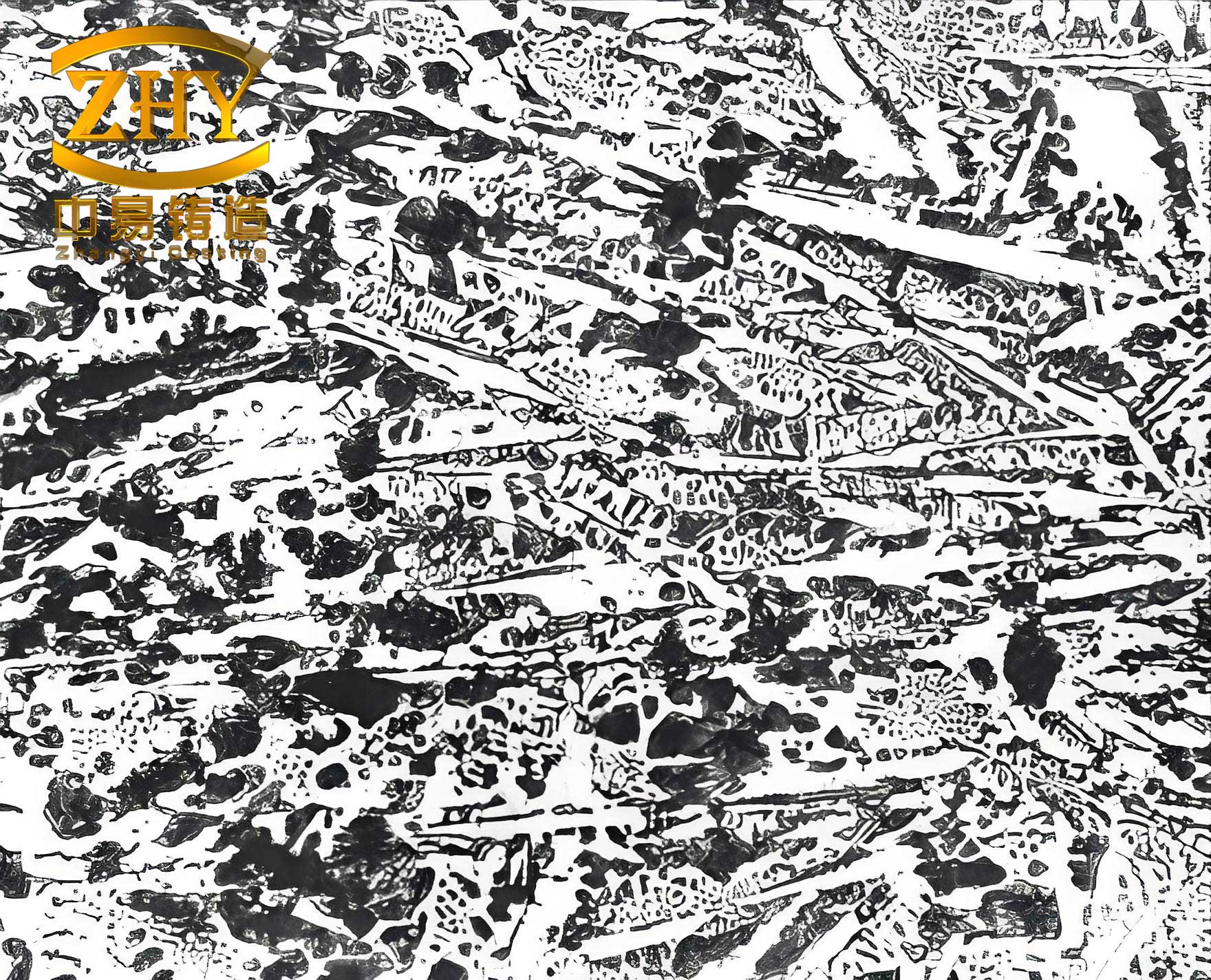
The casting process for these white cast iron components is relatively straightforward. We employed a cylindrical casting method, grouping four wheel rings per mold. The as-cast hardness of this white cast iron is typically high (HRC 50-55), necessitating an annealing process prior to machining to improve machinability. The annealing cycle involved heating to 850-880°C, holding for 4-6 hours, followed by a slow furnace cool. This process yields a pearlitic matrix, reducing the hardness to a machinable range of HRC 28-32. The machinability of annealed high-chromium white cast iron, while slower than standard gray iron, is feasible with appropriate tooling. We used YG6 or similar carbide inserts with a negative rake angle and a small nose radius. Rough machining for a single wheel typically required about 4 hours on a standard lathe. Keyways were machined prior to the final hardening heat treatment to avoid post-hardening machining difficulties.
The chemical composition is the cornerstone for tailoring the properties of white cast iron. We experimented with three primary grades, modifying carbon content to balance hardness, toughness, and carbide volume fraction. Rare-earth silicon iron alloy was used for modification treatment, which refines the microstructure and enhances the overall mechanical properties of the white cast iron. The chemical compositions we studied are summarized in the table below.
| Sample ID | C (%) | Cr (%) | Si (%) | Mn (%) | Mo (%) | Ni (%) | RE Modification |
|---|---|---|---|---|---|---|---|
| WCI-A | 2.8 – 3.0 | 14 – 16 | 0.5 – 0.8 | 0.5 – 0.8 | 0.8 – 1.2 | 0.8 – 1.2 | Yes |
| WCI-B | 3.0 – 3.2 | 14 – 16 | 0.5 – 0.8 | 0.5 – 0.8 | 0.8 – 1.2 | 0.8 – 1.2 | Yes |
| WCI-C | 3.2 – 3.6 | 14 – 16 | 0.5 – 0.8 | 0.5 – 0.8 | 0.8 – 1.2 | 0.8 – 1.2 | Yes |
The carbon content directly influences the volume fraction of hard carbides in the white cast iron. An empirical relationship for the approximate carbide volume fraction \(V_c\) can be expressed as a function of carbon and chromium:
$$V_c \approx f(C, Cr) = k_1 \cdot C + k_2 \cdot Cr – k_3$$
where \(k_1\), \(k_2\), and \(k_3\) are constants derived from phase diagram analysis. Higher carbon leads to more carbides and thus higher overall hardness, but may impact toughness. After annealing, the wheels undergo a critical hardening heat treatment: austenitizing at 980-1020°C for 2-4 hours, followed by air cooling (assisted by fans), and tempering at 200-250°C for 2-4 hours. This results in a final hardness of HRC 62-66. A significant advantage of this high-chromium white cast iron is its high hardenability; sections up to 100 mm thick can be through-hardened uniformly, ensuring consistent performance across the entire wheel profile. Post-hardening, final machining and grinding are performed using alumina-based grinding wheels to achieve a surface finish of Ra 0.8 μm or better.
The mechanical properties of our developed white cast iron grades, after quenching and tempering, were rigorously tested. The data below highlights the superior combination of hardness, strength, and impact resistance offered by this class of white cast iron, particularly the WCI-B grade which showed an optimal balance.
| Sample ID | Hardness (HRC) | Transverse Rupture Strength (MPa) | Impact Toughness (J/cm²) | Microhardness of Carbides (HV) |
|---|---|---|---|---|
| WCI-A | 62 – 64 | 1200 – 1350 | 8 – 10 | 1300 – 1500 |
| WCI-B | 64 – 66 | 1100 – 1250 | 6 – 8 | 1300 – 1500 |
| WCI-C | 66 – 68 | 1000 – 1150 | 4 – 6 | 1300 – 1500 |
The performance of these white cast iron drawing wheels was compared directly against traditional materials in production conditions over several years. The contrast is stark and unequivocally favors the white cast iron solution. The following comprehensive table synthesizes the operational and economic data collected from our field trials.
| Comparison Item | Medium-Carbon Steel (45#) | Alloy Steel (GCr15) | Carburized Steel | High-Chromium White Cast Iron (WCI-B) |
|---|---|---|---|---|
| Post-heat treatment Hardness (HRC) | 50 – 55 | 60 – 62 | 58 – 62 | 64 – 66 |
| Output per set (tons of wire) | ~150 | ~600 | ~600 | >3000 (and ongoing) |
| Manufacturing Cost per set (relative units) | 1.0 (baseline) | 1.8 | 2.2 | 2.5 |
| Cost per unit output (relative units/ton) | 1.0 | 0.45 | 0.55 | 0.12 |
| Regrinding frequency (times/year) | 12 | 2 | 2 | 0.5 – 1 |
| Typical service life before replacement | 1 – 3 months | ~6 months | ~6 months | >3 years |
| Hardness drop after regrinding | Significant | Moderate | Significant | Negligible |
| Machining allowance required | Large | Large | Large | Small |
| Heat treatment distortion | High | High | High | Low |
The medium-carbon steel wheels, though easy to forge, required significant machining allowance, suffered from poor hardenability and large distortion during quenching. They developed grooves within weeks, needing monthly regrinding which further degraded their already modest hardness and wear resistance. The alloy steel and carburized steel wheels offered better performance but were prone to forging cracks, required large machining allowances, and exhibited considerable heat treatment distortion. Their effective case depth was limited; regrinding quickly removed the hardened layer, leading to a rapid decline in performance and a service life capped at around half a year.
In stark contrast, the high-chromium white cast iron wheels demonstrated remarkable advantages. Their near-net-shape casting drastically reduced machining waste. The heat treatment resulted in minimal distortion and provided through-hardening across the entire section. This white cast iron maintained a consistently high surface hardness even after multiple regrinding cycles—a wheel could be refurbished 10-15 times by simply turning off the worn grooves and regrinding, with almost no loss in substrate hardness. This translates to an extraordinary service life exceeding three years, with some sets still in operation. The economic analysis is compelling: despite a higher initial manufacturing cost for the white cast iron wheel, its vastly superior longevity and reduced maintenance downtime result in a cost per ton of drawn wire that is only a fraction of that for conventional steel wheels.
The fundamental reason for the success of white cast iron in this application lies in its unique wear mechanism under sliding friction against copper. Microscopic examination, including scanning electron microscopy, revealed that the wear of the white cast iron surface does not occur primarily by abrasive grain pull-out. Instead, the wear mechanism is characterized by a micro-cutting or shear-induced flaking process. The hard M7C3 carbides in the white cast iron effectively resist penetration and ploughing by harder asperities or embedded particles. The tough martensitic matrix prevents catastrophic fracture of these carbides, allowing them to blunt and gradually wear in a controlled manner. This synergy gives the white cast iron excellent resistance to adhesive and abrasive wear specific to the copper drawing process. Importantly, the hard phases in the white cast iron did not cause any scratching or degradation of the copper wire surface finish, a critical quality requirement.
The wear resistance can be further analyzed by considering the composite nature of the white cast iron. Its effective hardness \(H_{eff}\) in a wear scenario is a complex function of the hardness of the matrix \(H_m\) and the carbides \(H_c\), as well as their volume fractions \(V_m\) and \(V_c\) (\(V_m + V_c = 1\)). A rule-of-mixtures approach provides a first approximation:
$$H_{eff} \approx H_m V_m + H_c V_c$$
For our white cast iron, with \(H_m \approx\) HV 700-800 (martensite) and \(H_c \approx\) HV 1400, and \(V_c\) around 30-35%, the calculated \(H_{eff}\) is significantly higher than that of a homogeneous steel of similar matrix hardness. This directly correlates to lower wear rates, as per the Archard equation. Furthermore, the morphology and distribution of carbides play a crucial role. The discontinuous, isolated nature of carbides in high-chromium white cast iron, as opposed to the continuous network in standard white irons, impedes crack propagation and enhances fracture toughness, which is vital for withstanding impact loads during wire drawing start-ups and stops.
From a manufacturing standpoint, the process flow for these white cast iron wheels is efficient. It begins with the careful melting and alloying to achieve the target composition for the white cast iron, followed by mold preparation and pouring. After shakeout and cleaning, the castings undergo annealing. Machining processes include turning the OD and ID, facing, and keyway cutting. The subsequent heat treatment—austenitizing, air quenching, and tempering—is the critical step that unlocks the final properties of the white cast iron. Finally, precision grinding ensures the exact dimensional tolerance and surface finish required for smooth wire guidance. Throughout this process, quality control checks on chemical composition, hardness, and microstructure are essential to guarantee the performance of the white cast iron component.
In conclusion, the application of high-chromium white cast iron for drawing wheels in large copper wire drawing machines represents a significant technological advancement with clear economic benefits. This white cast iron material solves the chronic problem of short wheel life through its exceptional and durable wear resistance. Its manufacturing process is relatively simple and adaptable. The white cast iron wheels can be repeatedly refurbished without significant performance loss, extending their service life to several years. While the current microstructure of this white cast iron is a martensitic matrix with a eutectic carbide network, ongoing research into spheroidizing these carbides could potentially yield even better combinations of toughness and wear resistance for white cast iron. Further exploration of alloying elements to partially substitute chromium could also lead to more cost-effective variants of wear-resistant white cast iron. The success of this project firmly establishes high-chromium white cast iron as a superior and viable material for severe sliding wear applications in the metalworking industry, paving the way for its broader adoption beyond wire drawing. The continued use and development of white cast iron alloys hold great promise for solving similar durability challenges in heavy industrial machinery.