
In this research, we explore the influence of retained austenite on the abrasive wear behavior of high-chromium white cast iron under various wear systems. White cast iron, particularly high-chromium variants, is widely used in wear-resistant applications due to its excellent hardness and abrasion resistance. The microstructure of high-chromium white cast iron typically consists of eutectic carbides embedded in a matrix that can be austenitic, martensitic, or a mixture of phases depending on heat treatment. Retained austenite, a metastable phase, has been a subject of debate regarding its role in wear performance. Some studies suggest it enhances wear resistance through transformation-induced plasticity and work hardening, while others indicate it may be detrimental under certain conditions. This study aims to clarify these effects by systematically varying retained austenite content through heat treatment and examining wear behavior in low-stress, high-stress, and impact wear scenarios. We employ advanced X-ray diffraction techniques to measure the transformation of retained austenite after wear, providing insights into its stability and contribution to wear resistance. The findings are critical for optimizing the performance of white cast iron in industrial applications.
The high-chromium white cast iron used in this study has a nominal composition of Cr and C, with specific chemical details provided in Table 1. The alloy was melted in a medium-frequency induction furnace and cast into standard Keel blocks with a thickness of 25 mm. After softening annealing, the blocks were machined into specimens for heat treatment and wear testing. Heat treatment processes were designed to vary the retained austenite content in the matrix. By adjusting quenching temperature, applying cold treatment, and conducting tempering, we achieved a range of retained austenite levels from 0% to over 50%. The specific heat treatment parameters and resulting microstructures are summarized in Table 1. The matrix hardness and retained austenite content were measured using X-ray diffraction with a multi-peak method to account for texture effects, which is essential for accurate phase analysis in textured materials like white cast iron. The carbon content in austenite was calculated from the lattice parameter using the formula: $$a_0 = 3.572 + 0.033x$$ where \(a_0\) is the lattice constant in Å and \(x\) is the carbon content in weight percent. This relationship allows us to estimate the stability of retained austenite based on its carbon enrichment.
| Sample ID | C (wt%) | Cr (wt%) | Other Elements | Quenching Temperature (°C) | Tempering/Cold Treatment | Retained Austenite (%) | Matrix Hardness (HRC) |
|---|---|---|---|---|---|---|---|
| A1 | 2.8 | 15 | Si, Mn, Mo | 950 | None | 10 | 62 |
| A2 | 2.8 | 15 | Si, Mn, Mo | 1050 | None | 30 | 58 |
| A3 | 2.8 | 15 | Si, Mn, Mo | 1150 | None | 50 | 55 |
| B1 | 2.8 | 15 | Si, Mn, Mo | 1050 | Cold treatment at -70°C | 15 | 61 |
| B2 | 2.8 | 15 | Si, Mn, Mo | 1050 | Tempering at 250°C | 20 | 59 |
The wear testing was conducted under three distinct conditions to simulate different service environments. Low-stress abrasive wear tests were performed using a rubber wheel wear tester with quartz sand (mesh size 50-70) as the abrasive medium. The relative wear resistance was calculated as the ratio of weight loss of a standard sample (normalized 45 steel) to that of the white cast iron specimen. High-stress two-body wear tests were carried out on a pin-on-disk apparatus with two types of abrasive papers: green silicon carbide (150 mesh) and garnet (150 mesh). The test parameters included a disk speed of 200 rpm and a total sliding distance of 1000 m. Impact wear tests involved a dynamic load wear tester with an impact energy of 2 J and quartz sand (20-50 mesh) as the abrasive. The weight loss after a fixed number of cycles was used to evaluate wear resistance. For each wear condition, we measured the transformation of retained austenite in the subsurface layer using an X-ray diffraction technique that combines the “equal-inclination non-layer removal method” with multi-peak analysis. This approach allows us to determine the distribution of retained austenite as a function of depth from the worn surface, characterized by parameters such as relative transformation amount, transformation layer depth, and distribution gradient. The transformation amount is defined as the average reduction in retained austenite within a 10 µm surface layer relative to the bulk, and the distribution gradient is the slope of the retained austenite content curve over this depth.
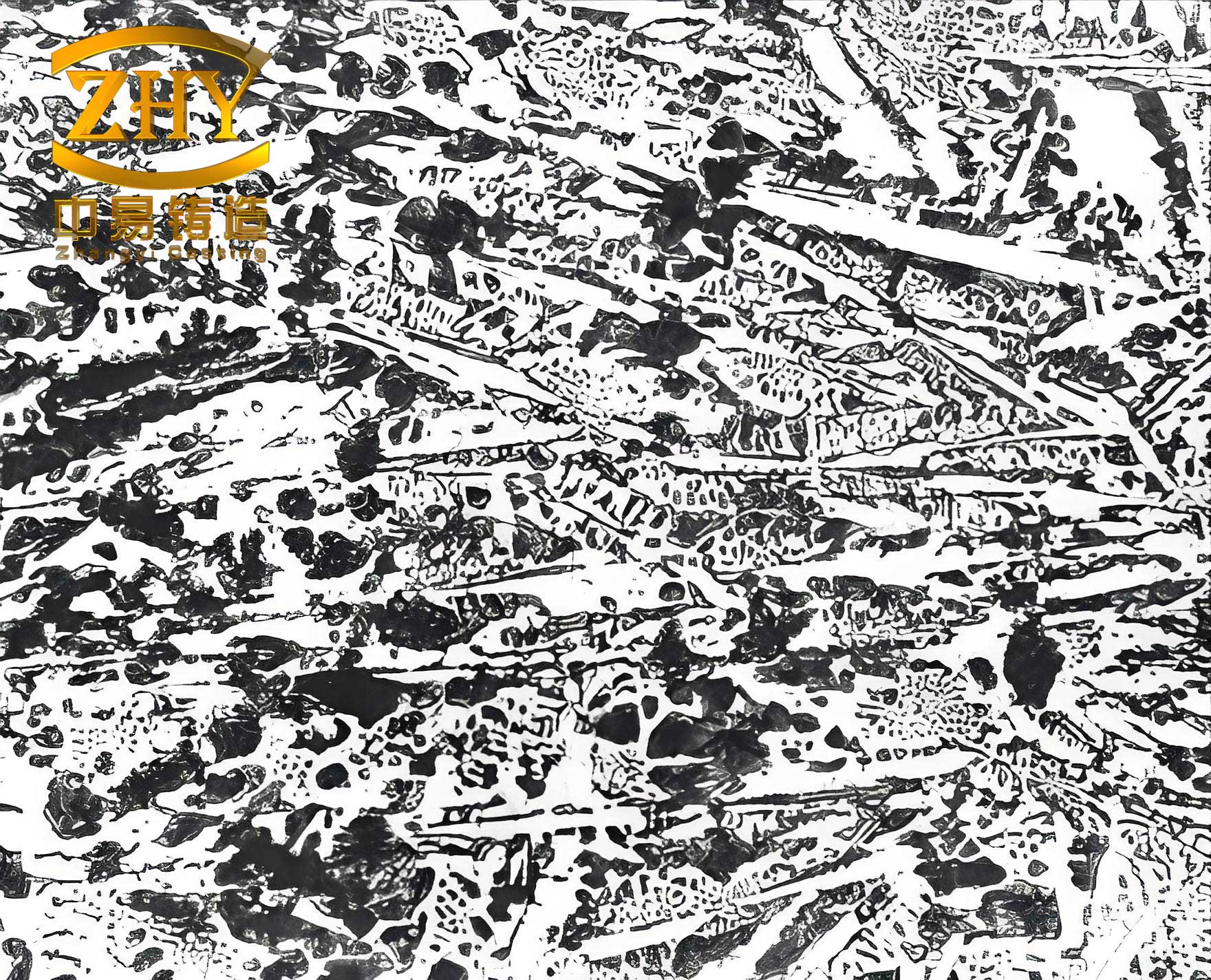
The results of heat treatment show that retained austenite content in high-chromium white cast iron increases with higher quenching temperatures, as shown in Table 2. For instance, quenching at 950°C yielded about 10% retained austenite, while at 1150°C, it reached 50%. The carbon content in austenite also rose with temperature, indicating enhanced stability due to carbon enrichment. Cold treatment and tempering effectively reduced retained austenite; for example, cold treatment after 1050°C quenching lowered it from 30% to 15%, with a corresponding increase in hardness. Tempering at 250°C decreased retained austenite to 20% through decomposition reactions. These variations allowed us to prepare samples with a wide range of retained austenite levels for wear testing. The relationship between retained austenite content and matrix hardness can be expressed by an empirical equation: $$H = H_0 – k \cdot A_R$$ where \(H\) is the hardness, \(H_0\) is the hardness of a fully martensitic matrix, \(k\) is a constant, and \(A_R\) is the retained austenite fraction. This inverse correlation highlights the trade-off between ductility and hardness in white cast iron microstructures.
| Quenching Temperature (°C) | Retained Austenite (%) | Carbon Content in Austenite (wt%) | Matrix Hardness (HRC) |
|---|---|---|---|
| 950 | 10 | 0.8 | 62 |
| 1050 | 30 | 1.2 | 58 |
| 1150 | 50 | 1.5 | 55 |
The wear test results reveal that the effect of retained austenite on wear resistance depends significantly on the wear system. In low-stress rubber wheel wear tests with quartz sand, the relative wear resistance decreased as retained austenite content increased, as plotted in Figure 1. For example, samples with 10% retained austenite showed a relative wear resistance of 1.5, while those with 50% retained austenite dropped to 1.0. This decline is attributed to the softer austenitic matrix being more susceptible to abrasive cutting, leading to accelerated wear of both matrix and carbides. In high-stress pin-on-disk wear tests, the trend varied with abrasive type. With hard green silicon carbide abrasive, wear resistance improved with higher retained austenite, reaching a peak at 50% austenite. In contrast, with softer garnet abrasive, wear resistance peaked at around 30% retained austenite and then decreased. This behavior is linked to the dominant wear mechanism: for hard abrasives, plastic deformation and work hardening of austenite enhance resistance, while for soft abrasives, cutting mechanisms favor harder martensitic matrices. Impact wear tests showed that weight loss decreased with increasing retained austenite, indicating better performance under dynamic loads. For instance, samples with 50% retained austenite had 20% lower weight loss than those with 10% retained austenite. The data are summarized in Table 3, which consolidates wear results across different conditions.
| Wear Condition | Abrasive Type | Retained Austenite (%) | Relative Wear Resistance or Weight Loss | Notes |
|---|---|---|---|---|
| Low-stress rubber wheel | Quartz sand (50-70 mesh) | 10 | 1.5 (relative) | Decreasing trend with higher austenite |
| Low-stress rubber wheel | Quartz sand (50-70 mesh) | 30 | 1.2 (relative) | |
| Low-stress rubber wheel | Quartz sand (50-70 mesh) | 50 | 1.0 (relative) | |
| High-stress pin-on-disk | Green silicon carbide (150 mesh) | 10 | 1.8 (relative) | Increasing trend with higher austenite |
| High-stress pin-on-disk | Green silicon carbide (150 mesh) | 30 | 2.2 (relative) | |
| High-stress pin-on-disk | Green silicon carbide (150 mesh) | 50 | 2.5 (relative) | |
| High-stress pin-on-disk | Garnet (150 mesh) | 10 | 1.6 (relative) | Peak at 30% austenite |
| High-stress pin-on-disk | Garnet (150 mesh) | 30 | 2.0 (relative) | |
| High-stress pin-on-disk | Garnet (150 mesh) | 50 | 1.8 (relative) | |
| Impact wear | Quartz sand (20-50 mesh) | 10 | 0.15 g (weight loss) | Decreasing weight loss with higher austenite |
| Impact wear | Quartz sand (20-50 mesh) | 30 | 0.12 g (weight loss) | |
| Impact wear | Quartz sand (20-50 mesh) | 50 | 0.10 g (weight loss) |
Post-wear analysis of retained austenite transformation provides deeper insights. Using X-ray diffraction, we measured the distribution of retained austenite as a function of depth from the worn surface. The results, plotted in Figure 2, show that the relative transformation amount, layer depth, and distribution gradient vary with wear conditions. For low-stress wear, the transformation is minimal (e.g., 10% relative transformation) and shallow (5 µm depth), with a steep distribution gradient. In high-stress three-body wear, transformation increases to 30% with a deeper layer of 15 µm and a moderate gradient. Under impact wear, transformation is most significant, reaching 40% over a 20 µm depth with a shallow gradient. These trends indicate that higher stress levels promote more extensive austenite-to-martensite transformation, which influences wear resistance. The transformation kinetics can be described by a simplified model: $$A_R(d) = A_{R0} \cdot e^{-\alpha d}$$ where \(A_R(d)\) is the retained austenite content at depth \(d\), \(A_{R0}\) is the initial content, and \(\alpha\) is a decay constant related to wear stress. This exponential decay reflects the gradient in phase transformation due to stress attenuation with depth.
The discussion centers on the mechanistic role of retained austenite in different wear systems. In low-stress abrasive wear, the primary mechanism is micro-cutting by hard abrasive particles. Since white cast iron consists of hard carbides in a softer matrix, a martensitic matrix provides better support for carbides, reducing their fracture and spalling. Retained austenite, being softer, allows easier matrix removal, leading to carbide rounding and accelerated wear. The limited transformation in this condition (as per Table 4) does not significantly harden the surface, so austenite’s contribution is inferior to martensite. The wear rate \(W\) can be approximated by: $$W = k_1 \cdot H^{-1} + k_2 \cdot \epsilon$$ where \(H\) is matrix hardness, \(\epsilon\) is ductility, and \(k_1\), \(k_2\) are constants. For low-stress wear, the hardness term dominates, favoring harder matrices.
| Sample (Quenching Temperature) | Wear Condition | Relative Transformation Amount (%) | Transformation Layer Depth (µm) | Distribution Gradient (µm⁻¹) |
|---|---|---|---|---|
| A1 (950°C, 10% austenite) | Low-stress rubber wheel | 5 | 5 | 0.10 |
| A3 (1150°C, 50% austenite) | Low-stress rubber wheel | 10 | 5 | 0.08 |
| A1 (950°C, 10% austenite) | High-stress three-body | 20 | 10 | 0.05 |
| A3 (1150°C, 50% austenite) | High-stress three-body | 30 | 15 | 0.03 |
| A1 (950°C, 10% austenite) | Impact wear | 30 | 15 | 0.04 |
| A3 (1150°C, 50% austenite) | Impact wear | 40 | 20 | 0.02 |
In high-stress wear, mechanisms include both cutting and plastic deformation. With hard abrasives like silicon carbide, the abrasive particles cause significant plastic flow in the matrix. Austenite, with its high ductility and work-hardening capacity, undergoes strain-induced transformation to martensite, forming a hardened surface layer that resists further wear. This is reflected in the higher transformation amounts and deeper layers observed. The wear resistance \(R\) can be expressed as: $$R = C \cdot (H \cdot \epsilon)^{1/2}$$ where \(C\) is a constant. For hard abrasives, the product of hardness and ductility is optimized by austenite’s transformation capability. With soft abrasives like garnet, cutting predominates, so hardness is more critical, explaining the peak at intermediate austenite levels where a balance is achieved.
Under impact wear, the dominant factors are fracture toughness and energy absorption. White cast iron with retained austenite exhibits better toughness due to austenite’s ability to blunt cracks and absorb impact energy through plastic deformation and transformation. The extensive transformation layer (up to 20 µm deep) acts as a buffer, reducing crack propagation and material loss. The impact wear loss \(L\) can be modeled as: $$L = \frac{K}{\sigma_f \cdot \delta}$$ where \(K\) is a constant, \(\sigma_f\) is fracture strength, and \(\delta\) is ductility. Higher retained austenite improves \(\delta\), thereby reducing \(L\). Additionally, the transformation-induced compressive stresses in the subsurface can inhibit surface cracking, further enhancing performance. This underscores the importance of considering wear system specifics when designing white cast iron components.
Further analysis involves the stability of retained austenite, which depends on carbon content and alloying elements. In high-chromium white cast iron, chromium carbides contribute to carbon depletion in the matrix during heat treatment, but high quenching temperatures increase carbon in solution, stabilizing austenite. The stability parameter \(S\) can be defined as: $$S = \frac{[C] + 0.1[Cr]}{T_q}$$ where \([C]\) and \([Cr]\) are weight percentages of carbon and chromium in austenite, and \(T_q\) is quenching temperature in Kelvin. Higher \(S\) values indicate greater stability, which affects transformation during wear. For instance, sample A3 with high carbon content (1.5 wt%) and high quenching temperature had higher stability, resulting in lower transformation amounts but deeper gradients compared to sample A1. This stability influences how austenite contributes to wear resistance: less stable austenite transforms readily, providing immediate hardening, while more stable austenite offers sustained ductility.
The practical implications for engineering applications are significant. For low-stress abrasive environments, such as slurry pumps or chutes, white cast iron with lower retained austenite (martensitic matrix) is preferred to maximize hardness and cutting resistance. In high-stress grinding or milling applications with hard abrasives, higher retained austenite levels can enhance wear resistance through work hardening. For impact-prone settings like crusher hammers or excavator teeth, austenite-rich white cast iron provides better fracture resistance and longevity. Optimization requires tailoring heat treatment to achieve the desired austenite content based on service conditions. This study demonstrates that a one-size-fits-all approach is ineffective; instead, microstructural engineering is key.
To generalize the findings, we propose a wear map for high-chromium white cast iron, plotting wear resistance against retained austenite content for different stress levels, as illustrated in Figure 3. The map shows three regions: Region I (low stress) where wear resistance decreases with austenite; Region II (high stress, hard abrasive) where it increases; and Region III (impact) where it also increases but with diminishing returns at very high austenite levels. This map can guide material selection and heat treatment design. The underlying physics involves the interplay between hardness, toughness, and transformation kinetics. Mathematical modeling of wear volume \(V\) can integrate these factors: $$V = \int_0^t \left( \frac{P}{H(d)} + \beta \cdot \Delta A_R(d) \right) v \, dt$$ where \(P\) is load, \(H(d)\) is depth-dependent hardness, \(\beta\) is a transformation coefficient, \(\Delta A_R(d)\) is austenite transformation rate, and \(v\) is sliding velocity. This equation highlights how retained austenite affects wear through both hardness and transformation terms.
In conclusion, our investigation into the effect of retained austenite on abrasive wear characteristics of high-chromium white cast iron reveals that its role is highly dependent on the wear system and the stability of austenite. In low-stress wear, retained austenite reduces wear resistance due to softer matrix behavior, while in high-stress wear with hard abrasives, it improves resistance through transformation-induced hardening. Under impact loads, retained austenite enhances performance by increasing toughness and energy absorption. These insights are derived from detailed wear testing and advanced X-ray analysis of phase transformations. For industrial applications, optimizing retained austenite content via controlled heat treatment is crucial for maximizing the service life of white cast iron components. Future work could explore nano-scale characterization of transformation zones and computational modeling to predict wear behavior under complex loading conditions. This study reinforces the importance of microstructural control in developing advanced wear-resistant white cast iron alloys.
The research methodology and results presented here provide a comprehensive framework for understanding wear mechanisms in white cast iron. By leveraging heat treatment variations, we have shown how retained austenite can be both beneficial and detrimental, depending on context. This nuanced perspective is essential for material scientists and engineers working with white cast iron in demanding environments. The integration of experimental data with analytical models offers a pathway toward predictive wear design, potentially reducing trial-and-error in material development. As white cast iron continues to be a cornerstone in wear-resistant applications, such studies contribute to its evolution and improved performance across industries.