
In many industrial sectors, the grinding and crushing of materials are essential processes, often leading to significant wear on equipment components. This wear results in downtime, material waste, and economic losses. A prime example is the ball mill, where grinding balls are subjected to intense abrasion and impact. Traditionally, materials like high-manganese steel, low-alloy steel, and white cast iron have been used for such applications. However, high-manganese steel can be expensive and underperforms in low-impact conditions, while low-alloy steel faces competition from more wear-resistant white cast iron. High-chromium white cast iron offers excellent wear resistance but is costly due to high alloy content, limiting its adoption in small and medium enterprises. Therefore, we focused on developing a low-chromium alloy white cast iron that balances performance, cost, and simplicity in production. This white cast iron variant aims to provide superior wear resistance, reduced breakage rates, and lower production costs, making it ideal for widespread use in power generation, mining, and cement industries. Our study delves into the microstructure, mechanical properties, and real-world performance of this material, emphasizing how heat treatment can enhance its characteristics. Throughout this article, the term “white cast iron” will be frequently referenced to underscore its centrality in耐磨 applications.
The design of the low-chromium alloy white cast iron began with a careful selection of化学成分 to achieve an optimal balance of hardness, toughness, and cost. White cast iron, by definition, is characterized by its high carbon content and the presence of cementite, which imparts hardness but can lead to brittleness. To mitigate this, we reduced the carbon content compared to traditional white cast iron, while adding chromium as the primary alloying element to improve hardenability and wear resistance without significantly increasing costs. Chromium promotes the formation of carbides and enhances淬透性, key for maintaining performance in larger castings like grinding balls. The chemical composition range we used is summarized in Table 1. This composition ensures that the white cast iron remains economical while providing the necessary mechanical properties.
| Element | Minimum | Maximum | Typical Value |
|---|---|---|---|
| C | 2.0 | 2.5 | 2.3 |
| Si | 0.5 | 1.0 | 0.8 |
| Mn | 0.5 | 1.0 | 0.7 |
| Cr | 1.5 | 2.5 | 2.0 |
| P | < 0.1 | < 0.1 | 0.05 |
| S | < 0.05 | < 0.05 | 0.03 |
| Fe | Balance | Balance | Balance |
The casting process was carried out in a 1-ton cupola furnace, with a melting temperature of approximately 1450°C and a pouring temperature of 1350°C. We produced grinding balls of various sizes (e.g., φ60 mm and φ100 mm), as well as standard specimens for impact testing (10 mm × 10 mm × 55 mm) and metallographic analysis (20 mm × 20 mm × 20 mm). The as-cast microstructure of this white cast iron was examined using optical microscopy and scanning electron microscopy. To enhance mechanical properties, we applied several heat treatment processes, including normalizing, quenching (with oil cooling), tempering, and austempering. Quenching temperatures ranged from 850°C to 1050°C, with holding times of 30 minutes, while tempering temperatures varied from 200°C to 600°C for 2 hours. Austempering involved heating at 900°C followed by isothermal holding at 300°C for 30 minutes. Hardness was measured using a Rockwell hardness tester, and impact toughness was evaluated with a Charpy impact tester. These methods allowed us to comprehensively assess how heat treatment influences the white cast iron’s performance.
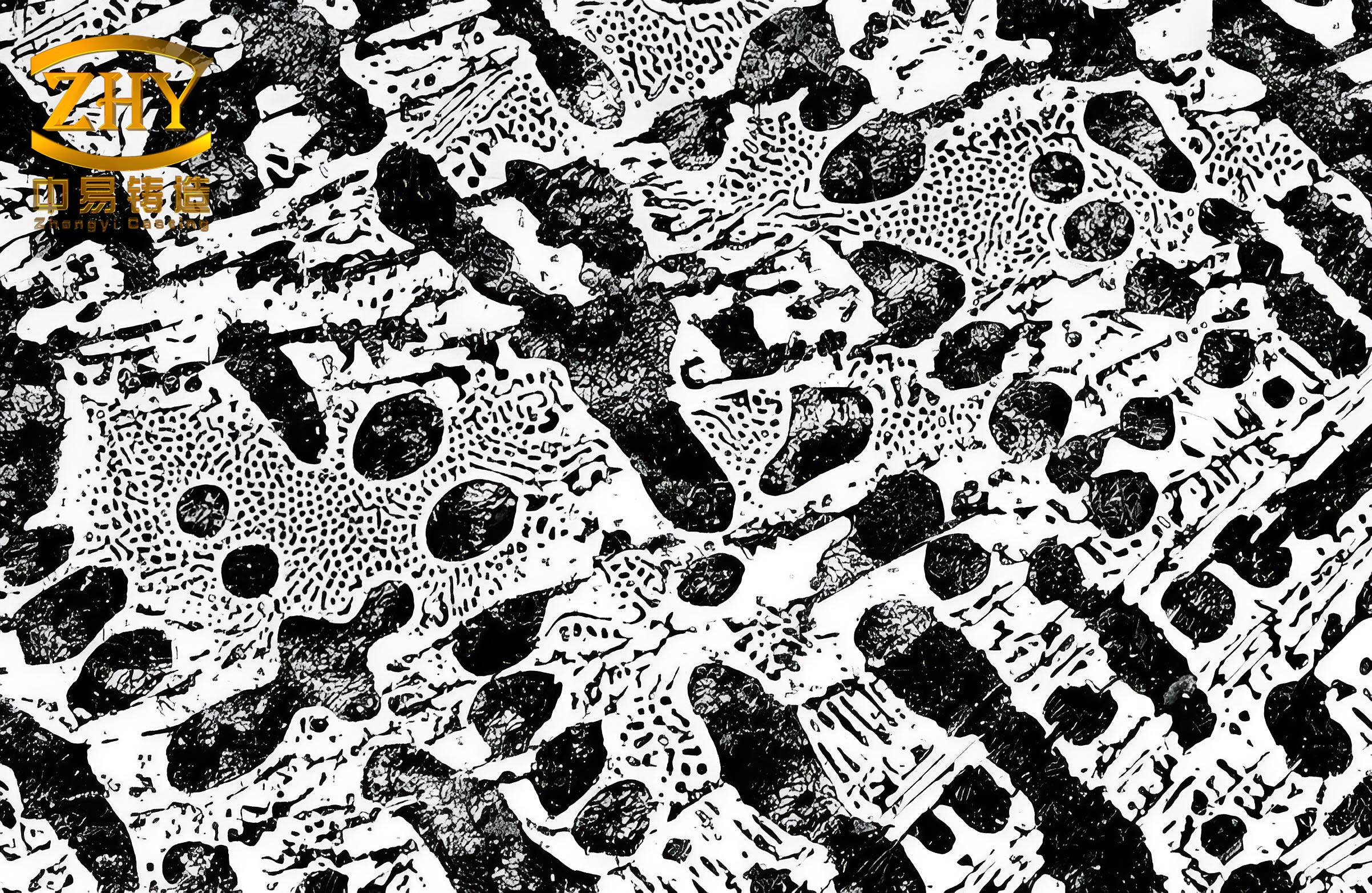
The as-cast microstructure of the low-chromium alloy white cast iron consists of pearlite, ledeburite (eutectic carbide network), and secondary carbides. Pearlite appears as coarse lamellae, while the ledeburite forms a continuous network, and secondary carbides exhibit a needle-like morphology dispersed within the pearlite or attached to the eutectic carbides. This structure is typical of white cast iron but is modified by the chromium addition, which refines the carbides and improves stability. Upon quenching, the microstructure transforms significantly. At lower quenching temperatures (e.g., 850°C), only partial austenitization occurs, resulting in a mixture of martensite, retained austenite, and undissolved carbides. As the quenching temperature increases to 950°C, complete austenitization leads to a martensitic matrix with dispersed carbides. At 1050°C, grain growth and increased alloy content in austenite result in coarser martensite and higher retained austenite. The austempered sample exhibits a lower bainite matrix, which combines high strength and toughness. These microstructural changes directly affect the mechanical properties, as detailed below. To visually represent the typical microstructure of white cast iron, consider the following image link, which illustrates the carbide network and matrix phases common in such materials:
The mechanical properties of the low-chromium alloy white cast iron are summarized in Table 2 for various states. The as-cast material has a hardness of approximately 45 HRC and an impact toughness of 2.5 J/cm². Normalizing at 900°C does not alter the microstructure substantially, so properties remain similar. Quenching, however, leads to significant improvements. At 950°C quenching, hardness peaks at 62 HRC, while impact toughness decreases to 4.0 J/cm² due to the martensitic transformation. Austempering yields a balance with 58 HRC hardness and 6.5 J/cm² impact toughness, thanks to the tough bainitic structure. These data highlight how heat treatment can tailor the white cast iron for specific applications, enhancing wear resistance without excessive brittleness.
| Condition | Hardness (HRC) | Impact Toughness (J/cm²) |
|---|---|---|
| As-cast | 45 ± 2 | 2.5 ± 0.3 |
| Normalized (900°C) | 46 ± 2 | 2.7 ± 0.3 |
| Quenched at 850°C | 55 ± 2 | 5.0 ± 0.5 |
| Quenched at 950°C | 62 ± 2 | 4.0 ± 0.5 |
| Quenched at 1050°C | 58 ± 2 | 3.0 ± 0.5 |
| Austempered (900°C + 300°C) | 58 ± 2 | 6.5 ± 0.5 |
Tempering further modifies the properties. After quenching at 950°C, tempering at various temperatures was performed, and the results are plotted in Figure 1. Hardness decreases gradually with tempering temperature, following an approximate exponential decay: $$ H = H_0 e^{-k(T – T_0)} $$ where \( H \) is hardness, \( H_0 \) is initial hardness (62 HRC), \( k \) is a constant (0.002 K⁻¹), \( T \) is tempering temperature in Kelvin, and \( T_0 \) is reference temperature (473 K). Impact toughness increases slightly up to 400°C, then plateaus, modeled as: $$ IT = IT_0 + a(1 – e^{-b(T – T_1)}) $$ with \( IT \) as impact toughness, \( IT_0 \) initial value (4.0 J/cm²), \( a \) and \( b \) constants (2.5 J/cm² and 0.005 K⁻¹), and \( T_1 = 473 \, \text{K} \). These trends reflect the tempering of martensite and carbide precipitation, common in heat-treated white cast iron. The淬透性 of this white cast iron was assessed by measuring hardness across the diameter of a φ100 mm grinding ball after quenching and tempering. The hardness profile, shown in Table 3, indicates a surface hardness of 60 HRC, with a hardened depth of 15-20 mm, gradually decreasing to the as-cast hardness at the core. This demonstrates adequate淬透性 for practical sizes, ensuring wear resistance in service.
| Distance from Surface (mm) | Hardness (HRC) |
|---|---|
| 0 (Surface) | 60 ± 1 |
| 5 | 58 ± 1 |
| 10 | 55 ± 2 |
| 15 | 50 ± 2 |
| 20 (Core) | 45 ± 2 |
Hammering tests were conducted on as-cast and heat-treated grinding balls to simulate impact resistance. The balls were struck repeatedly until failure, and the average number of blows is listed in Table 4. Heat-treated white cast iron balls withstand significantly more impacts than as-cast ones, confirming that proper heat treatment enhances toughness and reduces breakage. This is crucial for ball mill applications where impact loads are common.
| Ball Diameter (mm) | As-cast | Heat-Treated (950°C Quench + 250°C Temper) |
|---|---|---|
| φ60 | 15 ± 3 | 45 ± 5 |
| φ100 | 25 ± 5 | 70 ± 8 |
Field trials in industrial settings demonstrated the superior performance of this low-chromium alloy white cast iron. In coal grinding at a power plant, the white cast iron balls showed a wear rate of 80 g/ton of coal, compared to 500 g/ton for forged steel balls—a reduction of 84%. In copper ore processing, the wear rate was 0.45 kg/ton of ore versus 0.80 kg/ton for forged steel balls, a 44% improvement. In cement production, the wear rate dropped from 800 g/ton to 150 g/ton of cement, an 81% reduction. Breakage rates were consistently below 1%, much lower than the 2-3% typical for forged steel. These results validate the耐磨性 of this white cast iron, making it a viable alternative. Economically, the production cost of this white cast iron is around 1200 USD/ton, with a selling price of 1500 USD/ton, yielding a profit margin that supports scalability. For users, the lower wear rate translates to cost savings on replacement balls, reduced downtime, and energy savings due to less frequent maintenance. For instance, in a plant processing 1 million tons of material annually, switching to this white cast iron can save over 100,000 USD in ball costs and reduce electricity consumption by 50,000 kWh, highlighting its social and environmental benefits.
In discussion, the effectiveness of this low-chromium alloy white cast iron stems from its optimized microstructure. Chromium carbides, both eutectic and secondary, provide hard phases that resist abrasion, while the matrix—whether martensitic or bainitic—offers toughness to prevent fracture. Compared to high-chromium white cast iron, which may contain over 10% Cr, our material uses less chromium, reducing cost but still achieving satisfactory performance through careful heat treatment. The淬透性 is sufficient for medium-sized castings, though for larger components, further alloy adjustments might be needed. The wear mechanism in ball mills involves both abrasion and impact; this white cast iron excels due to its high hardness from carbides and reasonable toughness from the matrix. Heat treatment allows tuning: quenching and tempering increase hardness for high-abrasion settings, while austempering improves toughness for high-impact conditions. This versatility makes white cast iron a promising material for diverse耐磨 applications. Future work could explore adding trace elements like molybdenum or vanadium to enhance properties further, but our focus remains on simplicity and cost-effectiveness.
To conclude, our study confirms that low-chromium alloy white cast iron is an excellent material for grinding balls in industries like power, mining, and cement. Its microstructure, comprising pearlite, ledeburite, and carbides in the as-cast state, can be transformed via heat treatment to martensitic or bainitic matrices, significantly boosting hardness and impact toughness. The white cast iron offers wear resistance superior to forged steel, with breakage rates below 1%, and can be produced at low cost using standard foundry practices. Heat treatment, particularly quenching at 950°C and tempering at 250°C, optimizes mechanical properties, while austempering provides a balanced alternative. Field trials demonstrate practical benefits, including reduced consumption and downtime. Thus, this white cast iron represents a significant advancement in耐磨材料, combining performance, economy, and ease of production. We recommend its widespread adoption to replace traditional materials, contributing to industrial efficiency and sustainability. The enduring relevance of white cast iron in耐磨 applications is underscored by this research, paving the way for further innovations in alloy design and processing.