
The relentless wear and tear experienced by components in agricultural machinery represents a significant economic and material challenge. It is widely acknowledged that wear is the predominant failure mode for such parts, accounting for over 80% of material consumption. This translates to enormous annual consumption of high-quality steels; for instance, the production of plowshares alone consumes tens of thousands of tons annually. Therefore, the pursuit of materials that offer superior wear resistance combined with acceptable toughness and cost-effectiveness is a critical research frontier in agricultural engineering. Among traditional materials, white cast iron stands out due to its exceptional hardness and abrasion resistance, stemming from its characteristic microstructure rich in hard carbides. Historically, it has been used for applications like plowshares. However, its widespread adoption is severely limited by its characteristically low impact toughness and brittleness. This embrittlement is directly attributable to the continuous, three-dimensional network of carbides that forms within its microstructure during solidification. This network acts as a brittle skeleton, providing easy paths for crack propagation and drastically reducing ductility and fracture resistance.
The core challenge, therefore, lies in modifying the morphology of these carbides—specifically, in breaking up this continuous network into isolated, dispersed, or refined particles. Such a microstructural transformation would preserve the essential hardness and wear resistance of the white cast iron while simultaneously imparting a much-needed improvement in toughness. One of the most practical and commercially viable methods to achieve this during the manufacturing process is through liquid metal treatment, specifically by the addition of inoculants or modifying agents during the melt processing stage. This article, from the perspective of the research conducted, delves into a systematic investigation of a novel multi-component inoculant, designated here as the BZ modifier, and its efficacy in refining the carbide structure of both unalloyed and low-chromium white cast iron. The goal is to evaluate its potential for enabling the use of these more economical and wear-resistant irons in a broader spectrum of demanding agricultural components.
Methodology and Experimental Procedures
The entire experimental procedure was centered on the controlled melting, treatment, and characterization of various white cast iron compositions. Melting was carried out in a 25 kg capacity, 50 kW basic-lined medium-frequency induction furnace. Charges were calculated for an 8 kg melt. The base iron, comprising pig iron and pure iron, was first melted. Subsequently, other master alloys were added to achieve the target chemical composition. Once complete homogenization was achieved, fluorite (CaF₂) was added for slag formation, followed by slag removal. The critical step of inoculation was then performed: the BZ modifier, pre-crushed to particles smaller than 5 mm and wrapped in aluminum foil, was plunged into the molten bath at approximately 1500°C. The melt was held for 5 minutes after addition to ensure adequate dissolution and reaction before casting into pre-heated, coated metal molds. For each heat, one test block was cast before inoculation (to serve as the baseline) and one after inoculation.
The chemical compositions of the investigated white cast iron samples are summarized in Table 1. The study encompassed unalloyed white cast iron with two different carbon levels, as well as chromium-alloyed white cast iron with two chromium levels. A specific subset of experiments also investigated the role of a particular element, referred to as ‘D’ within the modifier complex.
| Sample ID | C | Si | Mn | Cr | Category |
|---|---|---|---|---|---|
| BC-1 | 2.2 | 0.89 | 0.8 | 0 | Low-C, Unalloyed |
| BC-2 | 3.2 | 1.29 | 0.8 | 0 | High-C, Unalloyed |
| BCr-1 | 2.6 | 1.05 | 0.8 | 1.0 | Low-Cr |
| BCr-2 | 2.6 | 1.05 | 0.8 | 12.0 | High-Cr |
The composition of the BZ modifier was a key variable. Its base formulation included Si-Ca, Si-Fe, and a Rare Earth (RE) containing Si-Fe alloy. For the samples labeled BX-1, BX-2, and BX-3, the influence of varying the addition level of component ‘D’ was studied, as detailed in Table 2.
| Sample ID | Si-Ca | Si-Fe | RE-Si-Fe | Element D | Purpose |
|---|---|---|---|---|---|
| BX-1 | 1.25 | 0.50 | 3.00 | 0.25 | Study effect of D content |
| BX-2 | 1.25 | 0.50 | 3.00 | 0.50 | Study effect of D content |
| BX-3 | 1.25 | 0.50 | 3.00 | 0.75 | Study effect of D content |
Metallographic preparation followed standard practices: sectioning via wire-electrical discharge machining, grinding with successively finer silicon carbide papers, and polishing with alumina suspension. The samples were etched with a 4% nital solution to reveal the microstructure. Detailed microstructural analysis was conducted using optical microscopy, with the primary focus being the morphology, distribution, and continuity of the carbide phase in both unmodified and modified conditions.
Microstructural Analysis and the Impact of Inoculation
Unalloyed White Cast Iron
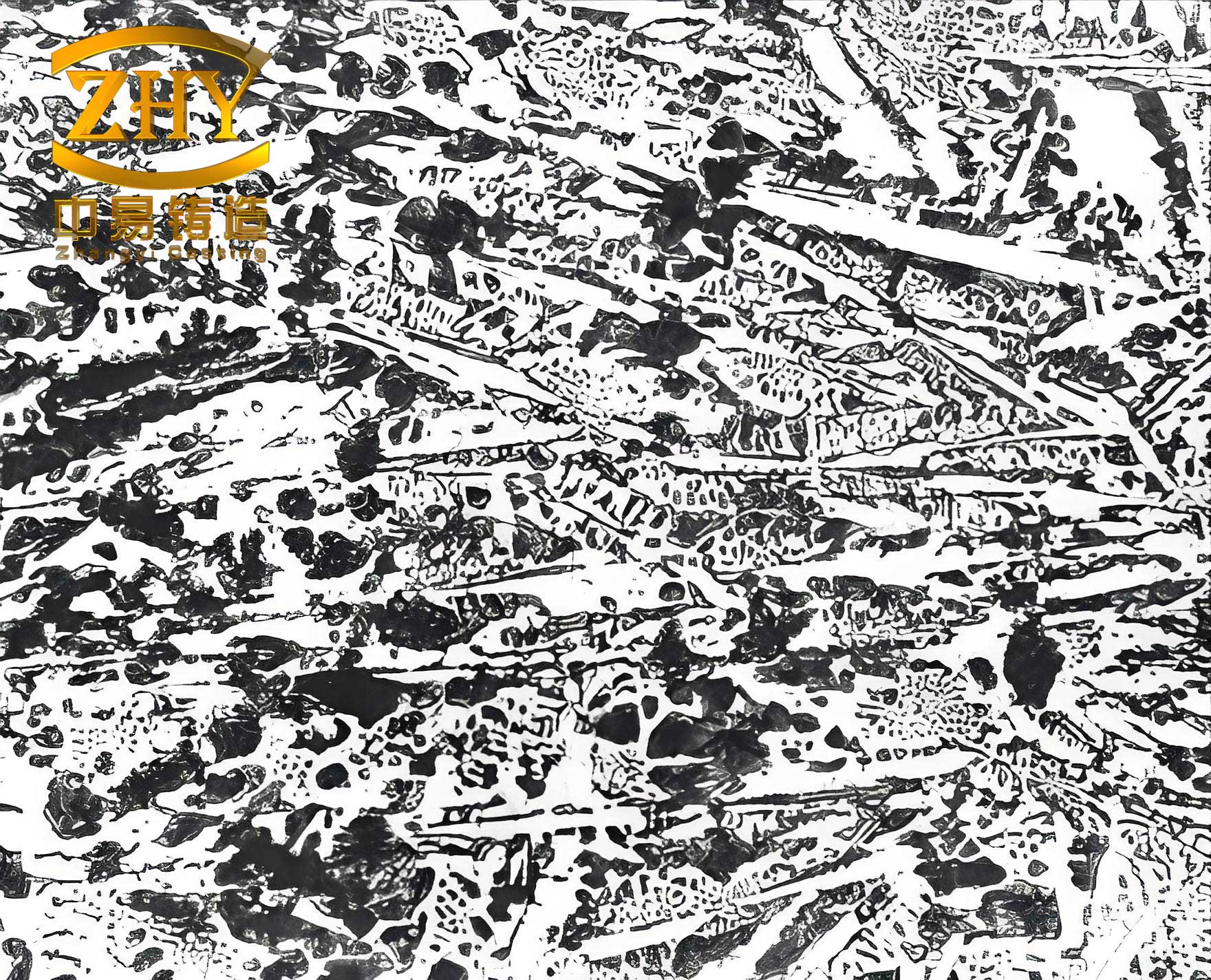
The microstructure of unmodified, low-carbon (2.2% C) white cast iron (Sample BC-1) typically exhibits a pronounced network of carbides. This structure originates from the solidification sequence of hypoeutectic white cast iron. Primary austenite dendrites form first and grow, enriching the interdendritic liquid with carbon. Upon reaching the eutectic composition, the remaining liquid undergoes the eutectic reaction. In the unmodified state, the eutectic cementite tends to form a continuous, interconnected skeleton in the interdendritic regions—a structure known as a divorced eutectic. This is precisely the brittle, crack-sensitive network that degrades toughness.
Inoculation with the BZ modifier dramatically altered this morphology. The treated microstructure showed a significant breakdown of the continuous carbide network. The carbides appeared more isolated, fragmented, and even assumed a blocky or somewhat spheroidal form. This fragmentation reduces the effective crack path continuity, thereby potentially enhancing the material’s resistance to crack propagation and impact loading.
For the higher carbon (3.2% C) unalloyed white cast iron (Sample BC-2), the unmodified structure consisted primarily of ledeburite (the austenite-cementite eutectic mixture) with a smaller proportion of pearlitic matrix. Here, the eutectic carbides themselves form a continuous, fine network. The effect of the BZ modifier, while still evident, was less pronounced than in the low-carbon iron. The modifier induced “necking” or thinning at the connections within the carbide network, with localized fragmentation, but the overall skeletal nature was still largely preserved. This indicates a strong sensitivity of the inoculation effect to the base carbon content of the white cast iron.
Chromium-Alloyed White Cast Iron
The introduction of chromium fundamentally changes the nature of the carbides. In low-chromium irons (e.g., ~1% Cr), the carbides remain predominantly of the M₃C type (cementite) but are alloyed with chromium. In the unmodified state of Sample BCr-1, the carbide network appeared even coarser than in the plain white cast iron of similar carbon level, highlighting chromium’s role as a strong carbide-forming element that promotes carbide formation at lower carbon concentration gradients. Inoculation with the BZ modifier was effective in refining and partially fragmenting this network, though the effectiveness was somewhat diminished compared to the chromium-free counterpart.
High-chromium white cast iron (Sample BCr-2, with 12% Cr) exhibits a different carbide type altogether. The predominant carbide becomes (Cr,Fe)₇C₃, which typically forms as isolated, hexagonal rods, blades, or irregularly shaped particles embedded in the matrix, rather than a continuous network. This intrinsic change already confers better toughness compared to network-forming white cast irons. The unmodified structure of BCr-2 showed these characteristic hard phases. Inoculation with the BZ modifier further refined these carbide particles, making them more discrete, finer, and more uniformly distributed within the matrix. The modifier also contributed to a general refinement of the matrix grains.
The Synergistic Role of Modifier Components
The efficacy of the BZ modifier is not due to a single element but results from the synergistic action of its constituents. The mechanisms can be summarized as follows:
- Rare Earths (RE): RE elements are powerful surface-active agents in molten iron. They adsorb at the growing interface of carbide nuclei, effectively poisoning their growth and preventing them from developing into an extensive network. Furthermore, RE elements can refine prior austenite grains, purify grain boundaries, and may even reduce the overall volume fraction of carbides.
- Silicon (Si) and Calcium (Ca): As non-carbide forming elements, silicon and calcium influence solidification. Silicon atoms have a higher affinity for iron than carbon does. When silicon is added, it tends to repel carbon atoms in the melt, creating localized micro-scale “carbon-rich” zones. This increases the number of potential nucleation sites for carbides, leading to a finer, more numerous population of carbide particles rather than a few large, connected ones. This process can be conceptually linked to a local supersaturation condition. Calcium contributes to deoxidation and desulfurization, which cleanses the melt and may also provide additional nuclei for solidification.
- Element D: The specific role of component ‘D’ proved to be highly significant. As illustrated by the BX-series experiments, increasing the ‘D’ content from 0.25% to 0.75% led to a progressive and marked improvement in carbide refinement. The carbides became increasingly finer, more spheroidal, and more uniformly dispersed. It is postulated that ‘D’ either forms very stable, high-melting-point compounds that act as potent heterogeneous nucleation sites for the carbides, or it strongly influences the interfacial energy between the carbide and the melt, altering the growth kinetics. The effect can be modeled as increasing the number density of nucleation sites, \( N \), which inversely affects the final grain or particle size according to classic solidification theory. If we consider the growth of a carbide particle, its radius \( r \) at time \( t \) might be described by a simplified relationship involving the diffusion coefficient \( D_C \) and the supersaturation \( \Delta C \):
$$ r \propto (D_C \cdot \Delta C \cdot t)^{1/2} $$
However, with effective inoculation increasing \( N \), the available solute for each particle is reduced, limiting the final size.
A summary of the microstructural observations is consolidated in Table 3.
| White Cast Iron Type | Key Unmodified Feature | Effect of BZ Modification | Relative Efficacy |
|---|---|---|---|
| Low-C (~2.2%C), Unalloyed | Coarse, continuous carbide network (divorced eutectic). | Pronounced network fragmentation; carbides become isolated/blocky. | High |
| High-C (~3.2%C), Unalloyed | Fine, continuous ledeburitic network. | Network necking and localized fragmentation; skeleton remains. | Moderate |
| Low-Cr (~1%Cr) | Coarse, continuous M₃C network. | Network refinement and partial fragmentation. | Moderate to Good |
| High-Cr (~12%Cr) | Isolated, hard (Cr,Fe)₇C₃ particles. | Further refinement and dispersion of carbide particles; matrix grain refinement. | Good |
Discussion on Mechanism and Thermodynamic Considerations
The underlying principle of modifying white cast iron lies in interfering with the natural solidification path to favor a discrete, rather than continuous, carbide phase. The formation of a network is thermodynamically and kinetically favored under normal cooling conditions for hypereutectic and hypoeutectic Fe-C alloys. The modifier alters the interfacial energies and nucleation kinetics.
The adsorption of surface-active elements like RE at the carbide/liquid interface reduces the interfacial energy \( \gamma_{SL} \). This reduction can change the critical nucleation radius \( r^* \) as described by the classical nucleation theory equation:
$$ r^* = \frac{2 \gamma_{SL}}{\Delta G_v} $$
where \( \Delta G_v \) is the volume free energy change. A lower \( \gamma_{SL} \) decreases \( r^* \), enabling a higher nucleation rate \( I \), which is exponentially sensitive to \( (r^*)^{-2} \):
$$ I \propto \exp\left(-\frac{\Delta G^*}{k_B T}\right) \quad \text{with} \quad \Delta G^* \propto \frac{\gamma_{SL}^3}{(\Delta G_v)^2} $$
A higher nucleation rate leads to a finer, more numerous distribution of carbide nuclei, consuming the available carbon more uniformly and preventing the excessive growth of a few interconnected crystals.
Furthermore, elements like Si and ‘D’ can influence the local solute distribution. Silicon’s tendency to create carbon-enriched zones can be conceptualized as increasing the local supersaturation \( \Delta C \), thereby increasing the driving force \( \Delta G_v \) for nucleation in those zones. Element ‘D’, likely forming stable nitrides, borides, or carbides, provides ready-made substrates (heterogeneous nuclei) with a low lattice mismatch with the growing carbide, drastically reducing the energy barrier \( \Delta G^* \) for nucleation.
The diminished effect in higher carbon white cast iron can be attributed to the overwhelming volume fraction of the eutectic. With more carbon to precipitate as carbide, even a high nucleation rate may not suffice to completely prevent interconnection before the remaining liquid solidifies. The effect in chromium-containing white cast iron is modulated by chromium’s powerful affinity for carbon, which stabilizes the carbide phase and can dominate the solidification sequence, partially overriding the influence of the inoculant.
Conclusions and Implications for Agricultural Machinery
This investigation into the modification of white cast iron with the BZ inoculant leads to several key conclusions with direct relevance to material selection in agricultural equipment manufacturing:
- Efficacy in Unalloyed White Cast Iron: The BZ modifier is highly effective in breaking up the continuous carbide network in unalloyed white cast iron, particularly when the carbon content is below approximately 3.2%. The modification effect is more pronounced in lower carbon grades, where it can transform the microstructure from a brittle network to one with isolated, refined carbides.
- Efficacy in Chromium-Alloyed White Cast Iron: The modifier also demonstrates a clear refining effect on the carbide structure in white cast iron containing up to 12% chromium. It refines and disperses both the network-forming M₃C carbides in low-chromium versions and the already discrete M₇C₃ carbides in high-chromium versions, though its absolute network-breaking power is somewhat less than in chromium-free irons.
- Critical Role of Specific Components: The performance of the complex inoculant is synergistic. Elements like RE, Si, Ca, and particularly component ‘D’ play crucial and complementary roles in enhancing nucleation, poisoning growth, and refining the final microstructure. The positive correlation between the addition level of ‘D’ and the degree of carbide refinement is especially noteworthy.
- Pathway to Improved Toughness: By successfully disrupting the continuous carbide network, this modification technique directly addresses the primary weakness of white cast iron—its low toughness. The transition from a continuous brittle skeleton to a dispersion of hard particles in a tougher matrix is a classic method for improving the fracture resistance of hard materials.
The implications for agricultural machinery are substantial. The ability to enhance the toughness of cost-effective, highly wear-resistant white cast iron opens the door for its application in a wider range of components beyond traditional uses like plowshares. Potential applications could include:
- Critical wearing edges on tillage tools (e.g., chisel points, subsolier points).
- Components in harvesting equipment subject to abrasive wear (e.g., chopper blades, wear plates).
- Parts in material handling systems for grains and soils.
Future work should focus on quantifying the mechanical property improvements, specifically measuring the Charpy impact energy and fracture toughness of the modified white cast iron versus the unmodified state. Furthermore, field trials of components manufactured from this modified material are essential to validate its performance under real-world abrasive and impact conditions encountered in agriculture. The combination of liquid metal modification with subsequent heat treatments (e.g., sub-critical annealing to soften the matrix further) could be an even more powerful route to engineering a new class of economical, high-performance abrasion-resistant materials for the agricultural sector.