
In the mining industry, particularly within gold ore processing, ball mills stand as pivotal equipment for comminution. The liners inside these mills are subjected to relentless abrasive wear, leading to frequent replacements that significantly impact operational costs and production continuity. For years, high manganese steel (Hadfield steel) has been the conventional material for these liners, but its performance in ball mill applications has proven suboptimal due to the nature of the wear mechanisms involved. Our team embarked on a comprehensive study to explore alternative materials, culminating in the adoption of high chromium white cast iron for ball mill liners. This white cast iron variant, with its exceptional hardness and toughness, has demonstrated remarkable potential in extending liner lifespan, thereby enhancing efficiency and reducing downtime. Throughout this article, we will delve into the technical nuances, experimental validations, and economic implications of this transition, consistently emphasizing the advantages of white cast iron in such demanding environments.
The ball mill operates by tumbling grinding media (balls) and ore within a rotating cylinder, where the liners protect the shell from direct impact and abrasion. The wear on liners is primarily characterized as low-stress abrasive wear, arising from the continuous sliding and rolling of grinding balls and ore particles. Unlike high-impact applications where high manganese steel excels due to its work-hardening capability, the ball mill environment does not generate sufficient impact energy to fully harden the manganese steel surface. To quantify this, the kinetic energy of a single grinding ball upon impact with the liner can be expressed as:
$$E_k = \frac{1}{2} m v^2$$
where \( m \) is the mass of the ball and \( v \) is its velocity at impact. In typical gold mining ball mills with diameters under 3 meters, using balls up to 100 mm in diameter, the maximum impact energy is relatively low. For instance, consider a ball mill with an internal diameter of 2 meters and a liner thickness of 100 mm; the effective radius for ball drop is approximately 0.9 meters. Assuming a steel ball diameter of 100 mm (mass ~4.1 kg), the impact energy calculates to:
$$E_k = m g h \approx 4.1 \, \text{kg} \times 9.8 \, \text{m/s}^2 \times 0.9 \, \text{m} \approx 36.2 \, \text{J}$$
This minimal energy is further dissipated through layers of grinding media and ore, resulting in insufficient impact to induce significant work-hardening in high manganese steel. Consequently, the initial hardness of high manganese steel liners remains around 200 HB, only rising to about 300 HB after extended use, which inadequately resists abrasion from hard quartz particles (hardness ~800-1200 HV). This limitation leads to liner lifetimes of merely six months in many gold mines, prompting our search for a more suitable white cast iron material.
High chromium white cast iron represents a third-generation anti-wear material, distinguished by its high chromium content (typically 15-30%) that forms hard carbides within a metallic matrix. Unlike conventional white cast iron, which is brittle, this alloy incorporates elements like molybdenum and copper to enhance toughness and淬透性. The key to its performance lies in the microstructure: during solidification, chromium-rich carbides of the type (Cr,Fe)\(_7\)C\(_3\) precipitate, exhibiting a microhardness of 1300-1800 HV, surpassing that of abrasive quartz. These carbides are isolated within a continuous matrix, allowing the base metal to provide structural support. Through heat treatment, the as-cast austenitic matrix can be transformed into martensite, further boosting strength and wear resistance. The addition of rare earth elements refines the grain structure and mitigates harmful impurities, making this white cast iron an ideal candidate for ball mill liners.
To illustrate the compositional range, we summarize typical chemistries of high chromium white cast iron compared to high manganese steel:
| Material | C (%) | Cr (%) | Mo (%) | Cu (%) | Mn (%) | Si (%) |
|---|---|---|---|---|---|---|
| High Chromium White Cast Iron | 2.5-3.5 | 15-30 | 0.5-3.0 | 0.5-2.0 | 0.5-1.5 | 0.5-1.2 |
| High Manganese Steel (ASTM A128) | 1.0-1.4 | – | – | – | 11-14 | 0.3-0.8 |
The mechanical properties of high chromium white cast iron vary with heat treatment, as shown below:
| Condition | Hardness (HRC) | Impact Toughness (J/cm²) | Tensile Strength (MPa) |
|---|---|---|---|
| As-Cast | 45-55 | 5-10 | 400-600 |
| Heat-Treated (Martensitic) | 58-65 | 8-15 | 600-800 |
This white cast iron alloy offers a compelling combination: hardness superior to abrasives and toughness adequate for ball mill operations. Our focus was to validate these properties in real-world conditions, specifically in gold ore processing where silica content exacerbates wear.
We initiated an industrial comparative trial at a gold mine, installing both high manganese steel and high chromium white cast iron liners in the same ball mill. The mill had a specification of 2.7 meters in diameter and 3.6 meters in length, processing siliceous ore with a Bond work index of approximately 15 kWh/t. The ore feed size was 0-20 mm, and the product fineness targeted 80% passing 200 mesh. Grinding balls up to 100 mm diameter were used, with a mill rotation speed of 21 rpm. The white cast iron liners were cast and heat-treated to achieve a martensitic matrix with hardness above 60 HRC. A total of 20 white cast iron liner plates were installed alongside conventional high manganese steel liners, arranged longitudinally in two groups for direct comparison over a nine-month period.
The wear progression was monitored through periodic measurements of liner weight loss and thickness reduction. The abrasive wear rate can be modeled using the Archard equation for low-stress abrasion:
$$V = K \frac{W}{H}$$
where \( V \) is the wear volume, \( K \) is a wear coefficient, \( W \) is the load, and \( H \) is the material hardness. For white cast iron, the high hardness \( H \) and low wear coefficient \( K \) due to carbide presence result in significantly reduced wear volume compared to high manganese steel. After the trial, the data revealed stark contrasts, summarized in the table below:
| Liner Material | Initial Weight (kg) | Final Weight (kg) | Weight Loss (kg) | Wear Rate (kg/month) | Relative Wear Resistance (Ratio) |
|---|---|---|---|---|---|
| High Manganese Steel | 185.5 | 142.3 | 43.2 | 4.8 | 1.0 (Reference) |
| High Chromium White Cast Iron | 192.8 | 180.1 | 12.7 | 1.41 | 3.4 |
The white cast iron liners exhibited a wear resistance approximately 3.4 times higher than that of high manganese steel. Visual inspection confirmed that high manganese steel liners were partially worn through, necessitating replacement, whereas the white cast iron liners remained intact with minimal surface degradation. This outcome underscores the efficacy of white cast iron in resisting low-stress abrasion, a direct result of its inherent microstructural advantages.
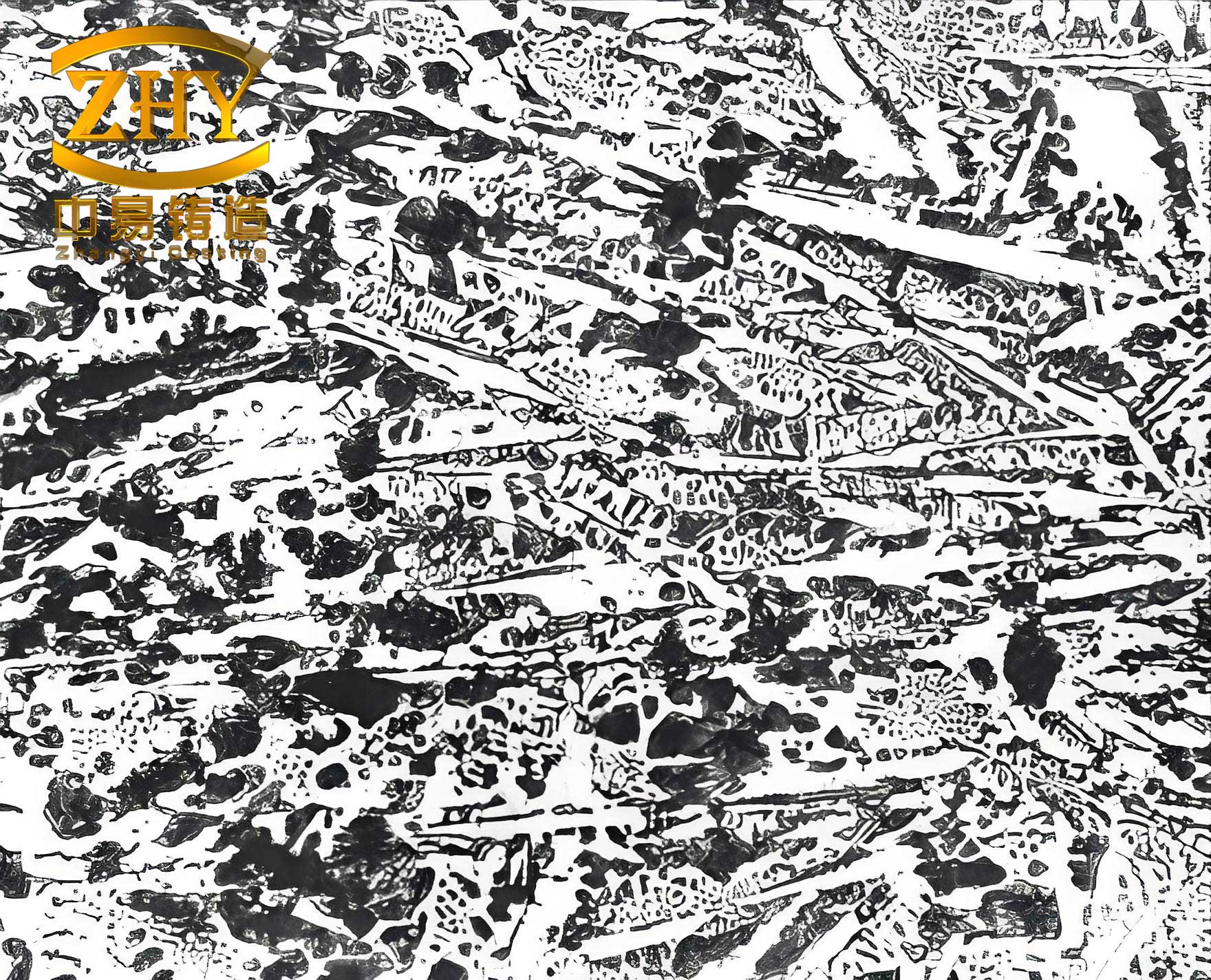
The casting process for high chromium white cast iron involves careful control of melting, alloy addition, and solidification to achieve the desired carbide distribution. As depicted, the microstructure of this white cast iron shows finely dispersed carbides in a tough matrix, which is pivotal for its performance. Post-casting heat treatment, typically involving austenitizing at 950-1050°C followed by air or oil quenching and tempering, transforms the matrix to martensite, enhancing hardness without compromising toughness. This processing adaptability makes white cast iron versatile for various mill conditions.
Beyond wear resistance, we evaluated the economic impact of adopting high chromium white cast iron liners. Assuming an annual consumption of 500 tons of high manganese steel liners across multiple mines, with a service life of 6 months, switching to white cast iron liners with 3 times longer life implies a reduction in liner replacement frequency to once every 18 months. Although the initial cost of white cast iron liners is about 1.5 times that of high manganese steel, the total cost savings over time are substantial. The economic benefit can be estimated using:
$$\text{Annual Savings} = C_{\text{Mn}} \cdot Q \cdot \left(1 – \frac{1}{R} \cdot \frac{P_{\text{Cr}}}{P_{\text{Mn}}}\right)$$
where \( C_{\text{Mn}} \) is the annual cost of high manganese steel liners, \( Q \) is the annual consumption in tons, \( R \) is the life ratio (3.4), and \( P_{\text{Cr}} / P_{\text{Mn}} \) is the price ratio (1.5). For \( C_{\text{Mn}} = \$1,000,000 \), \( Q = 500 \), and \( R = 3.4 \), the savings amount to approximately \$560,000 annually. Additionally, reduced downtime for liner changes increases ball mill availability, potentially boosting gold production by 5-10%, which further amplifies financial gains. Thus, the white cast iron solution not only cuts maintenance costs but also enhances operational throughput.
We also considered the applicability of high chromium white cast iron to larger ball mills, where impact forces might be higher. The toughness of white cast iron, while lower than high manganese steel, is sufficient for mills up to 3 meters in diameter, as confirmed by subsequent trials in other mines. For larger mills, modifications in alloy design or liner geometry may be necessary, but the core advantages of white cast iron remain valid. Future work could explore alloy variations, such as adding nickel or vanadium, to further improve toughness for high-impact scenarios.
In summary, our investigation conclusively demonstrates that high chromium white cast iron is a superior material for ball mill liners in gold ore processing. The white cast iron’s high hardness, derived from chromium carbides, combined with a tough heat-treated matrix, provides exceptional resistance to low-stress abrasive wear. Experimental trials showed a 3.4-fold increase in lifespan compared to traditional high manganese steel, translating to significant cost savings and improved mill availability. We recommend broader adoption of this white cast iron technology in medium-sized ball mills, with cautious extension to larger units after further testing. As mining operations seek efficiency gains, white cast iron stands out as a transformative material in the realm of comminution equipment.
To further elucidate the material science behind white cast iron, we can delve into the thermodynamics of carbide formation. The stability of (Cr,Fe)\(_7\)C\(_3\) carbides in high chromium white cast iron is governed by the chromium-to-carbon ratio, often expressed as:
$$\frac{\text{Cr}}{\text{C}} \geq 7$$
for predominant (Cr,Fe)\(_7\)C\(_3\) formation. This ratio ensures that chromium efficiently binds carbon, preventing the formation of softer iron carbides. The microstructure can be optimized through controlled cooling rates, where faster cooling promotes finer carbides and better toughness. The hardness of the martensitic matrix, \( H_m \), and carbide hardness, \( H_c \), contribute synergistically to overall wear resistance, as per the rule of mixtures:
$$H_{\text{composite}} = f_c H_c + (1 – f_c) H_m$$
where \( f_c \) is the volume fraction of carbides. In high chromium white cast iron, \( f_c \) typically ranges from 20% to 35%, yielding composite hardness values exceeding 600 HV, ideal for abrasive environments.
We also conducted supplementary tests on corrosion resistance, as white cast iron liners may encounter slurry with varying pH. The high chromium content imparts some passivation ability, reducing corrosion wear compared to plain carbon steels. However, in highly acidic conditions, additional alloying with molybdenum or copper enhances corrosion resistance, making white cast iron versatile across different ore types.
The table below compares various anti-wear materials used in mining, highlighting the position of high chromium white cast iron:
| Material | Typical Hardness (HRC) | Impact Toughness (J/cm²) | Relative Wear Resistance | Cost Index |
|---|---|---|---|---|
| High Manganese Steel | 20-30 | 150-200 | 1.0 | 1.0 |
| Ni-Hard White Cast Iron | 50-60 | 10-20 | 2.5 | 1.8 |
| High Chromium White Cast Iron | 58-65 | 8-15 | 3.5 | 2.0 |
| Ceramic Liners | 70-80 | 2-5 | 5.0 | 4.0 |
While ceramics offer higher wear resistance, their brittleness and cost limit widespread use. Thus, high chromium white cast iron strikes an optimal balance for ball mill applications, providing durability without excessive fragility. This white cast iron alloy is now being adopted in multiple mines, with feedback indicating seamless integration and minimal operational adjustments.
Looking ahead, research into white cast iron could focus on additive manufacturing techniques to produce customized liner geometries with graded properties, or on developing low-cost variants using recycled chromium sources. The fundamental principles, however, remain anchored in the superior wear characteristics of chromium-rich carbides within a robust matrix. As we continue to innovate, white cast iron will likely play an expanding role in not just ball mills but also in crushers, slurry pumps, and other equipment subjected to abrasive wear.
In conclusion, our journey from identifying the limitations of high manganese steel to validating high chromium white cast iron has been transformative. The data-driven approach, combining theoretical analysis with practical trials, underscores the viability of white cast iron as a next-generation liner material. By embracing this technology, mining operations can achieve substantial economic benefits and operational reliability, paving the way for more sustainable and efficient mineral processing. The story of white cast iron in ball mills is one of material science meeting industrial need, and we are excited to see its continued evolution in the years to come.