
The pursuit of enhanced durability and cost-effectiveness in wear-resistant materials for demanding industrial sectors—such as mining, cement production, power generation, and metallurgy—has long focused on alloy white cast irons. Among these, hypoeutectic low-chromium white cast iron presents an attractive compromise due to its relatively simple production process, lower cost compared to high-alloy variants, and inherently good wear resistance. However, its widespread application and service life are severely constrained by one critical microstructural flaw: the presence of continuous, coarse, and networked primary and eutectic carbides, predominantly of the M3C type. This brittle carbide network acts as a preferential path for crack initiation and propagation, leading to poor toughness and premature catastrophic failure under impact or high-stress abrasion. Consequently, improving the toughness of low-chromium white cast iron without sacrificing its hardness and wear resistance remains a pivotal engineering challenge.
Recent fracture mechanics studies on related high-chromium white cast irons have indicated that a significant percentage of cracks propagate along the eutectic carbide boundaries. It is logical to infer that in low-chromium white cast iron with its more continuous carbide network, this percentage would be even higher, fundamentally explaining its low fracture toughness. This research investigates a strategic approach to microstructural engineering: the use of multi-component, trace alloy addition for metastable modification (often termed “inoculation” or “modification”). The core hypothesis is that targeted modification can alter the nucleation and growth kinetics of carbides during solidification, transforming their morphology from a continuous network to a dispersed, isolated, and refined state. This microstructural refinement is expected to impede crack propagation, thereby enhancing toughness and potentially synergistically improving wear performance through a better-supported hard phase in a tougher matrix.
The fundamental metallurgy of white cast iron solidification is governed by the Fe-C-X phase diagram, where X represents alloying elements like Cr. In hypoeutectic compositions, the solidification sequence begins with the precipitation of primary austenite (γ) dendrites:
$$ L \rightarrow L_1 + \gamma_{primary} $$
As the temperature drops to the eutectic range, the remaining liquid undergoes the eutectic transformation. For low-chromium white cast iron, this typically results in a ledeburitic structure of austenite and cementite (M3C):
$$ L_1 \rightarrow \gamma_{eutectic} + M_3C $$
The morphology of this eutectic carbide is highly sensitive to cooling rate and chemical composition. Under normal conditions and with certain solute elements, it grows cooperatively, forming the characteristic continuous network. The modification process aims to disrupt this cooperative growth.
Experimental Methodology and Material Design
Melting and casting were conducted in a medium-frequency induction furnace lined with basic refractory. To isolate the effect of modification, the base chemical composition of the low-chromium white cast iron was held within a narrow, typical range. The target composition is summarized in Table 1.
| C | Si | Mn | Cr | P | S | Fe |
|---|---|---|---|---|---|---|
| 2.8 – 3.2 | 0.4 – 0.8 | 0.5 – 1.0 | 2.0 – 3.0 | < 0.1 | < 0.05 | Bal. |
The modifying agent was a carefully formulated compound containing Boron (B), Titanium (Ti), and Rare Earth (RE) elements. These elements were chosen based on their distinct and potentially synergistic effects on solidification thermodynamics and kinetics. The modifier was added to the molten metal via an in-stream inoculation process at a temperature of approximately 1450-1500°C, just prior to pouring. The treated metal was then cast into sand molds to produce standard test specimens for mechanical and wear property evaluation. Key specimens included unnotched impact test samples and transverse rupture (three-point bend) test samples.
The experimental matrix was designed using statistical methods (e.g., orthogonal arrays) to efficiently evaluate the individual and interactive effects of the modifying elements (B, Ti, RE) and their addition levels. For comparison, unmodified reference heats of low-chromium white cast iron were also produced under identical melting and casting conditions. A subset of both modified and unmodified samples subsequently underwent a standard heat treatment cycle involving austenitization, followed by air quenching to form a martensitic matrix, and tempering to relieve stresses. This was done to assess the combined effect of modification and heat treatment.
Characterization involved comprehensive metallographic examination using optical and scanning electron microscopy (SEM) to evaluate carbide morphology, size, and distribution. Mechanical testing included Rockwell hardness (HRC), Charpy impact tests (unnotched), and transverse rupture strength measurements. The relative toughness, a parameter combining hardness and impact energy, was calculated as a more comprehensive metric for abrasive wear materials. Wear resistance was evaluated using a standardized pin-on-drum or block-on-ring abrasion test against a silica sand abrasive, with results expressed as relative wear resistance compared to the unmodified reference material.
Results: Microstructural and Mechanical Transformation
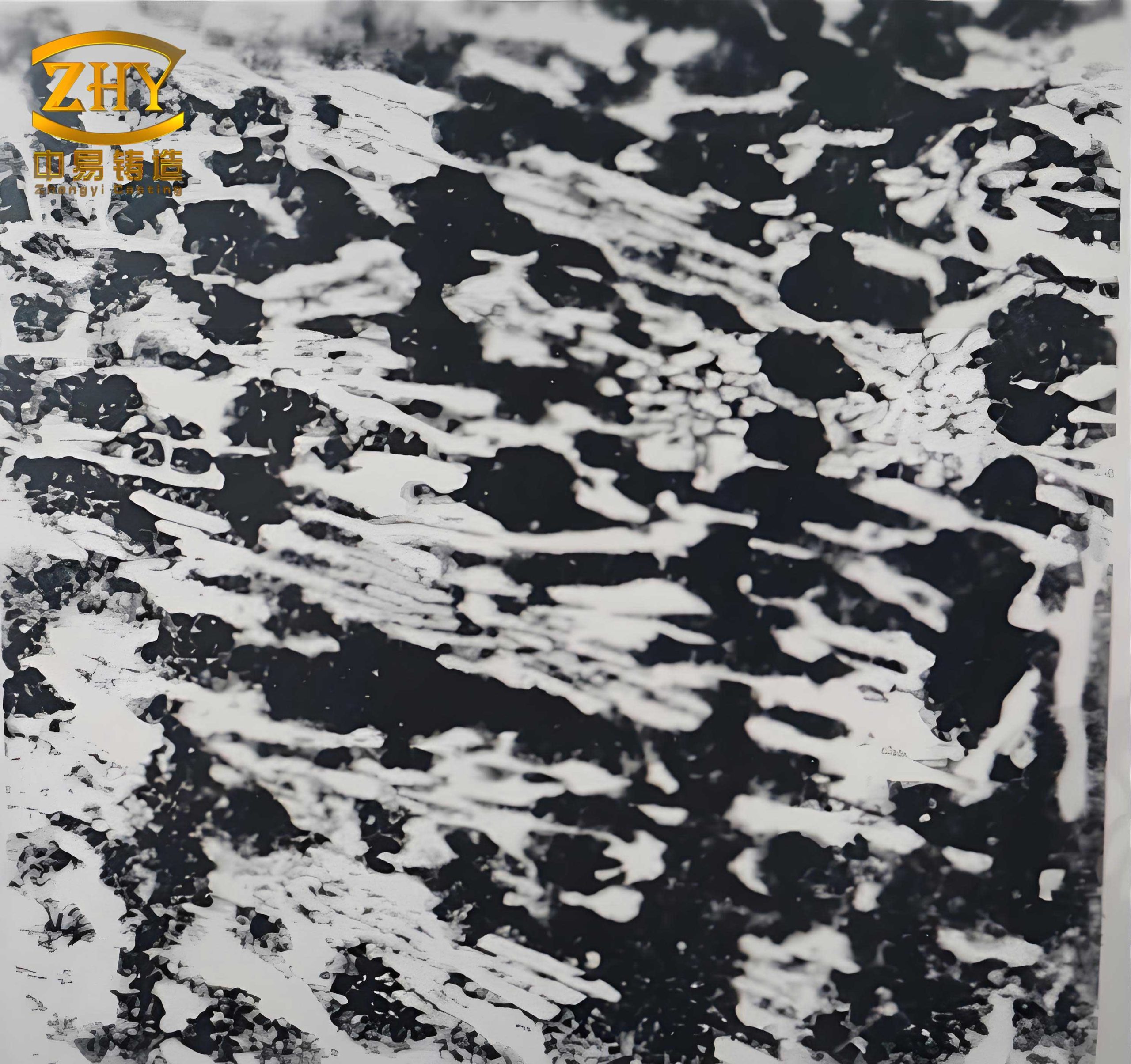
The microstructural analysis revealed a profound transformation induced by the multi-component modification. The typical as-cast structure of unmodified low-chromium white cast iron consisted of coarse primary austenite dendrites surrounded by a continuous, interconnected network of ledeburitic eutectic carbides (M3C).
In stark contrast, the modified white cast iron exhibited a significantly refined microstructure. The primary austenite dendrites were finer. Most notably, the eutectic carbides were no longer continuous. They appeared as isolated, irregular blocks or short rods, dispersed within the interdendritic regions. The network was effectively broken. This refined and disconnected carbide morphology was observed in both the as-cast and the heat-treated conditions, with heat treatment promoting further spheroidization and isolation of carbide particles.
The mechanical property data, summarized in Table 2, quantitatively confirm the benefits of this microstructural change.
| Material Condition | Hardness (HRC) | Impact Energy (J) | Relative Toughness* | Relative Wear Resistance** |
|---|---|---|---|---|
| Unmodified, As-Cast | ~52 | ~4.5 | 1.0 (Baseline) | 1.0 (Baseline) |
| Modified, As-Cast | ~54-55 | ~8.5 – 9.5 | ~1.7 – 2.0 | ~1.1 – 1.2 |
| Unmodified, Heat-Treated | ~58-60 | ~5.0 | ~1.1 | 1.15 |
| Modified, Heat-Treated | ~60-62 | ~11.0 – 13.0 | ~2.2 – 2.5 | 1.25 – 1.35 |
* Relative Toughness = (Impact Energy × Hardness)sample / (Impact Energy × Hardness)baseline
** Relative Wear Resistance = (Volume Loss)baseline / (Volume Loss)sample
The key findings are:
- Significant Toughness Improvement: The impact energy of the modified white cast iron increased by approximately 90-110% in the as-cast state and by over 120-160% after heat treatment compared to its unmodified counterparts. This represents a dramatic enhancement in fracture resistance.
- Synergistic Hardness Increase: Contrary to the often-observed trade-off, hardness slightly increased after modification, likely due to microstructural refinement and solid solution strengthening. The combined effect of higher hardness and much higher impact energy leads to the substantial increase in “Relative Toughness,” a critical index for wear materials.
- Enhanced Wear Resistance: The relative wear resistance improved by 10-20% in the as-cast state and 25-35% after heat treatment. This demonstrates that the toughness gain does not come at the expense of wear performance but actively enhances it, as a tougher matrix better retains the hard carbide particles during abrasion.
Discussion: Mechanisms of Multi-Component Modification
The efficacy of the B-Ti-RE modifier can be explained by its multi-faceted influence on the solidification process of the white cast iron. The mechanisms operate on both nucleation and growth kinetics.
1. Inoculation and Nucleation Enhancement
Titanium and Boron are strong carbide formers. Upon addition to the melt, they readily form high-melting-point compounds such as TiC, TiN, and various borides (e.g., (Fe,Cr)2B). These compounds, with their lattice parameters closely matching those of both primary austenite and cementite, can act as potent heterogeneous nucleation sites. The increased number of nucleation events leads to a finer grain size for the primary austenite. This is described by the classical nucleation theory where the heterogeneous nucleation rate I is given by:
$$ I = K \cdot \exp\left(-\frac{\Delta G^*}{kT}\right) $$
where $\Delta G^*$ is the critical energy barrier for nucleation, significantly reduced by a low interfacial energy ($\sigma$) between the nucleating solid and the substrate. The formation of these inoculants reduces $\Delta G^*$, increasing I and refining the microstructure.
2. Growth Restriction and Carbide Isolation
Rare Earth elements (e.g., Ce, La) are surface-active elements with strong deoxidizing and desulfurizing capabilities. They purify the melt by forming stable oxides and sulfides (e.g., Ce2O3, CeS), which can also serve as additional nucleation substrates. More importantly, RE elements are potent segregants and are known to induce significant constitutional undercooling ahead of the solid/liquid interface during solidification. The degree of constitutional undercooling $\Delta T_c$ is given by:
$$ \Delta T_c = \frac{m_L C_0 (1-k)}{k} \cdot \frac{D_L}{v} $$
where $m_L$ is the liquidus slope, $C_0$ is the bulk composition, $k$ is the partition coefficient, $D_L$ is the diffusion coefficient in the liquid, and $v$ is the growth velocity. For RE elements with $k < 1$, their rejection at the solidifying front increases $\Delta T_c$, destabilizing a planar interface and promoting a finer, more branched growth of the primary austenite.
This refined dendritic array physically confines the remaining liquid pools. Furthermore, the combined solute-rich layer (of B, Ti, RE) at the growing carbide front alters its growth kinetics. The high melting point of primary M3C carbides means they can precipitate as isolated particles before the eutectic reaction commences. The presence of B and Ti, which partition into the carbide, and RE, which segregates at its interface, can suppress the directional, coupled growth of the austenite-cementite eutectic. This promotes a “divorced eutectic” or irregular growth mode, where the austenite grows ahead, enveloping and isolating the cementite particles into discrete, blocky forms rather than allowing them to form a continuous network. This can be conceptualized as shifting the solidification path from cooperative to non-cooperative growth, governed by interfacial energy changes induced by the modifiers.
3. Synergy with Heat Treatment
The post-modification heat treatment (austenitizing and quenching) provides an additional benefit. The initially isolated and refined carbides in the modified white cast iron are more susceptible to Ostwald ripening during high-temperature austenitization. The process can be simplified by the Lifshitz-Slyozov-Wagner theory for diffusion-controlled coarsening:
$$ \bar{r}^3 – \bar{r}_0^3 = \frac{8 \gamma D C_\infty V_m}{9RT} \cdot t $$
where $\bar{r}$ is the mean particle radius, $\gamma$ is the interfacial energy, $D$ is the diffusivity, $C_\infty$ is the solubility in the matrix, $V_m$ is the molar volume, R is the gas constant, T is temperature, and t is time. While this describes coarsening, the key point is that isolated particles with higher curvature (sharp edges) dissolve faster, with solute redistributing to regions of lower curvature. In the modified structure, the already disconnected carbides undergo this shape change more efficiently than a continuous network, further rounding off and spheroidizing, which is highly beneficial for toughness. The modified white cast iron thus shows a more dramatic property improvement after heat treatment than the unmodified material, where the network is resistant to such morphological changes.
Conclusion
This investigation demonstrates that metastable modification using a multi-component inoculant containing Boron, Titanium, and Rare Earth elements is a highly effective and practical method for engineering the microstructure and enhancing the comprehensive properties of hypoeutectic low-chromium white cast iron.
- The modification successfully transforms the deleterious continuous carbide network into a dispersion of isolated, refined, and irregular blocky carbides.
- This microstructural refinement results in a dramatic improvement in impact toughness (increases of 90-160%) alongside a moderate increase in hardness, leading to a significant rise in the relative toughness index (70-150% improvement).
- Contrary to conventional trade-offs, the wear resistance of the modified white cast iron is also enhanced by 10-35%, as the tougher matrix provides better support for the hard carbide phases during abrasive wear.
- The benefits of modification are further amplified by subsequent heat treatment, indicating a powerful synergistic effect for optimal performance.
The underlying mechanisms involve a combination of enhanced heterogeneous nucleation of primary phases, growth restriction leading to dendritic refinement, and the promotion of a divorced eutectic solidification mode that isolates carbide formation. This approach provides a viable pathway to overcome the intrinsic brittleness of traditional low-chromium white cast iron, extending its service life and reliability in severe wear applications, thereby offering substantial economic benefits for industries reliant on durable abrasion-resistant materials.