
In the field of industrial machinery, particularly for slurry pumps operating under abrasive conditions, the selection of materials is critical for durability and cost-effectiveness. As a researcher focused on wear-resistant materials, I have extensively studied various alloys, and in this article, I will delve into the application of medium chromium abrasion-resistant white cast iron in slurry pumps. White cast iron, known for its high hardness and excellent wear resistance, has been a cornerstone in abrasive environments. However, traditional high-chromium white cast iron and nickel-hard white cast iron, while effective, come with high costs. To address this, my work centered on modifying the chemical composition of a medium chromium white cast iron, based on standards like GB/T 8263-1999, to enhance its hardenability and performance after heat treatment. This medium chromium white cast iron offers a promising alternative, balancing performance and economics. Throughout this discussion, I will emphasize the properties and advantages of white cast iron, using tables and formulas to summarize key findings, and share insights from laboratory tests and field applications.
The need for cost-effective wear-resistant materials in slurry pumps is driven by industries such as mining and mineral processing, where pumps handle abrasive slurries containing solids like iron ore or gold tailings. White cast iron, particularly alloyed with chromium, is favored due to its ability to form hard carbides that resist abrasion. In this study, I focused on a medium chromium white cast iron, with chromium content typically ranging from 6% to 11%, which provides a good balance between carbide formation and matrix toughness. The goal was to optimize the composition to achieve martensitic transformation upon air cooling, eliminating the need for expensive quenching media and reducing production costs. This involved adjusting elements like manganese, copper, and molybdenum to improve hardenability while controlling residual austenite. I will detail the experimental methods, results, and practical implications, highlighting how this modified white cast iron can outperform traditional materials in moderate to severe wear conditions.
To begin, let’s explore the chemical composition adjustments made to the medium chromium white cast iron. The base material, similar to KmTBCr5 in standards, had a typical composition in mass percent: 2.1–3.2% C, 1.5–2.2% Si, ≤2.0% Mn, 7.0–11.0% Cr, ≤1.5% Mo, ≤1.0% Ni, ≤1.2% Cu, ≤0.06% S, and ≤0.10% P. This composition is suitable for isothermal quenching but requires modification for air-cooling applications. In my approach, I increased the manganese and copper content to enhance hardenability, as these elements are cost-effective and synergistically improve hardenability without excessively lowering the martensite start temperature (Ms). Silicon was also adjusted to refine carbide morphology and improve toughness. The modified composition aimed for: 2.0–3.5% C, 1.5–2.5% Si, 2.0–3.5% Mn, 6.0–11.0% Cr, ≤1.5% Mo, and ≤2.2% Cu. This tailored white cast iron formulation ensures that after heat treatment, the matrix transforms to martensite with dispersed secondary carbides, providing high hardness and wear resistance. The role of each element in white cast iron is crucial; for instance, chromium promotes the formation of M7C3 carbides, which have a hardness of 1300–1500 HV, significantly higher than ordinary cementite. The following table summarizes the composition comparison and its impact on white cast iron properties.
| Element | Standard White Cast Iron (Base) | Modified Medium Chromium White Cast Iron | Function in White Cast Iron |
|---|---|---|---|
| Carbon (C) | 2.1–3.2% | 2.0–3.5% | Forms carbides, increases hardness |
| Silicon (Si) | 1.5–2.2% | 1.5–2.5% | Refines carbides, improves toughness |
| Manganese (Mn) | ≤2.0% | 2.0–3.5% | Enhances hardenability, stabilizes austenite |
| Chromium (Cr) | 7.0–11.0% | 6.0–11.0% | Promotes M7C3 carbides, improves wear resistance |
| Molybdenum (Mo) | ≤1.5% | ≤1.5% | Increases hardenability, minimal Ms lowering |
| Copper (Cu) | ≤1.2% | ≤2.2% | Improves hardenability synergistically with Mn |
| Nickel (Ni) | ≤1.0% | Excluded | Costly, lowers Ms, not used in this white cast iron |
The preparation of specimens involved melting in a 30 kg medium-frequency induction furnace, with a pouring temperature of 1400°C and casting into resin sand molds. Various samples were produced: wear test specimens (Ø20 mm × 15 mm), impact test specimens (20 mm × 20 mm × 110 mm), simulation cooling specimens (Ø110 mm × 120 mm) to assess hardenability, and castings with wall thicknesses of 20–30 mm. Heat treatment was conducted in a high-temperature electric furnace using two processes: Process I involved austenitizing at 900–980°C for 2–3 hours followed by air cooling, while Process II included a two-step treatment: 980–1050°C for 2–3 hours, then 850–940°C for 3–6 hours, followed by air cooling. Both were tempered at 200–250°C for 4 hours. The microstructural evolution in white cast iron during heat treatment is governed by phase transformations. For instance, the formation of martensite can be described by the Koistinen-Marburger equation for the volume fraction of martensite: $$f_M = 1 – \exp[-k(M_s – T)]$$ where \(f_M\) is the martensite fraction, \(k\) is a constant, \(M_s\) is the martensite start temperature, and \(T\) is the quenching temperature. In this white cast iron, adjustments in Mn and Cu raise the \(M_s\) point, facilitating martensite formation upon air cooling.
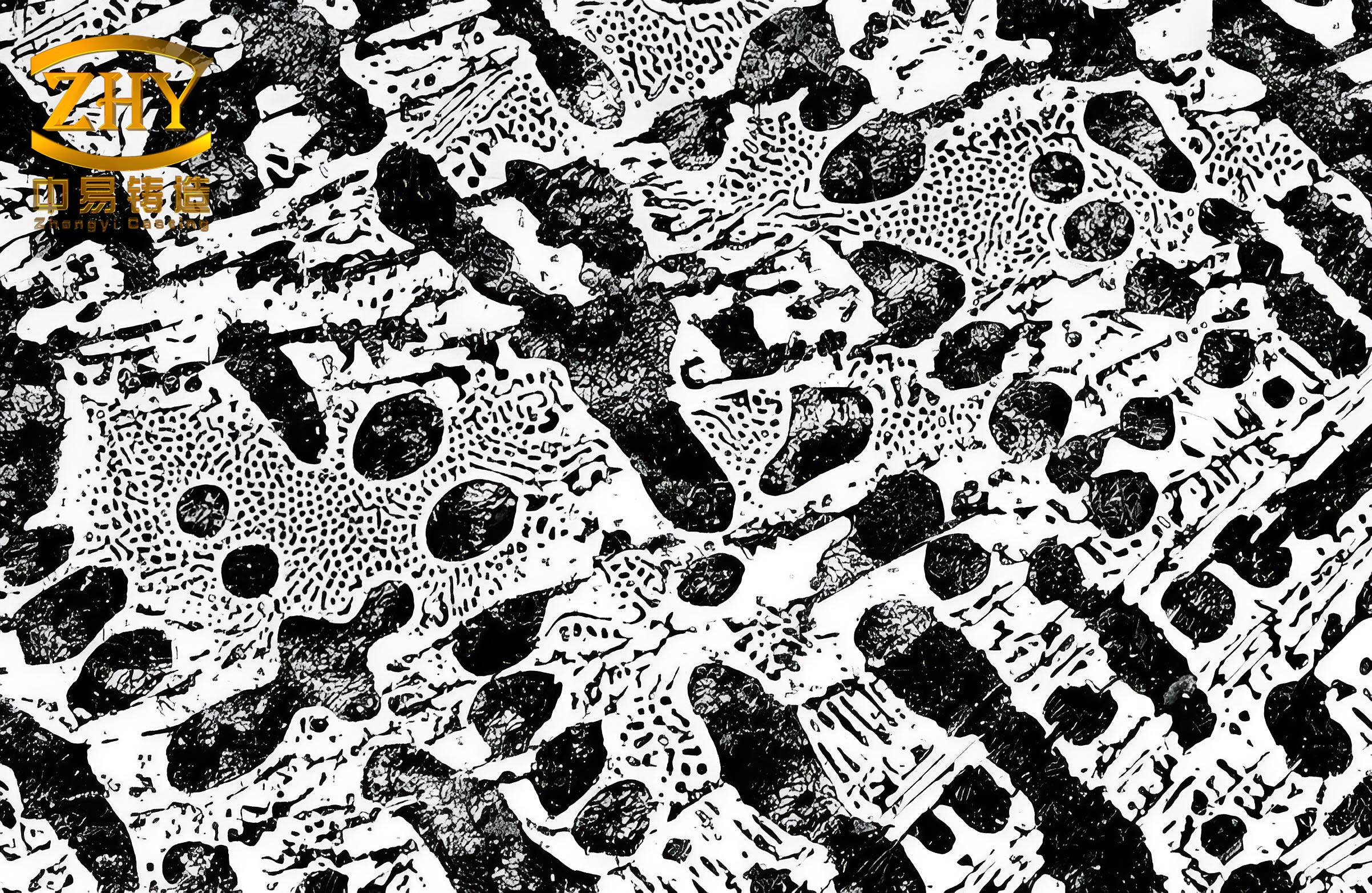
Microstructural analysis revealed that after quenching and tempering, the modified medium chromium white cast iron exhibited a microstructure consisting of eutectic carbides (primarily M7C3 with minor M3C), secondary carbides, martensite, and a small amount of retained austenite. The eutectic carbides were discontinuous, appearing as flower-like or bundle-shaped forms, which reduce stress concentration and improve toughness compared to continuous networks. The matrix contained finely dispersed secondary carbide particles, contributing to precipitation hardening. This structure is typical of high-performance white cast iron alloys, where the carbide volume fraction can be estimated using the lever rule from phase diagrams. For example, in a Fe-Cr-C system, the carbide fraction \(V_c\) can be approximated as: $$V_c = \frac{C – C_\alpha}{C_c – C_\alpha}$$ where \(C\) is the total carbon content, \(C_\alpha\) is the carbon solubility in ferrite, and \(C_c\) is the carbon content in carbides. In this white cast iron, with around 2.5% C and 8% Cr, \(V_c\) is approximately 30%, aligning with observations. The hardness of the carbides in white cast iron, particularly M7C3, can reach 1300–1500 HV, while the martensitic matrix provides a hardness of 700–870 HV after tempering, as measured by microhardness tests.
Mechanical properties were evaluated through hardness, impact toughness, and wear tests. The results are summarized in the table below, showcasing the performance of the modified medium chromium white cast iron in different states. The data indicate that heat treatment significantly enhances hardness and toughness, with Process II yielding slightly higher hardness due to increased secondary carbide precipitation. The impact toughness values, though modest, are sufficient for slurry pump components subjected to abrasive impacts.
| Material State | Core Hardness of 2# Specimen (HRC) | Core Hardness of 3# Specimen (HRC) | Core Hardness of 4# Specimen (HRC) | Matrix Microhardness (HV) | Impact Toughness (J/cm²) |
|---|---|---|---|---|---|
| As-cast White Cast Iron | 42–46 | 34–40 | 35–43 | 500–600 | 4.0–6.5 |
| Process I Treated White Cast Iron | 61–65 | 53–58 | 57–60 | 700–830 | 6.0–8.0 |
| Process II Treated White Cast Iron | 63–65 | 56–61 | 58–62 | 730–870 | 6.0–7.5 |
The wear resistance of white cast iron is paramount for slurry pump applications. To assess this, wear tests were conducted on an MSH-120 abrasion tester using a slurry of 40% 20–40 mesh quartz sand and 60% water, at a rotational speed of 2850 rpm for 5 hours. Mass loss was measured, and relative wear resistance was calculated by comparing with other common wear-resistant materials. The results, presented in the following table, demonstrate that the modified medium chromium white cast iron outperforms Ni-Hard I and is comparable to higher-grade materials like KmTBCr26. The wear rate \(W\) can be expressed as: $$W = \frac{\Delta m}{\rho \cdot A \cdot t}$$ where \(\Delta m\) is mass loss, \(\rho\) is density, \(A\) is worn area, and \(t\) is time. For this white cast iron, the low mass loss indicates superior abrasion resistance, attributed to the hard carbides and martensitic matrix.
| Material | Initial Mass (g) | Final Mass (g) | Mass Loss (g) | Relative Wear Resistance | Notes on White Cast Iron Type |
|---|---|---|---|---|---|
| Modified Medium Chromium White Cast Iron | 1536.399 | 1522.988 | 13.411 | 1.517 | Optimized white cast iron with adjusted composition |
| Ni-Hard I White Cast Iron | 1542.674 | 1522.249 | 20.425 | 1.000 | Standard nickel-chromium white cast iron |
| Ni-Hard IV White Cast Iron | 1553.061 | 1538.260 | 14.801 | 1.389 | High-nickel white cast iron variant |
| KmTBCr26 White Cast Iron | 1501.151 | 1488.106 | 13.045 | 1.524 | High-chromium white cast iron with 26% Cr |
| KmTBCr15Mo3 White Cast Iron | 1452.865 | 1441.707 | 11.158 | 1.724 | Molybdenum-alloyed high-chromium white cast iron |
Field applications in slurry pumps provided practical validation. For instance, in a 6/4-E AH pump at Shougang Miyun Iron Mine, handling slurry with density 1.5 t/m³ and 30–40% solids up to 3 mm, the modified medium chromium white cast iron components lasted 1050 hours, compared to 800 hours for Ni-Hard I white cast iron. Similarly, in a 50 B I pump at Lingshou Tuling Gold Mine, for tailings slurry with density 1.5 t/m³ and 18–20% solids below 20 mesh, the service life was 1560 hours for the modified white cast iron versus 1080 hours for Ni-Hard I. These results translate to a 1.3–1.4 times longer lifespan, demonstrating the efficacy of this white cast iron in moderate to severe abrasive conditions. The wear mechanisms in white cast iron vary with operating conditions: at low speeds and loads, abrasion dominates; at moderate conditions, a combination of abrasion and delamination occurs; and at high speeds and heavy loads, severe adhesion may take over. However, in this white cast iron, the discontinuous carbide network mitigates delamination, while the hard matrix resists abrasion.
Cost analysis is critical for industrial adoption. The table below compares the material costs and performance-to-price ratios, highlighting the economic advantage of the modified medium chromium white cast iron. The raw material cost is significantly lower than other white cast iron alloys, making it an attractive option for slurry pump manufacturers seeking to reduce expenses without compromising performance.
| Material | Raw Material Cost (USD/ton) | Relative Wear Resistance | Performance-to-Price Ratio (Resistance per USD/ton) | Comments on White Cast Iron Economics |
|---|---|---|---|---|
| Modified Medium Chromium White Cast Iron | 3,000 | 1.517 | 5.06 × 10⁻⁴ | Cost-effective white cast iron with optimized composition |
| Ni-Hard I White Cast Iron | 4,970 | 1.000 | 2.01 × 10⁻⁴ | Traditional white cast iron, higher cost due to nickel |
| Ni-Hard IV White Cast Iron | 6,600 | 1.389 | 2.10 × 10⁻⁴ | Premium white cast iron, expensive alloying |
| KmTBCr26 White Cast Iron | 5,300 | 1.524 | 2.88 × 10⁻⁴ | High-chromium white cast iron, moderate cost |
| KmTBCr15Mo3 White Cast Iron | 6,500 | 1.724 | 2.65 × 10⁻⁴ | Molybdenum-enhanced white cast iron, high cost |
The performance-to-price ratio is calculated as relative wear resistance divided by cost, emphasizing the value proposition of this white cast iron. For example, using the formula: $$\text{Performance-to-Price Ratio} = \frac{\text{Relative Wear Resistance}}{\text{Cost}}$$ the modified white cast iron scores 5.06 × 10⁻⁴, which is over twice that of Ni-Hard I white cast iron. This economic benefit, combined with adequate mechanical properties, positions this white cast iron as a viable material for slurry pumps in industries like mining, cement, and power generation.
In conclusion, the modified medium chromium abrasion-resistant white cast iron demonstrates excellent potential for slurry pump applications. Through careful adjustment of chemical composition, particularly increasing manganese and copper to enhance hardenability, and employing optimized heat treatment processes, this white cast iron achieves a martensitic matrix with dispersed carbides, providing high hardness (up to 65 HRC), improved impact toughness (6.0–8.0 J/cm²), and superior wear resistance. Laboratory tests show it outperforms Ni-Hard I white cast iron by 1.5 times in relative wear resistance, and field applications confirm a 1.3–1.4 times longer service life. Economically, its raw material cost is 40–55% lower than other white cast iron alloys, yielding a performance-to-price ratio 1.7–2.5 times higher. This makes it suitable for moderate to moderately severe abrasive conditions, such as in iron ore, gold tailings, or ash slurry pumps. Future work could explore further refinements, like varying carbide morphology or adding trace elements, to extend its application range. Overall, this white cast iron represents a significant advancement in cost-effective wear-resistant materials, aligning with industrial demands for durability and efficiency.