
Our extensive experience in manufacturing cylinder liners for drilling mud pumps in major oilfields has led us to a deep specialization in high-chromium white cast iron. The demanding service conditions—high pressure, high-frequency vibration, and abrasive slurry impact—require a material that masterfully balances exceptional wear resistance with sufficient toughness to withstand internal stresses and assembly procedures. After years of development and refinement, we have established that a centrifugally cast, duplex metal liner, with a high-chromium white iron inner sleeve metallurgically bonded to a steel outer jacket, provides the optimal solution. This article details our comprehensive analysis and the resulting technical framework for producing these critical components.
The Foundational Balance: Hardness, Toughness, and Wear Resistance
The pursuit of wear resistance in materials like white cast iron is fundamentally linked to hardness. Empirically, within the bounds of avoiding catastrophic fracture, wear resistance increases proportionally with material hardness. This relationship can be conceptually modeled for abrasive wear conditions:
$$ W \propto \frac{1}{H} $$
where \( W \) is the wear volume and \( H \) is the material hardness. However, this inverse relationship has limits. When the hardness of the grinding surface becomes excessively high, the dominant wear mechanism can shift from abrasive gouging to surface fatigue. Fatigue wear is a complex function of hardness and toughness. As hardness increases, toughness generally decreases, making the material more susceptible to crack initiation and propagation under cyclic loading. The relationship for fatigue-dominated wear is more nuanced:
$$ W_f \propto \frac{\sigma^n}{K_{IC}^m} $$
where \( W_f \) is fatigue wear rate, \( \sigma \) is the applied stress, \( K_{IC} \) is the fracture toughness, and \( n, m \) are exponents specific to the material and conditions.
For mud pump liners, while the impact is less severe than for crusher hammers or mill liners, the component must endure significant internal stresses from press-fit assembly with the steel jacket. Variations in ovality, taper, and contact area create complex stress fields. Therefore, the high-chromium white iron must possess not only high hardness but also adequate toughness and elastic resilience (rebound tension) to prevent cracking during manufacturing and service. Our goal is to maximize the product of hardness and toughness (\( H \times K_{IC} \)) for the specific application.
The Microstructural Architects: Carbides and Matrix
The superior performance of high-chromium white cast iron stems from its unique microstructure, which consists of hard chromium carbides embedded in a metallic matrix. The wear resistance is a synergistic property of both phases.
Role of Carbides
The heat-treated microstructure typically comprises carbides + martensite + retained austenite. The hard carbides (M7C3 type) act as the primary wear-resistant skeleton. Their volume fraction, morphology, and distribution are critical.
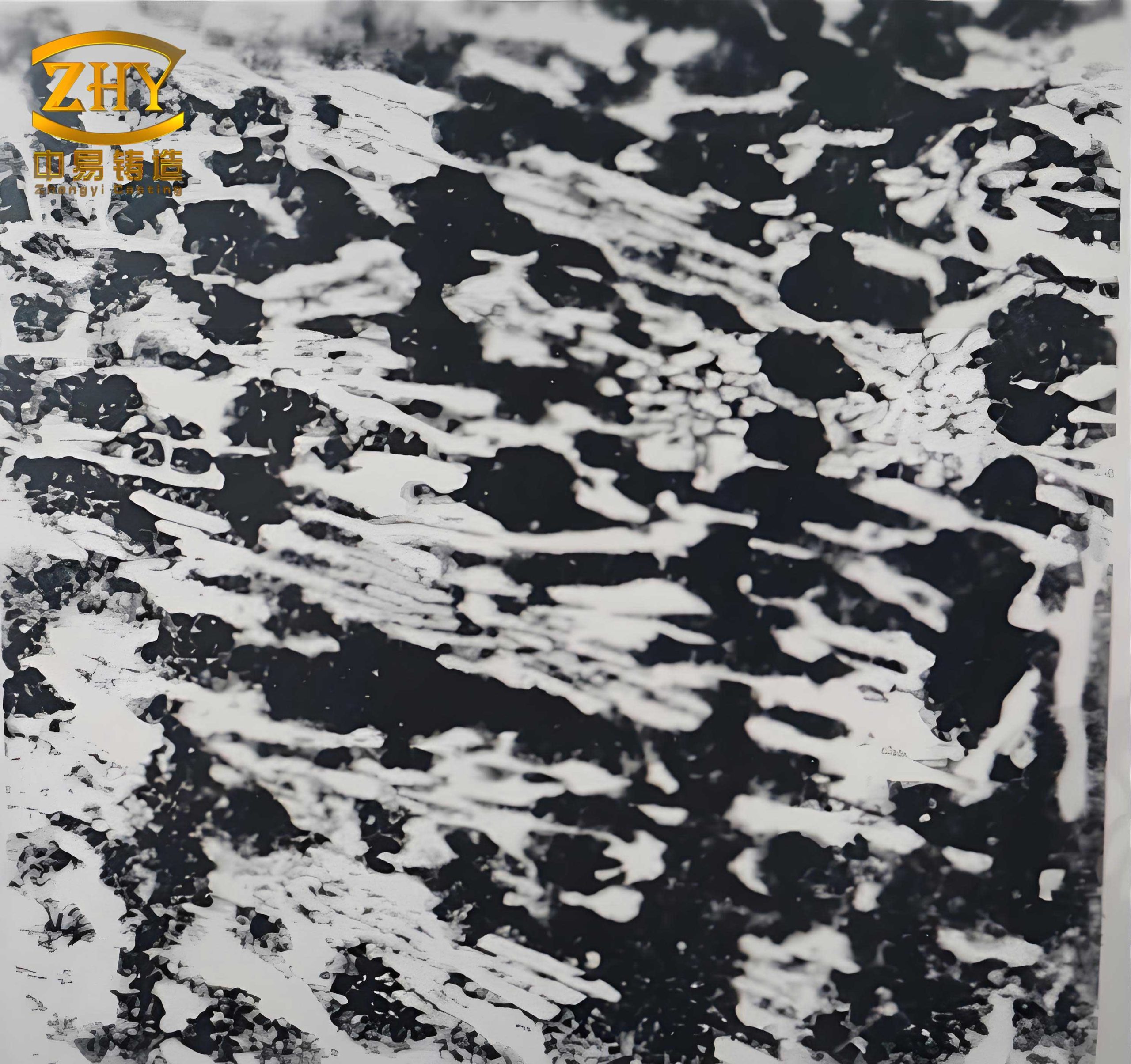
1. Volume Fraction: Primarily controlled by carbon content. Higher carbon increases carbide volume fraction (Vc) and bulk hardness, improving wear resistance provided toughness is maintained. The volume fraction can be estimated for hypoeutectic compositions. The eutectic carbon content itself varies with chromium, approximated by:
$$ C_{eutectic} \approx 4.3 – 0.05 \times (\%Cr) $$
2. Morphology and Distribution: Continuous networks or sharp, elongated carbides severely degrade toughness by providing easy crack paths. Ideal carbide structures are isolated, globular, nodular, or broken networks—an “open skeleton” that resists crack propagation and improves fracture toughness. The morphology is influenced by composition, cooling rate, and melt treatment.
Role of the Matrix
The matrix is the supporting structure that holds the carbide skeleton. Its strength and cohesion with the carbides are paramount. A weak matrix will wear away rapidly, undermining the carbides, which then become prone to fracture and pull-out. These liberated, hard carbide particles then act as third-body abrasives, accelerating wear. For mud pump liners, austenitic matrices are undesirable. Austenite can work-harden under high-stress gouging, but the liner service involves lower-stress abrasion and scratching where austenite remains soft and provides poor support. A strong, hard martensitic matrix is the target, ensuring minimal matrix wear and secure anchoring of the carbides.
In summary, the wear resistance of high-chromium white cast iron is a complex function of the individual properties and the collective interaction of its microstructural constituents:
$$ \text{Wear Resistance} = f(H_{carbide}, V_c, H_{matrix}, \tau_{bond}, K_{IC}(morphology)) $$
where \( \tau_{bond} \) is the interfacial bond strength between carbide and matrix.
Strategic Chemical Composition Design
Based on the above principles, we have optimized the chemical composition of our high-chromium white iron. The target is a hypoeutectic composition that avoids large primary carbides while providing a high volume of eutectic M7C3 carbides in a martensitic matrix.
| Element | Target Range (%) | Function and Rationale |
|---|---|---|
| Carbon (C) | 2.8 – 3.2 | Primary controller of carbide volume and hardness. Kept in the hypoeutectic range to avoid brittle primary carbides and ensure a good carbide-matrix mixture for optimal toughness/hardness balance. |
| Chromium (Cr) | 18-20 or 24-28 | Forms the hard, blocky M7C3 carbides (Cr > 10-12%). Higher Cr (24-28%) promotes some M23C6, improving corrosion/erosion resistance but requiring careful heat treatment. Cr also provides oxidation resistance. |
| Molybdenum (Mo) | 1.0 – 2.0 | Powerful hardenability enhancer, ensuring martensite formation in thicker sections. Modifies carbide morphology towards more isolated shapes. Balances the embrittling effect of strong carbide formers like Vanadium. |
| Manganese (Mn) | 0.5 – 0.8 | Neutralizes sulfur (as MnS). Excess Mn increases hardenability but strongly stabilizes austenite, leading to excessive retained austenite after quenching, which is detrimental for this application. |
| Silicon (Si) | 0.6 – 0.9 | Used for deoxidation during melting and to improve fluidity. Reduces hardenability, so content is limited to avoid pearlite formation in the matrix during quenching. |
| Vanadium (V) | 0.1 – 0.3 | Strong carbide former (forms fine, hard VC). Refines the as-cast structure, reduces columnar grain growth, and increases microhardness of the matrix. Used in conjunction with Mo to optimize the hardness-toughness profile. |
| Sulfur (S) | < 0.05 | Impurity. Kept as low as possible to prevent formation of low-melting-point sulfides at grain boundaries, which cause hot tearing and reduce strength/toughness. |
| Phosphorus (P) | < 0.05 | Impurity. Kept as low as possible to prevent phosphide eutectic networks at grain boundaries, which are brittle and initiate cracks. |
The interplay of Molybdenum and Vanadium on the hardness and impact toughness of a 16% Cr white cast iron is illustrated conceptually below. While V increases hardness, it can reduce toughness; Mo can mitigate this effect and improve overall performance.
$$ H \approx H_0 + k_{Mo}[Mo] + k_{V}[V] – \alpha[V]^2 \quad \text{(for hardness)} $$
$$ A_k \approx A_{k0} – \beta[V] + \gamma[Mo] \quad \text{(for impact energy)} $$
where \( H_0, A_{k0} \) are base values, and \( k, \alpha, \beta, \gamma \) are positive constants.
Casting and Process Technology
Melting and Pouring
We use a medium-frequency induction furnace (e.g., 0.5-ton capacity) for melting. Charge materials include low-silicon pig iron, steel scrap, and the necessary ferroalloys (FeCr, FeMo, FeV, etc.). Melting is conducted under oxidizing conditions initially, followed by deoxidation. A critical process window exists for pouring temperature. While high-chromium white iron has good fluidity, excessive superheat can lead to coarse microstructure, increased segregation, and a higher propensity for hot tearing. Very low temperatures cause cold shuts. Our optimized practice is to superheat to 1550-1580°C for homogenization and effective inclusion removal, then allow the metal to cool (stabilize) to 1500-1520°C before centrifugal casting. The centrifugal casting parameters are crucial:
| Parameter | Control Value | Objective |
|---|---|---|
| Pouring Temperature | 1500 – 1520 °C | Achieve complete filling without coarse grains or shrinkage porosity. Minimize mold dressing reaction. |
| Pouring Rate | ~1.8 – 2.2 kg/s | Adapt to metal temperature: faster for lower temp, slower for higher temp to prevent turbulence and segregation. |
| Mold Rotation Speed | G > 60 (G = ω²r/g) | Generate sufficient centrifugal force (G-force) for dense, sound casting and functional separation of any dross/inclusions towards the inner diameter (which is machined away). |
Melt Inoculation / Modification
To further enhance the toughness of the high-chromium white cast iron, we employ inoculation treatments. These additions do not drastically change the bulk chemistry but profoundly modify the carbide morphology and purify the grain boundaries. Common inoculants include:
- Rare Earth (RE) Silicide (e.g., 1# FeSiRE): Powerful deoxidizer and desulfurizer. RE elements adsorb onto carbide growth fronts, promoting more rounded, isolated carbide shapes instead of connected networks.
- Aluminum: A strong deoxidizer, often used in combination with RE.
- Potassium/Sodium-based modifiers: These elements can also modify eutectic growth, leading to carbide refinement.
The mechanism can be described as affecting the interfacial energy between the growing carbide and the melt, altering the growth kinetics:
$$ \gamma_{mod} = \gamma_{orig} + \Delta \gamma_{inoculant} $$
A change in interfacial energy \( \gamma \) influences the critical nucleation radius and growth morphology, leading to a refined and more favorable carbide structure.
Heat Treatment for Optimal Properties
As-cast high-chromium white iron typically contains a metastable austenitic matrix and may have high residual stresses. A tailored heat treatment cycle is essential to transform the matrix to martensite, relieve stresses, and achieve the target hardness and toughness.
| Process Stage | Typical Parameters | Microstructural Objective | Resulting Property Change |
|---|---|---|---|
| Stress Relief / Annealing (Optional) | 920-950°C for 2-4 hrs, furnace cool. | Reduce casting stresses, slightly soften matrix for easier machining if required. | Reduces hardness by 5-10 HRC, improves machinability. |
| Austenitization | 980-1020°C for 2-4 hrs (air furnace). | Dissolve secondary carbides, enrich austenite with carbon/chromium, achieve homogeneous solid solution. | Fully austenitic matrix (plus primary carbides). High alloying of austenite increases its hardenability and final martensite hardness. |
| Quenching | Air blast or forced air cooling. | Transform austenite to martensite without cracking. Avoid oil/water due to high stress risk. | Forms high-carbon martensite matrix. Target hardness > 60 HRC. Retained Austenite (RA) controlled to < 5%. |
| Tempering | 200-250°C for 4-6 hrs, air cool. | Relieve quenching stresses, temper the martensite slightly for added toughness, promote secondary carbide precipitation from RA (reducing RA%). | Slight hardness drop (1-3 HRC), significant increase in toughness and dimensional stability. Final hardness: 62-64 HRC. |
The final, ideal microstructure consists of hard, globular or broken-network M7C3 carbides uniformly distributed in a strong, tempered martensitic matrix with minimal retained austenite. The success of this heat treatment is contingent on the initial as-cast structure; a defective cast structure with continuous carbide networks cannot be fully remedied by heat treatment.
Conclusion and Performance
The systematic approach to developing high-chromium white cast iron for mud pump liners—balancing chemistry, carbide engineering, matrix control, and precision processing—has yielded a highly reliable product. Our liners, featuring a centrifugally cast and heat-treated white iron inner sleeve metallurgically bonded to a steel jacket, consistently achieve service lives exceeding 900 hours in severe drilling applications. This performance not only meets but often surpasses domestic benchmarks and approaches the level of imported, high-end counterparts. The material’s consistent performance stems from respecting the complex interrelationships governed by the science of white cast iron, proving that optimal wear resistance is an engineered compromise between ultimate hardness, controlled toughness, and microstructural integrity.