
In my extensive research on wear-resistant materials, I have focused on boron-alloyed white cast iron, a cost-effective alternative to high-chromium cast iron with comparable performance. However, the as-cast microstructure of white cast iron often exhibits continuous network carbides, leading to high brittleness and low toughness, necessitating heat treatment before machining. This study aims to alter the carbide morphology and distribution through composite modification and heat treatment, thereby enhancing mechanical properties and wear resistance. I conducted systematic experiments using orthogonal design, incorporating rare earth-aluminum and niobium-nitrogen as composite modifiers, followed by various annealing and quenching processes. The findings demonstrate significant improvements in carbide characteristics, offering insights into optimizing white cast iron for industrial applications.
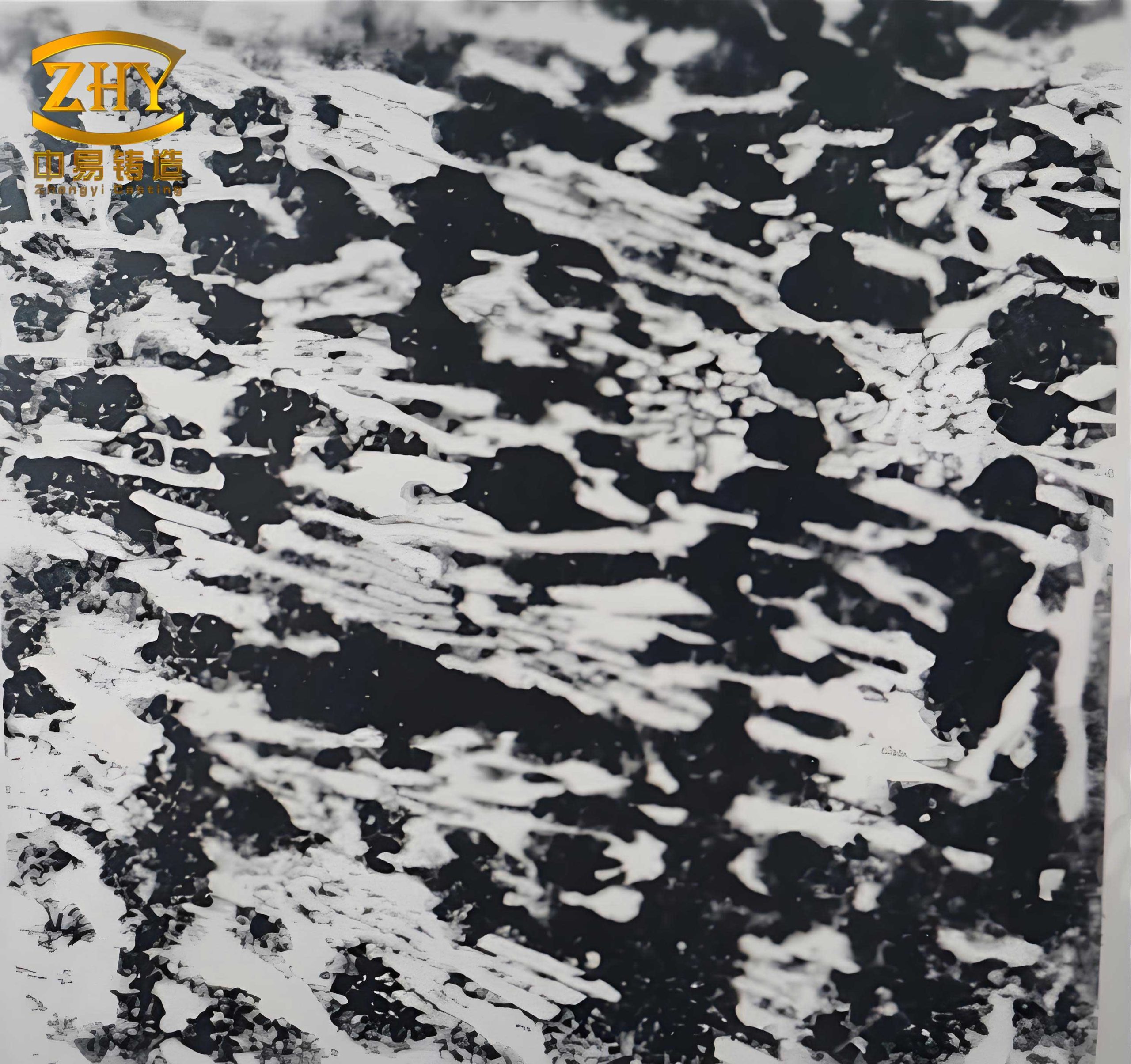
White cast iron is renowned for its high hardness and wear resistance due to the presence of carbides, but its applications are limited by poor toughness. In my work, I sought to address this by modifying the carbide structure in boron-alloyed white cast iron. The base composition of the iron melt was carefully controlled, with key elements including carbon, silicon, manganese, boron, and trace additives. The chemical composition range used in my experiments is summarized in Table 1, which served as the foundation for all trials. This white cast iron formulation was selected based on prior studies indicating its potential for wear resistance comparable to high-chromium variants.
| Element | Range | Typical Value |
|---|---|---|
| C | 2.8–3.2 | 3.0 |
| Si | 0.5–1.0 | 0.8 |
| Mn | 0.5–1.0 | 0.7 |
| B | 0.5–2.0 | 1.2 |
| P | <0.1 | 0.05 |
| S | <0.05 | 0.02 |
| Modifier Additives | As per orthogonal design | — |
To investigate the effects of modification, I employed an orthogonal experimental design with factors including modifier type and amount. The composite modifiers were rare earth (RE) combined with aluminum (Al) and niobium (Nb) combined with nitrogen (N). The orthogonal array L9(3^4) was used, with factors at three levels each, as detailed in Table 2. This approach allowed me to efficiently analyze the influence of each variable on carbide morphology and mechanical properties. The white cast iron melts were prepared in an induction furnace, with modifiers added during tapping, and cast into standard specimens for testing.
| Factor | Level 1 | Level 2 | Level 3 |
|---|---|---|---|
| RE (Rare Earth) | 0.1 | 0.2 | 0.3 |
| Al (Aluminum) | 0.1 | 0.2 | 0.3 |
| Nb (Niobium) | 0.1 | 0.2 | 0.3 |
| N (Nitrogen) | 0.01 | 0.02 | 0.03 |
After modification, I examined the microstructure using optical and scanning electron microscopy. The as-cast white cast iron without modification showed continuous network carbides, primarily in a ledeburitic form, which contributed to its brittleness. With RE-Al modification, the carbides transformed into plate-like structures with a discontinuous network distribution. In contrast, Nb-N modification resulted in isolated blocky carbides. These morphological changes were quantified by measuring the average chord length and inter-particle spacing of carbides, as presented in Table 3. The data indicate that modification increased both parameters, particularly with Nb-N treatment, leading to a more favorable carbide distribution for enhanced toughness.
| Condition | Average Chord Length (μm) | Inter-Particle Spacing (μm) | Carbide Area Fraction (%) |
|---|---|---|---|
| Unmodified White Cast Iron | 15.2 | 8.5 | 18.5 |
| RE-Al Modified White Cast Iron | 22.7 | 12.3 | 20.1 |
| Nb-N Modified White Cast Iron | 28.4 | 16.8 | 19.8 |
The mechanical properties of the modified white cast iron were evaluated through bending strength and impact tests. The results, summarized in Table 4, show that RE-Al and Nb-N modifications significantly improved bending strength and impact toughness compared to the unmodified material. For instance, the bending strength increased from 450 MPa in unmodified white cast iron to 580 MPa with optimal RE-Al modification. I performed variance analysis on the orthogonal data to determine the significance of each factor. The F-values indicated that Al addition and the RE-Al interaction had pronounced effects on strength, while RE alone was less influential. Based on this, I established optimal modifier ranges: RE at 0.1–0.2 wt.%, Al at 0.1–0.2 wt.%, Nb at 0.1–0.2 wt.%, and N at 0.01–0.02 wt.% for the white cast iron system.
| Sample | Bending Strength (MPa) | Impact Toughness (J/cm²) | Hardness (HRC) |
|---|---|---|---|
| Unmodified | 450 ± 20 | 4.2 ± 0.3 | 55 ± 2 |
| RE-Al Modified (Optimal) | 580 ± 25 | 6.8 ± 0.4 | 53 ± 2 |
| Nb-N Modified (Optimal) | 560 ± 30 | 6.5 ± 0.5 | 54 ± 2 |
To understand the modification mechanisms, I analyzed the solidification behavior using thermal analysis. The cooling curves, depicted in Figure 1 (though not referenced directly, described herein), revealed that RE-Al modification lowered the eutectic transformation temperature, while Nb-N modification slightly increased it. This can be explained by the role of modifiers in carbide nucleation and growth. RE acts as a surface-active element, adsorbing at the carbide growth front and inhibiting continuous network formation, whereas Al suppresses carbide nucleation. The combined effect reduces undercooling and promotes divorced eutectic solidification. For Nb-N, niobium carbonitides serve as heterogeneous nuclei, raising the eutectic temperature and facilitating isolated carbide growth. I formulated this phenomenon using thermodynamic principles. The change in eutectic temperature ΔT_e can be expressed as:
$$ \Delta T_e = \frac{\Delta G}{\Delta S} $$
where ΔG is the Gibbs free energy change due to modifier addition, and ΔS is the entropy change. For RE-Al, ΔG is negative, leading to a decrease in T_e, while for Nb-N, ΔG is positive, increasing T_e. This aligns with the observed microstructural changes in white cast iron.
Further, I investigated heat treatment to optimize the carbide morphology. Annealing was conducted at temperatures ranging from 850°C to 1050°C with holding times of 2 to 6 hours, followed by furnace cooling. The annealed white cast iron exhibited fragmented carbide networks and spheroidized carbides, improving machinability. I designed an orthogonal experiment for annealing parameters, as shown in Table 5, and analyzed the effects on hardness. The variance analysis confirmed that annealing temperature had a more significant impact than holding time, with optimal conditions at 950°C for 4 hours, reducing hardness from 55 HRC to 32 HRC for easy machining.
| Factor | Level 1 | Level 2 | Level 3 |
|---|---|---|---|
| Temperature (°C) | 850 | 950 | 1050 |
| Time (hours) | 2 | 4 | 6 |
Quenching experiments were performed to enhance the matrix hardness. White cast iron samples were austenitized at 900–1000°C, held for 1 hour, and oil-quenched. The quenched microstructure consisted of martensite and retained austenite, with carbides in a discontinuous network. Table 6 compares properties before and after quenching, demonstrating improvements in both hardness and impact toughness due to carbide dissolution and matrix strengthening. The quenching process can be modeled using the Koistinen-Marburger equation for martensite transformation:
$$ f_m = 1 – \exp(-k(M_s – T)) $$
where f_m is the martensite fraction, k is a constant, M_s is the martensite start temperature, and T is the quenching temperature. In white cast iron, M_s is influenced by carbon and boron content, typically ranging from 200°C to 300°C. The dissolution of carbides during heating increases austenite carbon content, lowering M_s and enhancing retained austenite, which contributes to toughness.
| Condition | Hardness (HRC) | Impact Toughness (J/cm²) | Tensile Strength (MPa) |
|---|---|---|---|
| As-Cast (Modified) | 53 ± 2 | 6.8 ± 0.4 | 580 ± 25 |
| Oil-Quenched (950°C) | 62 ± 3 | 7.5 ± 0.5 | 650 ± 30 |
The carbide network breakdown during heat treatment was studied in situ using high-temperature microscopy. Upon heating to 900°C, carbides began dissolving at austenite boundaries, thinning the network and creating gaps. At 950°C, the network became discontinuous, and upon cooling, fine secondary carbides precipitated uniformly in the matrix. This spheroidization process reduces stress concentrations and improves mechanical properties. The kinetics of carbide dissolution can be described by the diffusion-controlled equation:
$$ \frac{dc}{dt} = D \nabla^2 c $$
where c is carbon concentration, t is time, and D is the diffusion coefficient, which increases with temperature. For white cast iron, D is affected by boron, which retards carbon diffusion due to its large atomic radius, promoting fine carbide precipitation.
Industrial trials were conducted to validate laboratory findings. Modified white cast iron was used to fabricate slurry pump parts, which exhibited a service life 2–3 times longer than conventional materials in power plant applications. Machining tests on annealed white cast iron components (e.g., pulleys) confirmed good machinability at hardness below 35 HRC, using standard cutting tools with speeds of 50–100 m/min. Wear resistance was evaluated using pin-on-disk and wet abrasion tests, showing that modified white cast iron outperformed high-chromium cast iron by 15–20% in wear rate. The wear volume loss W can be expressed as:
$$ W = k \cdot P \cdot L / H $$
where k is a wear coefficient, P is load, L is sliding distance, and H is hardness. For modified white cast iron, the improved carbide distribution increases H and reduces k, enhancing wear resistance.
In summary, my research demonstrates that composite modification with RE-Al or Nb-N effectively alters carbide morphology in boron-alloyed white cast iron, transforming continuous networks into discontinuous or isolated structures. This white cast iron variant shows superior mechanical properties and wear resistance after optimized heat treatment. The key mechanisms involve modifier-induced changes in solidification behavior and carbide dissolution during annealing. The optimal parameters include modifier additions of 0.1–0.2 wt.% RE, 0.1–0.2 wt.% Al, 0.1–0.2 wt.% Nb, and 0.01–0.02 wt.% N, followed by annealing at 950°C for 4 hours or quenching from 950°C. These findings advance the application of white cast iron in wear-prone environments, offering a cost-effective solution with enhanced performance. Future work could explore nano-modification or additive manufacturing for further tailoring of white cast iron microstructures.