
In the field of thermal power generation, the coal pulverization process is critical for efficient combustion, and the grinding media within ball mills, traditionally composed of medium-manganese ductile iron, face severe degradation. This degradation arises from a combination of abrasive wear—including crushing and gouging types—and corrosive wear due to acidic media present in coal. Consequently, the consumption of grinding balls ranges from 450 to 950 grams per ton of pulverized coal, highlighting a significant operational inefficiency. To address this, we embarked on developing an advanced chromium-manganese-copper alloy white cast iron, aiming to enhance longevity and performance in coal mill environments. This white cast iron material was designed to withstand the harsh conditions, and our comprehensive study delves into its wear resistance, corrosion behavior, and microstructural characteristics. The focus on white cast iron stems from its inherent hardness and potential for alloying to improve toughness and corrosion resistance, making it a promising candidate for such applications.
The design of the chromium-manganese-copper alloy white cast iron involved careful selection of chemical composition to balance hardness, toughness, and corrosion resistance. The target composition ranges are summarized in the table below, which also includes the roles of key elements in enhancing the properties of white cast iron. The addition of chromium and manganese promotes carbide formation and matrix strengthening, while copper improves corrosion resistance and refines the microstructure. Self-made modifiers were used to control graphite formation, ensuring a predominantly white cast iron structure with minimal graphite, which is crucial for reducing electrochemical corrosion cells.
| Element | Composition Range (wt.%) | Primary Function in White Cast Iron |
|---|---|---|
| Carbon (C) | 2.6–3.6 | Forms hard carbides (e.g., Fe3C, alloy carbides) to enhance wear resistance. |
| Manganese (Mn) | 2.0–3.5 | Increases hardenability, stabilizes austenite, and promotes carbide formation. |
| Chromium (Cr) | 0.8–2.5 | Forms chromium carbides (e.g., Cr7C3), improving hardness and corrosion resistance. |
| Copper (Cu) | 0.5–1.5 | Enhances corrosion resistance by forming protective layers and refines microstructure. |
| Silicon (Si) | <1.0 | Controls graphitization; kept low to maintain white cast iron structure. |
| Phosphorus (P) | <0.1 | Minimized to avoid embrittlement and reduce corrosion susceptibility. |
| Sulfur (S) | <0.1 | Kept low to prevent hot tearing and improve ductility. |
| Modifier | Appropriate amount | Inoculates the melt to refine carbides and improve homogeneity. |
The theoretical basis for this composition can be expressed through alloy design equations. For instance, the carbide volume fraction in white cast iron can be estimated using the Lever rule for eutectic systems, considering the carbon content and alloying effects. The total carbide volume \( V_c \) is approximated by: $$ V_c = \frac{C – C_{\alpha}}{C_{carbide} – C_{\alpha}} $$ where \( C \) is the total carbon content, \( C_{\alpha} \) is the carbon solubility in ferrite (negligible in white cast iron), and \( C_{carbide} \) is the carbon content in the carbide phase (e.g., ~6.67% for Fe3C). With alloying, chromium and manganese modify this to form complex carbides, enhancing the wear resistance of the white cast iron. Additionally, the electrode potential \( E \) of the matrix can be improved by alloying, as described by: $$ E = E_0 + \frac{RT}{nF} \ln(a) $$ where \( E_0 \) is the standard potential, \( R \) is the gas constant, \( T \) is temperature, \( n \) is the number of electrons, \( F \) is Faraday’s constant, and \( a \) is the activity of alloying elements. The incorporation of chromium and copper increases \( E \), thereby reducing the corrosion rate of the white cast iron in acidic environments.
Our experimental methodology encompassed three main aspects: abrasion wear testing, corrosion resistance evaluation, and mechanical property assessment. For abrasion wear tests, we utilized a unidirectional reciprocating wear tester with quartz sand as the abrasive medium. Specimens were prepared from the chromium-manganese-copper alloy white cast iron in both as-cast and heat-treated conditions, alongside medium-manganese ductile iron for comparison. The wear loss was measured gravimetrically, and the specific wear rate \( W_s \) was calculated using: $$ W_s = \frac{\Delta m}{\rho \cdot A \cdot L} $$ where \( \Delta m \) is the mass loss in grams, \( \rho \) is the density of the material in g/cm³, \( A \) is the contact area in cm², and \( L \) is the sliding distance in meters. This formula allows for a normalized comparison of wear resistance across different materials. For corrosion tests, we employed a 20% sulfuric acid solution to simulate aggressive acidic conditions, with a 72-hour exposure time under electromagnetic stirring to maintain fluid flow. Specimens, including 45 steel, medium-manganese ductile iron, and the chromium-manganese-copper white cast iron, were uniformly distributed in the medium. The corrosion loss was determined gravimetrically per unit area, and the corrosion rate \( CR \) was computed as: $$ CR = \frac{K \cdot W}{A \cdot t \cdot D} $$ where \( K \) is a constant (8.76 × 10⁴ for mm/year), \( W \) is the mass loss in grams, \( A \) is the area in cm², \( t \) is the time in hours, and \( D \) is the density in g/cm³. Mechanical properties, such as hardness and impact toughness, were evaluated according to standard protocols, with hardness measured in HRC and impact energy in J/cm².
The heat treatment experiments were pivotal in optimizing the properties of the chromium-manganese-copper alloy white cast iron. Initially, 263 as-cast specimens exhibited hardness values between HRC 54.0 and 60.0, with impact toughness ranging from 0.24 to 0.46 × 9.8 J/cm². To enhance the toughness while maintaining adequate hardness, we conducted two orthogonal heat treatment trials using an Lg(3⁴) design. The results indicated that normalizing within the temperature range of 930–1050°C yielded the best balance of hardness and toughness. Post-treatment, the white cast iron showed hardness of HRC 52.0–58.0 and impact toughness of 0.45–0.79 × 9.8 J/cm². The improvement in toughness can be attributed to microstructural changes, which we will discuss later. The heat treatment kinetics can be modeled using the Avrami equation for phase transformations: $$ f = 1 – \exp(-k t^n) $$ where \( f \) is the fraction transformed, \( k \) is a rate constant, \( t \) is time, and \( n \) is the Avrami exponent. For this white cast iron, normalization promoted the precipitation of secondary carbides and spheroidization of eutectic carbides, leading to a more ductile matrix.
Abrasion wear test results demonstrated the superior performance of the heat-treated chromium-manganese-copper white cast iron. The mass losses were 2.21 g for medium-manganese ductile iron, 3.43 g for as-cast white cast iron, and 0.69 g for heat-treated white cast iron. This translates to a wear resistance improvement by a factor of 3.2 for the heat-treated white cast iron compared to medium-manganese ductile iron. The wear mechanism involves both micro-cutting and fatigue, with the hard carbides in the white cast iron resisting abrasion. The wear volume \( V_w \) can be related to the applied load \( P \) and sliding distance \( L \) through the Archard wear equation: $$ V_w = K \frac{P L}{H} $$ where \( K \) is a wear coefficient and \( H \) is the hardness of the material. The higher hardness and optimized microstructure of the heat-treated white cast iron result in a lower \( K \), confirming its enhanced durability. The table below summarizes the wear test data, highlighting the advantages of this advanced white cast iron.
| Material | Condition | Mass Loss (g) | Relative Wear Resistance (vs. Medium-Manganese Ductile Iron) | Key Microstructural Features |
|---|---|---|---|---|
| Medium-Manganese Ductile Iron | As-cast | 2.21 | 1.0 (baseline) | Graphite nodules in ferritic matrix |
| Chromium-Manganese-Copper White Cast Iron | As-cast | 3.43 | 0.64 | Ledeburite eutectic + pearlite |
| Chromium-Manganese-Copper White Cast Iron | Heat-treated (Normalized) | 0.69 | 3.20 | Eutectic carbides + pearlite + secondary carbides |
Corrosion resistance tests revealed significant benefits of the chromium-manganese-copper alloy white cast iron. The specific area losses were 7073.08 g/m² for 45 steel, 4632.83 g/m² for medium-manganese ductile iron, and 2621.49 g/m² for normalized white cast iron. This indicates that the white cast iron offers a 1.2 to 1.7 times improvement in corrosion resistance over 45 steel and a 29% to 57% improvement over medium-manganese ductile iron. In coal mill environments, raw coal typically contains 0.3–5.0% sulfur and 10–15% moisture, with operating temperatures between 120–180°C, creating acidic conditions that accelerate metal loss through reactions like: $$ \text{Fe} + \text{H}_2\text{SO}_4 \rightarrow \text{FeSO}_4 + \text{H}_2 \uparrow $$ The alloying elements in the white cast iron, particularly chromium and copper, elevate the electrode potential of the matrix, reducing the driving force for electrochemical corrosion. Moreover, the minimal graphite content in this white cast iron decreases the number of galvanic cells, as graphite acts as a cathode in ferrous alloys. The corrosion current density \( i_{corr} \) can be expressed by the Stern-Geary equation: $$ i_{corr} = \frac{B}{R_p} $$ where \( B \) is a constant and \( R_p \) is the polarization resistance. The white cast iron exhibits a higher \( R_p \) due to its alloyed matrix, leading to lower \( i_{corr} \) and thus better performance. These factors make the chromium-manganese-copper white cast iron highly suitable for coal grinding applications, where both wear and corrosion synergistically degrade materials.
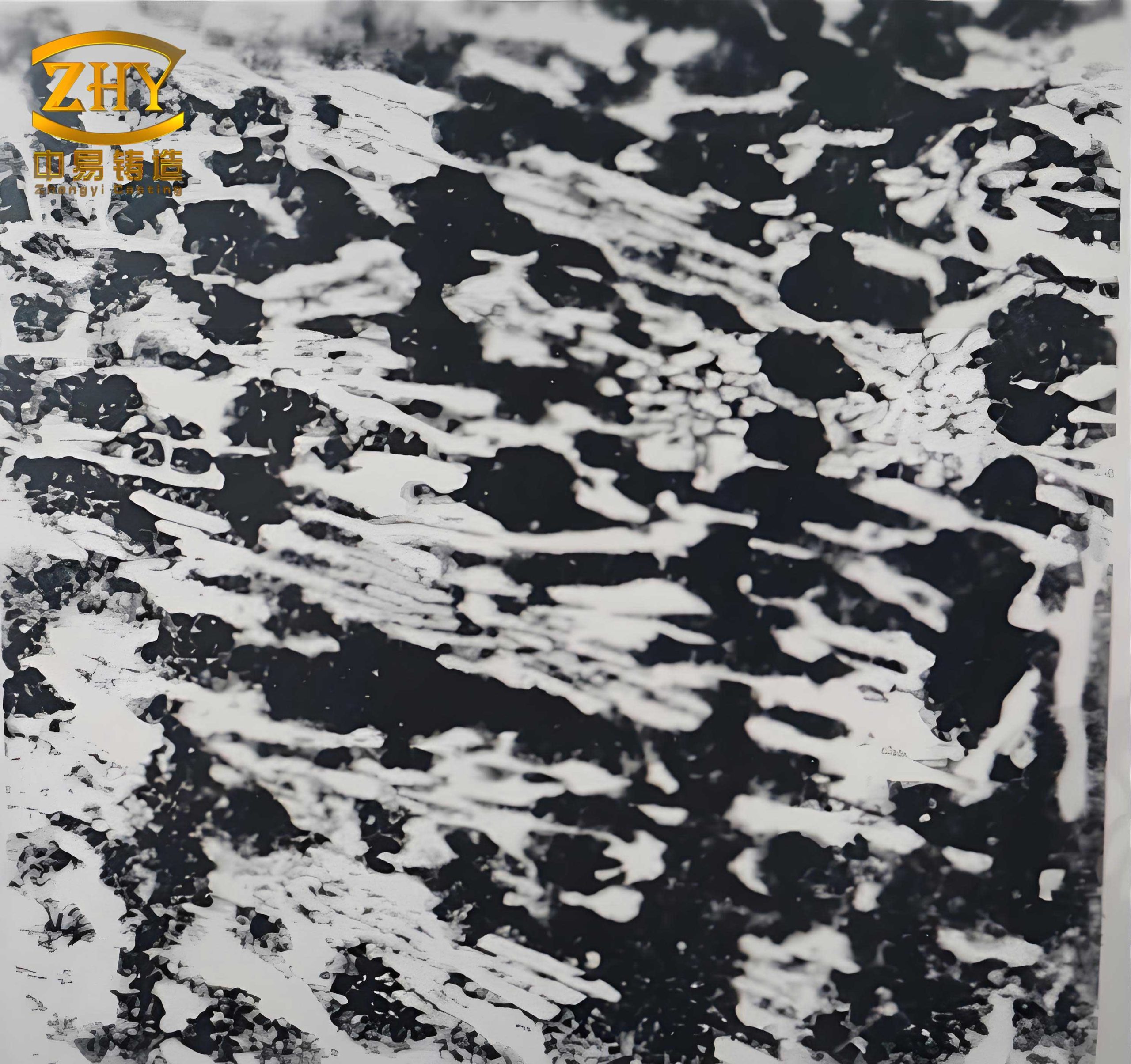
Microstructural analysis provided insights into the property enhancements of the chromium-manganese-copper alloy white cast iron. In the as-cast state, the microstructure consists of ledeburite eutectic (a mixture of austenite and cementite) and pearlite, with pearlite often encircled by eutectic carbides that exhibit a directional alignment. This structure contributes to high hardness but limited toughness. After normalizing heat treatment, the microstructure evolves to comprise eutectic carbides, pearlite, and dispersed secondary carbides. Compared to the as-cast condition, the amount of eutectic carbides decreases, while pearlite increases, and the edges of eutectic carbides become rounded, reducing stress concentrations. The secondary carbides appear as fine dots, particles, and small blocks uniformly distributed in the matrix, enhancing toughness and ensuring homogeneous hardness. The balance between these phases depends on the heat treatment temperature, as described by the phase diagram approximations. For instance, the volume fraction of secondary carbides \( V_{sc} \) can be estimated from the alloy composition and temperature using: $$ V_{sc} = \frac{C_{alloy} – C_{sol}}{C_{carbide} – C_{sol}} $$ where \( C_{alloy} \) is the alloy carbon content, \( C_{sol} \) is the carbon solubility in austenite at the treatment temperature, and \( C_{carbide} \) is the carbon content in the carbide. Microhardness measurements confirmed that the alloyed pearlite in this white cast iron has a hardness of HV 428–483, substantially higher than conventional pearlite due to solid solution strengthening from manganese and chromium. This refined microstructure is key to the superior wear and corrosion resistance of the white cast iron, as it combines hard phases for abrasion resistance with a tough matrix for impact load tolerance.
The application of this chromium-manganese-copper alloy white cast iron in coal pulverization systems offers substantial economic and operational benefits. By replacing traditional medium-manganese ductile iron balls, the consumption rate can be reduced significantly, leading to lower maintenance costs and downtime. The enhanced durability of the white cast iron also contributes to consistent grinding efficiency, as the ball size distribution remains stable over longer periods. In practice, the service life \( L_s \) of grinding media can be modeled as: $$ L_s = \frac{K_1}{\text{Wear rate} + K_2 \cdot \text{Corrosion rate}} $$ where \( K_1 \) and \( K_2 \) are system-dependent constants. For the developed white cast iron, both wear and corrosion rates are minimized, thereby maximizing \( L_s \). Furthermore, the environmental impact is reduced due to less frequent replacement and lower energy consumption in milling. Future work could explore variations in alloy composition, such as increasing chromium content for even better corrosion resistance or adding elements like molybdenum for enhanced high-temperature stability. The versatility of white cast iron as a material platform allows for such tailoring, making it adaptable to other industrial applications beyond coal grinding, such as mining and cement production.
In conclusion, our development of chromium-manganese-copper alloy white cast iron represents a significant advancement in materials for abrasive and corrosive environments. Through optimized composition design and heat treatment, we achieved a material that exhibits superior wear resistance, corrosion resistance, and mechanical properties compared to conventional alternatives. The microstructural modifications, including refined carbides and alloyed pearlite, underpin these improvements. This white cast iron is poised to revolutionize grinding media in coal pulverization systems, offering a durable and cost-effective solution. Continued research into white cast iron alloys will further expand their utility, driving innovation in heavy industrial applications where durability and efficiency are paramount.