
In my extensive research on alloyed white cast iron, I have focused on understanding how eutectic morphology influences material properties, particularly toughness. White cast iron is renowned for its high wear resistance, making it a valuable material for anti-wear components. However, its inherent brittleness, due to the continuous network of eutectic carbides, has limited its widespread application. Historically, from the 1920s onward, alloying has been explored to mitigate this issue, leading to various systems like chromium-based, manganese-based, and chromium-nickel-based white cast iron. Yet, even these alloyed versions, such as high-chromium white cast iron, often exhibit poor toughness, with room-temperature impact values around 2-4 J (unnotched Charpy) and fracture toughness (KIC) of 14-20 MPa·m1/2 for austenitic bases and 20-25 MPa·m1/2 for martensitic bases. This persistent challenge prompted me to investigate alternative approaches to modify eutectic carbide morphology, aiming to achieve discontinuous, uniformly distributed carbides that enhance ductility without compromising wear resistance.
My investigation centers on the hypothesis that by carefully adjusting alloy element combinations in white cast iron, it is possible to induce divorced eutectic solidification and constitutional undercooling, leading to ideal microstructures. In this study, I explore the effects of elements like chromium, tungsten, and molybdenum on eutectic morphology and carbide types. Through systematic experiments, I have identified compositions that yield blocky or rod-like eutectic carbides, which are isolated and evenly dispersed, rather than interconnected as in typical ledeburite structures. This paper details my findings, analyses the mechanisms behind these morphologies, and proposes practical strategies for developing high-performance alloyed white cast iron with improved toughness.
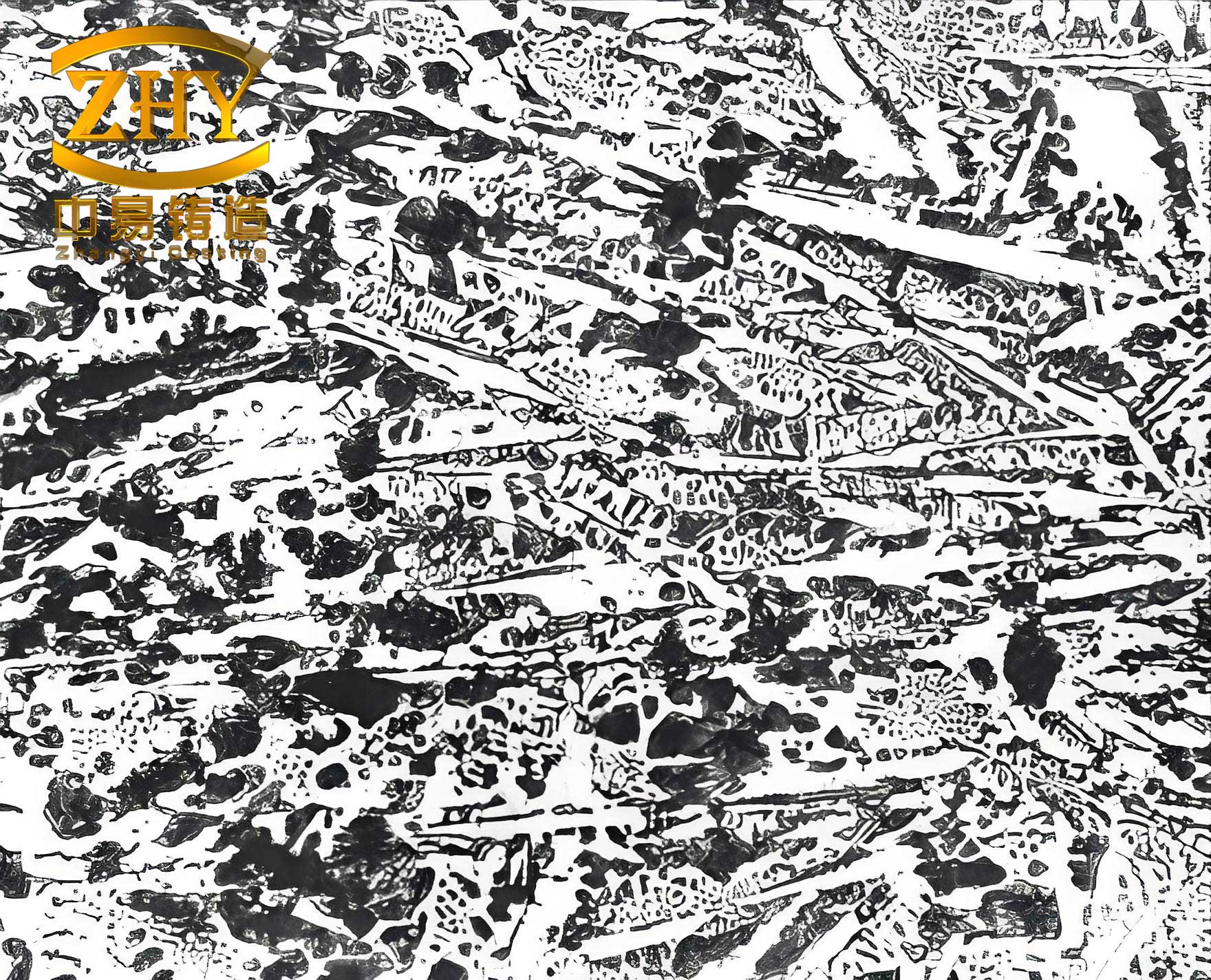
To conduct this research, I prepared a series of alloyed white cast iron samples with varying compositions, as summarized in Table 1. The raw materials included master alloys of different elements, and melts were produced in a high-temperature crucible furnace under a protective slag to prevent oxidation. Melting temperatures ranged from 1500°C to 1600°C, depending on the配方, and cooling occurred in sand molds. The total alloy content (excluding carbon) was controlled to assess its influence. For microstructural analysis, I employed multiple techniques: metallographic observation using etchants like nital, picric acid with sodium hydroxide, and potassium permanganate with sodium hydroxide; scanning electron microscopy (SEM) for high-resolution imaging; and X-ray diffraction (XRD) with a fully automated diffractometer to identify carbide types. Micro-area energy-dispersive X-ray spectroscopy (EDS) was also used to complement the XRD data, enabling precise categorization of carbides.
| Sample ID | Cr (wt.%) | W (wt.%) | Mo (wt.%) | Other Elements | Total Alloy Content (wt.%) | Matrix Structure | Eutectic Morphology |
|---|---|---|---|---|---|---|---|
| A1 | 2.0 | 0 | 0 | Bal. | ~2.5 | Pearlite | Ledeburite |
| A2 | 4.0 | 1.5 | 0.5 | Bal. | ~6.0 | Martensite | Chrysanthemum-like |
| A3 | 6.0 | 3.0 | 1.0 | Bal. | ~10.0 | Martensite + Austenite | Blocky/Rod-like |
| A4 | 8.0 | 5.0 | 1.5 | Bal. | ~14.5 | Austenite | Fishbone-like |
| A5 | 10.0 | 7.0 | 2.0 | Bal. | ~19.0 | Austenite + Carbides | Radiated |
From my observations, the eutectic structures in alloyed white cast iron exhibited diverse morphologies beyond traditional ledeburite. These included chrysanthemum-like, radiated, fishbone-like, feather-like, and blocky/rod-like forms, as illustrated in SEM images. The blocky/rod-like morphology was particularly promising, as it featured discontinuous carbides uniformly embedded in the matrix. To classify the carbide types, I utilized XRD and EDS analysis. The results, summarized in Table 2, reveal that multiple carbide phases can form depending on composition. For instance, alloy cementite ((Fe,Cr)3C) was common in low-alloy white cast iron, while M7C3, M6C, and M2C types appeared with higher alloy additions. The relative amounts were quantified using XRD peak intensities, providing insight into phase stability.
| Carbide Morphology | Chemical Formula (Type) | Common Alloy Range | Typical Composition from EDS |
|---|---|---|---|
| Blocky/Rod-like | (Fe,Cr)3C (Alloy Cementite) | Low to Medium Alloy | Fe-15%Cr-3%C (approx.) |
| Chrysanthemum-like | M7C3 (e.g., (Cr,Fe)7C3) | High Cr (>10%) | Cr-50%Fe-7%C (approx.) |
| Fishbone-like | M6C (e.g., (Fe,W)6C) | High W (>5%) | Fe-30%W-5%C (approx.) |
| Feather-like | M2C (e.g., (Mo,Fe)2C) | High Mo (>3%) | Mo-40%Fe-4%C (approx.) |
| Hexagonal/Regular | MC (e.g., VC or TiC) | With V/Ti additions | V-80%Fe-10%C (approx.) |
The influence of alloy elements on eutectic morphology in white cast iron is profound. Chromium content, for example, plays a key role: as Cr increases, the eutectic transitions from ledeburite to chrysanthemum-like structures, accompanied by a decrease in eutectic carbon content. In my experiments, samples with Cr around 4-6% showed this shift, and at higher levels, over-eutectic structures emerged. Tungsten addition significantly affects morphology; at moderate W levels (e.g., 3-5%), blocky/rod-like eutectics form, with a martensitic matrix and minimal retained austenite. However, exceeding 5% W promotes fishbone-like M6C carbides, which can interconnect, reducing toughness. Molybdenum, at levels below 2%, has minimal impact on eutectic shape but refines the matrix by precipitating fine M2C carbides, increasing martensite content. These trends highlight the delicate balance required in alloy design for white cast iron.
To quantify the effects, I derived empirical relationships between alloy content and eutectic carbide spacing (λ), a critical parameter for toughness. For blocky/rod-like morphologies in white cast iron, λ can be approximated by:
$$ \lambda = k \cdot (G \cdot R)^{-n} $$
where \( G \) is the temperature gradient, \( R \) is the solidification rate, \( k \) is a material constant, and \( n \) is an exponent typically around 0.5. In alloyed white cast iron with high tungsten, constitutional undercooling alters this, leading to modified growth. The degree of undercooling (ΔTc) due to solute rejection can be expressed as:
$$ \Delta T_c = \frac{m_L \cdot C_0 \cdot (1-k)}{k} \cdot \left(1 – \exp\left(-\frac{R \cdot x}{D}\right)\right) $$
Here, \( m_L \) is the liquidus slope, \( C_0 \) is the initial concentration, \( k \) is the partition coefficient, \( D \) is the diffusion coefficient, and \( x \) is distance. This undercooling promotes divorced eutectic behavior in white cast iron, where carbides nucleate separately from austenite.
The formation of ideal blocky/rod-like eutectics in white cast iron hinges on two intertwined mechanisms: divorced eutectic solidification and constitutional undercooling. In divorced eutectic, the two phases of the eutectic (austenite and carbide) nucleate and grow independently rather than cooperatively. This is facilitated in alloyed white cast iron when carbide nucleation is suppressed, often due to high alloy content slowing diffusion. Concurrently, constitutional undercooling arises from solute buildup ahead of the solidification front, steepening the liquidus profile and allowing austenite to grow in a dendritic manner that encloses liquid pools. I propose two distinct growth modes for austenite in this context: “pine-tree” and “fir-tree” growth, analogous to the observed microstructures.
In pine-tree growth, prevalent in compositions with strong undercooling, austenite dendrites extend rapidly into the melt, with secondary and tertiary arms expanding quickly to surround isolated liquid regions. As these pockets shrink, solute concentration increases until carbides nucleate and grow, pushing the austenite further. This iterative process yields discontinuous carbides, as seen in sample A3. The kinetics can be modeled using phase-field simulations, but a simplified analytical approach for white cast iron involves the growth velocity (v) of austenite:
$$ v = \mu \cdot (\Delta T)^2 $$
where \( \mu \) is a kinetic coefficient and \( \Delta T \) is the undercooling. For carbides, the nucleation rate (I) follows classical theory:
$$ I = I_0 \exp\left(-\frac{\Delta G^*}{kT}\right) $$
with \( \Delta G^* \) as the activation barrier. In fir-tree growth, under lower undercooling, austenite grows more uniformly, forcing liquid into inter-dendritic channels that eventually solidify into interconnected carbides, as in sample A4. This explains why some high-tungsten white cast iron shows fishbone patterns instead of isolated blocks.
Analyzing the solidification sequence of Fe-Cr-W-Mo-C white cast iron requires referencing pseudo-binary phase diagrams. Although full quinary diagrams are scarce, I constructed a schematic liquidus projection based on available binaries (e.g., Fe-Cr-C, Fe-W-C). For a typical alloy like A3, solidification begins with primary austenite (γ) formation, followed by a two-phase eutectic reaction: \( L \rightarrow \gamma + M_3C \). As temperature drops, a three-phase eutectic may occur: \( L \rightarrow \gamma + M_3C + M_6C \). However, in practice, divorced eutectic often obscures this, as phases nucleate heterogeneously. The fraction of eutectic (fe) in white cast iron can be estimated using the lever rule:
$$ f_e = \frac{C_0 – C_\alpha}{C_e – C_\alpha} $$
where \( C_0 \) is the overall carbon content, \( C_\alpha \) is the carbon in austenite, and \( C_e \) is the eutectic composition. In alloyed systems, these values shift due to solute effects. My XRD data confirmed that in many samples, three-phase eutectic regions were absent, supporting the divorced mechanism where M6C grows on existing M3C rather than forming a distinct ternary mixture.
The advantages of achieving blocky/rod-like carbides in white cast iron are substantial. Traditionally, to break the ledeburite network, high alloy additions (e.g., >15% Cr) are used to form special carbides like M7C3, but these often remain interconnected. My approach, using optimized combinations like in sample A3, reduces total alloy content to below 10%, cutting costs by over 50% while enhancing toughness. The key is promoting divorced eutectic through elements like tungsten and molybdenum, which elevate constitutional undercooling. This aligns with industrial goals for sustainable white cast iron production. Furthermore, the uniform distribution of carbides improves wear resistance by providing hard phases without stress concentrators, potentially extending component life in mining or machinery applications.
In conclusion, my research demonstrates that eutectic morphology in alloyed white cast iron can be tailored via controlled alloying to achieve discontinuous, blocky/rod-like carbides. This is driven by divorced eutectic solidification and constitutional undercooling, with austenite growth modes—pine-tree and fir-tree—dictating the final microstructure. By adjusting chromium, tungsten, and molybdenum levels, I have developed white cast iron compositions with improved toughness without sacrificing hardness. Future work could explore computational modeling to predict morphologies or investigate novel alloy systems for further optimization. This study underscores the potential of microstructural engineering in white cast iron to overcome longstanding brittleness issues, paving the way for broader adoption in demanding wear environments.