
White cast iron, characterized by its high carbon content typically above 2.11 wt.%, has traditionally been regarded as a brittle material due to the presence of substantial amounts of cementite (Fe3C) in its microstructure. This brittleness has historically limited its applications to raw materials for steelmaking or malleable iron production, despite its potential for high hardness and wear resistance. However, recent studies, including my own research, have challenged this notion by demonstrating that white cast iron can undergo significant plastic deformation under specific thermomechanical conditions. This article explores the plastic deformation behavior, microstructural transformations, and resulting properties of white cast iron, with a focus on hypereutectic compositions. The findings reveal that through controlled hot forging, hot rolling, and isothermal rolling, white cast iron can be processed to achieve refined microstructures, enhanced ductility, and even superplasticity, thereby expanding its utility in engineering applications.
In this investigation, I conducted a series of experiments on white cast iron with varying carbon contents to systematically analyze its deformation characteristics. The material was prepared by melting industrial pure iron, ferrochromium, ferromanganese, ferrovanadium, and pure carbon in a medium-frequency induction furnace under non-vacuum conditions. The melt was held at approximately 1500°C for 30 minutes before being poured into molds to form ingots. The chemical compositions of the produced white cast iron samples are summarized in Table 1.
| Sample ID | C | Cr | Mn | V | Si | P | S | Fe |
|---|---|---|---|---|---|---|---|---|
| WCI-1 | 2.5 | 0.5 | 0.8 | 0.2 | 0.4 | 0.03 | 0.02 | Bal. |
| WCI-2 | 3.0 | 0.6 | 0.9 | 0.3 | 0.5 | 0.04 | 0.03 | Bal. |
| WCI-3 | 3.5 | 0.7 | 1.0 | 0.4 | 0.6 | 0.05 | 0.04 | Bal. |
The as-cast white cast iron ingots were subjected to plastic deformation through multiple processes. First, hot forging was performed by heating the ingots to 1150°C, holding for 2 hours, and then forging on an air hammer until a thickness of 30 mm was achieved, corresponding to a total reduction rate of 70%. This initial deformation demonstrated that white cast iron could be forged without cracking in the austenitic state. Subsequently, the forged billets were cut into rectangular slabs for rolling experiments. Two rolling schemes were implemented: (1) Hot rolling at 1100°C with a per-pass reduction of 10 mm, continued until the temperature dropped to 800°C, resulting in a final thickness of 15 mm and a total reduction of 85%; (2) Isothermal rolling, where the billets were heated to 1000°C, hot-rolled to 20 mm, and then further rolled at 750°C with per-pass reductions of 2 mm, interpass holding at 750°C, until a minimum thickness of 5 mm was reached, achieving a cumulative reduction of 95%. The deformation conditions and outcomes are consolidated in Table 2.
| Process | Temperature Range (°C) | Initial Thickness (mm) | Final Thickness (mm) | Total Reduction (%) | Observations |
|---|---|---|---|---|---|
| Hot Forging | 1150 | 100 | 30 | 70 | No cracking, good plasticity |
| Hot Rolling | 1100 to 800 | 30 | 15 | 85 | Continuous deformation, fine microstructure |
| Isothermal Rolling | 1000 (initial) and 750 (isothermal) | 30 | 5 | 95 | Enhanced cementite spheroidization, superplastic behavior |
The microstructural evolution of white cast iron during deformation was critically examined. In the as-cast state, the microstructure consists of proeutectic austenite, secondary cementite, and ledeburite (eutectic mixture of austenite and cementite). Upon cooling to room temperature, the austenite transforms into pearlite, resulting in a brittle matrix. However, during heating for deformation, secondary cementite dissolves into austenite, forming a dual-phase structure of austenite and ledeburite. Plastic deformation in the temperature range of 750°C to 1150°C induces dynamic recrystallization of austenite, leading to grain refinement. At lower temperatures, such as during isothermal rolling at 750°C, deformation bands form within the austenite, promoting the precipitation of fine cementite particles along grain boundaries and slip bands. This process disperses the cementite, reducing its continuity and improving ductility. The ledeburite structure also undergoes significant refinement; the cementite matrix in ledeburite is fragmented into smaller segments due to strain-induced subgrain formation and carbon diffusion. The mechanism can be described using diffusion kinetics, where the flux of carbon atoms \( J \) is given by Fick’s first law: $$ J = -D \frac{\partial C}{\partial x} $$ where \( D \) is the diffusion coefficient of carbon in iron, \( C \) is the carbon concentration, and \( x \) is the distance. The enhanced diffusion at subgrain boundaries facilitates the dissolution of cementite at concave regions, leading to fragmentation.
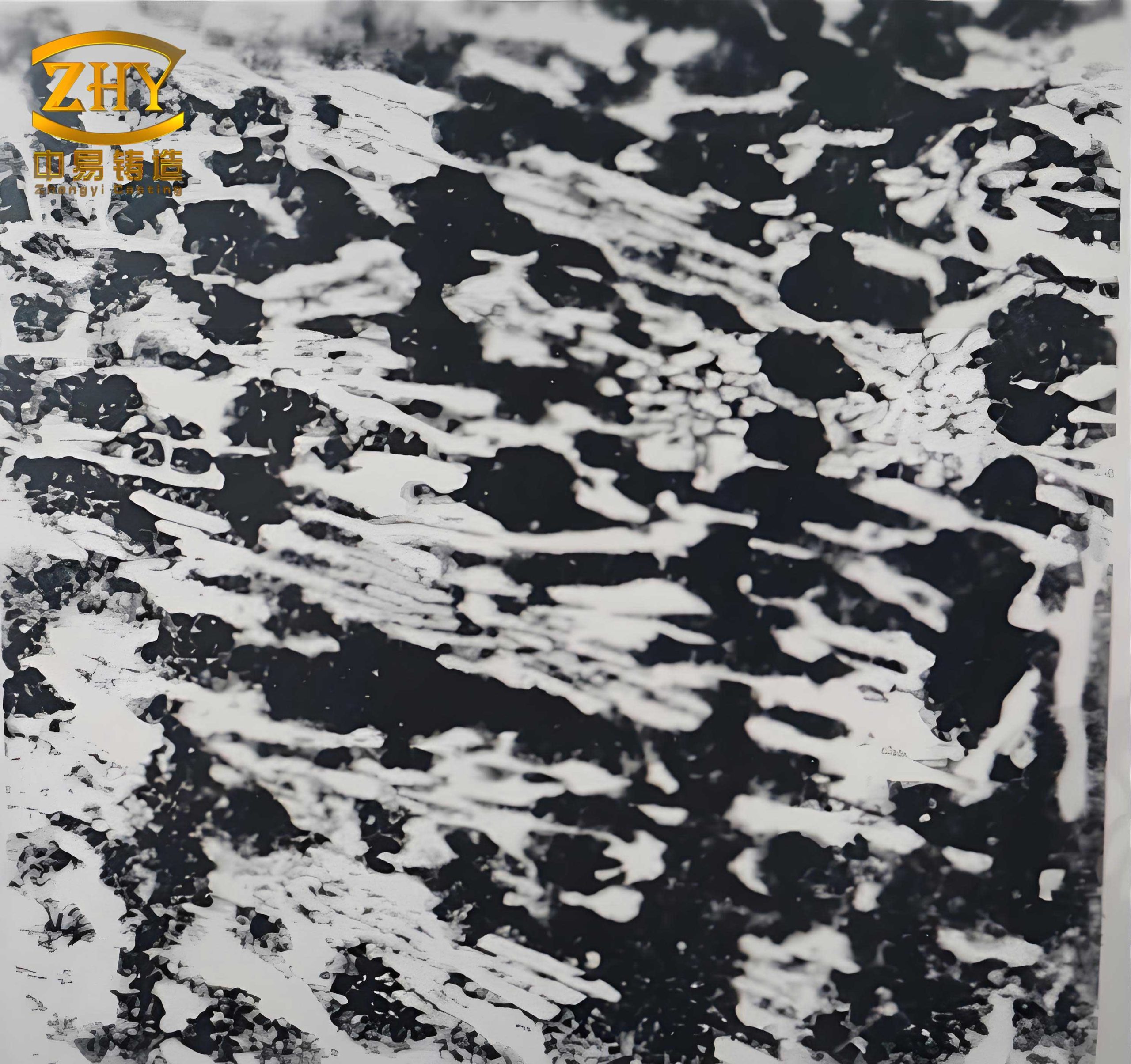
After deformation, the white cast iron exhibits a microstructure composed of a fine ferrite matrix with uniformly distributed cementite particles. With increasing deformation, especially during isothermal rolling, the cementite spheroidizes, as shown in microstructural analyses. This refined structure is key to the improved mechanical properties. The tensile tests conducted at 750°C revealed superplastic behavior, with elongation-to-failure values exceeding 200% for some compositions. The strain rate sensitivity index \( m \), a critical parameter for superplasticity, was calculated using the relationship: $$ \sigma = K \dot{\epsilon}^m $$ where \( \sigma \) is the flow stress, \( \dot{\epsilon} \) is the strain rate, and \( K \) is a material constant. For the deformed white cast iron, \( m \) values ranged from 0.3 to 0.5, indicating high sensitivity and confirming superplasticity. The mechanical properties at room temperature and elevated temperatures are summarized in Table 3.
| Sample ID | Processing Route | Yield Strength (MPa) | Ultimate Tensile Strength (MPa) | Elongation at 750°C (%) | Hardness (HRC) after Quenching |
|---|---|---|---|---|---|
| WCI-1 | Hot Rolling + Isothermal Rolling | 350 | 480 | 250 | 55 |
| WCI-2 | Hot Rolling + Isothermal Rolling | 380 | 520 | 180 | 58 |
| WCI-3 | Hot Rolling + Isothermal Rolling | 400 | 550 | 150 | 60 |
The deformation mechanisms in white cast iron involve complex interactions between dislocations, grain boundaries, and second-phase particles. During hot deformation, the austenite phase undergoes continuous recrystallization, which refines the grain size according to the kinetics: $$ d = A \cdot Z^{-p} $$ where \( d \) is the recrystallized grain size, \( Z \) is the Zener-Hollomon parameter (\( Z = \dot{\epsilon} \exp(Q/RT) \), with \( Q \) as activation energy, \( R \) as gas constant, \( T \) as temperature), and \( A \) and \( p \) are material constants. For white cast iron, the presence of cementite particles pins grain boundaries, slowing grain growth and promoting a fine microstructure. In the ledeburite, deformation induces high dislocation densities in the cementite matrix, leading to recovery and subgrain formation. The carbon diffusion from these subgrain boundaries to adjacent austenite regions causes localized dissolution of cementite, fragmenting the continuous network. This process is not merely mechanical “breaking” but a diffusion-controlled phenomenon, which is more effective at lower temperatures and slower strain rates.
The superplasticity observed in white cast iron is attributed to the fine-grained microstructure and the presence of spheroidized cementite particles. The deformation in the superplastic regime is governed by grain boundary sliding, accommodated by diffusion creep. The strain rate for diffusion creep can be expressed by the Coble creep equation: $$ \dot{\epsilon} = \frac{148 \Omega \delta D_{gb} \sigma}{\pi k T d^3} $$ where \( \Omega \) is the atomic volume, \( \delta \) is the grain boundary width, \( D_{gb} \) is the grain boundary diffusion coefficient, \( \sigma \) is the applied stress, \( k \) is Boltzmann’s constant, \( T \) is absolute temperature, and \( d \) is the grain size. For white cast iron, the fine ferrite grain size (on the order of 1–5 μm) and the dispersed cementite particles allow for significant grain boundary sliding, resulting in high elongations. The superplastic forming temperature window for white cast iron spans from 700°C to 900°C, making it suitable for industrial processing such as blow forming or deep drawing.
Furthermore, the deformed white cast iron can be heat-treated to enhance its hardness for wear-resistant applications. Quenching from 850°C results in a martensitic matrix with embedded cementite particles, achieving hardness values above 55 HRC. This makes deformed white cast iron a cost-effective alternative to alloyed wear-resistant steels in applications like mining equipment, crusher liners, and grinding media. The combination of plastic formability and high hardness opens new avenues for designing complex components from white cast iron, which were previously unattainable due to its brittleness.
In summary, my research demonstrates that white cast iron is not inherently brittle but can be plastically deformed under optimized conditions. The key findings are: (1) White cast iron with carbon contents up to 3.5 wt.% can be successfully forged, hot-rolled, and isothermal-rolled in the temperature range of 750°C to 1150°C with high reduction rates. (2) Plastic deformation refines the as-cast microstructure, transforming coarse ledeburite into a fine dispersion of cementite in a ferrite matrix, with spheroidization occurring during isothermal processing. (3) The refinement mechanism involves recrystallization of austenite, strain-induced precipitation, and diffusion-assisted fragmentation of cementite, rather than mechanical fracture. (4) Deformed white cast iron exhibits superplasticity at 700–900°C, with elongation over 200% and high strain rate sensitivity, enabling near-net-shape forming. (5) After quenching, the material achieves high hardness, making it suitable for wear-resistant parts. This work underscores the potential of white cast iron as a versatile engineering material, bridging the gap between cast irons and ductile metals through thermomechanical processing.