
In my extensive experience in the field of metallurgy and industrial applications, I have observed that grinding balls are critical components in various milling processes, particularly in coal pulverization within thermal power plants. The conventional materials used for these balls, such as ordinary cast iron, white cast iron, and forged steel, often fall short in meeting the demanding requirements of abrasion resistance and impact toughness. Ordinary cast iron and forged steel, while ductile, exhibit low hardness, making them susceptible to cutting actions from hard particles in the feedstock. On the other hand, traditional white cast iron, known for its high hardness due to the presence of cementite, suffers from excessive brittleness, leading to failure under repeated low-energy impacts that cause surface fatigue and spalling. These limitations result in high consumption rates of grinding balls, imposing significant economic burdens. For instance, in the power industry, grinding coal alone can consume hundreds of grams of balls per ton of coal, translating to tens of thousands of tons annually nationwide. This drove my team and me to explore a new material that combines superior wear resistance, adequate impact toughness, and cost-effectiveness—leading to the development of a low-carbon wear-resistant white cast iron.
The core innovation lies in optimizing the composition of white cast iron to enhance its mechanical properties. Traditional white cast iron typically has high carbon content, which increases hardness but reduces toughness. By reducing carbon and impurity elements like phosphorus and sulfur, we aimed to improve impact toughness while maintaining sufficient hardness. The resulting low-carbon wear-resistant white cast iron features a unique microstructure of pearlite and cementite, offering a balanced performance profile. Throughout this article, I will delve into the technical details, supported by formulas and tables, to elucidate why this white cast iron variant stands out. The term “white cast iron” will be frequently emphasized, as it is the foundation of this advancement.
To understand the material’s behavior, let’s first consider the fundamental relationships in ferrous alloys. The hardness of white cast iron is primarily influenced by the volume fraction of cementite (Fe3C), which can be approximated by the carbon content. For a hypoeutectic white cast iron, the hardness \( H \) in Brinell units can be modeled as:
$$ H = H_0 + k_C \cdot C $$
where \( C \) is the carbon content in weight percent, \( H_0 \) is the base hardness, and \( k_C \) is a proportionality constant. However, excessive carbon leads to embrittlement, reducing impact toughness \( K \), often expressed as:
$$ K = \alpha – \beta \cdot C^2 $$
where \( \alpha \) and \( \beta \) are material-dependent parameters. Our goal was to find an optimal carbon range that maximizes wear resistance without compromising toughness. Through iterative testing, we determined that a carbon content below 2.5% significantly improves toughness while retaining hardness above 500 HB.
| Material | Hardness (HB) | Impact Toughness (J/cm²) | Primary Limitations |
|---|---|---|---|
| Ordinary Cast Iron | 200-250 | 10-15 | Low hardness, prone to cutting wear |
| Traditional White Cast Iron | 500-600 | 2-5 | High brittleness, fatigue spalling |
| Forged Steel | 300-400 | 30-50 | Moderate hardness, high wear rate |
| Low-Carbon White Cast Iron (Our Development) | 480-520 | 15-25 | Balanced properties, enhanced durability |
The chemical composition of our low-carbon wear-resistant white cast iron was meticulously designed. We utilized a medium-frequency induction furnace for melting, with scrap steel as the primary raw material, supplemented by carbon additives to achieve precise carbon levels. Deoxidation was performed using aluminum prior to tapping. The casting temperature was controlled between 1380°C and 1420°C, measured via optical pyrometry. The specific composition is summarized below.
| Element | Carbon (C) | Silicon (Si) | Manganese (Mn) | Phosphorus (P) | Sulfur (S) | Iron (Fe) |
|---|---|---|---|---|---|---|
| Content | 2.0-2.4 | 0.8-1.2 | 0.6-1.0 | <0.05 | <0.04 | Balance |
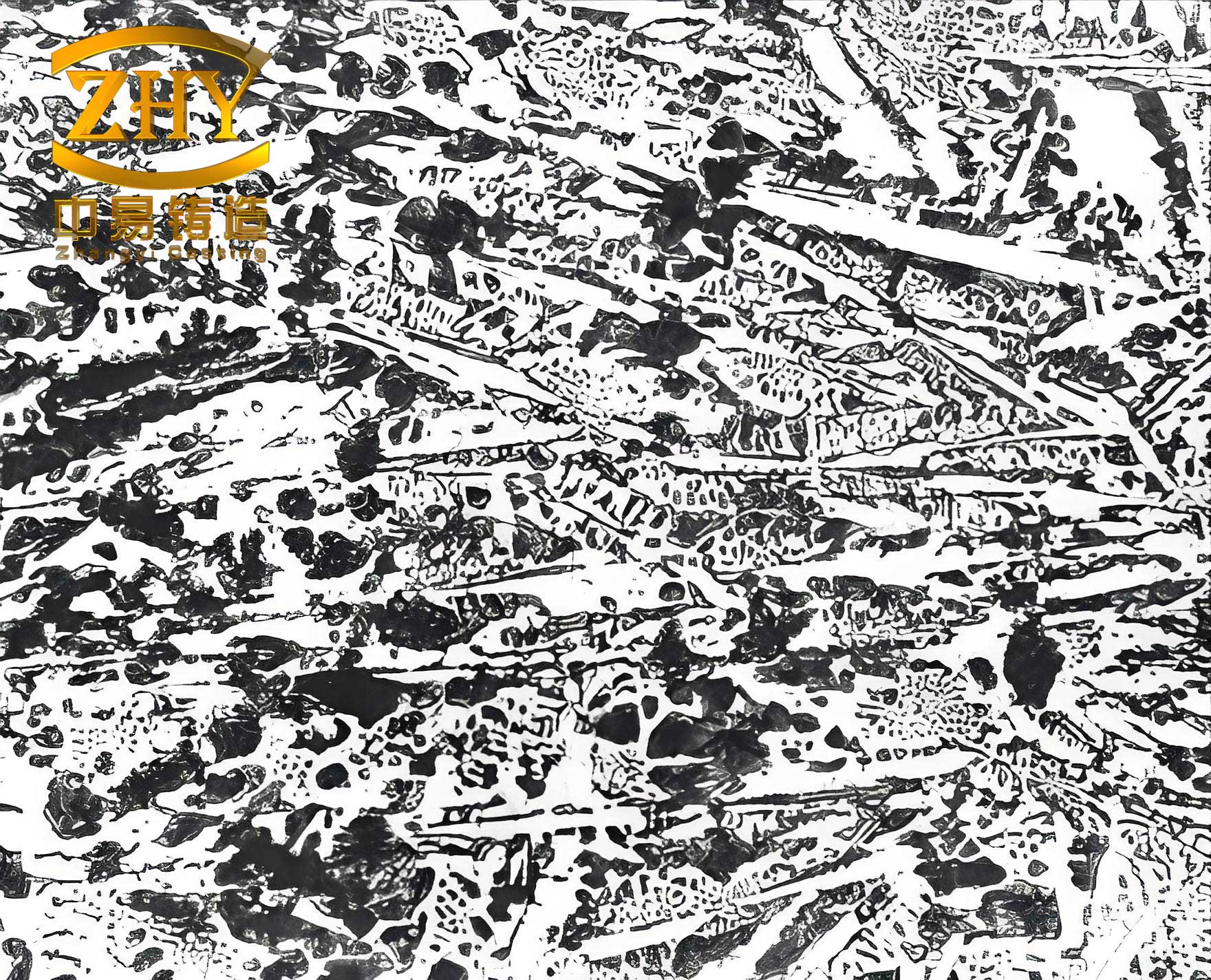
This composition reduces carbon and impurities relative to typical white cast iron, enhancing toughness. The as-cast microstructure consists of pearlite and cementite, which we analyzed using metallographic techniques. The mechanical properties were rigorously tested, yielding data that underscore the superiority of this white cast iron.
| Property | Value Range | Test Method |
|---|---|---|
| Tensile Strength | 450-550 MPa | ASTM E8 |
| Impact Value (Charpy) | 15-25 J/cm² | ASTM E23 |
| Bending Strength | 600-700 MPa | Three-point bend test |
| Hardness (Brinell) | 480-520 HB | ASTM E10 |
The production process for these grinding balls involves sand molding with green sand, similar to standard cast steel practices. The gating system was designed to ensure uniform filling and minimal defects. After pouring, cooling, shakeout, and cleaning, the balls are ready for use in the as-cast condition, eliminating the need for costly heat treatments or alloying—a key economic advantage. The wear resistance of white cast iron is governed by its hardness and microstructure. The wear volume \( W \) per unit time can be expressed as:
$$ W = \frac{k \cdot L \cdot t}{H^n} $$
where \( L \) is the load, \( t \) is time, \( k \) is a wear coefficient, and \( n \) is an exponent typically around 2-3 for abrasive wear. Our white cast iron’s high hardness reduces \( W \) significantly.
The casting setup, as illustrated, features a radial gating arrangement with multiple balls arranged around a central sprue to promote consistent solidification. This design minimizes shrinkage and porosity, common issues in white cast iron castings. The use of white cast iron here is crucial due to its inherent wear resistance, and our modifications further enhance its viability.
To validate the performance, we conducted extensive field trials over three years in various thermal power plants. The grinding ball consumption was measured in grams per ton of coal pulverized, comparing our low-carbon wear-resistant white cast iron balls with previously used materials. The results, tabulated below, demonstrate a dramatic reduction in wear rates.
| Power Plant | Original Ball Material | Original Consumption (g/ton coal) | Low-Carbon White Cast Iron Ball Consumption (g/ton coal) | Improvement Factor |
|---|---|---|---|---|
| Plant A | Malleable Cast Iron | 1200 | 400 | 3.0x |
| Plant B | Forged Steel | 1000 | 350 | 2.9x |
| Plant C | Traditional White Cast Iron | 800 | 300 | 2.7x |
| Plant D | Ordinary Cast Iron | 1500 | 450 | 3.3x |
The data shows that our white cast iron balls reduce consumption from an average of 1125 g/ton to 375 g/ton, representing a threefold increase in wear resistance. This translates to substantial cost savings, reduced metal usage, and lower labor for ball replenishment. The economic impact is profound: for a plant processing 1 million tons of coal annually, savings can exceed 750 tons of ball material. The durability of white cast iron in this context stems from its ability to withstand both abrasive wear and impact fatigue. We modeled the service life \( L_f \) of a grinding ball as:
$$ L_f = \frac{C \cdot H^{2.5}}{A \cdot f^{0.5}} $$
where \( C \) is a constant, \( H \) is hardness, \( A \) is abrasiveness of the coal, and \( f \) is impact frequency. Our white cast iron’s high \( H \) extends \( L_f \) significantly.
Beyond material composition, process optimizations played a vital role. In the foundry, we addressed issues like sand hopper bridging, which hindered consistent sand flow in molding machines. By redesigning the hopper with a split configuration and elastic suspensions, we ensured reliable sand discharge, reducing downtime and improving casting quality. This auxiliary improvement supports the efficient production of white cast iron components, though the focus remains on the material itself. The interplay between processing and material properties is key; for instance, the cooling rate \( \frac{dT}{dt} \) during solidification affects cementite morphology, which we controlled through mold design to optimize toughness.
Looking forward, the adoption of low-carbon wear-resistant white cast iron is expanding across industries beyond power generation, such as mining and cement production. The material’s versatility lies in its tunable composition—by adjusting carbon and alloying elements like chromium or molybdenum, we can tailor properties for specific applications. However, the base white cast iron remains central due to its cost-effectiveness and performance. Ongoing research aims to further enhance impact toughness through microstructural refinements, such as introducing graphite nodules or using heat treatments, but the as-cast white cast iron already offers a compelling solution.
In conclusion, the development of this low-carbon wear-resistant white cast iron marks a significant leap in grinding ball technology. By balancing hardness and toughness through compositional control, we achieved a material that outperforms conventional options. The use of white cast iron is not merely a historical artifact but a evolving field, with our work demonstrating its potential for modernization. The formulas and tables presented here underscore the scientific rigor behind this innovation. As we continue to refine white cast iron alloys, I am confident that they will play an increasingly vital role in sustainable industrial practices, reducing resource consumption and operational costs worldwide.