
The relentless degradation of surfaces through abrasive wear is a universal challenge across virtually all sectors of mechanical engineering. In the processing of raw materials like cement, coal, and ores, the components tasked with crushing, grinding, and handling these substances—referred to as wear parts—are subjected to extreme conditions that lead to rapid material loss. The economic impact is staggering. Within my analysis, I find the consumption of hundreds of thousands of tons of steel annually for these parts to be a significant figure, while internationally, the financial burden reaches billions of dollars. This underscores a critical and urgent mission: to enhance the service life of wear-resistant components, thereby reducing operational costs, downtime, and resource expenditure. Production practice has consistently demonstrated that among the pantheon of wear-resistant materials, one traditional workhorse continues to play a pivotal role—white cast iron. Its unique combination of high hardness and cost-effectiveness secures its position, and its evolution tells a story of continuous material science innovation aimed at conquering abrasion.
A Retrospective on the Development of White Cast Iron Wear Materials
The journey of white cast iron as a dedicated wear-resistant material can be traced through three distinct generations, each marked by a leap in performance through microstructural engineering.
First Generation: Plain White Cast Iron
The inaugural use of white cast iron in industrial applications for wear resistance is historically linked to the early development of malleablizing heat treatments. The as-cast structure of the white iron intended for annealing was found to possess inherent abrasion resistance. This material, not purposefully alloyed, exhibits a microstructure composed of hard, brittle cementite (Fe3C) carbides within a pearlitic matrix. Its hardness typically ranges between 350-450 HB, offering a basic level of abrasion resistance at a low production cost, often achievable in cupola furnaces. The general chemical composition for such irons is shown in Table 1.
| Generation | Type | C (%) | Si (%) | Mn (%) | Cr (%) | Ni (%) | Other |
|---|---|---|---|---|---|---|---|
| 1st | Plain White | 2.0 – 3.5 | 0.5 – 1.2 | 0.5 – 0.8 | – | – | P < 0.3 |
| 2nd | Ni-Hard I | 2.8 – 3.6 | 0.3 – 0.8 | 0.3 – 0.8 | 1.5 – 2.5 | 3.0 – 5.0 | – |
| 3rd | High-Cr (15-3) | 2.4 – 3.6 | 0.3 – 1.2 | 0.5 – 1.5 | 14.0 – 18.0 | 0 – 1.5 | Mo 0-3.0 |
However, the dominance of the network-like cementite phase imparts severe brittleness, limiting its application to low-stress, high-abrasion environments. Efforts to improve toughness by reducing carbon or phosphorus content provided only marginal gains, often at the expense of hardness. The fundamental limitation lay in the nature of the carbide itself.
Second Generation: Nickel-Chromium (Ni-Hard) White Cast Iron
A major milestone was achieved in the 1920s with the development of nickel-chromium alloyed white cast iron, commercially known as Ni-Hard. The addition of nickel (3-5%) and chromium (1.5-2.5%) enabled the formation of a martensitic matrix upon casting or after heat treatment. This transformation significantly increased the bulk hardness to a range of 550-650 HB. The martensitic base, being much harder than pearlite, dramatically improved wear resistance, leading to widespread adoption in ore processing, slurry pumps, and mill liners. The wear resistance could be approximated by a function of matrix hardness (Hm) and carbide volume fraction (Vc):
$$ W_R \propto H_m^{0.5} \cdot V_c $$
Despite this advancement, the brittle, continuous cementite network remained, still restricting impact toughness. The search for a tougher carbide morphology was the driving force for the next evolution.
Third Generation: High-Chromium White Cast Iron
The paradigm shift in white cast iron technology came with the significant increase in chromium content, typically to levels between 12-30%. This generation, though conceived earlier, gained industrial momentum post-World War II with the proliferation of electric arc furnaces. The key innovation lies in the change of the primary carbide phase. When chromium content exceeds approximately 12%, the carbide structure transitions from cementite (Fe3C) to complex chromium carbides of the type (Cr,Fe)7C3. This M7C3 carbide possesses two decisive advantages:
1. It has a higher intrinsic hardness (~1500-1800 HV) compared to cementite (~1100-1200 HV).
2. It grows in a discontinuous, blocky, or rod-like morphology rather than a continuous network.
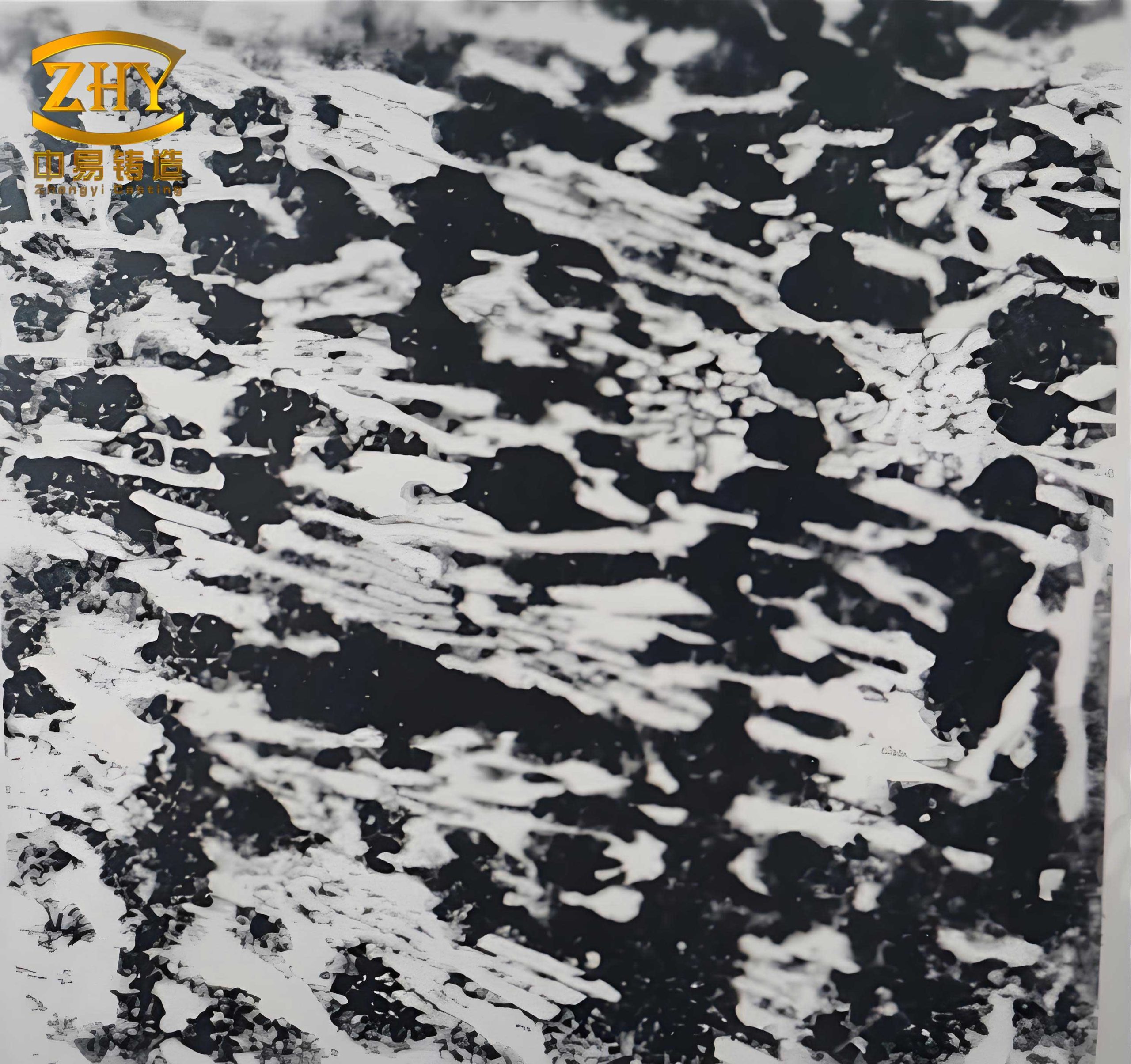
This micrograph often reveals the characteristic blocky M7C3 carbides embedded in a metallic matrix, which can be tailored through alloying and heat treatment. The combination of harder carbides and a tougher microstructure unlocked a new level of performance. Furthermore, the matrix of high-chromium white cast iron can be engineered to be austenitic, pearlitic, or martensitic, allowing properties to be fine-tuned for specific applications. The relationship between chromium content, carbon content, and the resulting carbide volume fraction is critical and can be estimated empirically:
$$ V_c \approx 12.33(C) + 0.55(Cr) – 15.2 $$
where C and Cr are weight percentages.
This class of white cast iron has seen explosive growth over recent decades. It is the material of choice in modern cement industry ball mills, where high-chromium grinding balls exhibit wear lives 8 to 12 times greater than forged steel balls. It successfully replaces austenitic manganese steel in applications like crusher liners, hammer mill beaters, and slurry pump housings, often delivering 3 to 5 times longer service life. The versatility and superior performance firmly establish high-chromium white cast iron as the current pinnacle of this material family for demanding abrasive environments.
Microstructure, Properties, and the Role of Heat Treatment
The exceptional wear resistance of white cast iron, particularly the high-chromium variants, is a direct consequence of its carefully engineered microstructure. The system is essentially a metal matrix composite, where hard ceramic-like carbides reinforce a metallic binder phase.
Carbide Phase and Morphology
The type, amount, and shape of carbides are governed primarily by the carbon and chromium equivalent. A higher Carbon Equivalent (CE) promotes more carbide formation:
$$ CE = C + 0.33(Si + P) $$
However, the chromium-to-carbon ratio (Cr/C) dictates the carbide type. For a hypoeutectic high-chromium white cast iron, primary austenite dendrites form first, followed by the eutectic mixture of austenite and M7C3 carbides. A higher Cr/C ratio leads to finer, more isolated eutectic carbides. The hardness of the carbide phase itself is paramount for abrasion resistance, with M7C3 offering a clear advantage.
| Carbide Type | Typical Formula | Hardness (HV) | Morphology | Formation Condition |
|---|---|---|---|---|
| Cementite | Fe3C | ~1100 – 1200 | Continuous Network | Low Cr, High C |
| M3C | (Fe,Cr)3C | ~1200 – 1400 | Network / Lamellar | Moderate Cr (4-10%) |
| M7C3 | (Cr,Fe)7C3 | ~1500 – 1800 | Discontinuous Blocky/Rod | High Cr (>12%) |
| M23C6 | (Cr,Fe)23C6 | ~1000 – 1200 | Fine Precipitates | Often during aging |
Matrix Structure and Heat Treatment
The as-cast matrix of high-chromium white cast iron is typically austenitic, owing to the high chromium and carbon content in solid solution which stabilizes austenite. While this austenite can work-harden in service, the full potential for abrasion resistance is realized by transforming this metastable austenite into martensite through heat treatment. This process is not trivial and is crucial for achieving optimal properties.
A standard heat treatment cycle involves:
1. Stress Relief/Austenitization: Heating to a temperature between 950-1050°C, where secondary carbides dissolve, enriching the austenite with carbon and chromium. The time at temperature is critical for homogenization: $$ t \propto \frac{(thickness)^2}{diffusivity} $$
2. Quenching: Rapid cooling (often in air, but sometimes in oil or fluidized bed for thicker sections) to suppress the formation of pearlite and retain austenite or form martensite. The hardenability is excellent due to high chromium.
3. Tempering: Reheating to 200-550°C to precipitate fine secondary carbides from the supersaturated martensite (or retained austenite), increasing hardness and dimensional stability. This secondary hardening peak is a key feature.
The final matrix hardness and the amount of retained austenite are controlled by the austenitizing temperature (TA) and tempering parameters. The resulting hardness (Hv) can often be correlated to the martensite content and tempering condition.
| Application Focus | Austenitize Temp. (°C) | Quench Medium | Temper Temp. (°C) | Expected Hardness (HRC) | Key Matrix Phase |
|---|---|---|---|---|---|
| Maximum Abrasion Resistance | 980 – 1020 | Air / Forced Air | 200 – 450 | 62 – 68 | Tempered Martensite |
| Good Abrasion & Toughness | 950 – 980 | Air | 450 – 550 | 58 – 62 | Tempered Martensite + Secondary Carbides |
| As-Cast / Work-Hardening | – | As-Cast | Stress Relieve only | 50 – 58 | Austenite (Stabilized) |
Mechanical Properties and Performance
The balanced properties of modern high-chromium white cast iron are its hallmark. While hardness is the primary indicator for abrasion resistance, often following a direct correlation (Archard’s law simplified for similar microstructures):
$$ V \propto \frac{1}{H} $$
where V is wear volume and H is material hardness, toughness cannot be ignored. The impact toughness, though low compared to steels, is significantly improved over earlier white cast iron generations due to the discontinuous carbides. Compressive strength is very high, making it suitable for high-pressure grinding zones. The specific properties depend heavily on the final microstructure, as summarized in Table 4.
| Property | Typical Range | Main Influencing Factors |
|---|---|---|
| Macrohardness | 58 – 68 HRC | Carbon content, Matrix phase, Tempering |
| Compressive Strength | 2000 – 3500 MPa | Carbide fraction, Matrix strength |
| Impact Toughness (Charpy Unnotched) | 5 – 20 J | Carbide morphology, Matrix toughness, Casting soundness |
| Fracture Toughness KIC | 15 – 25 MPa√m | Similar to impact factors |
Future Outlook and Development Trajectories
Looking forward, the development of white cast iron wear materials will progress along two parallel paths: the refinement and optimization of existing high-performance alloys, and the exploration of novel, economically and environmentally sustainable compositions.
1. Unlocking Further Potential in Existing High-Chromium White Cast Iron
The current generation of high-chromium white cast iron still holds untapped potential. Key research and development frontiers include:
- Microstructural Refinement: Investigating the effects of minor alloying additions (e.g., V, Nb, Ti, B) or processing techniques (e.g., melt treatment, controlled solidification) to refine the primary M7C3 carbides or promote their spheroidization. The Hall-Petch relationship, adapted for inter-carbide spacing (λ), suggests potential benefits: $$ H = H_0 + k_H \cdot \lambda^{-1/2} $$ where a smaller λ (finer/rounder carbides) could improve both hardness and toughness concurrently.
- Advanced Heat Treatment Modeling: Deepening the understanding and control of heat treatment processes through computational thermodynamics (e.g., using CALPHAD methods) to predict phase transformations, secondary carbide precipitation kinetics, and residual stresses more accurately. Optimizing tempering cycles to maximize secondary hardening while minimizing retained austenite is a continuous pursuit.
- Systematic Property Databases: Establishing comprehensive, reliable databases correlating composition, processing parameters, microstructure, and in-service performance (wear rates under different abrasion modes, fracture behavior). This is fundamental for reliable component design and for guiding the development of next-generation alloys.
2. Development of Novel, Economical Alloy Systems
The economic pressure from the cost and supply volatility of primary alloying elements like nickel and chromium is a strong driver for innovation. The future will see increased emphasis on developing high-performance white cast iron materials based on more abundant and cost-effective elements.
- Chromium-Free or Low-Chromium Systems: Exploring alloy systems using manganese, vanadium, or boron to form hard, discrete carbides or borides (e.g., (Fe,Mn)3C, VC, Fe2B). Manganese, in particular, is abundant and can stabilize austenite. Austenitic manganese white cast iron (AMWCI) is a promising candidate, offering a combination of high toughness (from the work-hardening austenitic matrix) and good abrasion resistance (from hard carbides). Its performance in certain impact-abrasion conditions can be competitive.
- Multi-Principal Element Alloys (MPEAs) in Cast Irons: The concept of high-entropy alloys is trickling into cast iron research. Designing white cast iron compositions with multiple principal elements (e.g., Fe-Cr-Mn-Mo-V) could lead to novel carbide types and matrix compositions with unique combinations of hardness, toughness, and corrosion-wear resistance.
- Hybrid and Composite Materials: Incorporating exogenous ceramic particles (e.g., crushed WC, TiC) into a white cast iron melt or using in-situ techniques to form even harder reinforcing phases. This approach aims to create “designer” composites where the volume fraction, size, and type of the hardest phase are directly controlled.
3. Sustainability and Life-Cycle Considerations
Future developments will increasingly be judged not just by performance, but by their environmental footprint. This includes:
- Optimizing alloys for easier remelting and recycling.
- Developing wear-resistant white cast iron coatings or overlays for repairing components, extending life with minimal new material.
- Precision casting and additive manufacturing (e.g., binder jetting, directed energy deposition) of white cast iron to produce near-net-shape wear parts, minimizing material waste and machining energy.
The trajectory is clear: the future of white cast iron lies in smarter microstructural design, savvy use of alloying resources, and integration into sustainable engineering practices. From its humble beginnings as the by-product of malleablizing, through the alloying triumphs of the 20th century, white cast iron remains a dynamically evolving field, poised to meet the abrasive challenges of the future with ever-greater efficiency and ingenuity.