
In my extensive research on wear-resistant materials, I have focused on high-chromium white cast iron due to its exceptional resistance to abrasive wear. This type of white cast iron is characterized by the presence of (Fe, Cr)7C3 carbides and a hardenable matrix, which contribute to its durability in demanding applications. However, despite its advantages, high-chromium white cast iron suffers from brittleness under impact conditions, limiting its use in industries such as mining, cement production, and mineral processing. To address this, I investigated the effects of rare earth (RE) and boron (B) modification on the microstructure and mechanical properties of this alloy. The goal was to refine the structure, alter carbide morphology, and enhance overall performance through a combination of modification and heat treatment.
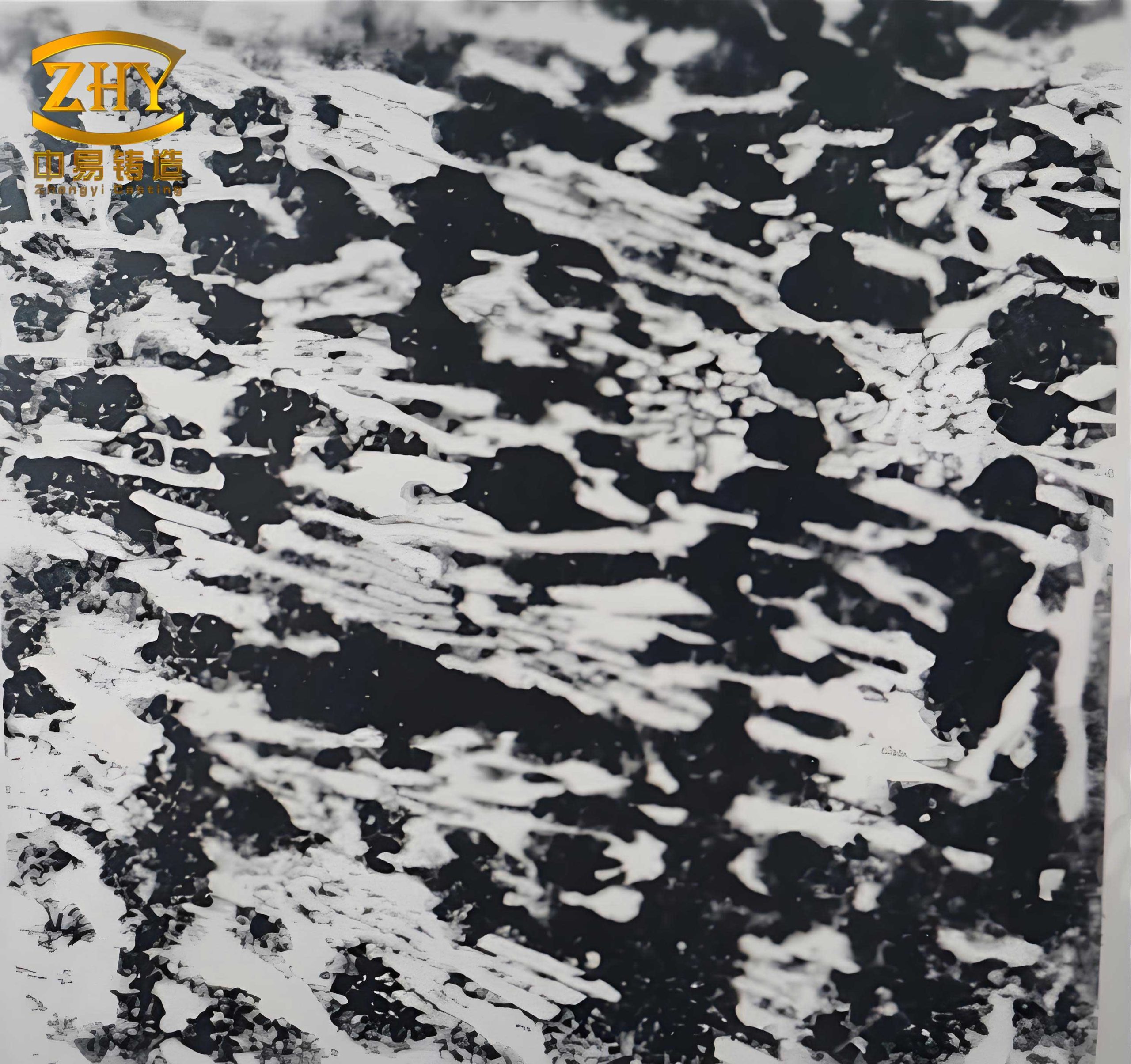
White cast iron, particularly high-chromium variants, has been widely studied for its excellent wear resistance. The microstructure typically consists of hard carbides embedded in a metallic matrix, which can be austenitic, martensitic, or pearlitic depending on composition and processing. In high-chromium white cast iron, the carbides are primarily of the M7C3 type, where M represents iron and chromium. These carbides provide high hardness, but their coarse and interconnected network can lead to crack initiation and propagation under stress. To improve toughness, researchers have explored various approaches, including alloying, heat treatment, and modification with elements like rare earths and boron. Rare earth elements are known for their ability to refine grains, modify carbide shape, and purify melts, while boron enhances hardness and further refines microstructure. In this study, I aimed to optimize these effects through a systematic investigation of RE-B modification on a multi-alloyed high-chromium white cast iron.
The theoretical basis for modification in white cast iron lies in the principles of solidification and phase transformation. During solidification, nucleation and growth of phases determine the final microstructure. The addition of modifiers like RE and B introduces heterogeneous nucleation sites, reducing the critical radius for nucleation and promoting finer grains. This can be described by the classical nucleation theory, where the nucleation rate \( I \) is given by:
$$ I = I_0 \exp\left(-\frac{\Delta G^*}{kT}\right) $$
Here, \( \Delta G^* \) is the activation energy for nucleation, \( k \) is Boltzmann’s constant, and \( T \) is temperature. By reducing \( \Delta G^* \) through the addition of modifiers, nucleation is enhanced, leading to a refined structure. For carbides in white cast iron, the morphology is influenced by interfacial energy and growth kinetics. The modification process alters these parameters, resulting in fragmented and spheroidized carbides rather than continuous networks. Additionally, boron affects the solubility of carbon in the matrix, as expressed by the equation:
$$ C_s = C_0 – \alpha B $$
where \( C_s \) is the carbon solubility in the solid solution, \( C_0 \) is the initial carbon content, \( B \) is the boron content, and \( \alpha \) is a constant. This reduction in carbon solubility increases the number of carbon atom clusters in the melt, promoting finer carbide precipitation. The combined action of RE and B thus optimizes the microstructure of white cast iron for better mechanical properties.
In my experimental work, I designed a multi-alloyed high-chromium white cast iron with additions of copper and vanadium to enhance performance under wet grinding conditions. The base composition was carefully selected based on prior studies on white cast iron, as summarized in Table 1. This table outlines the chemical composition ranges used in my research, emphasizing the key elements that influence the behavior of white cast iron.
| Element | Range | Role in White Cast Iron |
|---|---|---|
| C | 2.5-3.0 | Forms carbides for hardness; affects matrix stability. |
| Cr | 10.0-15.0 | Promotes M7C3 carbides; improves corrosion and wear resistance. |
| Cu | 0.5-1.5 | Enhances hardenability and corrosion resistance in wet environments. |
| V | 0.5-1.5 | Refines grains; forms hard vanadium carbides for additional wear resistance. |
| Mn | 0.5-1.0 | Stabilizes austenite; improves toughness. |
| Si | 0.8-1.2 | Promotes graphitization inhibition; affects fluidity and oxidation resistance. |
| P | ≤0.05 | Minimized to avoid embrittlement in white cast iron. |
| S | ≤0.05 | Minimized to reduce sulfide inclusions and improve toughness. |
The melting was conducted in a medium-frequency induction furnace under industrial conditions to ensure consistency. For modification, I used rare earth ferrosilicon and boron ferrous as modifiers, added via the bottom-pouring method. The amounts of RE and B were varied to study their effects, as detailed in Table 2. This table provides a comprehensive overview of the modification levels used in my experiments on white cast iron.
| Sample ID | RE Content | B Content | Description |
|---|---|---|---|
| 1 | 0.00 | 0.00 | Unmodified white cast iron for baseline comparison. |
| 2 | 0.30 | 0.05 | Low RE with low B modification in white cast iron. |
| 3 | 0.60 | 0.05 | Medium RE with low B modification in white cast iron. |
| 4 | 0.90 | 0.05 | High RE with low B modification in white cast iron. |
| 5 | 1.20 | 0.05 | Very high RE with low B modification in white cast iron. |
| 6 | 0.30 | 0.10 | Low RE with high B modification in white cast iron. |
| 7 | 0.60 | 0.10 | Medium RE with high B modification in white cast iron. |
| 8 | 0.90 | 0.10 | High RE with high B modification in white cast iron. |
| 9 | 1.20 | 0.10 | Very high RE with high B modification in white cast iron. |
After casting, the white cast iron samples underwent a quenching and tempering heat treatment to optimize the matrix structure. The austenitizing temperature was set at 950°C with a 2-hour hold, followed by air cooling. Tempering was performed at 290°C for 2.5 hours, also with air cooling. This treatment aimed to transform the matrix to martensite while precipitating secondary carbides, thereby enhancing hardness and toughness in the white cast iron.
To evaluate the effects, I conducted microstructural analysis using optical and scanning electron microscopy. Mechanical testing included hardness measurements on the Rockwell C scale and impact toughness tests using unnotched specimens of dimensions 10 mm × 10 mm × 55 mm. The results were averaged from multiple samples to ensure reliability. The data collected provided insights into how modification influences the properties of white cast iron.
The microstructural observations revealed significant changes due to RE-B modification in the white cast iron. In the as-cast state, the unmodified white cast iron exhibited coarse austenitic dendrites and a continuous network of carbides, which are typical of high-chromium white cast iron. This structure contributes to high wear resistance but poor impact toughness. With the addition of modifiers, the austenitic dendrites became refined, especially at 0.05% B content, where they transformed into fine equiaxed grains. This refinement is attributed to the increased nucleation sites provided by RE and B, which align with the nucleation theory discussed earlier. The carbides in the modified white cast iron showed a transition from a coarse mesh to fragmented and blocky shapes. For instance, at 0.3% RE and 0.05% B, the carbide network began to break up, and at higher RE levels, the carbides became more spheroidized. This change reduces stress concentration points and improves toughness in white cast iron.
After heat treatment, the microstructure of both modified and unmodified white cast iron consisted of martensite, eutectic carbides, and secondary carbides. However, the modified white cast iron displayed further carbide fragmentation, with carbides appearing as small blocks and short rods, whereas the unmodified white cast iron retained some plate-like carbides. The combination of modification and heat treatment proved effective in optimizing the carbide morphology in white cast iron. The secondary carbides precipitated within the matrix, contributing to dispersion strengthening without compromising toughness.
The mechanical properties of the white cast iron were strongly influenced by the modification. Hardness and impact toughness data are summarized in Table 3, which consolidates the results from my experiments on white cast iron. This table highlights the optimal modification levels for enhancing the performance of white cast iron.
| Sample ID | As-Cast Hardness (HRC) | Heat-Treated Hardness (HRC) | As-Cast Impact Toughness (J/cm²) | Heat-Treated Impact Toughness (J/cm²) |
|---|---|---|---|---|
| 1 | 52.5 | 58.3 | 3.5 | 4.2 |
| 2 | 53.8 | 60.1 | 4.8 | 6.1 |
| 3 | 54.2 | 61.5 | 5.0 | 5.8 |
| 4 | 54.9 | 62.8 | 4.5 | 5.5 |
| 5 | 53.5 | 60.9 | 4.0 | 4.9 |
| 6 | 53.0 | 59.8 | 4.2 | 5.0 |
| 7 | 53.5 | 60.5 | 4.5 | 5.2 |
| 8 | 54.2 | 61.2 | 4.8 | 5.3 |
| 9 | 52.8 | 59.5 | 4.1 | 4.7 |
From the data, it is evident that modification with 0.05% B and 0.9% RE yielded the highest heat-treated hardness of 62.8 HRC in white cast iron, while 0.05% B and 0.3% RE provided the best heat-treated impact toughness of 6.1 J/cm². The improvement in hardness can be explained by the Hall-Petch relationship, which relates grain size to yield strength:
$$ \sigma_y = \sigma_0 + k_y d^{-1/2} $$
where \( \sigma_y \) is the yield strength, \( \sigma_0 \) is a material constant, \( k_y \) is the strengthening coefficient, and \( d \) is the grain diameter. In white cast iron, finer grains from modification increase \( \sigma_y \), which correlates with higher hardness. For toughness, the refinement and fragmentation of carbides reduce crack initiation sites, as described by the fracture mechanics equation for stress intensity factor \( K \):
$$ K = Y \sigma \sqrt{\pi a} $$
Here, \( Y \) is a geometric factor, \( \sigma \) is applied stress, and \( a \) is crack length. By minimizing carbide size and connectivity, the effective crack length \( a \) decreases, allowing the white cast iron to withstand higher stresses before failure.
The fracture surfaces of the white cast iron samples were examined to corroborate the mechanical data. The unmodified white cast iron showed large cleavage facets, indicative of brittle fracture. In contrast, the modified white cast iron exhibited a mixed morphology with dimples and smaller cleavage areas, suggesting improved ductility. At optimal modification levels, such as 0.05% B and 0.3% RE, tear ridges were observed, reflecting localized plastic deformation. This aligns with the enhanced impact toughness values. However, excessive RE or B led to increased brittleness due to impurity segregation at grain boundaries, highlighting the importance of precise control in modifying white cast iron.
To further analyze the effects, I considered the thermodynamic aspects of carbide formation in white cast iron. The stability of carbides can be assessed using Gibbs free energy calculations. For the formation of M7C3 carbides, the reaction can be written as:
$$ 7M + 3C \rightarrow M_7C_3 $$
The free energy change \( \Delta G \) is given by:
$$ \Delta G = \Delta H – T\Delta S $$
where \( \Delta H \) is enthalpy change, \( T \) is temperature, and \( \Delta S \) is entropy change. Modification with RE and B alters \( \Delta H \) and \( \Delta S \) by changing interfacial energies and solute distributions, promoting finer and more stable carbides in white cast iron. Additionally, the kinetics of carbide growth can be modeled using the Avrami equation for phase transformation:
$$ f = 1 – \exp(-kt^n) $$
where \( f \) is the fraction transformed, \( k \) is a rate constant, \( t \) is time, and \( n \) is an exponent. Modification likely affects \( k \) and \( n \), leading to faster nucleation and slower growth of carbides in white cast iron.
In practical applications, the improved white cast iron from this study can be used for grinding balls, liners, and other components in abrasive environments. The enhanced toughness reduces the risk of fracture during impact, while the high hardness maintains wear resistance. For instance, in wet grinding mills, the modified white cast iron offers longer service life and lower downtime. Future work could explore other modifier combinations or advanced heat treatments to further optimize white cast iron. Additionally, computational modeling using finite element analysis could predict stress distributions in modified white cast iron components under load.
In conclusion, my research demonstrates that RE-B modification significantly improves the microstructure and mechanical properties of high alloy white cast iron. The refinement of austenitic dendrites, fragmentation of carbides, and purification of the melt contribute to higher hardness and impact toughness. The optimal modification levels were found to be 0.05% B with 0.9% RE for hardness and 0.05% B with 0.3% RE for toughness in white cast iron. The synergy between modification and heat treatment is crucial for achieving these enhancements. This study provides a foundation for developing advanced white cast iron materials for demanding industrial applications, ensuring better performance and durability. Continued exploration of white cast iron modifications will likely yield further innovations in wear-resistant materials.