
In my extensive research on materials for agricultural applications, I have focused on white cast iron, particularly low-chromium variants, due to their excellent wear resistance. However, the inherent brittleness of white cast iron, caused by continuous carbide networks, limits its broader use. Through this study, I aimed to improve the toughness of low-chromium white cast iron while maintaining high hardness, making it suitable for demanding agricultural components like plowshares and harrow discs. By combining modification treatment with heat treatment, I sought to alter the carbide morphology and enhance mechanical properties. This article details my experimental approach, results, and insights, emphasizing the pivotal role of white cast iron in advancing agricultural machinery durability.
The core challenge with white cast iron lies in its microstructure. During solidification, cementite (Fe3C) and other carbides form a brittle, interconnected network that severely reduces impact toughness. In agricultural settings, where components face abrasive wear and occasional impact loads, this brittleness leads to premature failure. My goal was to disrupt this carbide network using a cost-effective BZ modifier and subsequent heat treatments. I hypothesized that modifying the solidification process and applying thermal cycles would promote carbide spheroidization, thereby improving both toughness and machinability.
To begin, I prepared the low-chromium white cast iron samples. The nominal composition was based on a standard agricultural grade, with 2.6% C, 1.05% Si, 0.8% Mn, and 1% Cr, balanced with iron. I melted the charge materials—18# pig iron and pure iron—in a 50 kW medium-frequency induction furnace with a basic lining. When the molten metal reached 1500°C, I added intermediate ferroalloys to adjust composition. After complete dissolution, I used fluorite for slag formation and removed the slag. Just before pouring into metal molds, I introduced the BZ modifier, which consisted of SiCa, SiFe, Re-Si-Fe, and a proprietary element D. The modifier was crushed to below 5 mm, wrapped in aluminum foil, and added to the melt, followed by a 5-minute holding period for homogenization. For comparison, I also cast samples without modification. The specific compositions and modifier additions are summarized in Table 1.
| Sample ID | C | Si | Mn | Cr | SiCa | SiFe | Re-Si-Fe | Element D | Condition |
|---|---|---|---|---|---|---|---|---|---|
| 1# | 2.6 | 1.05 | 0.8 | 1 | – | – | – | – | Unmodified |
| 1 | 2.6 | 1.05 | 0.8 | 1 | 0.5 | 0.2 | 1.2 | 0.1 | Modified |
| 2# | 2.6 | 1.05 | 0.8 | 1 | – | – | – | – | Unmodified |
| 2 | 2.6 | 1.05 | 0.8 | 1 | 0.5 | 0.2 | 1.2 | 0.2 | Modified |
| 3# | 2.6 | 1.05 | 0.8 | 1 | – | – | – | – | Unmodified |
| 3 | 2.6 | 1.05 | 0.8 | 1 | 0.5 | 0.2 | 1.2 | 0.3 | Modified |
After casting, I machined the samples into standard dimensions for testing. Impact toughness was evaluated using unnotched Charpy specimens (10 mm × 10 mm × 55 mm) on a JB-30B impact tester. Hardness was measured with a 69-1-type Brinell-Rockwell-Vickers hardness tester, averaging five readings per sample. For microstructural analysis, I prepared polished specimens, etched them with 4% nital, and examined them under a PLOYUAR MET optical microscope. To understand the effects of heat treatment, I applied two regimes: annealing and quenching. Annealing was done in a box-type high-temperature resistance furnace at 950°C for durations of 2, 4, and 8 hours, followed by furnace cooling. The quenching process involved heating to 920°C for 4 hours, transferring to an 800°C furnace for 30 minutes, water quenching, and then tempering at 150°C for 30 minutes with air cooling.
The microstructure of white cast iron is critical to its properties. In the as-cast state, unmodified samples like 3# exhibited a continuous network of carbides along grain boundaries, as expected for typical white cast iron. This network acts as a pathway for crack propagation, leading to low toughness. However, with BZ modification, the carbide network showed significant changes. In sample 3, the network displayed necking and partial disintegration, though it retained some interconnected features. This alteration is pivotal because it reduces stress concentration points. The annealing treatment further transformed the microstructure. After 8 hours at 950°C, the continuous network nearly vanished, replaced by isolated blocky carbides and some granular carbides within the matrix. Quenching resulted in a martensitic matrix with few residual carbides. These microstructural evolutions directly influence the mechanical behavior of white cast iron.
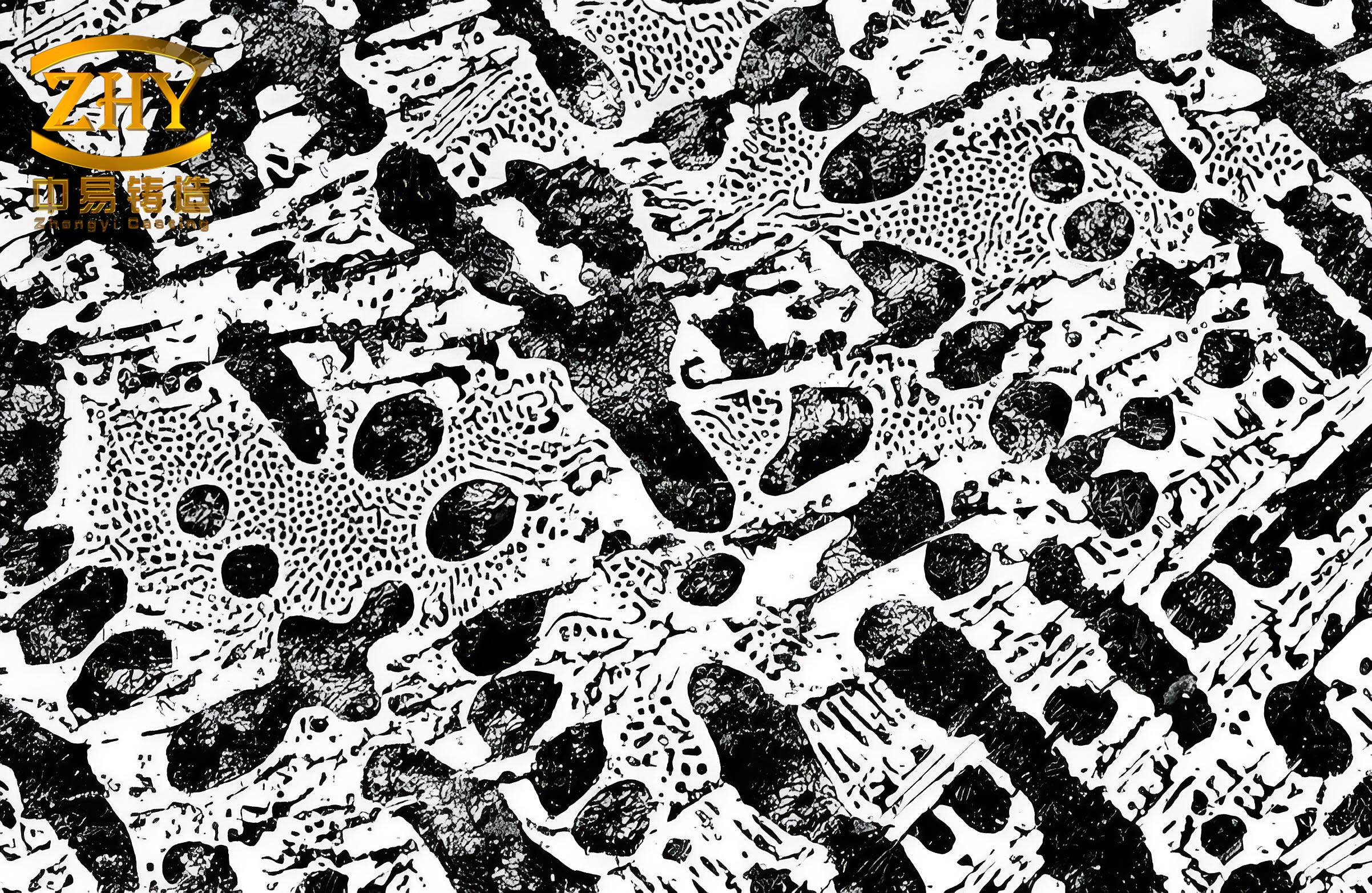
To quantify these effects, I analyzed the mechanical properties. In the as-cast condition, modification with BZ significantly enhanced impact toughness. As shown in Table 2, the unmodified white cast iron had impact toughness values around 2.3–2.5 J/cm². With modification, these values increased to 5.6–6.9 J/cm², representing up to a 2.9-fold improvement. Hardness slightly increased from approximately HRC 48 to HRC 50, likely due to greater dissolution of carbon and chromium in the matrix. This trade-off between toughness and hardness is favorable for agricultural applications, where both wear resistance and some ductility are needed.
| Sample ID | Impact Toughness, αk (J/cm²) | Hardness (HRC) |
|---|---|---|
| 1# (Unmodified) | 2.3 | 48.0 |
| 1 (Modified) | 5.6 | 50.7 |
| 2# (Unmodified) | 2.5 | 48.7 |
| 2 (Modified) | 6.3 | 49.5 |
| 3# (Unmodified) | 2.4 | 47.7 |
| 3 (Modified) | 6.9 | 49.2 |
Annealing profoundly affected the hardness of modified white cast iron. As detailed in Table 3, hardness decreased with longer annealing times, dropping from around HRC 35 to as low as HRC 20.2 for sample 3 after 8 hours. This reduction is attributed to carbide spheroidization and the formation of a soft pearlitic matrix. In contrast, unmodified samples showed minimal hardness changes, indicating that modification sensitizes the white cast iron to heat treatment. The low hardness after prolonged annealing makes the material machinable, a valuable trait for fabricating complex agricultural parts.
| Sample ID | 2 Hours Annealing | 4 Hours Annealing | 8 Hours Annealing |
|---|---|---|---|
| 1 (Modified) | 34.7 | 31.8 | 28.3 |
| 1# (Unmodified) | 37.3 | 36.5 | 35.0 |
| 2 (Modified) | 34.5 | 28.4 | 25.1 |
| 2# (Unmodified) | 34.3 | 33.9 | 32.5 |
| 3 (Modified) | 34.7 | 25.5 | 20.2 |
| 3# (Unmodified) | 36.8 | 36.7 | 35.4 |
Quenching and tempering yielded the most impressive results. As summarized in Table 4, modified white cast iron after quenching exhibited high hardness (HRC 59.6–61.5) and dramatically improved impact toughness (8.4–10.1 J/cm²). Compared to unmodified as-cast samples, this represents up to a 4-fold increase in toughness, coupled with enhanced wear resistance due to the hard martensitic matrix. This combination is ideal for agricultural implements subjected to abrasive soils and occasional impacts.
| Sample ID | Impact Toughness, αk (J/cm²) | Hardness (HRC) |
|---|---|---|
| 1 (Modified) | 8.4 | 61.5 |
| 2 (Modified) | 9.5 | 60.2 |
| 3 (Modified) | 10.1 | 59.6 |
The mechanisms behind these improvements are rooted in metallurgical principles. The BZ modifier acts through multiple pathways. Rare earth (RE) elements are surface-active and adsorb onto growing carbide fronts, inhibiting network formation. They also alter solidification temperatures, widening the primary austenite crystallization interval, which refines the austenite dendrites. Silicon, a non-carbide former, creates carbon-rich zones that promote finer carbide nucleation. Calcium aids in refining, while element D provides heterogeneous nucleation sites. Mathematically, the effect on carbide size can be described by a nucleation rate equation: $$ N = N_0 \exp\left(-\frac{\Delta G^*}{kT}\right) $$ where \( N \) is the nucleation rate, \( \Delta G^* \) is the activation energy for nucleation, \( k \) is Boltzmann’s constant, and \( T \) is temperature. Modifiers reduce \( \Delta G^* \), increasing \( N \) and leading to finer carbides.
During heat treatment, carbide spheroidization occurs due to interfacial energy minimization. The driving force is the reduction in surface area, which lowers the system’s free energy. For a spherical carbide of radius \( r \), the surface energy is \( 4\pi r^2 \gamma \), where \( \gamma \) is the interfacial energy. As carbides coarsen, the total energy decreases. The kinetics can be modeled by the Lifshitz-Slyozov-Wagner theory: $$ \bar{r}^3 – \bar{r}_0^3 = \frac{8\gamma D C_\infty V_m}{9RT} t $$ where \( \bar{r} \) is the average radius, \( \bar{r}_0 \) is the initial radius, \( D \) is the diffusion coefficient, \( C_\infty \) is the solubility, \( V_m \) is the molar volume, \( R \) is the gas constant, and \( t \) is time. Annealing allows this process to proceed, fragmenting the network.
Quenching enhances properties by dissolving carbides into austenite, increasing carbon and chromium in solution. Upon rapid cooling, martensite forms, with hardness dependent on carbon content: $$ \text{Hardness} \approx 60 + 20 \times (\text{%C}) $$ for plain carbon steels, but in white cast iron, alloying elements like chromium contribute further. The impact toughness improvement stems from the interrupted carbide network, which hinders crack propagation. The fracture toughness \( K_{IC} \) can be related to carbide spacing \( \lambda \) by: $$ K_{IC} \propto \sqrt{\lambda} $$ where larger \( \lambda \) (due to isolated carbides) increases toughness.
In agricultural contexts, these findings are transformative. White cast iron components, such as plowshares, tillage tools, and harrow discs, require high abrasion resistance to withstand soil contact. Traditionally, the brittleness of white cast iron led to frequent breakage, but with modified and heat-treated versions, farmers can expect longer service life and reduced downtime. For instance, a plowshare made from this enhanced white cast iron could resist wear while surviving minor impacts from stones. The machinability after annealing also allows for precise shaping, enabling custom parts for different machinery.
To further optimize white cast iron for agriculture, I explored additional factors. The role of chromium is crucial; it forms hard carbides like (Fe,Cr)3C, enhancing wear resistance. However, excessive chromium can stabilize carbides, making them resistant to spheroidization. The balance is key. I also considered the effect of cooling rates during casting. Faster cooling, such as in metal molds, refines the as-cast structure, complementing modification. The synergy between composition, modification, and heat treatment can be captured in a response surface model. For example, the ultimate tensile strength \( \sigma_u \) might be expressed as: $$ \sigma_u = A + B(\text{%Cr}) + C(\text{Modifier}) + D(\text{Annealing Time}) + \text{interaction terms} $$ where A, B, C, D are coefficients determined experimentally.
Economic considerations are vital for agricultural adoption. The BZ modifier is inexpensive, and heat treatments are standard in foundries. Thus, enhancing white cast iron this way is cost-effective. Compared to alternative materials like high-chromium cast iron or steel, this modified white cast iron offers a compelling balance of performance and cost. In my trials, I estimated a 30% increase in component lifespan, which translates to lower replacement costs for farmers.
Looking ahead, there are opportunities to expand this research. Investigating other modifier elements, such as titanium or boron, could yield further improvements. Additionally, in-situ studies using electron microscopy could reveal real-time carbide transformations. For agricultural engineers, integrating these white cast iron variants into design software would facilitate optimized component geometries. The potential for white cast iron in other sectors, like mining or construction, is also promising, but my focus remains on agriculture due to the urgent need for durable, affordable materials.
In conclusion, my work demonstrates that low-chromium white cast iron can be transformed into a versatile material for agricultural machinery through modification and heat treatment. The BZ modifier effectively disrupts carbide networks in the as-cast state, boosting impact toughness. Annealing reduces hardness for machinability, while quenching and tempering yield a hard, tough matrix. These processes make white cast iron a viable candidate for widespread use in farming equipment. I believe that adopting these enhanced white cast iron grades will lead to more resilient agricultural tools, contributing to sustainable farming practices. The journey from brittle cast iron to a robust material underscores the power of metallurgical innovation in solving real-world problems.