
In the field of wear-resistant materials, white cast iron has undergone significant evolution, progressing from ordinary white cast iron to nickel-hard white cast iron and finally to chromium-based white cast iron. Among these, chromium white cast iron stands out due to its exceptional resistance to abrasive wear, making it widely applicable in industries such as mining, construction materials, metallurgy, and agricultural machinery. However, in practical working conditions, the failure of chromium white cast iron due to abrasive friction remains a critical issue, limiting the enhancement of its cost-effectiveness. Therefore, investigating the microstructure and properties of chromium white cast iron, and establishing a unified theoretical model and research methodology, holds substantial practical significance for improving its macroscopic mechanical properties, such as wear resistance. In this review, I will comprehensively analyze the research advancements in chromium white cast iron, focusing on the effects of chemical composition and heat treatment processes, while also addressing existing shortcomings and future prospects.
Chromium white cast iron can be categorized into three types based on the chromium content: low-chromium white cast iron, medium-chromium white cast iron, and high-chromium white cast iron. Each type exhibits distinct microstructural characteristics and performance metrics, which I will elaborate on in the following sections.
Low-chromium white cast iron typically contains less than 5.0% chromium, with eutectic carbides of the (Cr,Fe)3C type, denoted as M3C. These carbides are distributed in a continuous network within the matrix. Compared to ordinary white cast iron, low-chromium white cast iron shows improved toughness and wear resistance. However, the continuous network distribution of carbides can cause matrix cracking, leading to drawbacks such as poor toughness and high brittleness. Consequently, this type of white cast iron is more suitable for low-stress, medium-to-low hardness abrasive wear conditions.
High-chromium white cast iron contains more than 12.0% chromium, with eutectic carbides of the (Cr,Fe)7C3 type, denoted as M7C3. These carbides are distributed in hexagonal rod-like or curved plate-like forms. The unique morphology and distribution of M7C3 carbides reduce matrix cracking and enhance matrix continuity, resulting in superior toughness and wear resistance. Nonetheless, the high production costs and relatively poor toughness under high-impact, high-stress abrasive wear conditions restrict its broader application, necessitating further improvements.
Medium-chromium white cast iron has a chromium content between that of low- and high-chromium types, featuring a mixture of (Cr,Fe)7C3 and (Cr,Fe)3C carbides. The M7C3 carbides are distributed in chrysanthemum-like or plate-like forms, while M3C carbides appear in a honeycomb structure. Since M7C3 carbides exhibit better strength, hardness, and toughness than M3C carbides, increasing the volume fraction of M7C3 in the microstructure is key to enhancing the material properties. Medium-chromium white cast iron addresses the excessive brittleness of low-chromium types and the high production costs of high-chromium types, but due to shorter research history, its performance in areas like complex heat treatment processes, poor matrix hardenability, and lower wear resistance still requires optimization for practical applications.
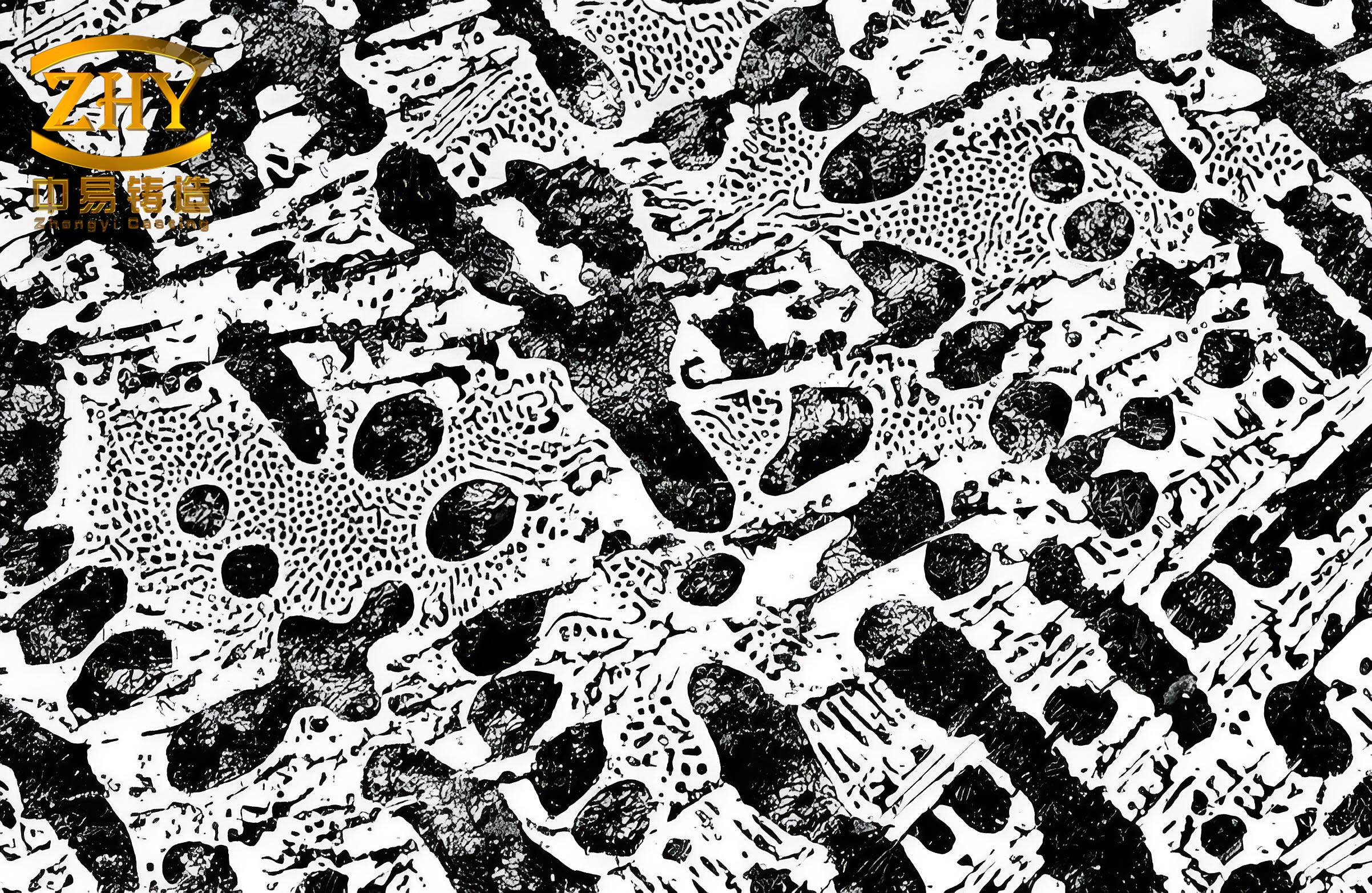
The mechanical properties of chromium white cast iron, particularly its wear resistance, are heavily influenced by chemical composition, with carbon and chromium playing dominant roles. Numerous studies have aimed to optimize the chemical composition by adjusting carbon content, chromium content, Cr/C ratio, and the addition of alloying elements like nickel, silicon, and manganese to develop chromium white cast iron suited for various working conditions. Below, I will discuss the individual effects of these elements and present a summary in table form.
| Element | Effect on Hardness | Effect on Toughness | Optimal Range |
|---|---|---|---|
| Carbon (C) | Increases with higher content | Decreases with higher content | 2.0-3.5% (depending on application) |
| Chromium (Cr) | Increases with higher content | Decreases with higher content | 5-30% (varies by type) |
| Nickel (Ni) | Moderate increase | Improves | 0-4% |
| Silicon (Si) | Slight decrease | Improves | 0.5-2.0% |
| Manganese (Mn) | Minor effect | Can improve or reduce based on content | 0.5-1.5% |
Carbon exists in chromium white cast iron in two forms: dissolved in austenite and as carbides. The carbon dissolved in austenite enhances the hardenability of the matrix, leading to carbon-supersaturated martensite upon quenching, which strengthens the matrix through lattice distortion. Meanwhile, carbon combined with carbide-forming elements creates various carbides that serve as hard wear-resistant phases. Generally, hardness and wear resistance increase with higher carbon content, but excessive carbon reduces transverse rupture toughness and impact toughness, increasing brittleness. Therefore, carbon content must be selected based on specific working conditions. For instance, in low-chromium white cast iron, reducing carbon content improves impact toughness but may weaken impact fatigue resistance, with an optimal range around 2.37-2.69% for balanced performance.
Chromium is the core alloying element in chromium white cast iron. Part of the chromium forms carbides, altering their structure, properties, and morphology, while the remainder dissolves in austenite, enhancing matrix hardenability. As chromium content increases, the microstructure and properties change significantly, including shifts in carbide type, increased hardness, and improved toughness. However, excessive chromium can reduce toughness despite boosting wear resistance. Studies show that in medium- and low-chromium white cast iron, higher chromium content strengthens hardness but reduces toughness due to increased carbide volume. In high-chromium white cast iron with fixed carbon content, carbide quantity rises with chromium, and morphology transitions from broken networks to continuous networks.
The Cr/C ratio is crucial for determining carbide quantity, composition, and morphology. Carbides act as the wear-resistant phase, and their volume fraction directly impacts hardness. The carbide mass fraction can be estimated using F. Maratray’s regression equation derived from experimental data: $$ \text{Carbide mass fraction} = W(C) \times 12.33\% + W(Cr) \times 0.55\% – 15.2\% $$ where \( W(C) \) and \( W(Cr) \) are the weight percentages of carbon and chromium, respectively. This equation shows a positive correlation between carbide mass fraction and carbon and chromium content, meaning adjusting Cr/C can control carbide quantity. For example, as Cr/C increases, carbides transition from M3C to M7C3, and the microhardness of M7C3 and its relative volume fraction rise, enhancing overall wear resistance.
To further illustrate the relationship between chemical composition and properties, consider the following formula for calculating the approximate hardness \( H \) of chromium white cast iron based on carbon and chromium content: $$ H = 200 + 50 \times W(C) + 10 \times W(Cr) – 5 \times (W(C) \times W(Cr)) $$ This empirical equation highlights the interactive effects, though actual hardness depends on other factors like heat treatment. Below is a table summarizing typical compositions for different types of white cast iron.
| Type of White Cast Iron | Carbon Content (%) | Chromium Content (%) | Typical Cr/C Ratio | Predominant Carbide Type |
|---|---|---|---|---|
| Low-chromium | 2.5-3.5 | 2.0-5.0 | 0.8-2.0 | M3C |
| Medium-chromium | 2.0-3.0 | 5.0-12.0 | 2.0-4.0 | M7C3 + M3C |
| High-chromium | 2.0-3.5 | 12.0-30.0 | 4.0-10.0 | M7C3 |
Heat treatment processes play a pivotal role in optimizing the mechanical properties of chromium white cast iron after chemical composition is determined. Research indicates that heat treatment primarily affects two aspects: first, it modifies the quantity, morphology, and distribution of carbides to enhance macroscopic properties; second, it adjusts the matrix structure to better support carbides and fully utilize their wear resistance. Given the adaptability of high-chromium white cast iron to diverse working conditions, most studies focus on its heat treatment, particularly quenching and tempering processes.
Quenching is essential for achieving optimal wear resistance in high-chromium white cast iron. The quenching temperature is a critical parameter, as it influences the dissolution of carbides into austenite. At lower quenching temperatures, fewer carbides dissolve into austenite, resulting in martensite with lower carbon and alloy content after quenching, leading to reduced hardness. As quenching temperature increases, carbon diffusion accelerates, dissolving more carbides into austenite, so martensite becomes richer in carbon and chromium, increasing hardness. However, excessively high quenching temperatures dissolve too many carbides, stabilizing austenite and resulting in retained austenite after quenching, which lowers hardness. Thus, an optimal quenching temperature exists for maximum hardness. Orthogonal experiments on Cr26 high-chromium white cast iron show that hardness increases with quenching temperature but first rises and then falls with extended holding time.
The effects of heat treatment parameters can be ranked by significance. For hardness, the order is quenching holding time > quenching temperature > tempering holding time > tempering temperature. For impact toughness, the order is tempering holding time > quenching temperature > quenching holding time > tempering temperature. This underscores the complexity of optimizing heat treatment for chromium white cast iron.
Tempering after quenching can further enhance hardness, with tempering temperature being key. High-chromium white cast iron has strong tempering resistance, so temperatures below 450°C have little effect on hardness. At 500°C, hardness changes depend on the prior quenching temperature: lower quenching temperatures decrease hardness, moderate ones maintain it, and higher ones may increase it. Tempering involves the precipitation of carbides and decomposition of martensite and retained austenite. As tempering temperature rises, diffusion of carbon and chromium accelerates, causing primary and eutectic carbides to fragment. At 450°C, secondary carbides agglomerate and increase. Above this, tertiary carbides precipitate from martensite and retained austenite, dispersing around primary and secondary carbides, hindering dislocation movement and increasing hardness. For example, in high-chromium white cast iron rolls, wear resistance improves with tempering temperature up to 450°C but declines beyond that, while hardness remains stable up to 525°C before dropping sharply above 575°C.
To summarize typical heat treatment cycles, I provide the following table for high-chromium white cast iron:
| Process | Temperature Range (°C) | Holding Time (hours) | Cooling Method | Effect on Hardness (HRC) |
|---|---|---|---|---|
| Quenching | 950-1100 | 2-6 | Air or oil | Increases to 50-65 |
| Tempering | 200-600 | 2-6 | Air | Stabilizes or slightly increases |
| Subcritical Treatment | 450-550 | 4-8 | Air | Enhances toughness |
In addition to conventional heat treatment, advanced techniques like deep cryogenic treatment have been explored for white cast iron. This involves cooling the material to very low temperatures (e.g., -196°C) to transform retained austenite into martensite and refine carbides, potentially improving wear resistance. The effect can be modeled using a phase transformation equation: $$ V_m = V_{m0} + \alpha \cdot \Delta T $$ where \( V_m \) is the martensite volume fraction, \( V_{m0} \) is the initial fraction, \( \alpha \) is a material constant, and \( \Delta T \) is the temperature change. However, this requires further validation for chromium white cast iron.
Looking at future research directions, several areas need attention. First, the interplay between carbon, chromium, and Cr/C ratio in chromium white cast iron warrants deeper investigation to establish precise models for predicting mechanical properties. Second, heat treatment processes should be tailored for specific applications, incorporating novel methods like multi-step tempering or alloy modifications to improve hardenability and reduce costs. Third, while chromium white cast iron excels in abrasive wear resistance, its performance under combined wear and corrosion environments remains underexplored, suggesting a need for alloy design incorporating elements like molybdenum or copper.
From a broader perspective, the development of chromium white cast iron aligns with industrial demands for durable materials. For instance, in mining applications, white cast iron components such as liners and grinding balls face severe abrasive wear, where optimized high-chromium white cast iron can extend service life. Similarly, in agricultural machinery, medium-chromium white cast iron offers a cost-effective solution for wear parts. To quantify wear resistance, the Archard wear equation is often adapted: $$ W = k \cdot \frac{F \cdot L}{H} $$ where \( W \) is wear volume, \( k \) is a wear coefficient, \( F \) is load, \( L \) is sliding distance, and \( H \) is hardness. For chromium white cast iron, \( k \) depends on carbide morphology and matrix support, highlighting the importance of microstructure control.
In conclusion, chromium white cast iron represents a critical class of wear-resistant materials, with its properties highly dependent on chemical composition and heat treatment. Through systematic research, we can enhance its performance and expand its applications. Future work should focus on integrated approaches combining computational modeling, experimental validation, and real-world testing to overcome existing limitations and unlock the full potential of white cast iron in various industries.