
Our journey in developing a superior bimetallic cylinder liner for drilling mud pumps began several decades ago, driven by the constant feedback from major oilfields and the need to improve wear resistance. We systematically analyzed imported components, particularly from American manufacturers, to understand their material science. The core finding was the use of a high-chromium white cast iron for the inner sleeve. This material’s chemical composition, as determined from our analysis, is summarized in the table below.
| Element | Composition (wt.%) |
|---|---|
| C | 2.8 – 3.2 |
| Cr | 14.0 – 18.0 |
| Mn | 0.6 – 1.2 |
| Si | 0.4 – 0.8 |
| Mo | ~1.0 |
| V | 0.3 – 0.8 |
| P | < 0.08 |
| S | < 0.05 |
The microstructure of this imported white cast iron consisted of martensite, alloy carbides, retained austenite, and a small amount of secondary carbides, achieving a hardness over 60 HRC. Inspired by this, we developed our own process. The outer sleeve of our liner is made from 45# steel, while the inner wear-resistant sleeve is crafted from a proprietary high-chromium white cast iron. We employ centrifugal casting for both components, followed by a shrink-fit assembly process with significant interference. Our development focused on a comprehensive analysis to select the optimal chemical composition and perfect the casting and heat treatment protocols for the white cast iron inner sleeve.
The Interplay of Hardness, Toughness, and Wear Resistance
The wear resistance of a material is intrinsically linked to its hardness. Generally, under the prerequisite that the material does not fracture, wear resistance is proportional to hardness. A classic conflict exists between wear resistance and toughness. Materials with higher hardness and better wear resistance typically exhibit lower toughness. Components subjected to abrasive wear, like our cylinder liners, must also withstand significant mechanical shock, vibration, and high-pressure loads during operation. Therefore, sufficient toughness is non-negotiable. Determining the precise required toughness is challenging, so industrial practice often involves a trade-off—sacrificing some toughness for hardness, or vice versa, based on service conditions.
While the impact toughness requirements for mud pump liners are not as severe as for hammerheads or ball mill liners, the operating environment is demanding. The liner experiences high pressure, high-frequency vibration, and direct impact from abrasive mud slurry. Furthermore, the manufacturing process itself imposes stresses. The high-interference shrink-fit assembly, variations in ovality and taper, and the degree of contact between the inner and outer sleeves all create internal stresses. These factors necessitate that the high-chromium white cast iron inner sleeve possesses adequate toughness and elastic resilience to prevent catastrophic failure. In the late 20th century, numerous domestic attempts to enhance liner life by simply increasing hardness—using materials like ceramic or boron-infused white cast iron—often failed. These ultra-hard liners showed minimal wear but fractured prematurely due to critically low toughness.
The Critical Role of Carbides in White Cast Iron
The microstructure of a heat-treated high-chromium white cast iron typically consists of carbides embedded in a matrix of martensite and retained austenite. The carbides act as the primary wear-resistant skeleton. Therefore, their volume fraction, morphology, and distribution are paramount to performance.
- Volume Fraction: A higher carbon content increases the volume of carbides, generally increasing hardness. Within the bounds of preventing brittle fracture, a higher carbide volume usually correlates with better wear resistance.
- Morphology and Distribution: To prevent crack propagation along carbide networks, the ideal morphology is spheroidal, globular, or broken blocky. Continuous networks or radial formations should be avoided. In essence, the carbide skeleton in three-dimensional space should be an “open” structure, which significantly improves impact toughness.
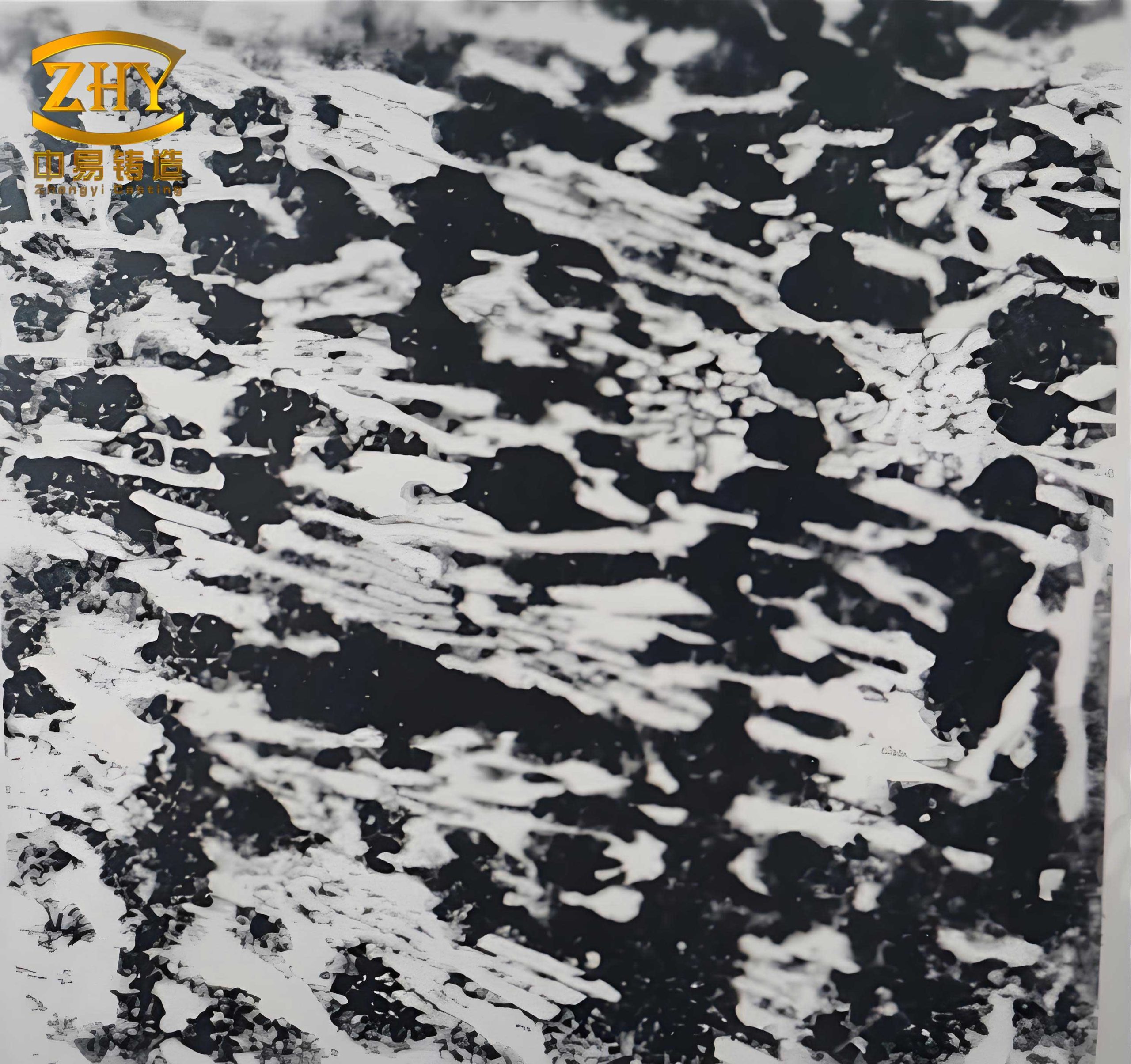
The image above provides a visual reference for the desired microstructure in a high-quality white cast iron, showcasing the distribution of hard carbides within the metallic matrix.
The Matrix and Its Bond with Carbides
The wear resistance of white cast iron is not solely determined by carbides; the matrix plays an equally crucial role. The matrix must possess sufficient strength and, critically, a high cohesive strength with the carbides. If the matrix is weak or the bond is poor, it will wear or deform rapidly under abrasion. This leaves the carbides unsupported, making them prone to fracture, spalling, or becoming孤立突出. Once dislodged, these extremely hard carbide particles become secondary abrasives, accelerating the wear process in a detrimental cycle. While austenite can work-harden under severe impact, the shock loads in a mud pump are insufficient to trigger significant transformation hardening. Therefore, for our application, retained austenite is a microstructural constituent that must be strictly controlled, as it represents a softer phase that can compromise overall wear resistance.
In summary, the abrasion resistance of high-chromium white cast iron is a function of a complex interplay between hardness, toughness, and strength. It depends on the composite structure—the显微组织, relative quantities, distribution morphology, and most importantly, the cohesive strength between the different phases. Developing this抗磨材料 requires a holistic, systems-based approach.
Rational Design of Chemical Composition for White Cast Iron
Based on the principles above, we designed our alloy composition through the following rationale:
- Carbon (C): Carbon has the most significant influence on the toughness and hardness of white cast iron. We target a hypoeutectic composition to balance properties. Carbon content is controlled at 2.8 – 3.2%. Lower carbon leads to networked carbides at grain boundaries, detrimental to all properties.
- Chromium (Cr): A strong carbide former and whitening agent. When the Cr/C ratio is > ~5, the M7C3 type carbide forms, which offers superior wear and corrosion resistance compared to M3C. At levels of 14-18%, M7C3 is the primary carbide, sometimes accompanied by harder M23C6. Although M23C6 can make annealing difficult and increase cracking tendency, its presence can be managed with other alloying elements to enhance overall performance.
- Manganese (Mn) and Silicon (Si): Mn neutralizes sulfur and improves hardenability but strongly stabilizes austenite. Excess Mn increases retained austenite, so we limit it to 0.6-1.2%. Si has the opposite effect, reducing hardenability but aiding deoxidation and fluidity during melting. We control Si at 0.4-0.8%.
- Molybdenum (Mo): A highly effective alloying element that significantly increases the hardenability of white cast iron. It dissolves in both carbides and the matrix, refining grains and increasing the micro-hardness of carbides. While it may slightly reduce hardness, it markedly improves impact toughness and wear resistance by preventing localized soft phases. It is an ideal addition, controlled at around 1.0% for cost-performance balance.
- Vanadium (V): A powerful carbide stabilizer that increases chill depth and refines the as-cast structure. It increases hardness but decreases toughness. When added in conjunction with Molybdenum (e.g., 0.3-0.8% V), the negative impact on toughness is mitigated, resulting in excellent综合力学性能.
- Sulfur (S) and Phosphorus (P): These elements form brittle eutectics at grain boundaries, severely reducing mechanical properties and promoting hot tears. They are strictly controlled at S < 0.05% and P < 0.08%.
Casting and Processing of High-Chromium White Cast Iron
Melting: We use a medium-frequency induction furnace. Charge materials include low-silicon pig iron, steel scrap, and ferroalloys (high-carbon ferrochrome, ferromanganese, ferrovanadium). Alloying elements like Mo, V, and Si are added when the melt reaches approximately 1500°C, followed by deoxidation and slag removal before tapping.
Centrifugal Casting Speed: The rotational speed of the centrifugal casting machine is critical. It must be high enough to prevent slag inclusions and “raining” but low enough to avoid cracking. Our empirical formula is:
$$ n = \frac{5520}{\sqrt{\rho \cdot r_i}} \cdot \sqrt{G} $$
Where:
- $n$ = mold speed (rpm)
- $G$ = gravity factor (typically 40-80)
- $r_i$ = inner radius of the casting (m)
- $\rho$ = density of the molten metal (kg/m³)
The selection of $G$ follows these principles: a higher value for alloys with a wide solidification range (for better interdendritic feeding), a lower value for alloys prone to density segregation, a higher value for small-diameter castings, and a higher value when using a dry sand liner.
Pouring Temperature and Speed: Pouring temperature directly affects quality. Too low, and cold shuts or laminations occur; too high, and cracking risk increases. Although high-chromium white cast iron has good fluidity, we maintain a pouring temperature around 1380°C (tapped at 1500-1520°C and allowed to cool) to avoid defects like “white bright hard spots”—high-melting-point inclusions that can spall during service and act as abrasives. Pouring speed is adjusted inversely with temperature, typically between 3-5 kg/s.
Inoculation/Modification: To further enhance toughness and modify carbide morphology, we use复合孕育剂 containing rare earth (RE) elements. These inoculants promote the formation of spheroidal,孤立块状 carbides instead of continuous networks, reducing the cutting effect on the matrix and improving both hardness and impact toughness. Furthermore, RE elements strongly bind with oxygen and sulfur, purifying grain boundaries and enhancing overall mechanical properties.
Heat Treatment for Optimal White Cast Iron Microstructure
The heat treatment cycle is designed to achieve the ideal combination of high hardness, good toughness, and minimal retained austenite for the inner sleeve. Our standard protocol is as follows:
- Softening Anneal: Facilitates machining of the as-cast white cast iron. Heat to 920-950°C, hold for 2-4 hours, then furnace cool to below 500°C before air cooling.
- Quenching: Achieves a hard, martensitic matrix. Heat to 950-980°C, austenitize for 1-2 hours (time depends on section thickness), then air cool or fan cool.
- Tempering: Relieves quenching stresses and stabilizes the structure. Heat to 200-250°C, hold for 2-4 hours, then air cool.
The resulting hardness is 60-65 HRC. The ideal final microstructure consists of团球状 or broken blocky carbides uniformly distributed in a martensitic matrix. It is crucial that the as-cast structure does not contain large blocky or networked carbides, as these persist through annealing and hinder machinability. Furthermore, we strictly control retained austenite post-quench to be less than 10%.
| Heat Treatment Stage | Temperature Range | Time | Cooling Method | Primary Objective |
|---|---|---|---|---|
| Softening Anneal | 920 – 950 °C | 2 – 4 hours | Furnace Cool to <500°C, then Air Cool | Machinability |
| Austenitizing & Quenching | 950 – 980 °C | 1 – 2 hours | Air/Fan Cool | Form Martensitic Matrix |
| Tempering | 200 – 250 °C | 2 – 4 hours | Air Cool | Stress Relief, Stabilization |
Performance Summary and Conclusions
Our systematic approach to developing high-chromium white cast iron for bimetallic liners has yielded exceptional results. The table below contrasts the key performance metrics of a standard material with our optimized white cast iron.
| Property / Characteristic | Standard Material | Optimized High-Cr White Cast Iron |
|---|---|---|
| Primary Wear Mechanism | Adhesive/Abrasive | Primarily Abrasive (carbide skeleton) |
| Typical Hardness (HRC) | 45 – 55 | 60 – 65 |
| Key Microstructural Feature | Pearlite/Graphite or Fine Carbides | M7C3 Carbides in Martensite |
| Impact Toughness (J/cm²) | Moderate to High | Sufficient for Application (Optimized) |
| Corrosion Resistance | Low to Moderate | High (due to Cr content) |
The final product demonstrates a service life exceeding 1000 hours in demanding oilfield applications. This performance not only places it at the forefront of domestic manufacturing but also meets or exceeds the standards of imported equivalents. The success of this high-chromium white cast iron formulation and its associated manufacturing process is validated by its reliable performance in domestic oilfields and its growing acceptance in the international market, supplying to regions including North America. The continuous refinement of white cast iron compositions and processing techniques remains a cornerstone of advancing wear-resistant component technology.