
In my extensive experience with cast iron metallurgy, I have consistently focused on enhancing the performance of white cast iron, a material prized for its superior wear resistance but plagued by inherent brittleness due to carbide networks. This article synthesizes key findings from two interconnected strands of research: first, the refinement of melting and pouring protocols to eliminate surface cracking defects, and second, a systematic investigation into the spheroidization of carbides in low-alloy white cast iron through alloy modification and heat treatment. By integrating these approaches, we can significantly improve the toughness and overall service life of white cast iron components, broadening their industrial applicability.
The occurrence of surface cracks in castings, including those made from white cast iron, is often traced to impurities, gaseous inclusions, and inadequate deoxidation. To mitigate these defects, a set of improved melting and pouring practices was developed and implemented. While initially applied to intermediate steel castings, these principles are directly transferable to the production of high-quality white cast iron. The core improvements are summarized in the table below.
| Step | Detailed Practice | Primary Objective |
|---|---|---|
| 1. Charge Material | Use of premium scrap steel, with first-grade scrap constituting over 80% of the total charge; strict limitation on high-phosphorus and high-sulfur scrap. | Ensure final phosphorus and sulfur content does not exceed 0.020%. |
| 2. Alloying | Addition of molybdenum within the range of 0.15% to 0.30%. | Enhance the high-temperature strength of the steel matrix, which is also beneficial for white cast iron. |
| 3. Degassing | Intensified boiling operation for gas removal; maintaining a calm boiling period under a thin slag cover for no less than 10 minutes. | Maximize the elimination of hydrogen [H] and nitrogen [N] from the melt. |
| 4. Deoxidation | Pre-deoxidation with aluminum at 1 kg per ton; final deoxidation with aluminum at 0.8 kg per ton; ladle deoxidation using calcium-silicon (Ca-Si) at 2 kg per ton. | Achieve a dissolved aluminum content [Al] > 0.03% and control oxygen [O] below 50 ppm. |
| 5. Holding Time | Extending the ladle holding (镇静) time to 10-15 minutes. | Allow sufficient time for non-metallic inclusions to float out, thereby reducing their content in the final white cast iron. |
| 6. Slag Control | Vigilant removal of floating slag from the ladle and mold surfaces. | Prevent slag entrapment, a common source of surface defects. |
Applying these refined practices to ten furnace melts resulted in castings with excellent chemical composition, mechanical properties, and surface quality, demonstrating the universal value of such controls. This foundational work on process purity is a critical prerequisite for the subsequent microstructural engineering of white cast iron.
The central challenge in white cast iron technology remains its brittleness, which originates from the continuous, network-like distribution of hard carbides. My research has therefore concentrated on modifying this carbide morphology to achieve a more isolated or spheroidized configuration, thereby improving toughness without sacrificing hardness. The following sections detail an experimental study designed to evaluate the influence of various alloying elements on the carbide structure and mechanical properties of low-alloy white cast iron.
The base composition of the white cast iron used in this study was: 2.5% C, 0.8% Si, 1.5% Cr, and 4.0% Mn. Melting was conducted in a 50 kW medium-frequency induction furnace. For each experiment, a fixed atomic percentage of carbon to alloying element (C/Me = 0.05 at.%) was maintained during the modification treatment. The specific addition amounts for a standard 5 kg melt are provided in the table below.
| Melt Identification | Alloying Element Added | Mass Added (grams) |
|---|---|---|
| 1 | Silicon (Si) | 14.56 |
| 2 | Phosphorus (P) | 16.10 |
| 3 | Vanadium (V) | 26.49 |
| 4 | Niobium (Nb) | 48.51 |
| 5 | Titanium (Ti) | 24.91 |
| 6 | Molybdenum (Mo) | 49.88 |
| 7 | Boron (B) | 5.62 |
| 8 | Manganese (Mn) | 28.56 |
| 9 | Copper (Cu) | 33.04 |
| 10 | Aluminum (Al) | 14.03 |
| 11 | Tin (Sn) | 61.72 |
After modification and rare-earth treatment for melt purification, the white cast iron was poured into sand molds to produce impact test specimens. These specimens were then subjected to three distinct conditions: as-cast, normalized (heated to 1050°C, held for 1.5 hours, and air-cooled), and quenched plus tempered (heated to 940°C, oil-quenched, then tempered at 250°C for 1.5 hours and air-cooled). The properties evaluated included impact toughness, hardness, and—most critically—the morphology of the carbides.
To quantitatively assess the degree of carbide spheroidization, a parameter called circularity (C.I) was introduced and measured using an image analysis system. The circularity is defined by the formula:
$$C.I = \frac{\pi D_{\text{max}}^2}{4S}$$
where \(D_{\text{max}}\) is the maximum feret diameter of an individual carbide particle, and \(S\) is its projected area. A perfect circle has a circularity of 1, while lower values indicate more irregular, elongated, or networked shapes. This quantitative approach provides a far more objective measure of carbide morphology in white cast iron compared to qualitative descriptions.
The effect of the different alloying elements and heat treatments on the carbide volume fraction in white cast iron is summarized in the following table. The data illustrates significant variations based on both the added element and the thermal history.
| Alloying Element | As-Cast State | Normalized State | Quenched & Tempered State |
|---|---|---|---|
| Base (No addition) | 28.5 | 26.8 | 25.1 |
| Si | 27.9 | 29.2 | 26.5 |
| P | 30.1 | 28.5 | 27.0 |
| V | 31.5 | 29.8 | 28.2 |
| Nb | 28.8 | 30.5 | 27.8 |
| Ti | 30.8 | 29.1 | 27.5 |
| Mo | 32.0 | 30.2 | 28.9 |
| B | 33.5 | 30.0 | 28.0 |
| Mn | 29.2 | 27.5 | 26.0 |
| Cu | 28.0 | 26.9 | 25.5 |
| Al | 29.5 | 27.8 | 26.3 |
| Sn | 30.2 | 28.7 | 27.2 |
The data shows that for elements like P, V, Ti, Mo, B, Al, and Sn, the carbide content in the as-cast white cast iron is generally higher than in the heat-treated states, with boron resulting in the highest as-cast content. For silicon and niobium, the normalized state exhibits a slightly higher carbide fraction. The quenched and tempered condition typically yields the lowest carbide volume fraction across most modifications, which can be attributed to the dissolution of some carbides during austenitization and their subsequent reprecipitation in a more dispersed form.
The paramount factor influencing the toughness of white cast iron is not merely the amount of carbide but its shape and distribution. The measured circularity values under the three conditions are presented below. Higher circularity values denote a more spheroidized, less networked carbide structure, which is the desired outcome for enhancing the ductility of white cast iron.
| Alloying Element | As-Cast C.I | Normalized C.I | Quenched & Tempered C.I |
|---|---|---|---|
| Base | 0.42 | 0.48 | 0.45 |
| Si | 0.45 | 0.50 | 0.47 |
| P | 0.44 | 0.52 | 0.46 |
| V | 0.50 | 0.65 | 0.55 |
| Nb | 0.47 | 0.53 | 0.49 |
| Ti | 0.46 | 0.51 | 0.48 |
| Mo | 0.48 | 0.58 | 0.52 |
| B | 0.52 | 0.68 | 0.58 |
| Mn | 0.43 | 0.49 | 0.46 |
| Cu | 0.44 | 0.50 | 0.47 |
| Al | 0.41 | 0.47 | 0.44 |
| Sn | 0.55 | 0.75 | 0.60 |
The results are striking. Tin (Sn) modification, followed by normalization, produces the most spheroidized carbides in white cast iron, with a circularity of 0.75. Boron and vanadium also show significant positive effects, especially after normalization. This visual transformation from a brittle, continuous network to isolated, rounded carbides is crucial for property enhancement. The following image provides a typical microstructural view of such improved white cast iron, highlighting the contrast between networked and spheroidized carbide formations.
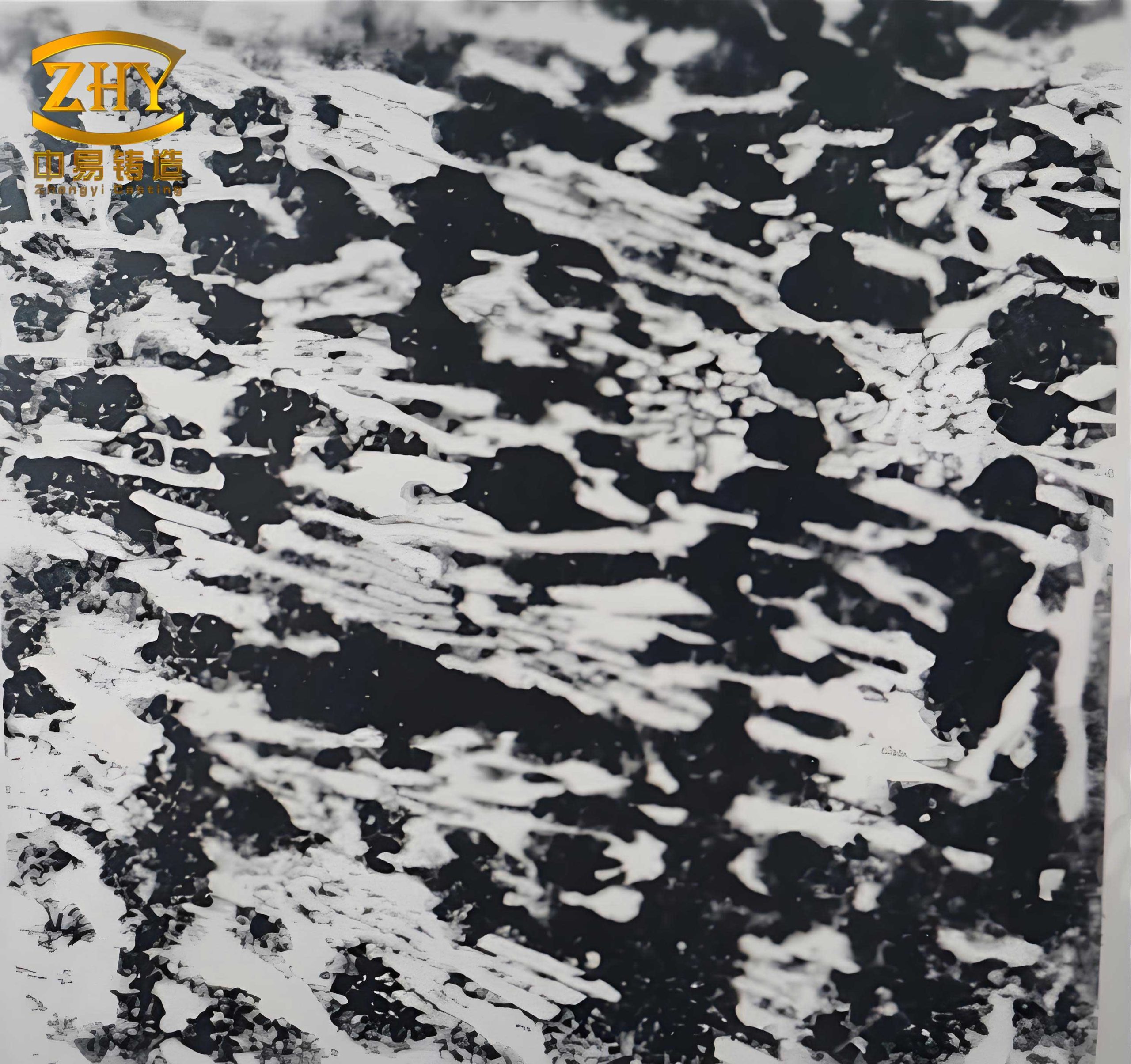
The mechanical properties directly correlate with these microstructural changes. Impact toughness, a key indicator of resistance to brittle fracture, was significantly affected by both alloying and heat treatment in white cast iron. The next table summarizes the Charpy impact energy values obtained.
| Alloying Element | As-Cast | Normalized | Quenched & Tempered |
|---|---|---|---|
| Base | 4.5 | 5.2 | 4.8 |
| Si | 4.8 | 5.5 | 5.0 |
| P | 4.6 | 5.3 | 4.9 |
| V | 5.5 | 6.8 | 6.0 |
| Nb | 5.0 | 5.6 | 5.2 |
| Ti | 4.9 | 5.4 | 5.1 |
| Mo | 5.2 | 6.2 | 5.6 |
| B | 5.8 | 7.5 | 6.5 |
| Mn | 4.7 | 5.4 | 5.0 |
| Cu | 4.6 | 5.2 | 4.9 |
| Al | 4.3 | 5.0 | 4.7 |
| Sn | 6.2 | 9.0 | 7.0 |
Consistently, the normalized state delivers the highest impact energy for elements like Si, V, Mo, B, Mn, Al, and Sn. The white cast iron modified with tin and normalized exhibits the peak toughness of 9.0 J, a substantial improvement over the base material. This aligns perfectly with its superior carbide circularity, demonstrating that spheroidization effectively mitigates the stress-concentrating effect of sharp carbide edges and network junctions. The relationship between circularity (C.I) and impact energy (IE) for normalized white cast iron can be approximated by a linear trend:
$$IE \approx k_1 \cdot (C.I) + k_2$$
where \(k_1\) and \(k_2\) are material constants. For our data set, a rough empirical fit suggests \(IE \approx 15.0 \cdot (C.I) – 2.5\). This underscores the direct, quantifiable benefit of carbide rounding on the toughness of white cast iron.
Hardness, the other critical property for wear-resistant white cast iron, was also measured. The quenched and tempered condition generally yielded the highest Rockwell hardness values across all alloys, as expected due to the formation of a hardened martensitic matrix. Molybdenum addition consistently resulted in the highest hardness in any given condition for this white cast iron. The data is consolidated below.
| Alloying Element | As-Cast HRC | Normalized HRC | Quenched & Tempered HRC |
|---|---|---|---|
| Base | 52 | 54 | 58 |
| Si | 53 | 55 | 59 |
| P | 54 | 56 | 60 |
| V | 55 | 57 | 61 |
| Nb | 54 | 56 | 60 |
| Ti | 54 | 56 | 60 |
| Mo | 57 | 59 | 63 |
| B | 56 | 58 | 62 |
| Mn | 53 | 55 | 59 |
| Cu | 52 | 54 | 58 |
| Al | 51 | 53 | 57 |
| Sn | 55 | 57 | 61 |
The ability to independently tailor toughness and hardness through composition and heat treatment is a powerful outcome. For instance, a white cast iron component requiring both good impact resistance and high surface hardness might be best produced using a tin-modified composition subjected to normalization, or a molybdenum-modified composition subjected to quenching and tempering, depending on the specific property priority.
The underlying mechanisms for carbide spheroidization in white cast iron involve complex interfacial energy effects and diffusion processes during solidification and heat treatment. The addition of certain elements like Sn, B, and V is believed to adsorb at the carbide/matrix interface, reducing the interfacial energy and promoting a lower-energy, more spherical shape to minimize total surface area. The process can be conceptually described by the Gibbs-Thomson equation, which relates the chemical potential to curvature:
$$\mu(r) = \mu_{\infty} + \frac{2\gamma V_m}{r}$$
where \(\mu(r)\) is the chemical potential of a particle with radius \(r\), \(\mu_{\infty}\) is the chemical potential of a flat surface, \(\gamma\) is the interfacial energy, and \(V_m\) is the molar volume. A reduction in \(\gamma\) due to solute adsorption favors the stabilization of smaller, rounded carbides over extended networks during the growth and coalescence stages in white cast iron. Furthermore, the heat treatment processes, particularly normalization, provide the thermal activation needed for diffusion-driven shape accommodation, allowing carbides to approach a more equilibrium, spheroidal morphology.
In conclusion, the journey toward superior white cast iron involves a dual strategy: stringent control over melting and pouring to ensure purity and soundness, followed by deliberate microstructural engineering. The experimental evidence clearly shows that minor additions of elements like tin, boron, and vanadium, coupled with an appropriate normalizing heat treatment, can effectively spheroidize the carbide network in low-alloy white cast iron. This transformation quantitatively improves impact toughness, as captured by the circularity parameter, while maintaining or even enhancing hardness through other alloying routes like molybdenum addition. The quantitative relationships established here, such as that between circularity and impact energy, provide a valuable framework for designing the next generation of high-performance white cast iron. The future of white cast iron lies in such integrated approaches, where process optimization and alloy design work in concert to unlock the full potential of this classic yet continually evolving wear-resistant material.