
In the realm of industrial materials, white cast iron stands out for its exceptional wear resistance, a property derived from its unique microstructure dominated by hard iron carbides. This material finds critical application in components subjected to severe abrasive environments, such as grinding rolls in flour milling, slurry pumps, and crusher liners. The traditional manufacturing route for such rolls often involves centrifugal casting to produce a composite structure—a tough steel core for strength shrouded by a hard, abrasive-resistant white cast iron shell. This shell is subsequently machined, ground, and finally grooved or “toothed” to create the functional grinding surface.
However, a significant technological challenge arises post-machining. The process of cutting teeth into the cast surface inherently severs the inherent “continuity of flow lines” established during centrifugal solidification. This disruption, combined with the inherent brittleness of the high-carbon, carbide-rich microstructure of conventional white cast iron, can lead to premature failure. Failure manifests not merely as gradual wear but often as catastrophic spalling or fracture of entire tooth sections under the combined impact, compression, and shear stresses encountered during service. Therefore, the quest is not only for hardness but for a synergistic combination of wear resistance and cohesive integrity within the toothed layer.
This article delves into an advanced surface engineering strategy aimed at overcoming these limitations: Plasma Arc Remelting (PAR). We explore the application of a controlled, high-energy-density plasma arc to selectively remelt and rapidly solidify the surface layer of toothed white cast iron rolls. The core hypothesis is that this localized re-processing can fundamentally alter the near-surface microstructure, restore metallurgical continuity, and thereby dramatically enhance both surface hardness and overall wear performance. Our investigation systematically examines the metallurgical transformations induced by PAR, quantifies the resulting mechanical properties, and elucidates the mechanisms behind the improved wear behavior.
Fundamentals of White Cast Iron and the Role of Alloying
To appreciate the impact of plasma remelting, one must first understand the baseline material. White cast iron is characterized by its microstructure where virtually all carbon is chemically combined with iron as cementite (Fe3C), rather than being present as free graphite. This results in a structure comprising a hard, brittle network of carbides embedded in a metallic matrix, which can be pearlitic, martensitic, or austenitic depending on composition and cooling rate.
The specific grade used in this study is a low-alloy white cast iron. While its wear resistance is primarily attributed to the high volume fraction of carbides, the addition of minor alloying elements plays a crucial role in tailoring its properties. A typical chemical composition is summarized in Table 1.
| C | Cr | Mn | Si | P | Ni | Cu | Other (Ti, B, S) |
|---|---|---|---|---|---|---|---|
| 3.8 – 4.0 | ~1.0 | ~0.5 | ~0.2 | ~0.45 | ~0.3 | ~0.03 | Trace |
Each element serves a distinct purpose:
- Carbon (C): The primary element controlling the amount and type of carbide. The carbon content places this iron in the hypereutectic or near-eutectic range, ensuring a large fraction of hard carbides.
- Chromium (Cr): A potent carbide former. It can dissolve in cementite to form (Fe,Cr)3C, which is harder and more stable than plain Fe3C. Chromium also increases hardenability, allowing the matrix to transform to harder phases (like martensite) even under moderate cooling rates, and improves corrosion/oxidation resistance. The hardness of complex carbides can be conceptually related to composition, approximated by factors in empirical hardness formulas for composite structures.
- Manganese (Mn): Acts as a mild carbide stabilizer and, more importantly, strengthens the metallic matrix by solid solution strengthening. It also lowers the eutectoid transformation temperature, promoting a finer pearlitic structure in the as-cast state, which is beneficial for toughness.
- Phosphorus (P): In amounts above 0.2%, it promotes the formation of a hard, brittle phosphide eutectic network. While detrimental to impact toughness, this hard phase can enhance resistance to low-stress abrasion.
- Nickel (Ni) & Copper (Cu): These elements primarily strengthen and toughen the metallic matrix (austenite or martensite) without forming carbides themselves. They improve hardenability and can help mitigate brittleness.
The equilibrium microstructure can be interpreted via the Fe-C phase diagram, but the rapid solidification from PAR pushes the system into non-equilibrium conditions. The driving force for phase formation shifts, favoring metastable phases. The tendency to form cementite over graphite is governed by kinetic factors. The nucleation and growth of graphite requires significant carbon diffusion and a specific crystallographic habit, whereas cementite, being an interstitial compound, nucleates more readily under high undercooling. The critical cooling rate to suppress graphite formation, $ \dot{T}_{critical} $, is a key parameter influenced by alloying elements like Cr and Si.
Plasma Arc Remelting: Technology and Process Parameters
Plasma Arc Remelting is a surface modification technique that utilizes a constricted, high-temperature plasma arc as a concentrated heat source. The arc, generated between a non-consumable tungsten electrode and the workpiece, is forced through a small orifice, achieving power densities on the order of $10^2$ to $10^3$ MW/m². When this arc scans the surface of the white cast iron tooth, it creates a small, intense melt pool. The bulk of the component, remaining cold, acts as an efficient heat sink, leading to extremely rapid solidification once the heat source moves away.
The primary metallurgical outcomes of PAR are:
- Microstructural Refinement: Rapid cooling leads to a high nucleation rate and limited crystal growth time, resulting in a significantly finer microstructure compared to the original centrifugal casting.
- Phase Transformation: The high undercooling can suppress the formation of equilibrium phases, leading to metastable or non-equilibrium structures. For white cast iron, this often means a shift in the eutectic composition and the suppression of high-temperature transformation products.
- Homogenization & Continuity Restoration: The melting and resolidification process effectively “erases” the prior cast structure, including the discontinuities introduced by machining. The new solidification front grows epitaxially from the unmelted substrate, establishing a coherent, directionally solidified layer with restored metallurgical continuity.
The final properties of the remelted layer are highly sensitive to the process parameters. Key variables include:
- Arc Current (I): Directly controls the heat input per unit time ($Q \propto I \cdot V$).
- Travel Speed (v): Determines the interaction time and effective energy density ($E = Q/v$).
- Plasma Gas Flow Rate: Affects arc stiffness, temperature profile, and shielding.
- Spot Size/Arc Force: Influences the power density and penetration profile.
For the processing of the white cast iron roll teeth, optimized parameters were employed to ensure sufficient melting depth without causing excessive dilution from the substrate or thermal damage. A summary is in Table 2.
| Parameter | Value / Setting | Primary Influence |
|---|---|---|
| Arc Current | 80 A | Melting depth, pool width |
| Travel Speed | 1.2 mm/s | Solidification rate, grain size |
| Workpiece Rotation | 393 rpm | Ensures uniform circumferential treatment |
| Electrode Diameter | 1.6 mm | Affects arc constriction and focus |
The rapid heat extraction can be modeled using heat transfer equations for a moving point source on a cylindrical body. The temperature gradient, $G$, and solidification rate, $R$, at the liquid-solid interface are critical in determining the morphology (planar, cellular, dendritic) of the resolidified structure. For high $G/R$ ratios typical of PAR, a fine cellular or dendritic structure is expected.
Microstructural Transformation Induced by Remelting
The most profound effect of PAR is the complete transformation of the near-surface microstructure. Comparative analysis reveals a stark contrast between the as-cast and remelted states.
1. As-Cast (Baseline) Microstructure:
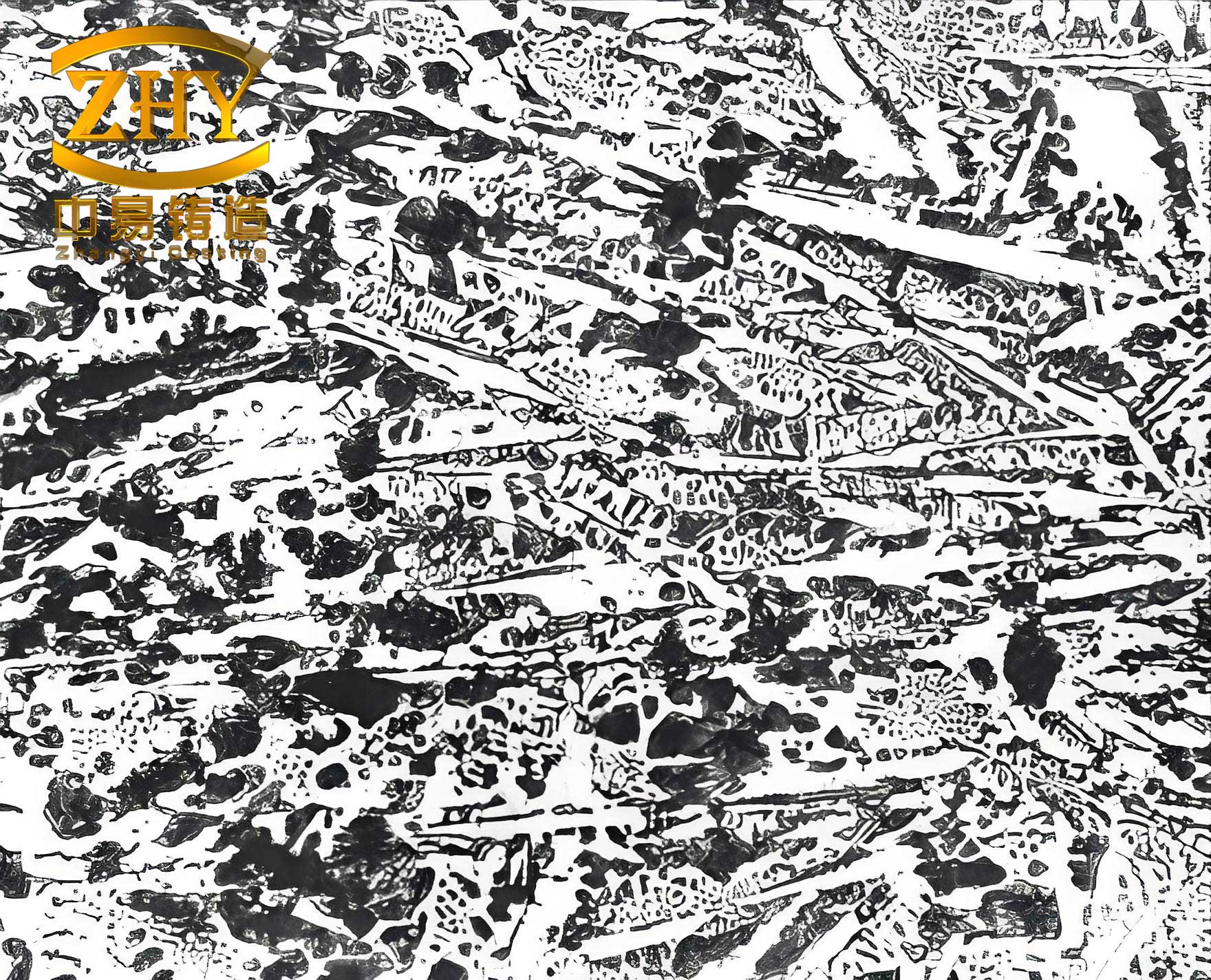
The original centrifugal-cast layer exhibits a classic hypoeutectic white cast iron structure. It consists of primary austenite dendrites (which subsequently transform to pearlite) surrounded by a network of the eutectic mixture called ledeburite. Ledeburite itself is a lamellar or rod-like composite of austenite (transformed to pearlite) and cementite. The microstructure is relatively coarse, reflecting the moderate cooling rate of centrifugal casting. The carbide network, while continuous, can be blocky and prone to acting as crack initiation sites under stress.
2. Post-PAR Microstructure:
After plasma remelting, the microstructure transitions to a mixture of eutectic and hypereutectic white cast iron structures. The key observations are:
- Absence of Primary Phases: The large primary austenite dendrites are eliminated.
- Dominance of Fine Ledeburite: The volume fraction of the eutectic ledeburite increases dramatically. Due to the rapid solidification, this ledeburite is extremely fine, with inter-lamellar spacing on the order of micrometers or less. The relationship between cooling rate ($\dot{T}$) and lamellar spacing ($\lambda$) often follows an inverse power law: $$ \lambda = k \cdot \dot{T}^{-n} $$ where $k$ and $n$ are material constants.
- Presence of Primary Carbides: In hypereutectic zones, fine, discrete primary cementite particles may form directly from the melt before the eutectic reaction.
- Matrix Refinement: The metallic matrix (now primarily a very fine pearlite or potentially even a metastable phase like austenite or martensite due to alloying elements) is significantly refined.
- Directional Solidification: The grains exhibit a clear growth direction, oriented perpendicular to the roll’s axis (i.e., aligned with the steepest temperature gradient, which is radially outward from the cold bulk). This directional growth enhances the structural cohesion of the tooth.
This microstructural shift from hypoeutectic to eutectic/hypereutectic is a direct consequence of the increased effective cooling rate. Rapid cooling suppresses the pro-eutectic austenite formation field, pushing the solidification path closer to, or past, the metastable eutectic point on the Fe-Fe3C diagram.
Hardness Profile and Mechanical Property Enhancement
The microstructural refinement and increased carbide content directly translate to superior surface hardness. Hardness measurements taken from the tooth tip down to the root reveal a clear gradient, as summarized in Table 3.
| Depth from Surface (mm) | As-Cast Hardness (HRC) | Post-PAR Hardness (HRC) |
|---|---|---|
| 0.0 (Tip) | 58.8 | 65.2 |
| 0.5 | 59.0 | 64.7 |
| 1.0 | 59.2 | 65.0 |
| 1.5 | 58.6 | 60.2 |
| 2.0 (Root) | 59.8 | 59.5 |
| Average (0-1mm) | ~59.1 | ~64.9 |
The data shows a remarkable increase in surface hardness, from approximately HRC 59 to HRC 65 at the tooth tip—a gain of about 6 HRC points, which represents a significant increase in yield strength and resistance to plastic deformation. The hardness remains elevated through a depth of about 1.0-1.5 mm, corresponding to the depth of the remelted and heat-affected zone. Beyond this depth, the hardness gradually converges with that of the unaffected base material.
This hardness improvement can be rationalized using composite strengthening models. The remelted layer can be considered a composite where ultra-fine, hard carbides (Fe3C with dissolved Cr) reinforce a strong metallic matrix. The hardness, $H$, of such a composite can be approximated by a rule-of-mixtures or a more refined model accounting for load transfer: $$ H_{composite} \approx f_{carbide} \cdot H_{carbide} + f_{matrix} \cdot H_{matrix} + \Delta H_{interface} $$ where $f$ represents volume fraction and $\Delta H_{interface}$ accounts for strengthening from the fine inter-phase spacing (Hall-Petch type effects). The increased $f_{carbide}$ and drastically reduced microstructural scale after PAR both contribute positively to $H_{composite}$.
Wear Resistance Evaluation and Governing Mechanisms
The ultimate test of the PAR treatment’s efficacy is its performance under abrasive wear conditions. Pin-on-disk or similar abrasive wear tests comparing as-cast and PAR-treated white cast iron samples reveal a dramatic difference. The PAR-treated material consistently exhibits wear rates that are 2 to 3 times lower than its as-cast counterpart. The wear vs. time curves typically show two distinct regimes for both conditions, but with crucial differences.
As-Cast Wear Behavior:
- Stage 1 (Run-in/High Wear): Initial rapid material loss. The relatively coarser carbides can be fractured or plucked out from the weaker matrix, creating micro-craters and accelerating wear.
- Stage 2 (Steady-State): A reduced but still significant wear rate continues. Wear proceeds by microfracture of carbides and abrasive grooving of the matrix.
PAR-Treated Wear Behavior:
- Stage 1 (Mild Run-in): A much smaller initial material loss. The fine, well-bonded carbides resist fracture and remain firmly embedded in the strong matrix.
- Stage 2 (Ultra-Low Wear Steady-State): The wear rate diminishes to a very low, nearly constant value. The surface undergoes polishing wear, where abrasive particles cause only minimal micro-cutting or deformation.
The enhanced wear resistance of the remelted white cast iron can be attributed to a confluence of mechanisms rooted in its modified microstructure:
1. Increased Surface Hardness and Load-Bearing Capacity:
According to classical abrasive wear models (e.g., the Archard-type model modified for abrasion), the wear volume $V$ is inversely proportional to the hardness $H$ of the wearing material for a given set of abrasives and loading conditions: $$ V \propto \frac{K \cdot W \cdot L}{H} $$ where $K$ is a wear coefficient, $W$ is the normal load, and $L$ is the sliding distance. The ~10% increase in hardness (from HRC 59 to 65 translates to a significant increase in Vickers or Brinell hardness) directly reduces $V$.
2. Microstructural Refinement and Cohesion:
The restoration of “flow line continuity” is critical. In the as-cast and machined state, the tooth profile intersects the cast structure, creating planes of weakness. PAR rebuilds the tooth with a coherent, directionally solidified structure where the hard phases are continuously interconnected from the tooth tip to its root. This greatly reduces the propensity for macroscopic spalling or fracture. The fine inter-lamellar spacing in the ledeburite ($\lambda$) also increases the fracture toughness of the eutectic colony by impeding crack propagation, following a relationship akin to $$ K_{IC} \propto \sqrt{\lambda} $$ for crack deflection mechanisms.
3. Optimal Carbide Morphology and Distribution:
The fine, interconnected network of carbides in the rapidly solidified ledeburite presents a more formidable barrier to penetrating abrasive particles. The abrasive particles experience greater difficulty in initiating micro-cutting or fracture in this refined composite. The wear mode shifts from brittle fracture and plucking to a more benign polishing or low-cycle deformation fatigue.
4. Supportive Matrix:
The refined metallic matrix, strengthened by solid solution (Mn, Ni, Cu) and potentially containing harder transformation products due to the alloying elements’ effect on hardenability under rapid cooling, provides better mechanical support to the carbides. This prevents them from being undercut and lost prematurely.
A comprehensive view of the performance enhancement is presented in Table 4.
| Property / Characteristic | As-Cast State | Post-PAR State | Key Benefit |
|---|---|---|---|
| Primary Microstructure | Hypoeutectic (Primary Austenite/Dendrites + Ledeburite) | Eutectic/Hypereutectic (Fine Ledeburite + Primary Carbides) | Higher carbide volume fraction, finer scale |
| Carbide Network | Coarse, discontinuous at machined surfaces | Fine, continuous, directionally aligned | Restored structural integrity, resistance to spalling |
| Surface Hardness (HRC) | 58 – 60 | 64 – 65 | ~10% increase, better resistance to plastic deformation and indentation |
| Relative Abrasive Wear Rate | 1.0 (Baseline) | 0.33 – 0.5 | 2 to 3 times improvement in wear life |
| Dominant Wear Mechanism | Micro-fracture, carbide plucking, grooving | Polishing, mild micro-cutting | More predictable and gradual material loss |
A more detailed abrasive wear model considering the composite nature can be expressed as:
$$ V = \left( f_{matrix} \cdot \frac{k_m}{H_m} + f_{carbide} \cdot \frac{k_c}{H_c} \right) \cdot W \cdot L $$
where subscripts $m$ and $c$ denote matrix and carbide, and $k$ is a material-specific abrasive wear coefficient. The PAR treatment reduces $k_m$ by strengthening the matrix, increases $H_m$ and $H_c$, and optimizes the $f_{carbide}$ ratio, all contributing to a lower total wear volume $V$.
Conclusion
Plasma Arc Remelting has been demonstrated as a highly effective surface engineering technique for dramatically enhancing the performance of toothed white cast iron components. By subjecting the surface to localized melting and ultra-rapid solidification, PAR fundamentally alters the near-surface metallurgy. The key outcomes are:
- Microstructural Metamorphosis: Transformation from a coarse, hypoeutectic as-cast structure to a refined, eutectic/hypereutectic mixture dominated by fine ledeburite with a directionally solidified character.
- Significant Hardness Gain: Surface hardness increases from approximately HRC 59 to HRC 65, a direct result of increased carbide volume fraction and extreme microstructural refinement governed by solidification kinetics.
- Exceptional Wear Improvement: The abrasive wear resistance of the white cast iron is improved by a factor of 2 to 3. This is attributed synergistically to higher hardness, restored microstructural continuity that prevents spalling, and a fine, well-bonded carbide network that forces a transition to a milder wear regime.
- Practical Restoration: The process effectively “heals” the discontinuity introduced by machining, rebuilding the tooth profile with a cohesive, wear-resistant layer that extends the service life of the component significantly.
The technology marries the inherent wear resistance of white cast iron with the benefits of rapid solidification processing. For industries reliant on abrasive-resistant components, the application of PAR represents a potent method to push the limits of material performance, reducing downtime, maintenance costs, and improving operational efficiency. Future work may explore the optimization of multi-layer remelting, the incorporation of in-situ alloying during the PAR process for further carbide modification, and a detailed investigation of the fatigue and impact resistance of the treated surfaces.