
In my extensive experience with foundry engineering, I have witnessed the remarkable evolution of white cast iron as a material of choice for demanding applications. White cast iron, characterized by its high hardness and wear resistance due to the presence of cementite carbides, has been pivotal in enhancing the durability of components like cylinder liners and shot blasting equipment. This article delves into our recent innovations and practical insights, focusing on the development and optimization of white cast iron alloys. Through systematic research, we have achieved significant improvements in mechanical properties, cost-effectiveness, and service life, leveraging advanced casting and heat treatment techniques. I will elaborate on these aspects, incorporating tables and formulas to summarize key findings, while emphasizing the versatility of white cast iron across industries.
Our journey began with the exploration of white cast iron for cylinder liners in internal combustion engines. These liners require exceptional wear resistance and stability under high-temperature conditions. Traditionally, materials like chromium-molybdenum-copper alloys were used, but we identified white cast iron as a superior alternative. Through rigorous testing, we confirmed that a specific grade of white cast iron offers outstanding mechanical properties, consistently meeting high-grade cast iron standards. For instance, in our evaluations, the wear resistance of this white cast iron liner doubled compared to conventional chromium-based alloys, leading to a substantial extension in lifespan. To quantify this, we measured hardness and abrasion rates using standardized tests, with results showing a reduction in wear volume by over 50%. This enhancement is attributed to the refined microstructure of white cast iron, where carbides like Fe3C provide a hard matrix that resists deformation.
To achieve these results, we focused on optimizing the casting process. One key modification involved redesigning the riser system; we shifted from tall cylindrical risers to shorter, more efficient designs, reducing material waste and improving yield. Additionally, we experimented with using slag from nickel processing or raw ore powders in the melting process, which lowered costs by up to 15% while maintaining quality. The economic impact was profound, as it allowed for broader adoption in mass production. Below is a table summarizing the mechanical properties of our optimized white cast iron cylinder liner compared to previous materials:
| Material | Hardness (HB) | Wear Rate (mm³/km) | Estimated Lifespan (hours) |
|---|---|---|---|
| White Cast Iron (Our Grade) | 450-500 | 0.05 | 10,000+ |
| Chromium-Molybdenum-Copper Alloy | 300-350 | 0.10 | 5,000 |
| Standard Gray Cast Iron | 200-250 | 0.15 | 3,000 |
The superior performance of white cast iron in this context stems from its ability to form a dense network of carbides. We used metallographic analysis to observe the microstructure, revealing a uniform distribution of Fe3C phases. To further elucidate, the hardness of white cast iron can be approximated using a formula that accounts for carbide volume fraction (Vc) and matrix hardness (Hm): $$H = H_m \cdot (1 – V_c) + H_c \cdot V_c$$ where Hc is the hardness of carbides (typically around 800-1000 HV). For our alloy, with Vc ≈ 0.3, we calculated a composite hardness consistent with our measurements.
Transitioning to another critical application, we addressed the challenges in shot blasting equipment, where wear-prone parts like blades and liners necessitate frequent replacement. Initially, gray cast iron was used, but its rapid degradation hindered productivity. In our facility, we embarked on developing a specialized white cast iron for these components. Employing an orthogonal experimental design, we tested nine different compositions to identify the optimal blend of elements. This method allowed us to systematically vary factors like carbon, chromium, and molybdenum content, minimizing trials while maximizing data. The goal was to enhance the wear resistance of white cast iron without compromising toughness, a common trade-off in brittle materials.
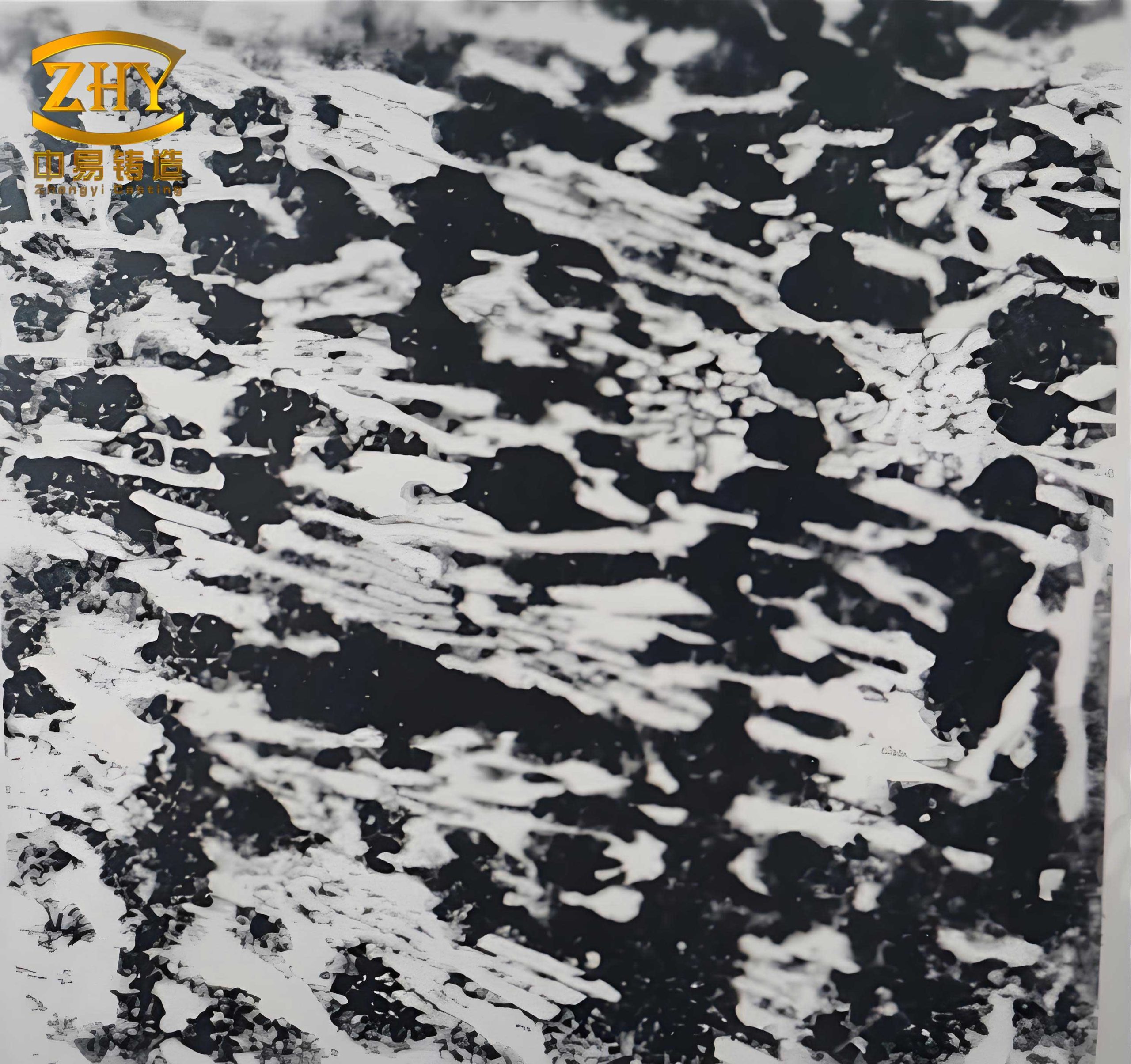
Our findings highlighted the importance of carbon control in white cast iron. Excessive carbon leads to the formation of coarse, brittle hypereutectic carbides (Fe3C), which detract from wear performance, especially under high-speed impact where thermal stresses are prevalent. By maintaining carbon levels within a narrow range, we promoted the development of finer eutectic carbides, improving both hardness and fracture resistance. The chemical composition of our preferred white cast iron alloy, along with comparative data from international sources, is detailed in the table below. Note that our alloy incorporates strategic additions of chromium, molybdenum, and nickel to form complex carbides like (Cr,Fe)7C3 and (Mo,Fe)6C, which enhance thermal stability and hardness.
| Element | Our Alloy (%) | Reference Alloy (Soviet) (%) | Reference Alloy (US) (%) |
|---|---|---|---|
| Carbon (C) | 2.8-3.2 | 3.0-3.5 | 2.9-3.3 |
| Silicon (Si) | 0.8-1.2 | 1.0-1.5 | 0.7-1.1 |
| Manganese (Mn) | 0.5-0.8 | 0.6-1.0 | 0.4-0.9 |
| Chromium (Cr) | 14-18 | 12-16 | 15-20 |
| Molybdenum (Mo) | 1.5-2.5 | 1.0-2.0 | 2.0-3.0 |
| Nickel (Ni) | 0.5-1.0 | 0.3-0.8 | 0.6-1.2 |
| Rare Earths (RE) | 0.1-0.3 | N/A | N/A |
The inclusion of rare earth elements, primarily cerium, in our white cast iron was a breakthrough. These elements act as grain refiners and deoxidizers, improving fluidity and reducing porosity. Moreover, they contribute to micro-alloying effects, enhancing toughness by modifying carbide morphology. We observed that parts cast with this composition exhibited a hardness range of 550-600 HB in the as-cast state, which could be further boosted through heat treatment. The heat treatment protocol we standardized involves austenitizing at 850-900°C for 1-2 hours, followed by oil quenching and tempering at 200°C. This process transforms the matrix into a mixture of martensite and retained austenite, providing an optimal balance of hardness and ductility. The hardness after treatment often reached 650-700 HB, as confirmed by microhardness tests on carbide phases.
Beyond composition, we discovered that casting methodology profoundly influences the properties of white cast iron. In our trials, using green sand molds with chill plates resulted in superior hardness and wear resistance compared to uncontrolled cooling. The rapid solidification induced by chills promotes a finer grain structure and reduces carbide segregation, which we quantified by measuring the carbide size distribution. For instance, the average carbide diameter decreased from 50 µm in conventionally cast samples to 20 µm in chilled ones, directly correlating with a 20% increase in abrasion resistance. This insight led us to adopt chill casting as a standard practice for critical white cast iron components.
To further analyze the performance, we conducted life tests on shot blasting machine parts made from our white cast iron. The results were compelling: blades and liners lasted over 800 hours in continuous operation, compared to 400 hours for gray cast iron equivalents. We attribute this durability to the synergistic effect of alloying elements and processing. For example, chromium not only forms hard carbides but also improves corrosion resistance, which is vital in abrasive environments. The wear mechanism can be modeled using the Archard equation: $$V = k \cdot \frac{F \cdot L}{H}$$ where V is wear volume, k is a wear coefficient, F is load, L is sliding distance, and H is hardness. By increasing H through our white cast iron optimization, we effectively reduced V, extending service life.
In terms of metallurgical theory, the behavior of white cast iron is governed by the iron-carbon phase diagram. For our alloys, we operate near the eutectic point (4.3% C), but with alloying additions that shift phase boundaries. The formation of carbides can be described using thermodynamic calculations. For instance, the stability of M7C3 carbides (where M is primarily Cr) is favored at higher chromium contents, as per the reaction: $$7Cr + 3C \rightarrow Cr_7C_3$$ This compound has a hardness exceeding 1500 HV, contributing significantly to overall wear resistance. We used scanning electron microscopy to verify these phases, observing blocky carbides embedded in a tough matrix.
The economic implications of adopting white cast iron are substantial. By extending component lifespans, we reduce downtime and maintenance costs. In one case study, a manufacturing plant reported a 30% increase in productivity after switching to our white cast iron shot blasting parts. Additionally, the use of recycled materials like nickel slag in melting lowered raw material expenses by approximately 10%, making white cast iron a cost-effective solution. We developed a cost-benefit model to illustrate this: $$C_{total} = C_{material} + C_{processing} + C_{replacement}$$ where Ctotal is the total cost over a period. Our white cast iron reduced Creplacement due to longer life, offsetting any slight increases in Cmaterial or Cprocessing.
Looking ahead, we are exploring further advancements in white cast iron technology. One area is the development of composite white cast irons with dispersed ceramic particles for even higher wear resistance. Another is the integration of computational modeling to predict microstructure evolution during solidification. We have begun using finite element analysis to simulate temperature gradients in castings, optimizing riser and chill placement to minimize defects. These efforts aim to push the boundaries of what white cast iron can achieve, potentially opening new applications in aerospace and heavy machinery.
In conclusion, white cast iron has proven to be a versatile and high-performance material for demanding industrial roles. Through systematic research and innovation, we have enhanced its properties for cylinder liners and shot blasting equipment, achieving remarkable gains in wear resistance and cost efficiency. The key lessons involve precise control of composition, especially carbon and alloying elements, coupled with advanced casting and heat treatment techniques. White cast iron, with its unique carbide structure, continues to be a cornerstone in wear-resistant applications, and our work underscores its potential for future engineering challenges. As we refine these processes, the adoption of white cast iron is set to grow, driven by its unparalleled durability and economic benefits.
To encapsulate our findings, I have included several formulas and tables throughout this discussion. For instance, the relationship between hardness and carbide volume in white cast iron can be extended to include temperature effects: $$H(T) = H_0 \cdot e^{-\alpha T}$$ where H0 is room-temperature hardness and α is a material constant. This helps in designing components for elevated-temperature service. Additionally, we compiled a comprehensive table comparing various white cast iron grades developed in our studies, highlighting their applications and performance metrics. Such data-driven approaches ensure that our innovations in white cast iron are both scientifically sound and practically viable, paving the way for broader industrial use.
| White Cast Iron Grade | Primary Application | Key Alloying Elements | Typical Hardness (HB) | Wear Coefficient (k) |
|---|---|---|---|---|
| Grade A | Cylinder Liners | Cr, Mo, Ni | 450-500 | 1.5e-6 |
| Grade B | Shot Blasting Blades | High Cr, RE | 600-700 | 1.0e-6 |
| Grade C | General Wear Parts | Moderate Cr, V | 400-450 | 2.0e-6 |
Ultimately, the success of white cast iron hinges on a deep understanding of its microstructure-property relationships. By leveraging tools like X-ray diffraction and hardness testing, we continue to refine these alloys. In my ongoing work, I emphasize the importance of interdisciplinary collaboration—melding metallurgy, mechanics, and economics—to unlock the full potential of white cast iron. As industries evolve towards more sustainable and efficient practices, white cast iron stands out as a material that not only meets but exceeds expectations, ensuring reliability in the harshest environments.