
This investigation examines the influence of a niobium-silicon (Nb-Si) complex modification treatment on the microstructure and properties of medium-vanadium white cast iron. White cast irons are widely valued for their exceptional wear resistance, primarily due to their hard, brittle carbide networks. However, this very feature often compromises their toughness and impact resistance, limiting their application in more demanding, impact-abrasive service conditions. The pursuit of improved toughness while maintaining high hardness and wear resistance is a central challenge in the development of advanced white cast iron grades.
Recent studies have explored the use of alloying elements like vanadium (V) and niobium (Nb) to address this. Vanadium promotes the formation of hard, discrete MC-type carbides, which can refine the microstructure and enhance abrasion resistance. Niobium is known to act as a potent microstructure modifier and carbide former in ferrous alloys. This study aims to synergistically employ these elements: utilizing a lower, more economical vanadium content (around 3 wt.%) and introducing微量 Nb via a complex modification treatment with ferrosilicon. The goal is to achieve a superior combination of mechanical properties, particularly enhanced toughness, in the resulting white cast iron, making it suitable for components subjected to impact loads.
1. Experimental Methodology
The white cast iron was melted in a medium-frequency induction furnace. The charge consisted of pig iron, steel scrap, and vanadium ferroalloy. Niobium was introduced as a ferro-niobium alloy, and carbon content was adjusted using crushed graphite electrodes. The melt was superheated to approximately 1450°C, followed by slag removal and deoxidation with aluminum before tapping.
The complex modification treatment was performed via an inoculation method in the ladle, using a combination of Nb-bearing inoculant and ferrosilicon. The treated molten white cast iron was then poured into oil-sand molds to produce test specimens for mechanical property evaluation: tensile (converted from transverse rupture) specimens, unnotched impact specimens, and wear test specimens. The final chemical compositions of the experimental heats and the corresponding modifier addition amounts are detailed in Table 1.
| Heat ID | C | Si | Mn | V | Nb | Nb-Inoculant Addition (%) |
|---|---|---|---|---|---|---|
| A1 | 3.2 | 1.8 | 0.8 | 2.9 | 0.00 | 0.00 |
| A2 | 3.1 | 1.9 | 0.8 | 3.0 | 0.05 | 0.10 |
| A3 | 3.2 | 1.8 | 0.7 | 3.1 | 0.10 | 0.20 |
| A4 | 3.1 | 1.9 | 0.8 | 2.9 | 0.15 | 0.30 |
| A5 | 3.2 | 1.8 | 0.7 | 3.0 | 0.20 | 0.40 |
Five different heat treatment cycles were applied to selected samples to study their effect on the modified white cast iron’s properties. These included four normalizing treatments and one austempering treatment. The specific parameters for each thermal cycle are summarized in Table 2.
| Process | Austenitizing Temp. (°C) | Austenitizing Time (min) | Quenching/Cooling Medium | Tempering/Isothermal Temp. (°C) | Tempering/Isothermal Time (min) |
|---|---|---|---|---|---|
| As-Cast | – | – | – | – | – |
| Normalizing N1 | 900 | 60 | Air | – | – |
| Normalizing N2 | 950 | 60 | Air | – | – |
| Normalizing N3 | 1000 | 60 | Air | – | – |
| Normalizing N4 | 1050 | 60 | Air | – | – |
| Austempering A | 950 | 60 | Salt Bath (270°C) | 270 (Isothermal) | 90 |
Macro-hardness was measured using a Rockwell hardness tester, and micro-hardness was determined on a显微硬度计. Unnotched impact toughness was evaluated on a pendulum impact tester with a specified span. Transverse rupture strength was measured on a universal testing machine. Abrasive wear tests were conducted on a laboratory-scale wet sand rubber wheel test apparatus. The operational parameters for the wear test are given in Table 3. The relative wear resistance, ε, was calculated as the weight loss of a standard mild steel specimen divided by the weight loss of the white cast iron test sample.
| Parameter | Specification |
|---|---|
| Wheel Material | Rubber-lined Steel |
| Abrasive | Quartz Sand, 50-70 mesh |
| Abrasive Feed Rate | 300 g/min |
| Load | 70 N |
| Wheel Speed | 240 rpm |
| Test Duration | 30 min |
2. Results and Discussion
2.1 Influence of Modification on the Microstructure of White Cast Iron
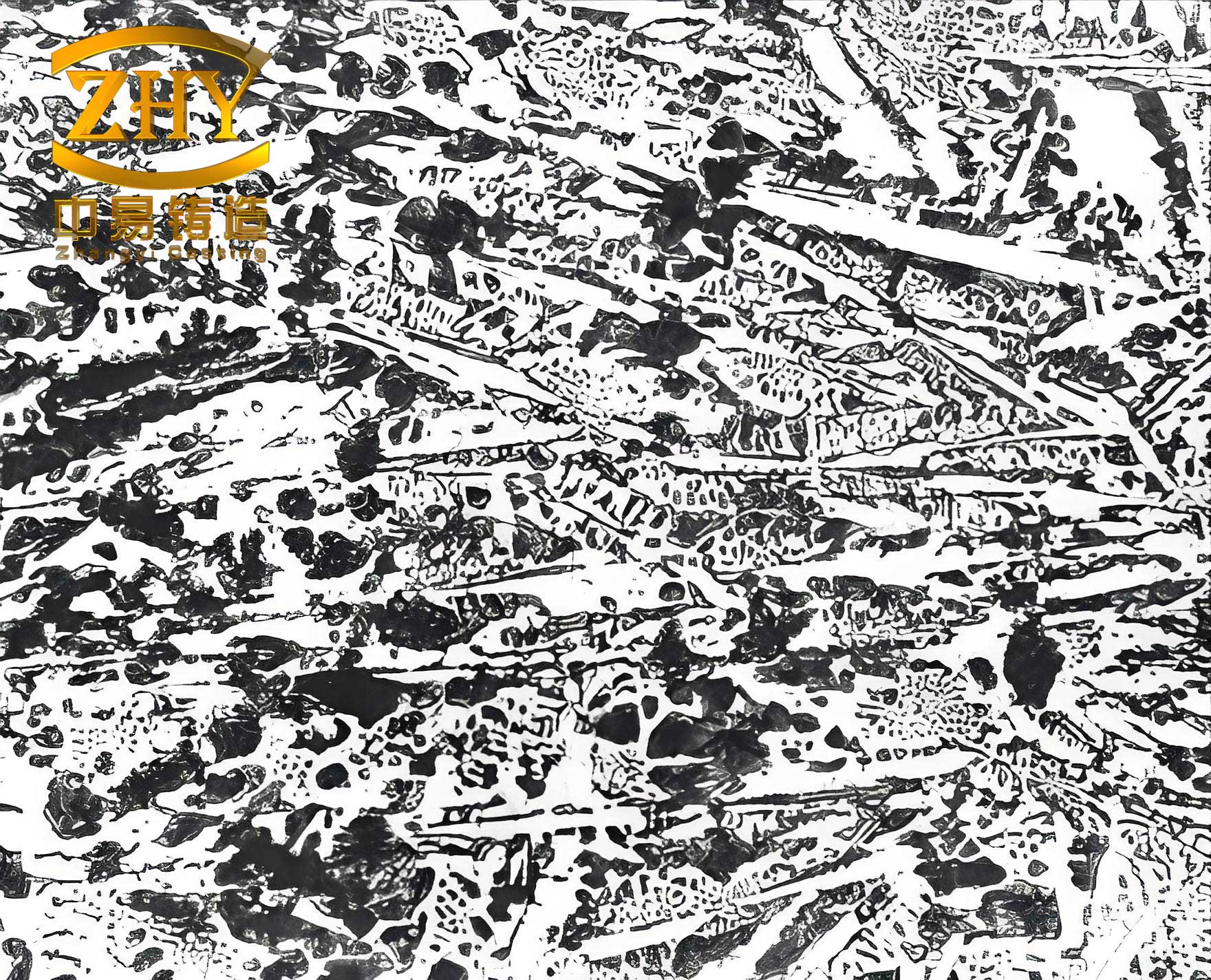
The microstructural analysis revealed a profound change in carbide morphology following the Nb-Si complex modification. In the unmodified vanadium white cast iron, the carbides predominantly formed a continuous, interconnected network. This skeletal network severely embrittles the matrix, providing easy paths for crack propagation and resulting in poor toughness. After the modification treatment, this detrimental network was effectively broken. The carbides were transformed into isolated, irregularly shaped particles such as nodules, blocks, and short rods, dispersed within the refined metallic matrix. This change from a continuous to a discontinuous carbide phase is crucial for improving the ductility and toughness of white cast iron, as it maintains the continuity of the tougher matrix.
Elemental mapping via electron probe micro-analysis (EPMA) confirmed that niobium was primarily concentrated within these modified carbides, forming discrete, Nb-rich phases. This suggests that niobium carbides (or carbonitrides) formed in the melt prior to the solidification of the eutectic carbides. The mechanism for this microstructural modification can be explained through thermodynamic and crystallographic considerations.
Thermodynamically, in the Nb-containing white cast iron melt, several carbide phases can potentially form: NbC, VC, and Fe3C. Their stability can be compared by their standard Gibbs free energy of formation, ΔG°f. The more negative the value, the greater the driving force for formation and the higher the stability of the compound. The approximate standard free energies for these carbides relevant to solidification temperatures can be considered. For instance, at a reference temperature, the formation energies follow the order:
$$ ΔG°_{f(\text{NbC})} << ΔG°_{f(\text{VC})} < ΔG°_{f(\text{Fe}_3\text{C})} $$
This indicates that NbC has the strongest tendency to form first and is the most stable phase, providing potent nucleation sites.
Crystallographically, to act as an effective heterogeneous nucleus for the M7C3 or M3C carbides in white cast iron, there should be a favorable lattice match (low interfacial energy) between the nucleant and the growing carbide. Studies have reported that NbC or Nb(C,N) particles exhibit specific crystallographic orientation relationships with iron carbides, involving coherent or semi-coherent interfaces on certain lattice planes. This allows the carbide to grow epitaxially on the pre-existing niobium compound, utilizing its atomic arrangement as a template. Therefore, Nb-rich particles formed in the liquid act as potent substrates for the subsequent crystallization of the chromium-iron carbides, leading to their refined and isolated morphology, as observed in the modified white cast iron.
2.2 Effect of Modification on Mechanical Properties of White Cast Iron
The mechanical property data for both unmodified and modified white cast iron under various heat treatment conditions are consolidated in Table 4. The variation of key properties with niobium content is plotted graphically. The results demonstrate a significant enhancement in the overall mechanical profile due to the complex modification.
| Sample Code* | Hardness (HRC) | Impact Toughness (J/cm²) | Transverse Rupture Strength (MPa) | Relative Wear Resistance, ε |
|---|---|---|---|---|
| A1-AsCast | 54.5 | 4.8 | 580 | 1.85 |
| A3-AsCast | 56.0 | 8.2 | 650 | 2.10 |
| A3-N3 | 52.5 | 13.5 | 820 | 1.95 |
| A3-N4 | 55.0 | 10.8 | 780 | 2.05 |
| A3-A | 58.5 | 9.5 | 720 | 2.65 |
| A5-AsCast | 57.5 | 7.0 | 710 | 2.30 |
* Code: A1/A3/A5 = Heat ID; AsCast/N3/N4/A = Heat Treatment state (see Tables 1 & 2).
With increasing Nb content, the hardness and transverse rupture strength of the white cast iron showed a consistent upward trend. The impact toughness, however, reached an optimal value at a niobium addition of approximately 0.10 wt.% (Heat A3) before slightly decreasing at higher levels. This behavior can be attributed to the dual role of niobium. Firstly, by refining and isolating the carbides, it reduces stress concentration points and prevents easy crack propagation through a brittle network, thereby improving toughness. Secondly, the fine, hard NbC particles dispersed in the matrix act as potent strengtheners by pinning dislocations, increasing the resistance to plastic deformation and enhancing strength and hardness. The relationship between flow stress (σ) and dislocation pinning can be described by an Orowan-type strengthening mechanism:
$$ Δσ_{orowan} \propto \frac{Gb}{L} $$
where G is the shear modulus, b is the Burgers vector, and L is the inter-particle spacing. A higher volume fraction of fine NbC particles decreases L, increasing the strengthening contribution. However, beyond an optimal level, an excessive number of hard particles may begin to act as micro-crack initiators under impact loading, slightly reducing the toughness of the white cast iron.
2.3 Influence of Heat Treatment on Modified White Cast Iron
Heat treatment proved to be a critical factor in unlocking the full potential of the modified white cast iron. The normalizing treatments, particularly N3 (1000°C), resulted in the most significant improvement in toughness and strength. For the optimally modified white cast iron (Heat A3), impact toughness increased from 4.8 J/cm² in the as-cast state to 13.5 J/cm² after the N3 treatment, while transverse rupture strength rose from 580 MPa to 820 MPa.
The austenitizing temperature during normalizing plays a key role. At lower temperatures (e.g., 900°C), diffusion is limited, preventing full homogenization and optimal spheroidization/dissolution of carbides. At the optimal temperature (1000°C), enhanced diffusion allows for a more uniform matrix and further rounding and dispersion of carbides. At excessively high temperatures (e.g., 1050°C), the increased solubility of carbon and alloying elements in austenite can lead to the precipitation of fine, secondary carbide networks upon cooling, which is detrimental to toughness. Therefore, properties peak at an intermediate austenitizing temperature.
The hardness of normalized samples was generally lower than the as-cast state due to the tempering effect and the precipitation of alloying elements from the supersaturated as-cast matrix, which reduces matrix micro-hardness. However, at the highest normalizing temperature (N4, 1050°C), the higher carbon content in solution in the austenite resulted in a harder matrix upon air cooling, partially recovering the hardness.
The austempered sample (Process A) exhibited the highest macro-hardness (~58.5 HRC) due to the formation of a fine, acicular lower bainitic matrix. This very hard matrix resulted in excellent wear resistance, as discussed in the next section, though the impact toughness and strength were slightly lower than the optimally normalized sample due to the inherent brittleness of the high-carbon bainite.
2.4 Abrasive Wear Resistance of the Modified White Cast Iron
The wear resistance, expressed as the relative wear resistance coefficient ε, improved with increasing niobium content, as shown in Table 4. The NbC particles themselves are extremely hard and act as wear-resistant protrusions. Furthermore, the refined and isolated primary carbide structure is more resistant to being fractured and plucked out from the matrix under abrasion compared to a continuous network.
The heat treatment state had a dramatic effect on wear performance. While the normalized conditions often showed a slight decrease in ε compared to the as-cast state, the austempered condition (Process A) delivered a remarkable ~43% increase in wear resistance over the best as-cast modified white cast iron (ε = 2.65 vs. 1.85 for unmodified). This underscores the dominant role of the matrix in supporting the carbides during abrasion.
In the normalized conditions, the matrix is primarily pearlitic, which has a relatively low yield strength. Under abrasive loading, this softer matrix can be easily micro-cut, undermining the support for the finely dispersed carbides and allowing them to be easily removed. In the as-cast state, the matrix is a harder, metastable mixture (martensite/austenite/carbides), providing better support. However, the austempered lower bainite matrix provides the optimal combination: very high hardness and good strength. This strong, hard matrix firmly anchors the hard carbides, preventing their premature detachment. The wear mechanism shifts from a combination of micro-cutting and carbide fracture/debonding in normalized samples to predominantly mild micro-cutting on the bainitic surface studded with well-supported carbides in the austempered white cast iron, leading to superior wear life.
3. Conclusions
1. The application of an Nb-Si complex modification treatment fundamentally alters the microstructure of medium-vanadium white cast iron, successfully transforming the continuous carbide network into a dispersion of isolated, irregularly shaped particles. This is attributed to the prior formation of stable NbC particles in the melt, which act as potent heterogeneous nucleation sites for the eutectic carbides.
2. Niobium plays a dual role in this white cast iron: it modifies the carbide morphology and refines the overall microstructure, while the dispersed NbC particles provide significant precipitation strengthening. This synergy leads to a substantial increase in transverse rupture strength and hardness while maintaining or significantly improving impact toughness compared to the unmodified white cast iron. An optimal addition of approximately 0.10 wt.% Nb was identified for peak toughness.
3. Post-casting heat treatment is essential to maximize the properties of the modified white cast iron. Normalizing at 1000°C (Process N3) yielded the best combination of strength and toughness, with impact toughness increasing by over 180% compared to the unmodified as-cast material.
4. The abrasive wear resistance of this white cast iron is enhanced by Nb addition and is highly dependent on the matrix microstructure. Austempering to produce a lower bainitic matrix resulted in the highest wear resistance, as this hard, strong matrix provides superior support for the hard carbide phases against abrasive removal.
In summary, the complex modification of medium-vanadium white cast iron with niobium and silicon represents a highly effective strategy for developing a new class of abrasion-resistant materials. It successfully decouples the traditional hardness-toughness trade-off, offering a viable material solution for components requiring both good impact resistance and excellent wear performance.