
The widespread application of low-alloy white cast iron stems from its cost-effectiveness, ease of production, and commendable wear resistance. However, its low toughness and propensity for brittle fracture or cracking under impact severely limit its broader utilization. Consequently, enhancing the toughness of low-alloy white cast iron is of paramount engineering significance. The primary reason for its poor toughness lies in the continuous, interconnected network of M3C-type carbides. Therefore, modifying the morphology of these carbides through inoculation treatment is a promising avenue for toughness improvement.
While significant and successful work has been conducted on the modification of high-chromium white cast iron, progress in low-alloy variants has been less pronounced. Previous studies indicated that the effectiveness of modification in low-alloy white cast iron was often highly dependent on cooling rate. For sand-cast impact specimens, the as-cast impact toughness (ak) achieved was typically around 4-5 J/cm², and even after heat treatment, it rarely exceeded 6-7 J/cm². These values would be even lower in actual castings with thicker sections. Our preliminary investigations revealed that the combined use of certain elements often leads to synergistic interactions, amplifying the modification effect. Furthermore, the efficacy of these elements varies considerably with their specific ratios. This research was initiated to explore composite modification treatments that could substantially refine carbide morphology and, thereby, significantly improve the toughness of low-alloy white cast iron.
Experimental Methodology and Material Design
To systematically explore modification methods for low-alloy white cast iron, a series of treatments with different modifier compositions was designed. The base iron composition was a low-chromium white cast iron. The composite modifiers primarily consisted of carefully balanced proportions of titanium (Ti), vanadium (V), niobium (Nb), along with additions of an alkali metal and a rare earth (RE) alloy. The specific treatment regimes are summarized in the table below.
| Treatment ID | Primary Modifier Components | Key Function/Note |
|---|---|---|
| M0 | None (Base Iron) | Reference untreated sample. |
| M1 | Alkali Metal Salt + RE | Exploration of alkali metal effect. |
| M2 | Ti + V + RE | Composite of Ti, V, and RE. |
| M3 | Ti + V + Nb + RE | Composite with added Nb. |
| M4 | Alkali Metal + RE + Ti/V/Nb | Full composite modification. |
Melting was conducted in a medium-frequency induction furnace. The composite modifiers were added to the molten iron during tapping or in the ladle using a plunging bell method to ensure recovery and uniform distribution. Standard Y-block sand molds were used for casting impact and hardness test specimens. A portion of the specimens from each treatment underwent a quenching and tempering heat treatment cycle. Mechanical properties evaluated included as-cast and heat-treated impact toughness (ak, J/cm²) and hardness (HRC). Microstructural analysis was performed using optical and scanning electron microscopy to assess carbide morphology, continuity, and matrix characteristics.
Results: Mechanical Properties and Microstructural Evolution
The results demonstrated a dramatic effect of the composite modification on the properties of the low-alloy white cast iron. The performance data for both as-cast and heat-treated conditions are consolidated in the following table.
| Treatment ID | As-Cast ak (J/cm²) | As-Cast HRC | Heat-Treated ak (J/cm²) | Heat-Treated HRC |
|---|---|---|---|---|
| M0 | ~3.5 | 52-54 | ~5.5 | 58-60 |
| M1 | ~5.8 | 50-52 | ~7.8 | 56-58 |
| M2 | ~7.2 | 51-53 | ~9.5 | 57-59 |
| M3 | ~8.6 | 52-54 | ~11.2 | 58-60 |
| M4 | ~9.8 | 53-55 | ~12.5 | 59-61 |
The improvement is staggering. The optimally modified white cast iron (M4) exhibited an as-cast impact toughness nearly three times that of the unmodified white cast iron. After heat treatment, the ak value surpassed 12 J/cm², representing an increase of over 2.2 times compared to the heat-treated, unmodified material. This level of toughness is comparable to that of modified high-chromium white cast irons, marking a significant breakthrough for low-alloy systems.
Microstructurally, the transformation was equally profound. In the unmodified white cast iron (M0), the carbides formed a distinct, continuous network surrounding the austenite (later transformed to martensite/pearlite) dendrites. After composite modification, this network was effectively broken. The carbides became isolated, appearing as irregular rods, blocky segments, and even somewhat globular forms. The degree of refinement and isolation correlated directly with the modifier composition. Treatment M4 yielded the most favorable morphology, with finely dispersed carbides and a significantly refined prior-austenite grain size. A qualitative scoring of carbide morphology is presented below:
| Treatment ID | Carbide Continuity (1=Full Net, 5=Isolated) | Carbide Morphology (1=Sharp, 5=Rounded/Blocky) | Overall Refinement Score (1-10) |
|---|---|---|---|
| M0 | 1 | 1 | 2 |
| M1 | 3 | 2 | 5 |
| M2 | 4 | 3 | 6 |
| M3 | 4.5 | 4 | 8 |
| M4 | 5 | 4.5 | 9 |
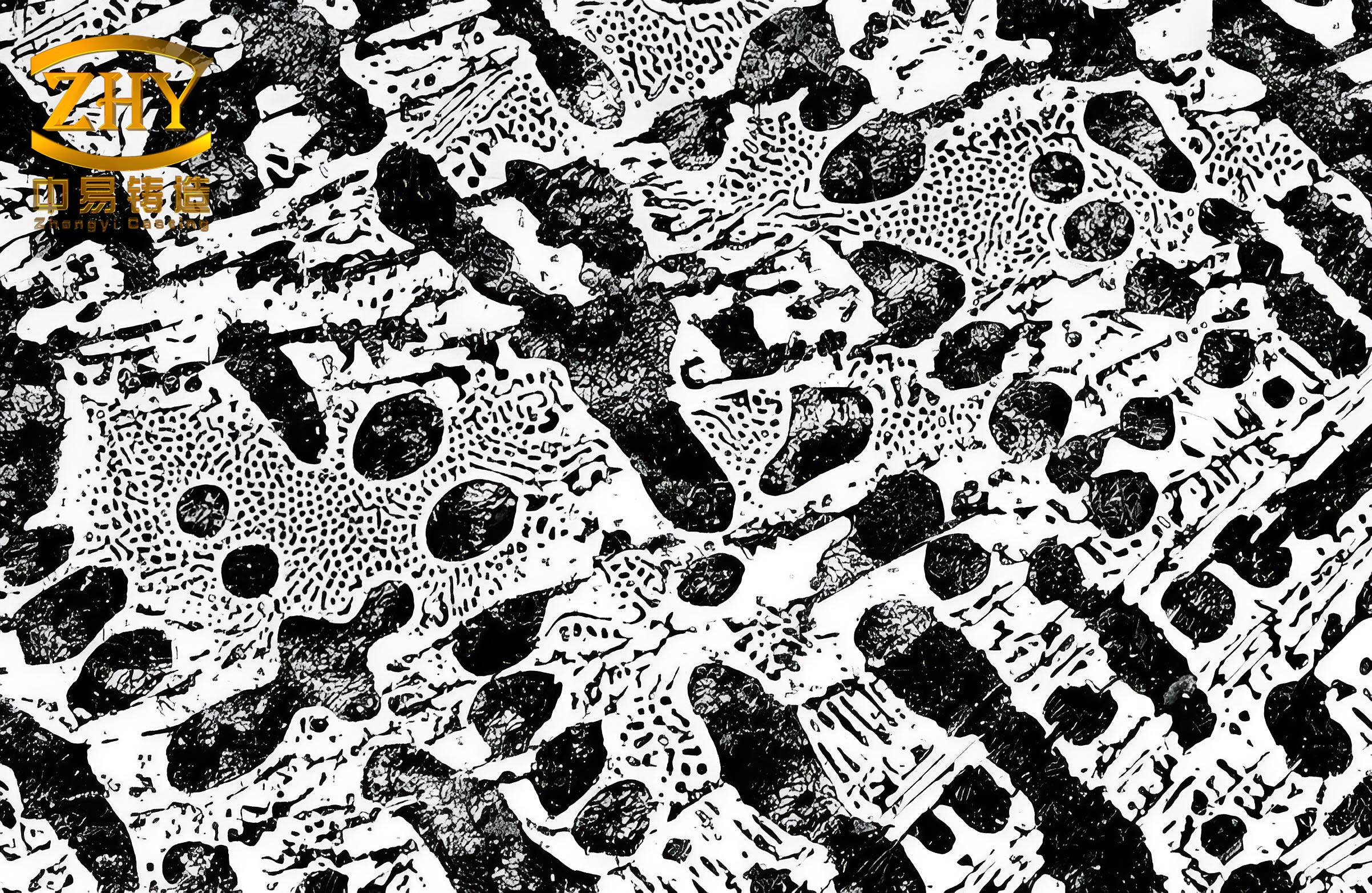
Theoretical Analysis and Discussion of Mechanisms
The solidification of white cast iron involves the coupled growth of austenite (a faceted phase) and carbide (a non-faceted phase). This rough-faceted coupled growth mode is theoretically amenable to morphological modification through inoculation, providing the foundation for treating low-alloy white cast iron.
The composite modifiers act through several synergistic mechanisms:
1. Enhanced Nucleation and Grain Refinement: The combined action of alkali metals and rare earths (e.g., in M1, M4) has a powerful deoxidizing and desulfurizing effect. This purification increases the melt’s surface tension ($\gamma_{SL}$) and significantly raises the undercooling ($\Delta T$) prior to solidification—measured to increase by approximately 20-30°C. According to classical nucleation theory, a higher undercooling dramatically increases the nucleation rate ($I$). The relationship can be expressed as:
$$I = K \cdot \exp\left(-\frac{\Delta G^*}{kT}\right) \cdot \exp\left(-\frac{Q}{kT}\right)$$
where $\Delta G^*$ is the critical nucleation energy barrier, reduced by a larger $\Delta T$:
$$\Delta G^* = \frac{16\pi\gamma_{SL}^3}{3(\Delta G_v)^2}$$
and $\Delta G_v \propto \Delta T$.
This surge in nucleation rate applies first to the primary austenite. Elements like Ti, V, and Nb have a strong affinity for carbon and nitrogen, forming high-melting-point carbide/nitride particles (e.g., TiC, NbC, V4C3) that act as potent heterogeneous nucleation sites for austenite. For instance, NbC has a face-centered cubic (FCC) crystal structure with a lattice parameter $a_{NbC} \approx 4.47 \, \text{Å}$. Austenite (γ-Fe) is also FCC with $a_{\gamma} \approx 3.65 \, \text{Å}$. The crystallographic lattice misfit ($\delta$) along certain orientations can be remarkably low:
$$\delta = \frac{|a_{NbC} – a_{\gamma}|}{a_{\gamma}} \approx 0.22$$
This small misfit (often considered effective when δ < 0.15-0.20 depending on orientation) allows NbC particles to act as excellent substrates for austenite nucleation. The combined effect of enhanced undercooling and copious heterogeneous sites leads to a dramatic refinement of the primary austenite grains.
2. Disruption of Carbide Network Formation: The refined and more numerous primary austenite dendrites effectively partition the remaining liquid during the later stages of solidification. This physical separation restricts the continuous growth path for the eutectic M3C carbide. The eutectic reaction is forced to occur in isolated liquid pools, leading to a “divorced” eutectic growth where austenite grows preferentially from the existing primary dendrites, and carbides form separately within the confined spaces. This process is the direct cause of the transition from a continuous network to isolated, blocky carbides in the modified white cast iron. The degree of isolation can be conceptually related to the density of primary austenite nuclei ($N_a$) and the secondary dendrite arm spacing (SDAS, $\lambda_2$), which is also refined by the modifiers.
3. Solid-State Transformation and Heat Treatment Response: The heat treatment (quench and temper) further improves toughness by transforming the austenitic matrix to martensite and then tempering it. The refined and isolated carbide morphology in the modified white cast iron presents fewer and less severe stress concentration points, allowing the tougher matrix to better absorb impact energy. This explains the synergistic effect of modification and heat treatment on final properties. The hardness remains high due to the hard carbides and martensitic matrix, demonstrating that the composite modification successfully decouples hardness and toughness to a significant degree in this white cast iron.
Conclusion and Implications
This investigation conclusively demonstrates that a designed composite modification treatment, utilizing optimal ratios of Ti, V, Nb in conjunction with alkali metal and rare earth additions, can profoundly transform the microstructure and mechanical properties of low-alloy white cast iron. The key outcomes are:
- The continuous carbide network is effectively broken, yielding isolated, blocky carbides.
- Austenite grain size is significantly refined.
- The as-cast impact toughness of the low-chromium white cast iron can be increased to approximately 10 J/cm², making it suitable for use in the as-cast condition for many applications.
- Following appropriate heat treatment, the impact toughness can be elevated to over 12 J/cm², a level competitive with modified high-chromium white cast irons. This represents more than a doubling of toughness compared to the unmodified, heat-treated baseline.
The governing mechanisms involve a synergistic combination of melt purification (increasing undercooling), prolific heterogeneous nucleation of primary austenite on modifier-induced particles, and the consequent physical disruption of the eutectic solidification path. This work provides a viable and effective pathway to overcome the traditional brittleness limitation of low-alloy white cast iron, potentially expanding its application scope into more demanding wear environments that involve moderate impact or thermal shock.
Future work could focus on optimizing the modification process for specific alloy compositions (e.g., low-vanadium, low-niobium white cast iron), scaling up the treatment for industrial ladle sizes, and conducting detailed wear and impact testing under simulated service conditions to fully quantify the performance benefits of this advanced composite-modified white cast iron.