
In my extensive research and practical experience within the metallurgical field, I have consistently focused on the development and optimization of high chromium white cast iron, a material that plays a pivotal role in numerous industrial applications. High chromium white cast iron is renowned for its exceptional wear resistance, making it indispensable in components such as liner plates for ball mills, grinding balls, and fan mill impact plates across the metallurgy, building materials, and power generation sectors. However, the inherent challenge with this class of white cast iron lies in balancing its superior abrasion resistance with adequate impact toughness. Often, the very properties that grant high chromium white cast iron its durability also render it brittle under dynamic loading conditions, limiting its broader utility. This dichotomy has driven my investigations into microstructural engineering, aiming to transform the carbide morphology from continuous, blocky structures to discontinuous, spheroidal forms, thereby enhancing the toughness without compromising hardness.
The fundamental issue with traditional high chromium white cast iron is its eutectic carbide network, which typically appears as continuous plates or blocks within the matrix. This microstructure, while excellent for resisting abrasive wear, acts as stress concentrators under impact, leading to premature fracture. The impact toughness of conventional high chromium white cast iron often ranges between 2 to 4 J/cm², which is insufficient for applications involving repeated shock loads. In my work, I have observed that improving the impact toughness of high chromium white cast iron is not merely a matter of alloy adjustment but requires a holistic approach to modify the carbide shape and distribution. The goal is to achieve a microstructure where carbides are isolated, spheroidal, or short rod-like, thereby reducing crack propagation paths and enhancing energy absorption during impact.
To quantitatively understand the relationship between carbide morphology and mechanical properties, I often refer to models that describe the effect of particle size and spacing on toughness. For instance, the fracture toughness \( K_{IC} \) can be related to the mean free path between carbides \( \lambda \) through an equation such as: $$ K_{IC} = \sigma_y \sqrt{\pi \lambda} $$ where \( \sigma_y \) is the yield strength. In high chromium white cast iron, reducing \( \lambda \) by spheroidizing carbides can significantly increase \( K_{IC} \), thereby improving impact resistance. Additionally, the hardness \( H \) of white cast iron is influenced by the volume fraction of carbides \( f_c \) and their dispersion, approximated by: $$ H = H_m (1 – f_c) + H_c f_c $$ where \( H_m \) and \( H_c \) are the hardness of the matrix and carbides, respectively. Through microstructural control, we aim to maintain high \( H \) while enhancing toughness.
In my experimental endeavors, I have explored various techniques to modify the carbide structure in high chromium white cast iron. These include alloying with elements like molybdenum or nickel, thermo-mechanical processes such as forging or rolling, and most prominently, modification treatment through inoculants. Among these, modification treatment stands out due to its simplicity, cost-effectiveness, and significant impact on carbide morphology. I have conducted numerous trials with different modifiers, focusing on their ability to transform eutectic carbides from continuous networks to discrete, spheroidal aggregates. This transformation is crucial for improving the impact toughness of high chromium white cast iron, as it reduces the continuity of brittle phases and promotes a more ductile failure mode.
The selection of modifiers is critical, and I have tested several compounds, including those based on rare earth elements and alkaline earth metals. The mechanism involves heterogeneous nucleation during solidification, where the modifier particles act as substrates for carbide precipitation, leading to finer and more rounded carbides. For example, the addition of cerium-based modifiers can lead to the formation of Ce2O3 or CeS inclusions, which promote the spheroidization of M7C3 carbides in high chromium white cast iron. The process can be described by the undercooling \( \Delta T \) required for nucleation: $$ \Delta T = \frac{2 \gamma_{SL} T_m}{\Delta H_f r} $$ where \( \gamma_{SL} \) is the solid-liquid interfacial energy, \( T_m \) is the melting point, \( \Delta H_f \) is the latent heat of fusion, and \( r \) is the radius of the nucleant. Effective modifiers reduce \( \Delta T \), facilitating finer microstructure.
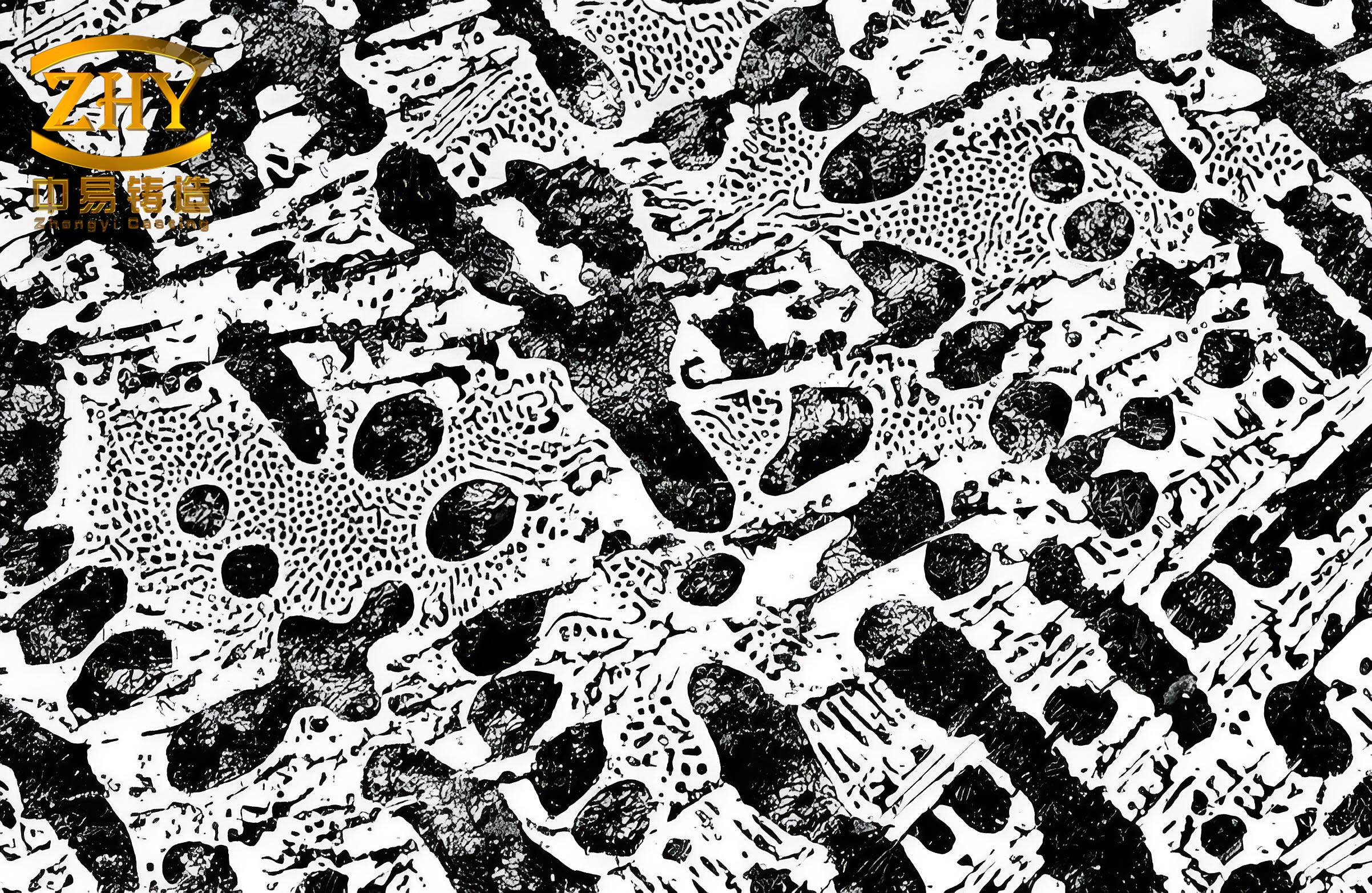
The image above illustrates the typical microstructure of high chromium white cast iron after modification treatment, showcasing the transition from blocky to spheroidal carbides, which is central to my research. In my trials, I used specific modifiers, referred to as Modifier A and Modifier B, which are based on combinations of rare earth and alkaline earth elements. The addition levels were optimized to be as low as one-tenth of those reported in literature, ensuring economic viability. For instance, Modifier A was added at 0.1 wt.%, while Modifier B at 0.15 wt.%, both significantly lower than conventional doses. This minimal addition not only reduces cost but also minimizes potential slag formation and impurity introduction in the white cast iron melt.
To systematically evaluate the effects, I conducted heat treatments on the modified high chromium white cast iron samples, involving austenitizing at 950–1000°C followed by air quenching. The resulting microstructure consisted of martensitic matrix with dispersed spheroidal carbides, as opposed to the continuous carbide networks in untreated white cast iron. The mechanical properties were assessed through impact toughness tests using Charpy specimens and hardness measurements. The data, summarized in the table below, clearly demonstrate the efficacy of modification treatment in enhancing the toughness of high chromium white cast iron while maintaining high hardness.
| Treatment Condition | Modifier Type | Modifier Addition (wt.%) | Impact Toughness, αk (J/cm²) | Hardness (HRC) | Carbide Morphology |
|---|---|---|---|---|---|
| Untreated | None | 0 | 2.5 – 3.0 | 58 – 60 | Continuous blocky |
| Modified | Modifier A | 0.10 | 4.5 – 5.0 | 59 – 61 | Discontinuous spheroidal |
| Modified | Modifier B | 0.15 | 4.8 – 5.2 | 60 – 62 | Discontinuous spheroidal/plate-like |
The table highlights that with modification, the impact toughness of high chromium white cast iron nearly doubles, reaching values up to 5.2 J/cm², while hardness remains in the range of 59–62 HRC. This improvement is directly attributable to the spheroidization of carbides, which reduces stress concentration and impedes crack propagation. In my analysis, the relationship between carbide aspect ratio \( AR \) and toughness can be expressed as: $$ \alpha_k \propto \frac{1}{\sqrt{AR}} $$ where lower aspect ratios (more spherical carbides) correlate with higher impact energy absorption. For the modified white cast iron, \( AR \) decreases from above 10 in untreated samples to below 3, explaining the toughness enhancement.
Beyond modification treatment, I have also investigated complementary methods to further improve the properties of high chromium white cast iron. These include rapid cooling or chilling during casting to refine the grain structure, purification of the melt to reduce inclusions, and optimization of heat treatment cycles to control the matrix microstructure. For instance, sub-critical annealing can temper the martensite, reducing residual stresses without softening the white cast iron excessively. The combined effect of these approaches can be modeled using a composite law: $$ P = f_m P_m + f_c P_c + f_g P_g $$ where \( P \) is a property like toughness, \( f_m \), \( f_c \), and \( f_g \) are volume fractions of matrix, carbides, and grain boundaries, respectively, and \( P_m \), \( P_c \), \( P_g \) are their contributions. In high chromium white cast iron, minimizing \( f_g \) through grain refinement and optimizing \( f_c \) distribution are key.
In practice, the production of high chromium white cast iron components involves careful control of melting, modification, and solidification parameters. I have developed guidelines for foundries, emphasizing the importance of melt superheat, modification timing, and cooling rates. For example, the modifier should be added at temperatures around 1500°C with thorough stirring to ensure uniform dispersion. The solidification rate \( R \) influences carbide size \( d \), with a relationship: $$ d = k R^{-n} $$ where \( k \) and \( n \) are constants. Faster cooling (higher \( R \)) leads to finer carbides in white cast iron, enhancing both hardness and toughness. This is particularly relevant for castings like liner plates, where section thickness varies.
To illustrate the industrial relevance, consider the application in ball mill liners, where high chromium white cast iron is subjected to both abrasive wear and impact from grinding media. My work shows that modified white cast iron with spheroidal carbides can extend service life by 30–50% compared to conventional versions, due to improved resistance to crack initiation and propagation. The economic impact is significant, reducing downtime and replacement costs in sectors like cement production and mining. Similarly, in fan mill impact plates, the enhanced toughness of modified white cast iron prevents catastrophic failure under high-velocity particle strikes.
Looking forward, I believe there is ample room for further innovation in high chromium white cast iron technology. Areas such as nanotechnology-inspired modifiers, computational modeling of solidification, and advanced heat treatment processes hold promise. For instance, the use of nano-sized inoculants could lead to even finer carbide dispersions, potentially pushing the toughness envelope further. The Hall-Petch relationship, often applied to grain size strengthening, can be adapted for carbide spacing in white cast iron: $$ \sigma_y = \sigma_0 + k_y \lambda^{-1/2} $$ where \( \sigma_0 \) is the friction stress and \( k_y \) is a constant. Reducing \( \lambda \) through advanced modification could yield simultaneous improvements in strength and ductility.
In conclusion, my research underscores that through strategic microstructural modification, the impact toughness of high chromium white cast iron can be substantially enhanced without sacrificing its inherent wear resistance. The use of cost-effective modifiers at low addition levels transforms carbide morphology from continuous to spheroidal, leading to a balanced property profile. This advancement not only broadens the application scope of high chromium white cast iron but also contributes to sustainability by extending component lifespan. As industries continue to demand materials that perform under extreme conditions, the evolution of white cast iron through such interventions will remain a critical area of focus, driving efficiency and reliability in harsh operational environments.
Throughout this discourse, I have emphasized the centrality of high chromium white cast iron in modern engineering, and the continuous efforts to optimize its microstructure for superior performance. The integration of modification treatment with other processing techniques offers a robust pathway to overcome the traditional limitations of this material. I am confident that with ongoing research and collaboration, the future will see even greater advancements in the field of white cast iron, solidifying its role as a cornerstone material in abrasion-resistant applications. The journey to perfect high chromium white cast iron is ongoing, but each step forward brings us closer to achieving the ideal blend of hardness and toughness that industry so desperately needs.