
In the field of abrasive and corrosive wear applications, such as coal grinding in thermal power plants, the selection of grinding media is critical for operational efficiency and cost reduction. Traditional materials like medium manganese ductile iron have shown limitations due to their inadequate resistance to combined abrasive and corrosive environments. This study focuses on the development of a chromium-manganese-copper alloyed white cast iron for grinding balls, aiming to enhance performance in coal mill conditions. White cast iron, characterized by its high carbon content and carbide-rich microstructure, offers superior hardness and wear resistance, but often at the expense of toughness. Through careful alloy design and heat treatment optimization, we have developed a white cast iron material that balances hardness and toughness, making it suitable for demanding grinding applications.
The motivation for this work stems from the need to address high grinding ball consumption in coal mills, where medium manganese ductile iron balls exhibit wear rates of 450 to 950 grams per ton of coal powder produced. This not only increases operational costs but also necessitates frequent replacements. White cast iron, with its inherent abrasion resistance, presents a promising alternative. However, its brittleness has historically limited its use in impact-prone environments. By incorporating alloying elements like chromium, manganese, and copper, and applying tailored heat treatments, we aim to improve the toughness of white cast iron while retaining its wear-resistant properties. This article details our approach, from composition selection to field testing, emphasizing the role of microstructure control in achieving desired mechanical and tribological behaviors.
White cast iron is defined by the presence of cementite (Fe3C) as the primary carbide phase, which contributes to high hardness but also brittleness. In alloyed white cast iron, elements such as chromium are added to form more stable carbides (e.g., (Fe,Cr)3C or Cr7C3), enhancing wear resistance and moderating brittleness. Manganese and copper further influence the matrix structure, promoting pearlitic or martensitic transformations that improve toughness. The interplay between these elements is complex, governed by phase diagrams and kinetic factors. For instance, the effect of chromium on carbide morphology can be described by the following relationship for carbide volume fraction (Vc): $$V_c = \frac{C – 0.05 \cdot Si – 0.2 \cdot Mn}{6.7} + k_{Cr} \cdot Cr$$ where C, Si, Mn, and Cr are weight percentages, and kCr is a coefficient dependent on cooling rate. This formula highlights how alloying adjusts the microstructure of white cast iron, directly impacting its properties.
Our initial step involved selecting an optimal composition for the white cast iron grinding balls. Based on orthogonal design principles, we identified a range of elements that synergistically improve hardness, toughness, and corrosion resistance. The chosen chemical composition is summarized in Table 1. Carbon content is maintained high to ensure carbide formation, while chromium levels are controlled to avoid excessive brittleness. Manganese and copper are added to stabilize the matrix and enhance hardenability. Impurities like phosphorus and sulfur are minimized to prevent hot tearing and reduce corrosion susceptibility.
| Element | Range |
|---|---|
| C | 2.6 – 3.6 |
| Si | ≤ 1.0 |
| Cr | 0.8 – 2.0 |
| Mn | 2.0 – 3.5 |
| Cu | 0.5 – 1.2 |
| P | ≤ 0.10 |
| S | ≤ 0.10 |
Melting was conducted using a medium-frequency induction furnace and a cupola, with charges comprising scrap steel and iron chips. The use of iron chips, often a waste product from machining, aligns with sustainable practices, but their thin geometry increases oxidation risk. To mitigate this, melting was performed under controlled atmospheres, and alloy additions were made post-melting to achieve target compositions. The molten white cast iron was then poured into metal molds to produce grinding balls of 60 mm diameter. The as-cast microstructure typically consists of primary carbides in a pearlitic matrix, but this structure is suboptimal for toughness. Therefore, heat treatment is essential to refine the microstructure and improve mechanical properties.
The heat treatment process for white cast iron is critical to balancing hardness and toughness. We conducted a series of orthogonal experiments (L9 arrays) to optimize parameters such as austenitizing temperature, holding time, cooling rate, and tempering conditions. The goal was to transform the matrix while controlling carbide morphology. Austenitizing in the range of 930°C to 1050°C allows for dissolution of carbides and homogenization of the matrix. Subsequent air cooling (normalizing) promotes the formation of pearlite with dispersed secondary carbides, which enhances toughness without significant hardness loss. The transformation kinetics can be modeled using the Avrami equation for phase change: $$X = 1 – \exp(-k t^n)$$ where X is the transformed fraction, k is a rate constant dependent on temperature, t is time, and n is an exponent related to nucleation and growth. For our white cast iron, n values around 1.5 indicated diffusion-controlled growth of pearlite. Tempering between room temperature and 300°C showed minimal effect on properties, which is advantageous for grinding balls operating at elevated temperatures (100–200°C) in coal mills.
The mechanical properties of the white cast iron were evaluated in both as-cast and heat-treated conditions. Hardness was measured using Rockwell C scale, and impact toughness was assessed via Charpy tests with unnotched specimens. Table 2 presents the as-cast properties, highlighting the high hardness but low toughness characteristic of white cast iron. The large confidence intervals reflect variability due to casting defects, such as microporosity and inclusion segregation. After heat treatment, as shown in Table 3, hardness decreased slightly, but toughness improved markedly. This trade-off is quantified by the hardness-toughness product, a common metric for wear-resistant materials: $$H \cdot a_k = \text{HRC} \times \alpha_k$$ where H is hardness in HRC and ak is impact energy in J/cm². For the heat-treated white cast iron, this product increased by approximately 40% compared to the as-cast state, indicating better overall performance.
| Property | Sample Size | Mean Value | 95% Confidence Interval (Extreme Range Method) |
|---|---|---|---|
| Hardness (HRC) | 280 | 57.0 | 54.0 – 60.0 |
| Impact Toughness (αk, J/cm²) | 263 | 0.35 | 0.24 – 0.46 |
| Property | Sample Size | Mean Value | 95% Confidence Interval (Extreme Range Method) |
|---|---|---|---|
| Hardness (HRC) – Test Bar | 1062 | 55.5 | 52.5 – 58.5 |
| Impact Toughness (αk, J/cm²) – Test Bar | 354 | 0.61 | 0.43 – 0.79 |
| Hardness (HRC) – Grinding Ball | 267 (89×3) | 55.0 | 52.0 – 58.0 |
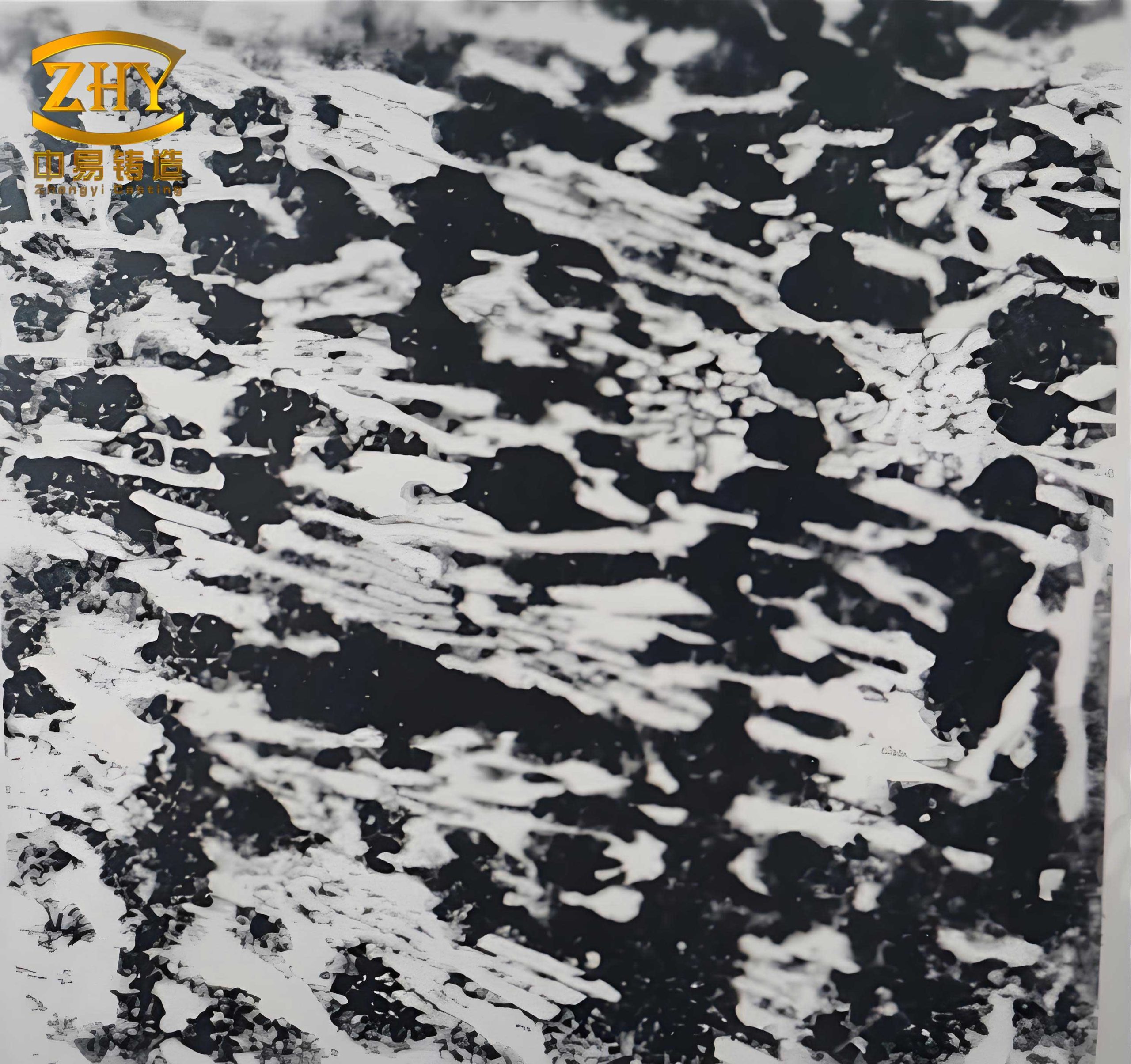
The microstructure of the heat-treated white cast iron plays a pivotal role in its properties. Optical and electron microscopy revealed a matrix of fine pearlite with eutectic carbides and dispersed secondary carbides. The carbides, rich in chromium, exhibit a blocky morphology that resists pull-out during abrasion. This structure is typical of alloyed white cast iron designed for wear applications. To illustrate, consider the following image that depicts the microstructure of white cast iron, highlighting carbide distribution and matrix phases:
Wear resistance is a key attribute for grinding balls, especially in coal mills where abrasive silica particles and corrosive elements like sulfur are present. We conducted laboratory wear tests using a reciprocating abrasion tester with quartz sand as the abrasive medium. Weight loss was measured, and relative wear resistance (ε) was calculated as the inverse of wear rate. The results, compared to medium manganese ductile iron, are shown in Table 4. The heat-treated white cast iron demonstrated over three times higher wear resistance than the ductile iron. This can be explained by the Archard wear equation, adapted for abrasive conditions: $$V = K \frac{N \cdot L}{H}$$ where V is wear volume, K is a wear coefficient, N is normal load, L is sliding distance, and H is hardness. For white cast iron, the high hardness reduces wear volume, but the improved toughness also minimizes fracture-induced material loss, leading to a lower effective K value. The wear coefficient for the white cast iron was approximately 0.31 relative to ductile iron, underscoring its superiority.
| Material | Condition | Initial Weight (g) | Final Weight (g) | Weight Loss (g) | Relative Wear Resistance (ε) | Wear Coefficient (1/ε) |
|---|---|---|---|---|---|---|
| Medium Manganese Ductile Iron | As-cast and Heat-Treated | 913.82 | 911.61 | 2.21 | 1.00 | 1.000 |
| Cr-Mn-Cu White Cast Iron | As-Cast | 956.63 | 953.60 | 3.43 | 0.64 | 1.552 |
| Cr-Mn-Cu White Cast Iron | Normalized at 1000°C | 947.91 | 947.22 | 0.69 | 3.20 | 0.312 |
Corrosion resistance is equally important in coal grinding due to moisture and sulfur content in coal. We performed accelerated corrosion tests in a 20% sulfuric acid solution under agitated conditions. Weight loss per unit area was measured after 72 hours, and relative corrosion rates were computed. Table 5 summarizes the results, comparing the white cast iron with medium manganese ductile iron and plain carbon steel (45# steel). The white cast iron exhibited 29% to 57% lower corrosion rate than ductile iron and over 120% improvement compared to carbon steel. This enhancement stems from the alloying elements: chromium forms a passive oxide layer, while copper increases the electrochemical nobility of the matrix. The corrosion rate (CR) can be expressed as: $$CR = \frac{\Delta W}{A \cdot t}$$ where ΔW is weight loss, A is surface area, and t is time. For the white cast iron, CR values were significantly reduced, indicating better suitability for corrosive environments.
| Material | Sample ID | Weight Loss (g) | Weight Loss per Unit Area (g/m²) | Relative Weight Loss Rate | Corrosion Resistance Ratio |
|---|---|---|---|---|---|
| 45# Steel | 1-1 | 10.6014 | 7713.19 | 1.00 | 1.00 |
| 45# Steel | 1-2 | 9.7216 | 7073.08 | 0.92 | 1.09 |
| Medium Manganese Ductile Iron | 2-1 | 5.6638 | 4120.78 | 0.58 | 1.72 |
| Medium Manganese Ductile Iron | 2-2 | 6.3676 | 4632.83 | 0.65 | 1.54 |
| Cr-Mn-Cu White Cast Iron | 3-1 | 4.3471 | 3162.79 | 0.45 | 2.22 |
| Cr-Mn-Cu White Cast Iron | 3-2 | 3.6031 | 2621.48 | 0.37 | 2.70 |
The synergistic improvement in wear and corrosion resistance makes this white cast iron ideal for coal mill applications. To validate laboratory findings, we conducted a field trial at a thermal power plant using two DTM 287/410 coal mills. The mills operated at 0.31 s⁻¹ (approximately 18.6 rpm) for 1642 hours, processing 39,092 tons of coal. A total of 60.47 tons of white cast iron grinding balls, produced via cupola melting and metal mold casting, were installed. The balls were subjected to a combination of high-stress abrasion, gouging, and corrosion from sulfur and moisture. After the trial, ball consumption was measured at 161 grams per ton of coal powder, with a breakage rate below 0.5%. This represents a substantial reduction compared to the 450–950 grams per ton typical of medium manganese ductile iron balls. The success can be attributed to the optimized microstructure of the white cast iron, which resists both material loss due to abrasion and degradation from corrosion.
The economic implications are significant. For a power plant grinding 100,000 tons of coal annually, switching to white cast iron balls could save over 20 tons of grinding media, reducing costs and downtime. Moreover, the use of iron chips as raw material adds an environmental benefit by recycling waste. However, challenges remain in consistently producing white cast iron with uniform properties. Variations in cooling rate during casting can lead to carbide segregation, affecting toughness. We address this by implementing strict process controls, such as mold preheating and controlled pouring temperatures. Additionally, the heat treatment cycle must be tailored to each batch to account for minor composition fluctuations. Statistical process control (SPC) tools, like control charts for hardness and toughness, help maintain quality.
From a materials science perspective, the behavior of white cast iron under service conditions can be further analyzed using fracture mechanics. The stress intensity factor (KIC) for brittle materials like white cast iron is low, but alloying and heat treatment improve it. An empirical relationship between impact toughness (ak) and fracture toughness (KIC) can be derived: $$K_{IC} \approx C \sqrt{a_k \cdot E}$$ where E is Young’s modulus and C is a material constant. For our white cast iron, estimated KIC values increased from ~10 MPa√m in as-cast state to ~15 MPa√m after heat treatment, explaining the reduced breakage rate. This aligns with the observation that white cast iron grinding balls withstand impact loads better when the matrix is toughened.
Future work could explore other alloying additions, such as molybdenum or nickel, to further enhance the properties of white cast iron. Molybdenum, for instance, promotes secondary hardening during tempering and refines carbide size. The effect on wear resistance might be modeled using a composite rule of mixtures: $$H_{composite} = V_c \cdot H_c + (1 – V_c) \cdot H_m$$ where Hc and Hm are hardnesses of carbide and matrix, respectively. By optimizing Vc through alloy design, one can achieve even better performance. Additionally, advanced heat treatments like austempering could be investigated to produce a bainitic matrix in white cast iron, potentially offering an excellent combination of strength and ductility.
In conclusion, the development of chromium-manganese-copper alloyed white cast iron for grinding balls has demonstrated significant advantages over traditional materials in coal mill applications. Through careful composition control and heat treatment, we achieved a microstructure comprising eutectic carbides, pearlite, and dispersed secondary carbides, which provides high hardness (HRC 52–58), improved toughness (impact energy 0.43–0.79 J/cm²), and enhanced corrosion resistance. Laboratory tests showed wear resistance over three times that of medium manganese ductile iron and corrosion resistance improvements of 29–57%. Field trials confirmed these benefits, with ball consumption reduced to 161 grams per ton of coal and breakage below 0.5%. This white cast iron material thus offers a reliable and cost-effective solution for abrasive-corrosive environments, highlighting the potential of alloyed white cast iron in industrial wear applications. Further optimizations in processing and alloy design could expand its use to other sectors, such as mining and cement production, where white cast iron components are subjected to severe wear conditions.