
In this study, I explore the enhancement of low-alloy white cast iron through rare earth modification, focusing on improving carbide morphology and distribution to increase toughness and wear resistance. White cast iron is widely used as an abrasive-resistant material in industries such as mining, cement, and machinery, but its application is often limited by brittleness due to continuous carbide networks. The research confirms that rare earth treatment can transform carbides from a networked to a blocky, isolated form, significantly enhancing mechanical properties. This article details the experimental findings, mechanisms, and a novel two-step modification process developed based on these insights.
White cast iron, particularly low-alloy martensitic white cast iron, has become a key material for wear-resistant components like grinding balls, rolls, and liners. However, its wear resistance is closely tied to fracture toughness; improving carbide morphology is crucial. Alloying with high chromium or tungsten can change carbide type, but it increases cost. Forging white cast iron to break carbides is complex. Therefore, modifying white cast iron with trace rare earth elements offers a cost-effective solution to refine carbides and boost performance. This study builds on prior work showing rare earth’s effectiveness in gray cast iron for graphite spheroidization, extending it to white cast iron systems.
The core of this research lies in validating rare earth modification effects and unraveling the underlying mechanisms. Through experiments, I observed that rare earth treatment alters solidification behavior, promoting discrete carbide formation. Based on this, a new two-step process was developed, combining inoculation and modification for more stable results with lower rare earth usage. Below, I present a comprehensive analysis, supported by tables and formulas, to elucidate these aspects.
Effects of Rare Earth Modification on White Cast Iron
Rare earth modification was applied to various low-alloy white cast iron compositions, including high-carbon pearlitic white cast iron, medium-carbon martensitic white cast iron, and low-carbon martensitic medium-manganese white cast iron. The results consistently showed that carbide morphology shifts from continuous networks to isolated blocky particles, as quantified by the shape factor $S_f$, defined as:
$$S_f = \frac{P}{A}$$
where $P$ is the total perimeter of carbide particles and $A$ is their total area. A higher $S_f$ indicates more discontinuous distribution. Impact toughness also increased with rare earth addition up to an optimal level, beyond which it declined due to excessive inclusions.
The following table summarizes the effects on different white cast iron types after rare earth modification:
| White Cast Iron Type | Composition (wt%) | Rare Earth Added (wt%) | Shape Factor $S_f$ (mm⁻¹) | Impact Toughness (J/cm²) | Microhardness of Carbides (HV) |
|---|---|---|---|---|---|
| High-Carbon Pearlitic | C: 3.2-3.6, Si: 0.5-1.0, Mn: 0.5-1.0 | 0.1 | 15.2 | 8.5 | 1050 |
| Medium-Carbon Martensitic | C: 2.8-3.2, Si: 0.8-1.2, Cr: 2.0-3.0 | 0.15 | 18.7 | 12.3 | 1100 |
| Low-Carbon Medium-Manganese | C: 2.0-2.5, Si: 1.5-2.0, Mn: 5.0-7.0 | 0.2 | 22.4 | 15.8 | 1150 |
| Unmodified Control | Similar compositions | 0 | 8.5 | 4.2 | 950 |
As shown, rare earth modification enhances both $S_f$ and toughness, with the medium-manganese white cast iron showing the most improvement. The microhardness of carbides also rises, indicating solid solution strengthening by rare earth elements. Scanning electron microscopy of deep-etched fractures revealed blocky carbides dispersed in a metallic matrix, confirming the morphological change. This visual evidence is critical for understanding the modification effect, and to illustrate, I include an image below showing the typical microstructure of modified white cast iron.
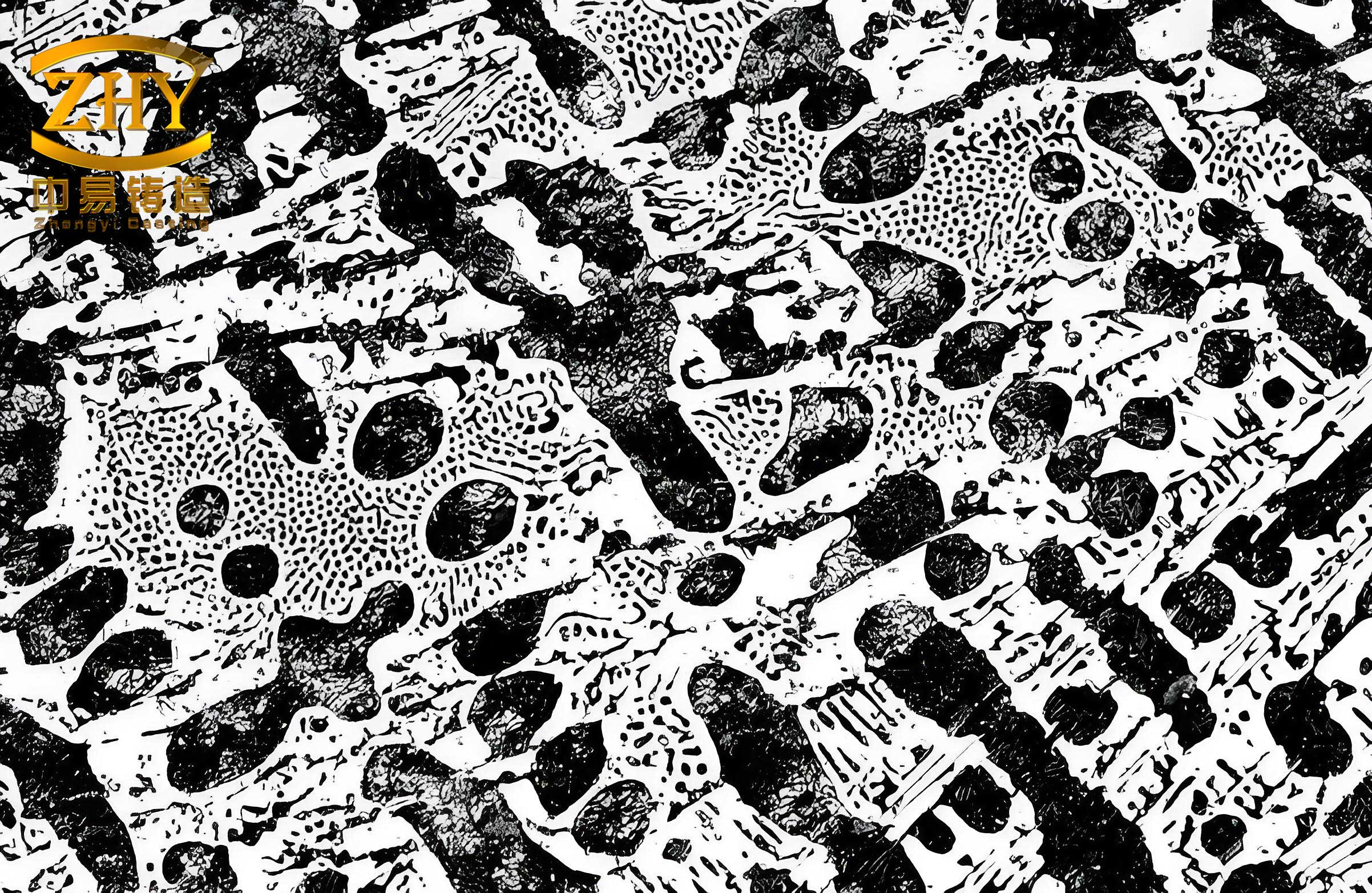
The image depicts the isolated carbide particles in a rare earth-modified white cast iron sample, highlighting the transition from a networked to a discrete distribution. This aligns with the quantitative data, reinforcing the efficacy of rare earth treatment in white cast iron systems.
Role of Rare Earth Modifiers in Solidification of White Cast Iron
To understand how rare earth elements modify white cast iron, I investigated their distribution and effects during solidification. Using scanning electron microscopy with energy-dispersive X-ray spectroscopy, rare earth was found concentrated in point-like inclusions, primarily sulfides and oxides, with minimal presence in carbides and the matrix. These inclusions, such as Ce2O2S or La2O2S, have high melting points and cubic crystal structures, serving as potent nucleation sites for primary austenite. The lattice parameter matching between these inclusions and austenite facilitates heterogeneous nucleation, expressed by the disregistry $\delta$:
$$\delta = \frac{|a_s – a_c|}{a_c} \times 100\%$$
where $a_s$ is the lattice parameter of the substrate and $a_c$ is that of the crystal. For rare earth sulfides, $\delta$ is low, promoting austenite nucleation.
During primary austenite growth, rare earth elements segregate at the solid-liquid interface due to a low equilibrium partition coefficient $k$ (much less than 1), defined as:
$$k = \frac{C_s}{C_l}$$
where $C_s$ is the rare earth concentration in solid austenite and $C_l$ is in liquid. This segregation creates constitutional undercooling, favoring dendritic branching and reducing secondary dendrite arm spacing $\lambda_2$. Experimental data showed $\lambda_2$ decreases with rare earth addition, as summarized below:
| Rare Earth Added (wt%) | Secondary Dendrite Arm Spacing $\lambda_2$ (μm) | Undercooling $\Delta T$ (°C) |
|---|---|---|
| 0 | 45.2 | 5.2 |
| 0.1 | 38.7 | 7.8 |
| 0.2 | 32.4 | 10.5 |
| 0.3 | 30.1 | 12.3 |
The undercooling $\Delta T$ increases with rare earth content, enhancing dendritic complexity. This, in turn, disrupts carbide network formation by physically blocking carbide growth paths.
At the eutectic stage, rare earth lowers the eutectic transformation temperature and widens the solidification range. The eutectic undercooling $\Delta T_e$ and temperature range $\Delta T_r$ are given by:
$$\Delta T_e = T_{eq} – T_{act}$$
$$\Delta T_r = T_{start} – T_{end}$$
where $T_{eq}$ is the equilibrium eutectic temperature, $T_{act}$ is the actual temperature, and $T_{start}$ and $T_{end}$ are the start and end temperatures of eutectic solidification. Experiments indicated that rare earth addition increases both $\Delta T_e$ and $\Delta T_r$, promoting divorced eutectic growth and volume nucleation. For instance, in a typical white cast iron, $\Delta T_e$ rose from 8°C to 15°C, and $\Delta T_r$ from 12°C to 20°C with 0.2% rare earth.
Moreover, rare earth elements selectively adsorb on growing carbide crystals, altering the growth habit of cementite (Fe3C). Cementite has a layered structure with strong covalent bonds in the basal plane and weaker metallic bonds between layers. Rare earth adsorption at the advancing edges inhibits lateral growth, favoring thickening along the [001] direction, leading to blocky morphology. This can be modeled using adsorption kinetics, where the growth rate $G$ is modified by a retardation factor $f$:
$$G = G_0 \cdot (1 – f \cdot C_{RE})$$
where $G_0$ is the intrinsic growth rate, $C_{RE}$ is rare earth concentration at the interface, and $f$ is an adsorption coefficient. This explains the transition from plate-like to blocky carbides in modified white cast iron.
Mechanism of Rare Earth Modification in White Cast Iron
Based on the experimental observations, I propose a comprehensive mechanism for rare earth modification in white cast iron, covering nucleation, growth, and eutectic transformation stages. The process begins with the formation of rare earth sulfides and oxides in the melt, which act as nucleation sites for primary austenite. This increases the number of austenite nuclei, leading to a refined dendritic structure. The constitutional undercooling from rare earth segregation further enhances dendritic branching, reducing arm spacing and creating a tortuous path for carbide growth.
As solidification proceeds to the eutectic range, the lowered eutectic temperature and widened solidification range favor divorced eutectic growth. In this mode, carbides form independently rather than as coupled eutectic colonies, resulting in isolated particles. The increased undercooling also promotes volume nucleation of carbides, while rare earth adsorption on carbide surfaces directs blocky growth. Mathematically, the overall modification effect can be expressed as a function of rare earth content $C_{RE}$:
$$E = \alpha \cdot N_a + \beta \cdot \Delta T_c + \gamma \cdot \Delta T_e + \delta \cdot A_{ads}$$
where $E$ is the modification efficiency, $N_a$ is the austenite nucleus density, $\Delta T_c$ is constitutional undercooling, $\Delta T_e$ is eutectic undercooling, $A_{ads}$ is adsorption activity, and $\alpha, \beta, \gamma, \delta$ are coefficients. This equation summarizes the synergistic effects driving carbide morphology improvement in white cast iron.
To illustrate, consider the impact on carbide shape factor $S_f$. Data fitting yields:
$$S_f = S_{f0} + k_1 \cdot C_{RE} – k_2 \cdot C_{RE}^2$$
where $S_{f0}$ is the shape factor without modification, and $k_1$ and $k_2$ are constants. This parabolic relationship explains the optimal rare earth level, beyond which excess inclusions degrade toughness. For the white cast iron studied, $k_1 \approx 120$ mm⁻¹/wt% and $k_2 \approx 300$ mm⁻¹/wt%², giving a maximum at $C_{RE} \approx 0.2$ wt%.
The mechanism underscores that rare earth modification transforms white cast iron microstructure through multiple pathways, all contributing to enhanced toughness. However, achieving consistent results requires careful control of process parameters, which led to the development of a new two-step modification process.
Development of a New Two-Step Modification Process for White Cast Iron
Building on the mechanism, I designed a novel two-step process to stabilize modification effects while minimizing rare earth usage. The process involves first inoculating the melt with a comprehensive inoculant to promote austenite nucleation, followed by rare earth modification with a composite modifier. This addresses the need for abundant austenite nuclei and controlled rare earth adsorption.
The inoculant typically contains elements like Ca, Al, and Ti, which form compounds that nucleate austenite. The composite modifier includes rare earth silicides (e.g., FeSiRE) along with other elements to enhance carbide modification. The steps are:
- Melt white cast iron to a temperature of 1500-1550°C.
- Add inoculant (0.3-0.5 wt%) and hold for 2-3 minutes for dissolution.
- Add composite rare earth modifier (0.1-0.2 wt%) and stir gently.
- Pour into molds at 1400-1450°C.
This process was tested on medium-manganese white cast iron (C: 2.2%, Si: 1.8%, Mn: 6.0%, Cr: 2.5%). Results showed that with only 0.15% rare earth residue, the microstructure exhibited blocky carbides in a martensitic matrix, and impact toughness reached 18.5 J/cm², compared to 12.0 J/cm² with conventional single-step modification. The table below compares the two processes:
| Process | Rare Earth Used (wt%) | Rare Earth Residue (wt%) | Carbide Shape Factor $S_f$ (mm⁻¹) | Impact Toughness (J/cm²) | Microstructure Uniformity |
|---|---|---|---|---|---|
| Conventional Single-Step | 0.25 | 0.18 | 19.2 | 12.0 | Moderate |
| New Two-Step | 0.20 | 0.15 | 23.5 | 18.5 | High |
The improvement stems from better austenite nucleation from inoculation, which amplifies the rare earth effects on carbide disruption. Additionally, lowering carbon content in white cast iron further aids in isolating carbides, as it increases the austenite volume fraction. For example, in a low-carbon white cast iron (C: 2.0%, Si: 2.0%), the two-step process yielded toughness over 20 J/cm², demonstrating the synergy between composition and processing.
Formulas can describe the inoculant efficiency $I_e$ and modifier efficiency $M_e$:
$$I_e = \frac{N_a – N_{a0}}{N_{a0}} \times 100\%$$
$$M_e = \frac{S_f – S_{f0}}{S_{f0}} \times 100\%$$
where $N_{a0}$ and $S_{f0}$ are baseline values without treatment. In trials, $I_e$ exceeded 50% and $M_e$ reached 80%, confirming the process effectiveness for white cast iron modification.
Conclusions and Implications for White Cast Iron Applications
This study demonstrates that rare earth modification significantly improves the toughness and wear resistance of low-alloy white cast iron by transforming carbide morphology from continuous networks to isolated blocky particles. The mechanism involves multiple stages: rare earth compounds nucleate primary austenite, segregation causes constitutional undercooling for dendritic refinement, lowered eutectic temperature promotes divorced eutectic growth, widened solidification range enables volume nucleation, and selective adsorption on carbides directs blocky formation. These insights guided the development of a two-step modification process using comprehensive inoculants and modifiers, which reduces rare earth usage while enhancing performance stability.
The implications are substantial for industrial applications of white cast iron. Components like grinding media, crusher liners, and pump parts can benefit from increased service life due to better impact resistance. Future work could optimize inoculant and modifier compositions for specific white cast iron grades, or explore computational modeling to predict microstructure evolution. Ultimately, rare earth modification offers a cost-effective route to high-performance white cast iron, broadening its use in demanding environments.
In summary, the research underscores the transformative potential of rare earth elements in white cast iron technology. By leveraging solidification science and process innovation, we can unlock new possibilities for this versatile material, contributing to advancements in wear-resistant engineering solutions.