
In the production of prestressed concrete hollow-core slabs, the spiral extrusion machine is a critical piece of forming equipment. It operates with a dry, stiff mixture of cement, aggregate, and sand with very low slump. The key component of this machine is the spiral blade, or auger, which is responsible for conveying and compacting this abrasive mixture into its final shape. The operational lifespan and economic efficiency of the entire process are heavily dependent on the wear resistance of this blade. This study investigates the development, processing, and practical application of a cost-effective, low-alloy white cast iron material designed specifically to meet the severe service demands of these extruder blades.
The service environment for the blade is exceptionally harsh. It can be conceptually divided into three functional zones: the feed zone, the compaction zone, and the forming tube zone. The most severe conditions exist within the compaction zone. Here, the blade rotates within a confined space filled with the concrete mix, subjecting it to a classic three-body abrasive wear system under high compressive stresses. Analyses and simulations suggest localized pressures can exceed 40 MPa. The primary wear mechanism is identified as high-stress abrasion, where hard quartz and feldspar particles in the aggregate plow and cut into the metal surface, creating deep grooves and pits aligned with the material flow. Furthermore, the presence of moisture in the mix introduces a corrosive element, leading to a synergistic effect where corrosion accelerates material loss from the wear process. Therefore, the ideal blade material must possess exceptionally high hardness to resist abrasion, sufficient toughness to handle impact and prevent brittle fracture, and a microstructure devoid of soft phases that would wear away rapidly.
While high-chromium white cast iron is renowned for its outstanding abrasion resistance, its high alloy content makes it a costly solution. The objective of this research was to formulate a more economical white cast iron variant by strategically using lower levels of chromium and molybdenum, coupled with appropriate heat treatment, to achieve a fully hardened microstructure with high hardness and improved toughness.
Material Design and Chemical Composition
The chemical composition was carefully selected to balance performance, hardenability, and cost. The target range for the low-chromium molybdenum white cast iron is summarized in Table 1.
| Element | C | Si | Mn | Cr | Mo | P, S |
|---|---|---|---|---|---|---|
| Content | 2.8 – 3.3 | < 0.8 | 0.8 – 1.2 | 1.5 – 2.5 | 0.5 – 1.0 | < 0.1 |
The role of the key alloying elements is crucial. Chromium is a primary carbide former. It promotes the formation of the white cast iron structure, stabilizes carbides, and dissolves in the cementite phase, transforming $(Fe)_3C$ into the harder, more wear-resistant complex carbide $(Fe, Cr)_3C$. It also contributes moderately to hardenability. Molybdenum’s primary function is to significantly enhance the hardenability of the section. Given the relatively uniform and modest wall thickness of the blade (< 40 mm), a controlled molybdenum addition is sufficient to ensure through-hardening during air quenching, preventing the formation of soft pearlitic or bainitic transformation products. The balance aims to minimize the use of this expensive element. To address the inherent brittleness of white cast iron caused by the continuous network of eutectic carbides, a rare earth (RE) treatment was employed during pouring. This inoculant modifies the morphology and distribution of the carbides, promoting a more discontinuous, rod-like structure that improves toughness without sacrificing hardness.
Microstructure, Properties, and Heat Treatment
The as-cast microstructure of the rare-earth-treated low-chromium molybdenum white cast iron consists of eutectic carbides within an austenitic matrix that may partially transform to martensite, depending on the cooling rate. To achieve optimal performance, a specific heat treatment is essential. The designed heat treatment cycle is illustrated in Figure 1.
$$ \text{Temperature} \quad ^\circ\text{C} $$
$$ 950-980 \quad \text{______________________} \quad \text{Air Quench} $$
$$ \quad \quad \quad \quad \quad \quad \quad \quad \quad | $$
$$ \quad \quad \quad \quad \quad \quad \quad \quad \quad | $$
$$ \text{Room Temp} \quad \text{___________________} \quad \text{Time (h)} $$
$$ \quad \quad \quad \quad \quad \quad \quad \quad 2-3 $$
Figure 1: Schematic of the Heat Treatment Process for the White Cast Iron Blade.
The steel is austenitized in the range of 950-980°C. At this temperature, carbon and alloying elements diffuse, leading to the precipitation of fine secondary carbides within the austenite grains. This process not only hardens the matrix by depleting it of carbon but also refines the overall carbide distribution. Subsequent forced air cooling transforms the carbon-depleted austenite into martensite, avoiding the formation of softer microconstituents. The final microstructure, as shown in the micrograph below, comprises primary and eutectic carbides, secondary carbides, and a martensitic matrix, which is the target for high wear resistance.
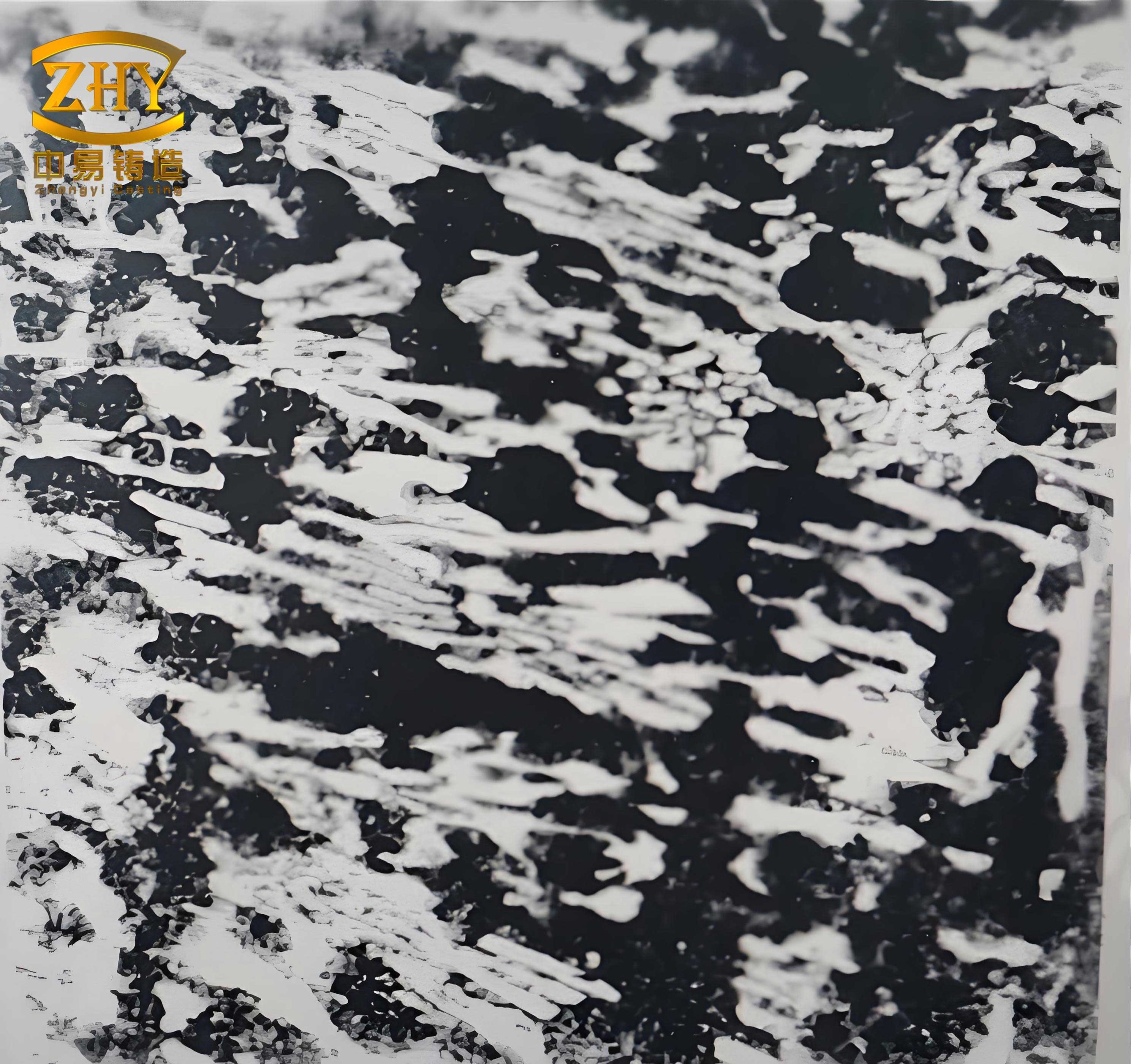
The mechanical properties before and after heat treatment are quantitatively compared in Table 2. The dramatic increase in hardness is a direct result of the martensitic transformation and secondary carbide precipitation.
| Condition | Microstructure | Macro Hardness (HRC) | Impact Toughness, $a_k$ (J/cm²) |
|---|---|---|---|
| As-Cast | Eutectic Carbides + Martensite + (Some Pearlite/Bainite) | 48 – 52 | 4 – 6 |
| Heat-Treated | Eutectic Carbides + Secondary Carbides + Martensite | 62 – 65 | 5 – 7 |
The relationship between hardness and wear resistance in white cast iron is often approximated, though simplistically, by the Archard wear law’s dependence on hardness: $$ V \propto \frac{1}{H} $$ where $V$ is wear volume and $H$ is material hardness. However, for abrasive wear, the carbide volume fraction, type, and morphology are equally critical. The secondary hardening effect from the $(Fe, Cr)_3C$ carbides can be conceptually linked to their dispersion strengthening contribution, which adds to the matrix hardness.
Casting Process and Bimetallic Solution
A significant manufacturing challenge was the need to machine threads onto the smaller diameter end of the blade for assembly. Machining the fully hardened white cast iron was impractical. Localized annealing was considered but risked compromising the hardness and wear resistance of the critical working sections. A bimetallic casting, or镶铸 (xiāng zhù), process was successfully developed. A pre-fabricated low-carbon steel sleeve was placed in the mold cavity for the blade’s small end. During pouring, the high-temperature white cast iron melt partially fused with the steel sleeve surface, creating a strong metallurgical bond at the interface, as confirmed by microstructural analysis. This allowed the steel end to be easily machined while preserving the integrity and hardness of the white cast iron working body.
Wear Performance and Industrial Validation
The abrasive wear resistance of the developed low-chromium molybdenum white cast iron was quantitatively evaluated against a commercially successful alloyed white cast iron used by a major domestic blade manufacturer. Tests were conducted on a MLS-23 wet sand rubber wheel abrasion tester under controlled conditions: 70 mesh quartz sand slurry, 100 N load, and a rubber wheel speed of 240 rpm. The relative wear resistance, $\varepsilon$, was calculated as the ratio of the weight loss of the reference material to that of the test material. The results are shown in Table 3.
| Material Code | Average Weight Loss (g) | Relative Wear Resistance, $\varepsilon$ | Notes |
|---|---|---|---|
| Developed White Cast Iron (A) | 0.181 | 1.00 (Reference) | Low-Cr-Mo White Cast Iron |
| Commercial Blade Material (B) | 0.229 | 0.79 | Alloyed White Cast Iron |
The results clearly indicate that the developed low-alloy white cast iron exhibited superior abrasion resistance under these test conditions, with a wear loss approximately 21% lower than the commercial benchmark.
Industrial field trials were conducted to validate laboratory findings under real operating conditions. The performance of blades made from the new material was compared directly with the commercial blades at different construction prefabrication plants. Service life was measured in linear meters of produced concrete slab before blade failure or excessive wear. The operational data is summarized in Table 4.
| User Site | Blade Material | Average Service Life (km of slab) | Mix Proportion (Cement:Sand:Aggregate:Water) |
|---|---|---|---|
| Site 1 | Developed Low-Cr-Mo White Cast Iron | > 12.5 | 1 : 1.5 : 3.5 : 0.4 |
| Site 1 | Commercial Alloyed White Cast Iron | 8 – 10 | |
| Site 2 | Developed Low-Cr-Mo White Cast Iron | 12.8 | 1 : 1.6 : 3.2 : 0.38 |
| Site 2 | Commercial Alloyed White Cast Iron | 9.5 |
The field data consistently showed that blades manufactured from the low-chromium molybdenum white cast iron achieved a significantly longer service life, exceeding 12,000 meters on average and reaching up to 13,500 meters, compared to the 8,000-10,000 meter range of the widely used commercial alternative. This represents a life extension of 25% or more, demonstrating a clear technical and economic advantage.
Conclusion
This study successfully developed and validated a low-chromium molybdenum white cast iron for spiral extruder blades in concrete product manufacturing. Through strategic alloy design featuring controlled chromium and molybdenum additions, rare earth inoculation for toughness improvement, and a tailored austenitization and air-quench heat treatment, a microstructure of eutectic carbides, secondary carbides, and a martensitic matrix was achieved. This structure provided an excellent combination of high hardness (62-65 HRC) and adequate toughness. The innovative bimetallic casting process solved the machining challenge for assembly without compromising the wear-resistant body of the blade.
Both laboratory abrasive wear tests and extended industrial field trials confirmed the superior performance of this white cast iron. It demonstrated approximately 21% better wear resistance in controlled tests and increased blade service life by over 25% in real-world applications compared to a leading commercial alloyed white cast iron. The significant reduction in costly alloying elements like chromium and molybdenum makes this low-chromium molybdenum white cast iron a highly cost-effective material solution, offering enhanced durability and economic benefits for the precast concrete industry. The principles of microstructural control through composition and heat treatment established here are broadly applicable to the development of other wear-resistant white cast iron components.