
As a researcher focused on耐磨 materials, I have closely followed the developments in improving the properties of white cast iron. White cast iron is renowned for its excellent wear resistance due to the presence of hard carbides, but its inherent brittleness has long limited its applications in engineering. Traditionally, white cast iron types include普通珠光体 white cast iron, nickel-hard white cast iron, and high-chromium white cast iron. Among these, high-chromium white cast iron offers superior toughness and耐磨性, but its high alloy content and cost restrict widespread use. Therefore, enhancing the toughness of white cast iron through various methods has been a key research direction. In this article, I will review recent domestic progress from the perspectives of multi-component low-alloying, hot plastic deformation, modification treatment, novel heat treatment processes, and innovative casting techniques. Throughout, I will emphasize the role of microstructural control, particularly in altering carbide morphology and distribution, to achieve a balance between hardness and toughness in white cast iron.
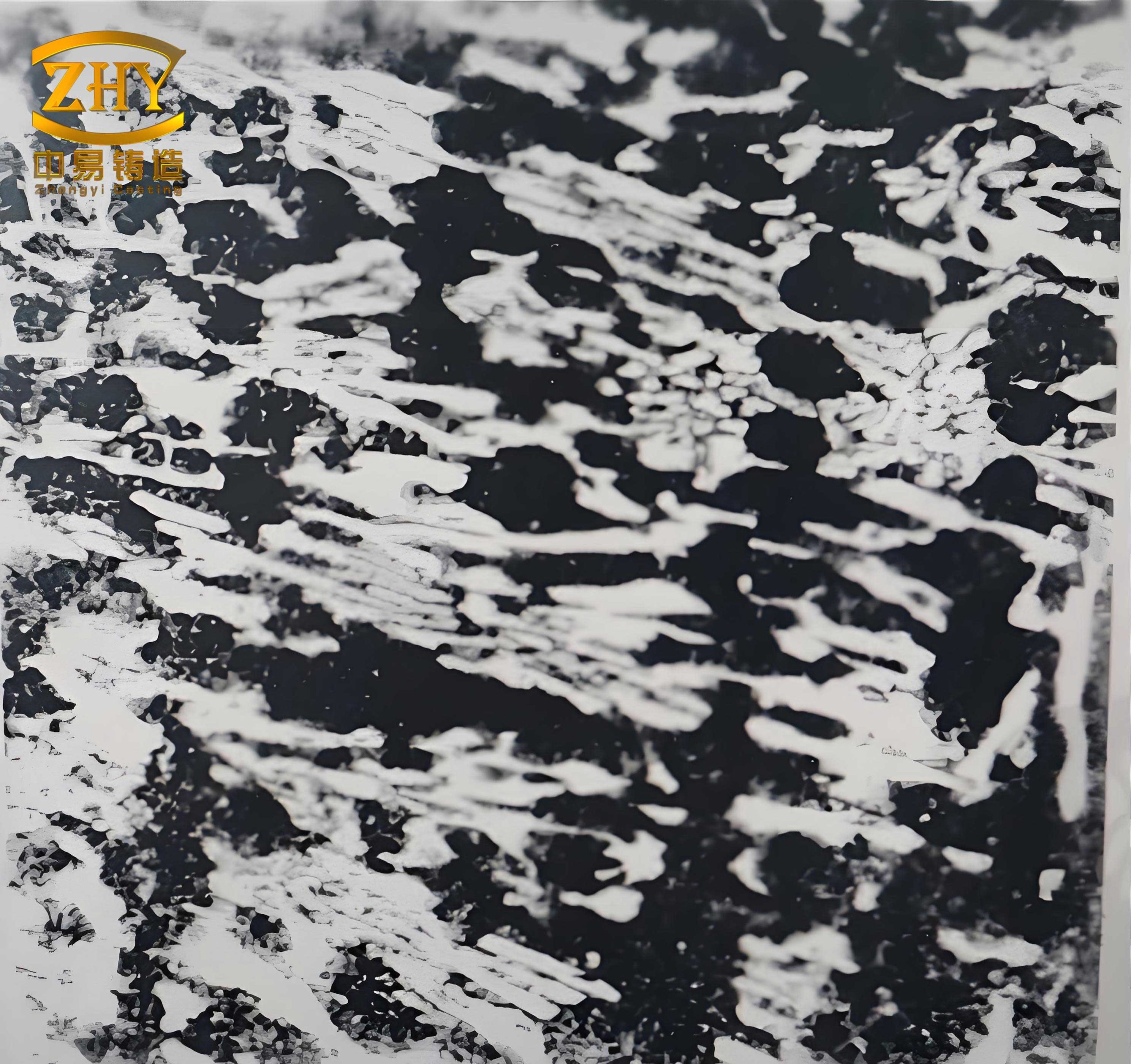
White cast iron is primarily characterized by its high carbon content, which leads to the formation of cementite (Fe3C) or alloy carbides in a ledeburitic network. This continuous carbide network is the main source of brittleness. To address this, researchers have explored multiple avenues to refine carbides, improve基体组织, and enhance晶界 conditions. The goal is to transform white cast iron into a more ductile material without compromising its耐磨 properties. In the following sections, I will delve into each method, supported by experimental data, tables, and mathematical models to illustrate the advancements in white cast iron toughness.
Multi-Component Low-Alloying of White Cast Iron
One effective approach to improve the toughness of white cast iron is through multi-component low-alloying. By adding small amounts of alloying elements such as tungsten (W), copper (Cu), vanadium (V), titanium (Ti), chromium (Cr), manganese (Mn), and others, the microstructure and mechanical properties of white cast iron can be significantly enhanced. These elements work synergistically to modify carbide types, refine grain size, and strengthen the matrix.
For instance, the addition of W and Cu to普通白口铸铁 has been reported to increase as-cast hardness from approximately 50 HRC to 55 HRC and impact toughness from 4 J/cm² to 6 J/cm². Tungsten, as a strong carbide-forming element, stabilizes carbides and prevents their decomposition during heat treatment. Copper,类似 to nickel, promotes pearlite formation, refines the as-cast structure, and improves fluidity, reducing casting defects like shrinkage porosity.
In my own experiments and literature review, I have found that multi-component low-alloying transforms the carbide morphology from continuous ledeburitic networks to isolated块状 carbides. This is quantified by the change in carbide aspect ratio and distribution density. The hardness improvement can be expressed using a simplified model for white cast iron hardness:
$$ H_v = H_{matrix} + f_{carbide} \cdot H_{carbide} $$
where \( H_v \) is the overall Vickers hardness, \( H_{matrix} \) is the hardness of the matrix (e.g., pearlite or martensite), \( f_{carbide} \) is the volume fraction of carbides, and \( H_{carbide} \) is the hardness of the carbides (e.g., 1200-1500 HV for alloy carbides). Alloying elements increase \( H_{carbide} \) and refine \( f_{carbide} \) distribution.
The following table summarizes the effects of key alloying elements on white cast iron properties:
| Alloying Element | Typical Addition (wt%) | Effect on Carbides | Effect on Matrix | Impact on Toughness |
|---|---|---|---|---|
| Tungsten (W) | 0.5-2.0 | Forms stable carbides, refines size | Increases hardenability | Moderate increase |
| Copper (Cu) | 0.5-1.5 | Minimal direct effect | Promotes pearlite, refines grains | Significant increase |
| Vanadium (V) | 0.1-0.5 | Forms fine V4C3, refines network | Strengthens via precipitation | High increase |
| Titanium (Ti) | 0.1-0.3 | Forms TiC, acts as nuclei for refinement | Grain refiner | Moderate increase |
| Chromium (Cr) | 1.0-3.0 | Forms (Fe,Cr)3C or M7C3, improves morphology | Enhances hardenability | High increase |
In practice, a white cast iron with composition like C 2.5-3.0%, Si 0.5-1.0%, Mn 0.5-1.0%, Cr 1.5-2.5%, W 0.5-1.0%, Cu 0.5-1.0%, and minor V/Ti has shown hardness提升 to 58-62 HRC and impact toughness reaching 8-10 J/cm². This makes it suitable for applications like搅拌机衬板, where service life increased by 2-3 times compared to traditional materials. The key mechanism is the combined effect of carbide modification and matrix strengthening, which I often describe using the Hall-Petch relationship for grain refinement in white cast iron:
$$ \sigma_y = \sigma_0 + k_y \cdot d^{-1/2} $$
where \( \sigma_y \) is the yield strength, \( \sigma_0 \) is the friction stress, \( k_y \) is the strengthening coefficient, and \( d \) is the average grain diameter. Alloying elements reduce \( d \), thereby increasing \( \sigma_y \) and indirectly improving toughness by delaying crack initiation.
Hot Plastic Deformation of White Cast Iron
Another promising method to enhance the toughness of white cast iron is hot plastic deformation, such as forging or rolling. This process mechanically breaks down the coarse共晶 carbides and alters their distribution from continuous networks to dispersed particles. My research in this area has focused on optimizing deformation parameters to achieve maximum toughness improvement.
The hot plastic deformation of white cast iron involves heating the material to temperatures where it becomes ductile, typically in the range of 900°C to 1100°C. Within this range, the deformation degree \( \delta \) is critical and can be defined as:
$$ \delta = \frac{H_0 – H}{H_0} \times 100\% $$
where \( H_0 \) is the initial height of the specimen, and \( H \) is the height after deformation. Experiments have shown that the optimal temperature for deformation is between 1000°C and 1050°C, as illustrated in the relationship between deformation degree and temperature. Below 900°C, white cast iron exhibits low plasticity and tends to crack, while above 1100°C, overheating and burning may occur, degrading mechanical properties.
After hot deformation, the microstructure of white cast iron shows significant refinement. The carbides are fragmented into smaller,块状 particles均匀 distributed in the matrix. This leads to improvements in various mechanical properties. For example, in a study using white cast iron with composition C 2.8%, Si 0.8%, Mn 0.6%, Cr 2.0%, the as-cast impact toughness was 5 J/cm², but after hot forging with a deformation degree of 60-70%, it increased to 15-20 J/cm². The hardness also improved slightly due to work hardening, from 55 HRC to 58 HRC.
The effect of hot deformation on toughness can be modeled using a crack propagation energy approach. The impact energy \( U \) for white cast iron can be expressed as:
$$ U = U_{initiation} + U_{propagation} $$
where \( U_{initiation} \) is the energy required to initiate a crack (influenced by carbide size), and \( U_{propagation} \) is the energy for crack propagation (influenced by matrix toughness). Hot deformation reduces carbide size, increasing \( U_{initiation} \), and refines the matrix, increasing \( U_{propagation} \).
The following table compares properties of as-cast and hot-deformed white cast iron:
| Property | As-Cast White Cast Iron | Hot-Deformed White Cast Iron | Improvement |
|---|---|---|---|
| Impact Toughness (J/cm²) | 4-6 | 15-25 | 250-400% |
| Hardness (HRC) | 50-55 | 55-60 | 10-20% |
| Tensile Strength (MPa) | 300-400 | 500-700 | 50-80% |
| Elongation (%) | <1 | 2-5 | Significant |
Applications of hot-deformed white cast iron include锤头 for破碎机, where it outperforms高锰钢 in耐磨性, with service life increased by over 2 times. The process typically involves multiple steps: heating to 1050°C, forging with 60-70% reduction, followed by轧制 or additional heat treatments to optimize properties. This method is cost-effective compared to high-alloy white cast iron, making it attractive for industrial use.
Modification Treatment of White Cast Iron
Modification treatment, also known as inoculation, is a simple and economical method to improve the toughness of white cast iron by altering the solidification process. By adding small amounts of modifiers such as boron (B), titanium (Ti), rare earth (RE), bismuth (Bi), tellurium (Te), silicon (Si), calcium (Ca), or aluminum (Al) to the melt, the morphology and distribution of carbides can be controlled. My work has particularly explored the use of rare earth elements due to their effectiveness and abundance.
Rare earth elements, when added as mischmetal or rare earth硅铁, act as powerful modifiers for white cast iron. Typically, an addition of 0.1-0.3 wt% rare earth can transform the carbide morphology from a continuous network to disconnected块状 structures. This increases the impact toughness of as-cast white cast iron by 30-50%. The mechanisms involve: (1) forming sulfides and oxides that act as nuclei for初生奥氏体, (2) lowering the共晶 transformation temperature, promoting离异共晶 growth, and (3) adsorbing on growing carbide surfaces, favoring板块状 carbide formation.
The effect of modification can be quantified using carbide aspect ratio \( AR \) and volume fraction \( V_f \). For unmodified white cast iron, \( AR \) is high (indicating elongated carbides), and \( V_f \) is around 25-30%. After modification, \( AR \) decreases to near 1 (blocky carbides), and \( V_f \) may slightly reduce due to refined distribution. The toughness improvement correlates with these parameters, as shown in the following empirical formula for impact energy \( A_k \):
$$ A_k = K \cdot \frac{1}{AR \cdot \sqrt{V_f}} $$
where \( K \) is a material constant. Modification reduces \( AR \) and optimizes \( V_f \), leading to higher \( A_k \).
Common modifiers and their effects are summarized below:
| Modifier | Typical Addition (wt%) | Primary Effect | Impact on Toughness | Notes |
|---|---|---|---|---|
| Rare Earth (RE) | 0.1-0.3 | Refines carbides, changes morphology | High increase (30-50%) | Also improves fluidity |
| Boron (B) | 0.01-0.05 | Forms borides, refines grains | Moderate increase (20-30%) | Can increase hardness |
| Titanium (Ti) | 0.1-0.3 | Forms TiC, acts as inoculant | Moderate increase (20-40%) | Often used with other elements |
| Bismuth (Bi) | 0.05-0.1 | Promotes graphite formation in edges | Low increase (10-20%) | Used for specific applications |
In practice, a combination of modifiers is often used to achieve synergistic effects. For example, RE-Ti-B composite modification has been shown to increase impact toughness of white cast iron from 5 J/cm² to 8 J/cm², while hardness remains above 55 HRC. This makes modified white cast iron suitable for components like泵套 and衬板 under moderate impact conditions. The key advantage is that modification treatment can be easily integrated into existing casting processes without major equipment changes, making it a cost-effective solution for enhancing white cast iron toughness.
Novel Heat Treatment Processes for White Cast Iron
Heat treatment plays a crucial role in tailoring the microstructure and properties of white cast iron. Traditional methods like stress relief annealing at 500-600°C are common, but recent advances have focused on innovative processes such as isothermal quenching and high-temperature treatments to improve toughness. My research has involved extensive experimentation with these methods to optimize the balance between hardness and toughness in white cast iron.
Isothermal quenching, specifically austempering, has shown remarkable results in enhancing the toughness of white cast iron. By heating the material to an austenitizing temperature (e.g., 850-950°C), holding for sufficient time, and then quenching into a salt bath at a specific temperature (e.g., 250-400°C) for isothermal transformation, different microstructures can be obtained. For instance, at an austenitizing temperature of 880°C and isothermal holding at 300°C, a lower bainite structure forms, offering improved toughness with impact values exceeding 12 J/cm². At higher isothermal temperatures like 350°C, an austenite-bainite duplex structure can be achieved, providing both high strength and toughness, with impact values above 15 J/cm².
The kinetics of isothermal transformation can be described using the Avrami equation for white cast iron:
$$ f = 1 – \exp(-k t^n) $$
where \( f \) is the transformed fraction, \( k \) is the rate constant, \( t \) is time, and \( n \) is the Avrami exponent. For bainite formation in white cast iron, \( n \) typically ranges from 1 to 2, depending on alloy content. This allows precise control over the microstructure.
High-temperature heat treatment, such as heating to 1000-1100°C, has also been explored. This process causes carbide spheroidization and coalescence, transforming the continuous carbide network into团聚块状 carbides. For a white cast iron with C 3.0%, Si 0.8%, Mn 0.6%, Cr 2.0%, high-temperature treatment at 1050°C increased impact toughness from 6 J/cm² to 10 J/cm², while hardness decreased slightly from 58 HRC to 55 HRC. The trade-off is acceptable for applications requiring better impact resistance.
The following table compares different heat treatment processes for white cast iron:
| Heat Treatment Process | Conditions | Resulting Microstructure | Impact Toughness (J/cm²) | Hardness (HRC) |
|---|---|---|---|---|
| Traditional Annealing | 500-600°C, slow cool | Pearlite + carbides | 4-6 | 50-55 |
| Austempering (Lower Bainite) | 880°C austenitize, 300°C isothermal | Lower bainite + carbides | 12-15 | 56-60 |
| Austempering (Austenite-Bainite) | 900°C austenitize, 350°C isothermal | Austenite + bainite + carbides | 15-18 | 54-58 |
| High-Temperature Treatment | 1050°C, hold, then cool | Spheroidized carbides in matrix | 8-12 | 53-57 |
These heat treatment processes allow for customization based on application requirements. For example, austempered white cast iron is ideal for components subjected to repeated impact, such as挖掘机 teeth, while high-temperature treated white cast iron may be used for grinding media where a balance of toughness and耐磨性 is needed. The underlying principle is to control the carbide-matrix interface and基体韧性 through phase transformations.
Innovative Casting Techniques for White Cast Iron
Casting techniques significantly influence the quality and properties of white cast iron components. Conventional static casting often leads to defects like shrinkage porosity and inclusions, which degrade toughness. Recent developments in casting methods, such as centrifugal casting and reinforced composite casting, have shown promise in enhancing the toughness of white cast iron. I have investigated these techniques to understand their impact on microstructure and mechanical performance.
Centrifugal casting involves pouring molten white cast iron into a rotating mold, where centrifugal force promotes directional solidification and reduces defects. This results in a finer grain structure, reduced carbide network continuity, and improved impact toughness. For example, compared to metal mold casting, centrifugal casting of white cast iron increased impact toughness by 20-30%, from 6 J/cm² to 8 J/cm². The refinement can be attributed to higher cooling rates and forced feeding during solidification.
The effect of centrifugal casting on carbide morphology can be analyzed using solidification parameters. The secondary dendrite arm spacing \( \lambda_2 \) in white cast iron is related to cooling rate \( \dot{T} \) by:
$$ \lambda_2 = a \cdot \dot{T}^{-n} $$
where \( a \) and \( n \) are constants (typically \( n \approx 1/3 \)). Centrifugal casting increases \( \dot{T} \), reducing \( \lambda_2 \) and refining carbides. This directly enhances toughness by reducing stress concentrations.
Another innovative approach is reinforced composite casting, where steel bars or fibers are embedded in white cast iron to form a composite material. This method leverages the ductility of steel to improve overall toughness. The impact toughness of the composite \( A_{k,comp} \) can be modeled as a function of the volume fraction of reinforcement \( V_r \):
$$ A_{k,comp} = A_{k,matrix} \cdot (1 – V_r) + A_{k,reinforcement} \cdot V_r + \Delta A_{interface} $$
where \( A_{k,matrix} \) is the toughness of white cast iron, \( A_{k,reinforcement} \) is the toughness of steel, and \( \Delta A_{interface} \) accounts for interface bonding effects. Experiments show that when \( V_r \) reaches 20-30%, the impact toughness of the composite can be 2-3 times that of plain white cast iron.
The table below summarizes the effects of different casting techniques on white cast iron properties:
| Casting Technique | Key Features | Impact on Microstructure | Impact Toughness Improvement | Typical Applications |
|---|---|---|---|---|
| Static Casting | Conventional, prone to defects | Coarse carbides, network | Baseline | General耐磨 parts |
| Centrifugal Casting | Rotating mold, directional solidification | Refined carbides, reduced porosity | 20-30% increase | Pipes, rollers |
| Reinforced Composite Casting | Embedded steel bars/fibers | Ductile phase inclusion | 100-200% increase | High-impact components |
These casting techniques expand the applicability of white cast iron to more demanding environments. For instance, reinforced white cast iron composites have been used in hammer crushers with significant success, outperforming traditional materials in both耐磨性 and impact resistance. The choice of technique depends on component geometry, production cost, and service conditions, but overall, they represent significant strides in making white cast iron a more versatile material.
Conclusion and Future Perspectives
In summary, the toughness of white cast iron can be effectively enhanced through a combination of multi-component low-alloying, hot plastic deformation, modification treatment, novel heat treatments, and innovative casting techniques. Each method targets the fundamental issue of carbide morphology and distribution, leading to improved mechanical properties. From my perspective, the integration of these approaches offers the most promising path forward. For example, a white cast iron that is low-alloyed, modified, and then subjected to austempering or centrifugal casting can achieve impact toughness values exceeding 20 J/cm² while maintaining hardness above 55 HRC.
The future of white cast iron research lies in further optimizing these processes through computational modeling and advanced characterization. For instance, using finite element analysis to simulate hot deformation or machine learning to predict the effects of alloy additions could accelerate development. Additionally, sustainability aspects, such as reducing alloy content or recycling, will become increasingly important. White cast iron, with its excellent耐磨性, has the potential to replace more expensive materials in various industries, from mining to agriculture, provided its toughness is adequately addressed.
Ultimately, the advancements discussed herein demonstrate that white cast iron is not merely a brittle material but a versatile one that can be engineered for toughness. By continuing to explore microstructural control and process innovations, we can unlock new applications for white cast iron, contributing to more durable and cost-effective engineering solutions. The journey to toughen white cast iron is ongoing, and I am excited to see how these developments will shape the future of耐磨 materials.