
The quest for enhanced performance in metallic materials has long driven the exploration of combined processing techniques. Among these, the integration of plastic deformation with thermal cycles, often termed thermomechanical treatment, represents a powerful methodology to synergistically harness the strengthening mechanisms of both work hardening and phase transformation. While extensively researched and applied in steels since the mid-20th century, the application of such principles to white cast iron—a material renowned for its exceptional wear resistance but notoriously limited by brittleness—opens a promising avenue for developing a new class of high-performance wear-resistant materials. This article, from my research perspective, delves into the fundamental aspects of applying deformation and subsequent heat treatment to white cast iron. It explores the material’s hot workability, the consequent microstructural evolution, and the resulting improvements in mechanical and tribological properties, thereby establishing a foundational understanding for this advanced processing route.
The inherent brittleness of white cast iron, stemming from its continuous network of hard, brittle carbides (primarily cementite, Fe3C) in a metallic matrix, has historically restricted its applications despite its superior hardness. Traditional approaches to mitigate this have involved either heat treatment to modify the carbide morphology or, more rarely, hot working to physically break the carbide network. My research builds upon these concepts by systematically investigating a sequential process of hot deformation followed by controlled heat treatment. The core hypothesis is that deformation not only fragments the carbide network but also introduces defects in the austenitic matrix that can influence subsequent transformation kinetics and precipitate dispersion, leading to superior toughness and strength without compromising the essential wear characteristics of white cast iron.
A critical first step in any thermomechanical process is assessing the material’s formability at elevated temperatures. For white cast iron, this is not a trivial consideration given its brittle nature at room temperature. Therefore, I conducted hot plasticity tests on two grades of white cast iron with differing carbon contents. The goal was to determine the Critical Deformation Rate (CDR)—the maximum strain achievable before crack initiation—as a function of temperature. This parameter fundamentally defines the processing window for hot working this material. The tests were performed using a laboratory-scale rolling mill, with samples heated to various temperatures within the austenitizing range.
The critical deformation degree (\(\varepsilon_c\)) was calculated using the formula for thickness reduction in rolling:
$$\varepsilon_c = \frac{t_0 – t_f}{t_0} \times 100\%$$
where \(t_0\) is the initial thickness and \(t_f\) is the final thickness after rolling.
The results, summarized in the table below, reveal a strong dependence of hot plasticity on both temperature and carbon content.
| Material (Approx. C%) | Deformation Temperature (°C) | Critical Deformation Rate, \(\varepsilon_c\) (%) |
|---|---|---|
| ~2.2% C | 850 | ~15 |
| 900 | ~22 | |
| 950 | ~30 | |
| 1000 | ~38 | |
| 1050 | ~45 | |
| 1100 | ~48 | |
| ~3.6% C | 850 | < 10 |
| 900 | ~12 | |
| 950 | ~20 | |
| 1000 | ~35 | |
| 1050 | ~45 | |
| 1100 | ~47 |
The lower-carbon white cast iron exhibits appreciable plasticity even at lower temperatures, increasing gradually. In contrast, the high-carbon variant shows low initial plasticity but a very steep increase above 950°C, nearly matching the lower-carbon material by 1100°C. This behavior is intrinsically linked to microstructure. The high-carbon white cast iron contains a larger volume fraction of the ledeburitic (carbide-austenite eutectic) network. At lower temperatures, despite some dissolution, this network remains largely continuous, severely limiting ductility. As the temperature increases, carbon solubility in austenite rises significantly, allowing more complete dissolution and “breaking” of the network, thereby rapidly improving hot workability. It is also crucial to note that the stress state during deformation significantly impacts the CDR. The triaxial compressive stress state in rolling is far more favorable for deforming white cast iron compared to the tensile stress components present in free forging, explaining why reported forgeability limits are considerably lower than the rolling CDRs presented here.
Following the establishment of processing windows, I implemented a rolling deformation process followed by an isothermal heat treatment (austempering) on a hypoeutectic white cast iron. The focus was to characterize the microstructural transformation induced by the thermomechanical cycle. The changes in carbide morphology were profound and directly correlated with the applied deformation ratio.
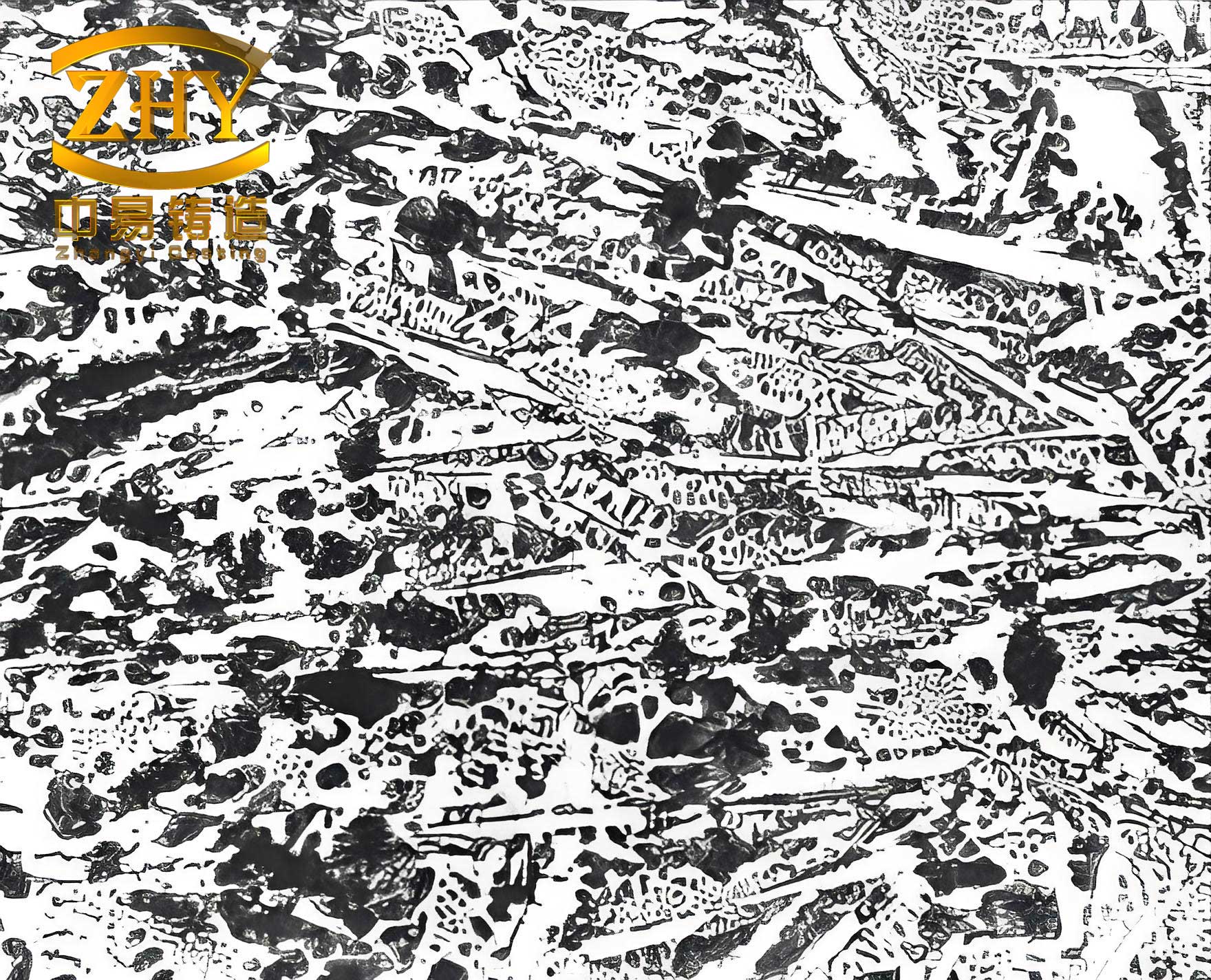
At low deformation ratios (e.g., below 30%), the ledeburitic network is merely elongated, retaining its interconnected nature. A critical threshold exists—around 40% reduction in this study—beyond which the carbide network is effectively fractured. At higher strains (e.g., 60-70%), the carbides are completely fragmented into isolated, blocky particles aligned in the rolling direction. This transition occurs because cementite, although softened at high temperatures, possesses a crystalline structure with high coordination numbers that offers limited plasticity. Beyond a certain strain, it cannot keep pace with the more ductile austenite matrix and undergoes brittle fracture under tensile stresses. The fragmented carbides are then carried and aligned by the flowing matrix.
Simultaneously, the deformation of the austenitic matrix has two other significant effects. First, it introduces a high density of dislocations and other lattice defects. Second, it thermodynamically shifts the phase boundaries, reducing carbon solubility in austenite. These two factors synergistically promote the precipitation of fine, secondary carbides. The dislocation structures act as potent nucleation sites, leading to a uniform dispersion of carbides within the austenite grains. This precipitation is a direct consequence of the deformation and is a key strengthening mechanism. Furthermore, during any intermediate heating or holding stages, spheroidization and rounding of the fractured primary carbides occur, further contributing to a less stress-concentrating microstructure.
The final matrix structure after deformation and isothermal quenching also shows distinct features. Rather than exhibiting classical lath or feathery bainite morphology, the structure consists of sheaves of curved, spear-like plates. This suggests that the deformation-induced defects and stress fields disrupt the typical coherent growth interface between the bainitic ferrite and the parent austenite, altering the transformation mechanism—a rich area for further in-depth study on the kinetics of phase transformation in deformed white cast iron.
The ultimate validation of any processing route lies in the measurable improvement of properties. The mechanical performance of the deformed and heat-treated white cast iron was evaluated through bend tests, impact tests, and hardness measurements. The correlation with deformation ratio is striking and aligns perfectly with the observed microstructural changes.
| Deformation Ratio (%) | Transverse Rupture Strength (MPa) | Deflection (mm) | Impact Toughness (J/cm²) | Macro Hardness (HRC) |
|---|---|---|---|---|
| 0 (As-cast reference) | ~400 | ~1.0 | ~3.0 | ~52 |
| 20 | ~520 | ~1.4 | ~4.0 | ~55 |
| 40 | ~750 | ~2.0 | ~6.5 | ~56 |
| 60 | ~980 | ~2.8 | ~9.0 | ~57 |
| 70 | ~950 | ~2.6 | ~8.5 | ~56 |
The data reveals that a deformation ratio of around 60% yields the optimal combination of strength and toughness: a transverse rupture strength approaching 1 GPa, a deflection nearly three times that of the as-cast material, and an impact toughness tripled. It is critical to note that improvements below 40% are modest. The property enhancement curve exhibits an “S” shape, with a sharp rise coinciding with the microstructural threshold where the carbide network is completely fractured (beyond 40%). This underscores that the key mechanisms—network fragmentation, strain-induced precipitation, substructure formation (dislocation cell structures), and grain refinement—become fully operative only after sufficient deformation. The matrix strengthening from the refined substructure and grain size plays a dominant role. The consistent hardness values indicate that the overall volume fraction of hard phases remains similar; the dramatic improvement in toughness and strength is thus primarily due to the morphological and distributional changes of the carbides and the refined, strengthened matrix.
For white cast iron, wear resistance is the paramount functional property. The processed materials were subjected to abrasive wear tests against standard samples, with relative wear resistance (\(\varepsilon\)) calculated as:
$$\varepsilon = \frac{\text{Weight loss of standard sample}}{\text{Weight loss of test sample}}$$
| Deformation Ratio (%) | Relative to As-Cast White Iron | Relative to 0.45% C Steel | Relative to High Manganese Steel |
|---|---|---|---|
| 20 | 1.15 | 2.30 | 1.05 |
| 40 | 1.25 | 2.50 | 1.12 |
| 60 | 1.35 | 2.70 | 1.18 | 70 | 1.38 | 2.76 | 1.20 |
The results are significant. The thermomechanically processed white cast iron outperformed all standards, including the as-cast white iron (by 15-38%) and even high manganese steel under these test conditions. Crucially, wear resistance increased monotonically with deformation ratio, mirroring the trends in toughness and strength, while hardness remained nearly constant. This provides compelling evidence that for abrasive wear, the optimal material performance is not dictated by hardness alone but by an appropriate combination of hardness and toughness. The fragmentation of the brittle carbide network prevents large-scale spalling, while the toughened matrix better supports the hard phases, leading to more sustained wear resistance. This principle is central to designing advanced white cast iron grades for demanding applications.
In conclusion, this investigation demonstrates that hypoeutectic white cast iron possesses sufficient hot plasticity within the austenitizing range to undergo significant deformation processing, such as rolling. The deformation behavior is highly sensitive to carbon content, temperature, and stress state. A thermomechanical treatment comprising substantial hot deformation (around 60% reduction) followed by isothermal quenching can dramatically enhance the comprehensive mechanical properties of white cast iron, achieving a unique combination of high strength (≈980 MPa TRS), good toughness (≈9 J/cm² impact), and elevated hardness (≈57 HRC). The enhancement follows a threshold behavior, becoming pronounced only after the continuous carbide network is thoroughly broken. The underlying strengthening-toughening mechanisms are multifaceted, involving fragmentation and spheroidization of primary carbides, strain-induced precipitation of secondary carbides, and most importantly, the formation of a refined and work-hardened matrix substructure. Consequently, the wear resistance is significantly improved, proving that the synergy of deformation and heat treatment is a highly effective strategy to unleash the latent potential of white cast iron, transcending its traditional brittleness limitation and paving the way for its use in more severe and impactful engineering applications.