
The relentless pursuit of lightweighting and component integration within the aerospace and automotive industries has positioned high-strength cast aluminum alloys at the forefront of advanced materials engineering. My extensive work in this field has solidified the understanding that the exceptional performance of these alloys is not inherent to their nominal composition alone. It is, in fact, the direct and synergistic consequence of meticulously controlled casting processes coupled with precisely engineered heat treatment cycles. This article synthesizes my experience and research, aiming to provide a comprehensive technical discourse on the integrated manufacturing of high-strength aluminum alloy castings. I will delve into the intricacies of foundry practices, the scientific principles governing heat treatment, and the critical interplay between them, with particular emphasis on identifying, understanding, and mitigating pervasive heat treatment defects.
1. An Overview of High-Strength Cast Aluminum Alloys
Cast aluminum alloys are distinguished from their wrought counterparts by their chemical composition and, more fundamentally, by their manufacturing route, which involves directly shaping the component via pouring molten metal into a mold. High-strength variants within this family are engineered to deliver an optimal balance of low density, excellent specific strength, good castability, and satisfactory corrosion resistance. This unique combination has cemented their role in critical applications across naval, military, and aerospace sectors.
The alloy systems are typically categorized based on their principal alloying elements, each imparting distinct characteristics:
| Alloy System | Key Characteristics | Typical Applications & Notes |
|---|---|---|
| Al-Si (e.g., A356, A357) | Excellent castability, good fluidity, moderate strength, good corrosion resistance and weldability. | Complex, thin-walled housings, structural components. Strength can be significantly enhanced via modification and heat treatment. |
| Al-Cu (e.g., 206, A201, ZL205A) | High strength potential, good elevated temperature performance, good machinability. Prone to hot tearing and microsegregation. | Highly loaded structural members. Some variants, like ZL205A, can achieve tensile strengths exceeding 500 MPa. |
| Al-Mg (e.g., 535, 508) | Excellent corrosion resistance, good combination of strength and ductility, good machinability. Can be challenging to cast. | Marine components, decorative fittings, applications requiring high toughness. |
| Al-Zn (e.g., 700 series) | Very high as-cast strength, good machinability. Generally poor castability and corrosion resistance. | Applications are less common due to limitations; often used for prototype tooling. |
| Al-RE (Rare Earth) | Low thermal expansion, good high-temperature stability, excellent pressure tightness. | Emerging alloy system for components operating under thermal cycling conditions. |
The foundation for achieving high performance begins with melt quality. Advanced purification techniques, such as rotary degassing with argon or nitrogen and flux refinement, are essential to reduce hydrogen content and non-metallic inclusions. The dissolved hydrogen, if not removed, leads to porosity, a critical defect that severely undermines mechanical properties and fatigue life. The governing relationship for hydrogen solubility is given by Sieverts’ Law:
$$ S = k \sqrt{p_{H_2}} $$
where \(S\) is the solubility of hydrogen in the melt, \(k\) is a temperature-dependent constant, and \(p_{H_2}\) is the partial pressure of hydrogen above the melt. This underscores why maintaining a dry, controlled atmosphere during melting and handling is paramount to prevent re-gassing.
2. Foundry Processes for High-Strength Alloys
The choice of casting process is dictated by the component’s geometry, required dimensional accuracy, production volume, and, most importantly, the desired integrity of the final microstructure. The process directly influences grain size, dendritic arm spacing (DAS), and the distribution of secondary phases and porosity—all precursors to the final, heat-treated properties.
| Casting Process | Principle & Capabilities | Impact on Microstructure & Typical Defects |
|---|---|---|
| Sand Casting | Utilizes bonded silica sand molds. Suitable for very large parts (>2m). Lower dimensional accuracy (CT8-9). | Relatively slow cooling leads to coarse DAS. Potential for sand inclusions and gas-related porosity from binder decomposition. |
| Permanent Mold (Gravity Die) | Uses reusable metal molds. Good for high-volume, simpler shapes. | Faster cooling than sand yields finer DAS, improved strength. Risk of cold shuts if gating is poor. Thermal fatigue of the die. |
| Investment (Lost-Wax) Casting | Ceramic shell built around a wax pattern. Excellent for complex, near-net-shape components with fine detail. | Moderate cooling rate. Can achieve excellent surface finish (Ra ≤ 6.3 µm) and thin walls. Shell mould reactions and microporosity are concerns. |
| Low-Pressure Die Casting (LPDC) | Molten metal is pushed upward into a metal die by low-pressure gas. High yield, good mechanical properties. | Controlled, turbulent-free filling reduces oxide entrapment. Fine, uniform microstructure. Excellent for complex, thin-walled parts like automotive frames. |
For large, complex thin-wall castings, the thermal dynamics during filling and solidification are critical. The fluidity of the alloy, a function of composition and superheat, must be sufficient to fill the mold completely before freezing begins. The famous fluidity length model can be conceptually simplified as:
$$ L_f \propto \frac{\Delta T_{superheat} + \Delta H_f / C_p}{K \cdot \sqrt{t_f}} $$
where \(L_f\) is the fluidity length, \(\Delta T_{superheat}\) is the pouring superheat, \(\Delta H_f\) is the latent heat of fusion, \(C_p\) is the specific heat, \(K\) is a constant related to mold properties, and \(t_f\) is the local freezing time. Inadequate fluidity leads to misruns or cold shuts. Conversely, excessive turbulence during filling entraps oxides and air, creating initiators for fatigue failure. This is why processes like LPDC and well-designed gating systems in investment casting are favored for high-integrity components.
3. The Science and Practice of Heat Treatment
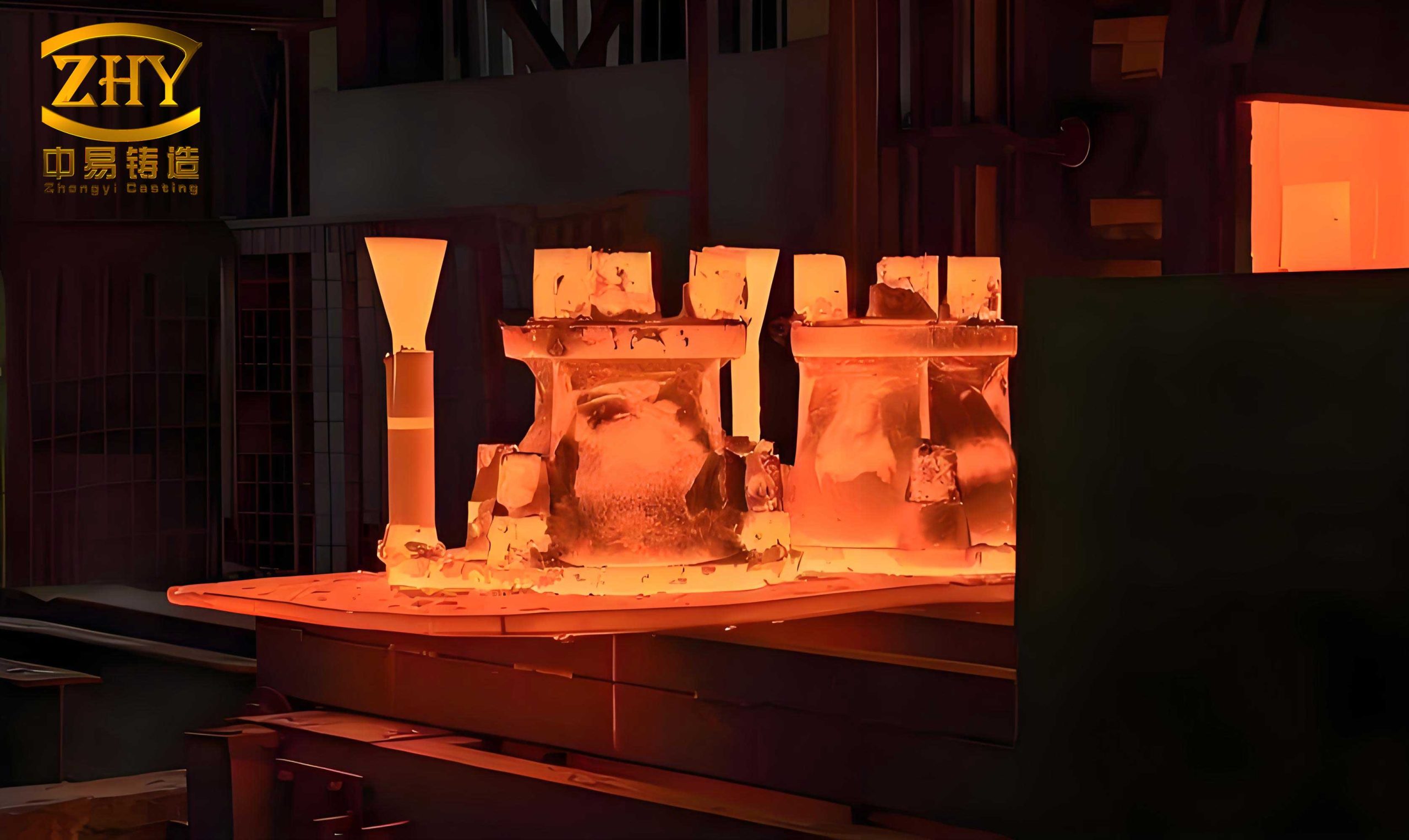
Heat treatment is the transformative step that unlocks the full strength potential of cast aluminum alloys. It is a sequence of precisely controlled thermal processes designed to manipulate the microstructure for optimal properties. The standard temper designations (e.g., T5, T6, T7) define the sequence, but the specific parameters (time, temperature, quenching medium) are tailored to the alloy and casting geometry.
3.1 The Core Stages:
- Solution Treatment (Homogenization): The casting is heated to a temperature just below the eutectic melting point (typically 480°C – 540°C, depending on alloy) and held for an extended period (2 to 20 hours). The objective is to dissolve soluble secondary phases (like Mg₂Si in Al-Si-Mg alloys or Al₂Cu in Al-Cu alloys) into the aluminum matrix to form a supersaturated solid solution (SSSS). This stage also helps homogenize microsegregation from casting.
- Quenching: Following solution treatment, the component is rapidly cooled (quenched) to room temperature. The goal is to “freeze-in” the SSSSS and prevent the coarse, equilibrium phases from precipitating. The quench must be rapid enough to achieve this but controlled enough to minimize residual stresses and distortion. Common media include water (at various temperatures), polymer solutions, and forced air.
- Aging (Precipitation Hardening): The quenched, metastable structure is then heated to an intermediate temperature (100°C – 200°C) for a specified time. This allows finely dispersed metastable precipitates to form uniformly throughout the matrix. These precipitates impede dislocation movement, dramatically increasing strength and hardness. Aging can be natural (at room temperature, T4) or artificial (at elevated temperature, T5-T9).
The precipitation sequence for a common Al-Si-Mg alloy like A356 typically follows:
$$ SSSS \rightarrow GP Zones \rightarrow \beta” \rightarrow \beta’ \rightarrow \beta (Mg_2Si) $$
The peak strength (T6 condition) is usually associated with a high density of coherent or semi-coherent metastable precipitates like \(\beta”\). Over-aging (T7) coarsens these precipitates, slightly reducing strength but improving dimensional stability and, in some alloys, corrosion resistance.
3.2 Critical Heat Treatment Parameters in a Standard T6 Cycle:
| Parameter | Typical Range | Technical Rationale & Risks |
|---|---|---|
| Solution Temperature | ±5°C of target (e.g., 540°C for A201) | Too low: incomplete dissolution of phases. Too high: incipient melting of eutectics, a catastrophic heat treatment defect. |
| Solution Time | 2 to 20 hours | Function of casting thickness and dendrite arm spacing (DAS). Insufficient time leads to undissolved particles; excessive time promotes grain growth. |
| Quench Delay | < 15 seconds | Maximizes supersaturation. Delays allow coarse precipitation during slow cooling in air, severely reducing strengthening potential (a key heat treatment defect). |
| Quench Medium Temp. | Water: 20-80°C; Polymer: as specified | Controls cooling rate (CR). High CR maximizes properties but increases residual stress/distortion. Low CR minimizes stress but risks property loss. |
| Aging Temperature | ±3°C of target (e.g., 155°C for A356-T6) | Tight control is vital. A 10°C variation can significantly shift peak aging time and final mechanical properties. |
| Aging Time | 2 to 24 hours | Determines precipitate size/coherency. Under-aging gives lower strength; over-aging reduces strength and hardness. |
4. Analysis of Manufacturing Challenges and Associated Defects
The production of high-integrity, large, and complex castings presents multifaceted challenges that often manifest as defects, many of which are exacerbated or revealed during heat treatment.
4.1 Foundry-Centric Challenges:
- Filling and Thermal Gradients in Large Castings: Long fill times increase oxide formation. Varied section thicknesses create drastic differences in local solidification time (\(t_f\)), governed by Chvorinov’s Rule: \(t_f = B \cdot (V/A)^n\), where \(V\) is volume, \(A\) is cooling surface area, and \(B\) and \(n\) are constants. This leads to heterogeneous microstructure (e.g., coarse DAS in thick sections vs. fine in thin walls), causing inconsistent mechanical properties post-heat treatment.
- Porosity: The arch-nemesis of castings. It acts as a stress concentrator, drastically reducing fatigue life and ductility. During heat treatment, internal pressure from trapped gas can expand pores, worsening the defect. Hydrogen porosity is particularly pernicious.
4.2 Heat Treatment-Centric Challenges and Defects:
The following table categorizes common heat treatment defects, their root causes, and consequences.
| Defect | Primary Cause | Consequence on Component | Preventive/Corrective Measures |
|---|---|---|---|
| Incipient Melting (Burning) | Solution temperature exceeding the solidus of a low-melting-point eutectic phase. | Formation of liquid films at grain boundaries, catastrophic loss of strength and ductility. Irreversible. | Precise furnace calibration, use of protective atmosphere, careful temperature ramp-up. |
| Quench Cracking | Excessive thermal stresses during quenching due to a too-severe quench (water on complex shapes) or pre-existing stress concentrators (sharp corners, porosity). | Macroscopic cracking, often intergranular. Component scrappage. | Use of milder quenchants (hot water, polymers), improved casting design (fillets), stress-relief prior to full quench. |
| Distortion/Warpage | Non-uniform cooling during quenching inducing residual stresses, compounded by inadequate support in the furnace. | Dimensional non-conformance, requiring costly straightening or causing assembly issues. | Use of dedicated fixtures/tooling during HT, controlled quench agitation, press quenching for critical dimensions. |
| Precipitation of Coarse Phases | Excessive quench delay or too slow a quench rate (“quench sensitivity”). | Loss of strength and hardness (under-aged characteristics) as coarse, non-strengthening precipitates form. | Minimize transfer time to quench, optimize quenchant type, temperature, and agitation. |
| Over-Aging/Under-Aging | Inaccurate aging temperature or time. | Failure to achieve specified mechanical properties (UTS, YS, elongation). | Stringent control of aging furnace temperature uniformity and accuracy, validated time cycles. |
| Residual Stress | High thermal gradients during quenching. Not a defect per se, but a detrimental condition. | Reduced fatigue life, stress corrosion cracking susceptibility, and dimensional instability during machining. | Optimized quench practice, post-quench stress relieving (e.g., T7x tempers), cryogenic treatment. |
The cooling rate (\(CR\)) during quenching is the most critical variable linking process to properties and defects. It can be approximated for a simple geometry by Newtonian cooling:
$$ \frac{T(t) – T_{quenchant}}{T_{initial} – T_{quenchant}} = \exp\left(-\frac{hA}{\rho C_p V}t\right) $$
where \(T(t)\) is the temperature at time \(t\), \(h\) is the heat transfer coefficient (HTC), \(A\) is surface area, \(\rho\) is density, \(C_p\) is specific heat, and \(V\) is volume. The HTC (\(h\)) varies dramatically with quenchant and part surface condition, directly controlling \(CR\). A low \(CR\) in a thick section risks property loss, while a very high \(CR\) in a thin section risks distortion—this is the fundamental quench dilemma for complex castings.
5. Integrated Process Optimization Strategy
To consistently produce high-performance castings, a holistic, data-driven approach is mandatory. The following framework outlines key strategies.
5.1 Foundry Process Optimization:
- Melt Quality Assurance: Implement mandatory on-line hydrogen measurement (e.g., Reduced Pressure Test, ALSPEAK) and inclusion assessment (PoDFA, Prefil). Establish strict limits for melt cleanliness prior to pouring.
- Advanced Process Simulation: Utilize comprehensive computational fluid dynamics (CFD) and solidification modeling (e.g., MAGMAsoft, ProCAST) to predict fill patterns, shrinkage porosity, hot spots, and microstructure (DAS). This enables virtual optimization of gating, risering, and chilling before any tooling is cut, reducing development time and scrap.
- Process Parameter Control: Automate pouring (e.g., using dosing furnaces) to ensure consistent pouring temperature and speed. For investment casting, control shell preheat temperature to manage fluidity and solidification front.
5.2 Heat Treatment Process Optimization:
- Customized Thermal Profiles: Move beyond generic recipe cards. Develop thermal profiles based on the specific alloy’s TTT/CCT diagrams and the casting’s characteristic thickness. For example, the solution time can be optimized using a relationship like: \(t_s = k \cdot (DAS)^2\), where \(t_s\) is the required solution time and \(k\) is an alloy-dependent constant.
- Quench Process Engineering: Select quenchants based on the alloy’s quench sensitivity and the part’s geometry. Polymer quenchants offer tunable cooling rates. For complex parts, consider interrupted or time-quenching techniques. Quench tank design (agitation, flow direction) is critical for uniformity.
- Distortion Mitigation: Design and use heat treatment fixtures that support the part in its nominal geometry and allow for uniform heat transfer and quenchant flow. Finite Element Analysis (FEA) can be used to simulate distortion and design effective tooling.
- In-Process Monitoring & Data Logging: Instrument furnaces and quench tanks with multiple thermocouples (on fixtures and test coupons) to map thermal uniformity. Log all cycle data (times, temperatures, quench parameters) for every load to ensure traceability and facilitate root-cause analysis for any property deviation or heat treatment defect.
5.3 Post-Treatment Validation:
- Mechanical Testing: Test coupons cast integrally with the component (e.g., on a gating system extension) and heat-treated with it provide the most accurate assessment of achieved properties.
- Non-Destructive Evaluation (NDE): 100% X-ray inspection remains the gold standard for detecting internal porosity and shrinkage. Fluorescent penetrant inspection (FPI) is essential for detecting surface-connected heat treatment defects like quench cracks. Ultrasonic testing can be used to assess density changes indicative of improper aging.
- Metallographic Analysis: Regular microstructural evaluation confirms proper dissolution of phases, absence of incipient melting, and general grain structure.
6. Conclusion and Future Perspectives
The journey from molten alloy to a high-performance structural casting is a testament to precision engineering across multiple disciplines. My experience unequivocally demonstrates that the exceptional properties of high-strength cast aluminum alloys are not a given; they are engineered through a symbiotic relationship between advanced foundry practices and scientifically rigorous heat treatment. The casting process lays the foundational microstructure, while the heat treatment transforms it, unlocking latent strength. Ignoring the intricacies of either process, or the link between them, inevitably leads to subpar properties or catastrophic heat treatment defects.
The path forward lies in deeper integration and smarter control. The adoption of Industry 4.0 principles—with interconnected sensors, real-time process adaptation based on simulation-digital twin feedback loops, and machine learning algorithms for defect prediction—will usher in a new era of consistency and quality. Furthermore, research into novel alloy compositions with reduced quench sensitivity, and the development of more sophisticated quench technologies, will help overcome the enduring challenge of balancing properties with residual stress and distortion.
Ultimately, mastery over the combined casting and heat treatment landscape is what allows engineers to fully harness the lightweight potential of aluminum, pushing the boundaries of design in aerospace, automotive, and beyond. It is a continuous endeavor of learning, optimization, and vigilant attention to detail, where every thermal cycle is an opportunity to perfect the metallic structure upon which critical applications depend.