
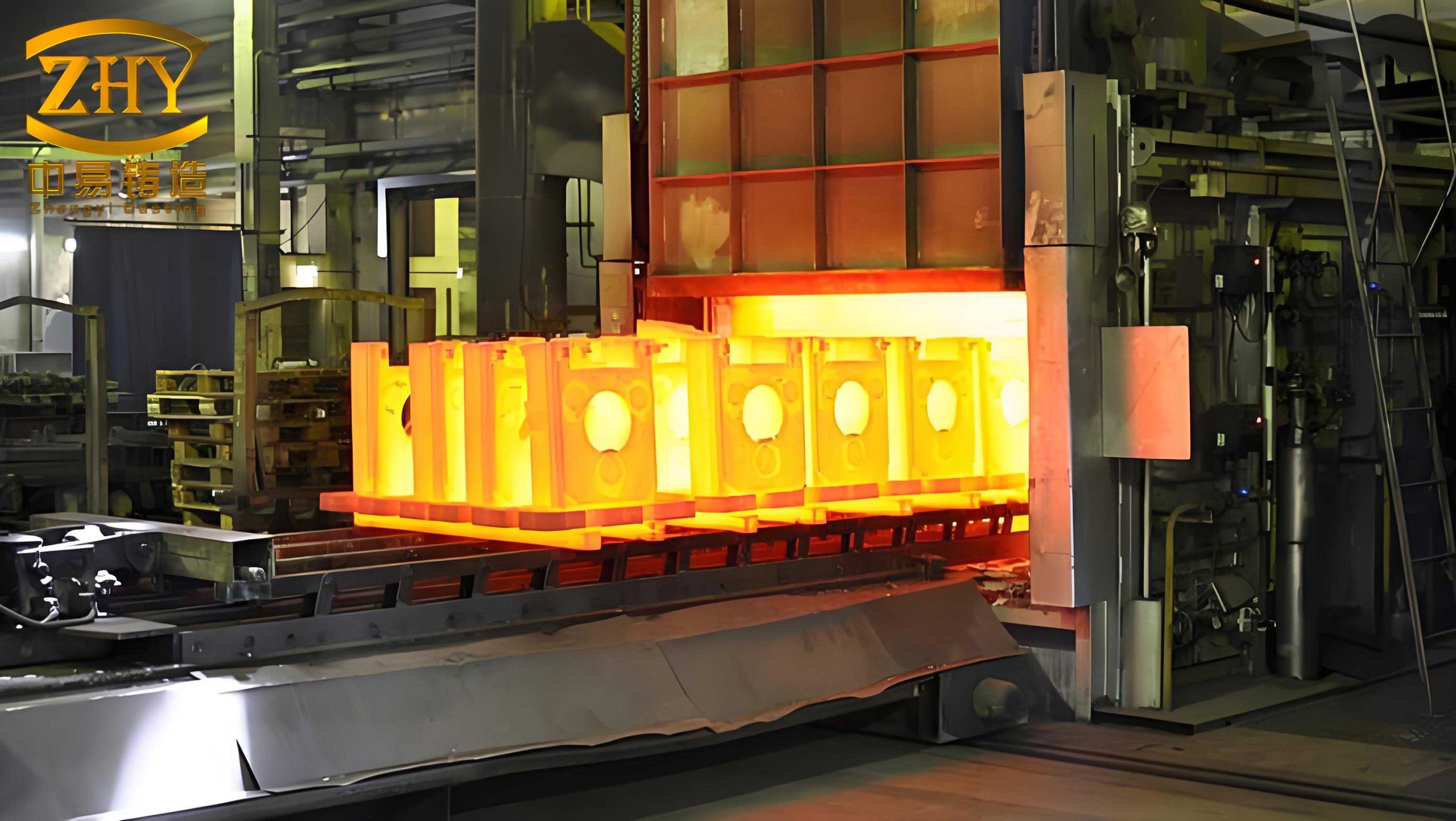
In my extensive experience within the foundry and heat treatment sector, addressing heat treatment defects is a central challenge that directly dictates the success or failure of a production batch. Among these defects, structural heterogeneity or segregation in cast steel components presents a particularly stubborn problem. It is a classic example where the casting process lays the groundwork for potential failure, and the subsequent heat treatment must act not as a cure-all, but as a sophisticated mitigator of inherited flaws. The core issue is that segregation, once established during solidification, is largely immutable through standard thermal cycles. The primary goal of heat treatment then shifts from eliminating the segregation to managing its detrimental consequences—specifically, the localized stresses and poor toughness it introduces. This realization fundamentally changes the approach to designing a heat treatment schedule.
Segregation in cast steels like medium-carbon, low-alloy grades manifests as chemical inhomogeneity on a microscopic scale. Elements such as manganese, chromium, nickel, and, crucially, carbon do not solidify uniformly. The last regions to solidify become enriched in these alloying elements and carbon, leading to distinct microstructural zones alongside the normal matrix. This chemical and microstructural disparity is the root cause of several heat treatment defects. During cooling after casting or heat treatment, these different regions transform at different temperatures according to their specific Continuous Cooling Transformation (CCT) behavior. The resulting volume changes are out of sync, generating intense localized internal stresses known as transformation stress. The mechanical property profile becomes highly anisotropic; while strength might be adequate, the ductility and impact toughness, especially in the segregated zones, can plummet far below specification. This scenario is a direct pipeline to in-service failure.
The interaction between standard heat treatment operations and segregated structures is complex and often counterintuitive. A common initial reaction to poor ductility is to increase the normalizing temperature, aiming for greater homogenization. However, for a segregated casting, this can be a recipe for exacerbating heat treatment defects. Let’s analyze this using a systematic framework. Suppose we define the matrix region composition as $C_m$ and the segregated region composition as $C_s$, where $C_s > C_m$ for carbon and alloying elements. The effective austenitization temperature for each region differs due to this compositional shift. The critical temperatures can be approximated by linearized relationships like Andrews’ formulas:
$$ A_{c3}(^\circ C) = 910 – 203\sqrt{C} – 15.2Ni + 44.7Si + 104V + 31.5Mo + 13.1W $$
$$ A_{c1}(^\circ C) = 723 – 16.9Ni + 29.1Si + 6.38W $$
where element concentrations are in weight percent. In a segregated zone with higher $C$, $Mn$, $Cr$, the $A_{c3}$ temperature is depressed. While this means the segregated zone is fully austenitized at a lower temperature, the matrix region requires the standard temperature. Raising the normalizing temperature excessively ($T_{N2} > T_{N1}$) has two major effects:
| Normalizing Temperature Regime | Effect on Matrix | Effect on Segregated Zone | Net Result on Defects |
|---|---|---|---|
| Optimal ($T_{N1}$, e.g., 900-920°C) | Full austenitization, grain refinement. | Full austenitization, possible grain growth initiation. | Controlled transformation mismatch. |
| Excessive ($T_{N2}$, e.g., >950°C) | Significant grain coarsening. | Severe grain coarsening, possible incipient melting at extreme temperatures. | Amplified transformation stress, lower ductility, risk of new heat treatment defects (overheating). |
The data from numerous trials consistently shows this pattern. For a grade with nominal yield strength requirement $R_{eL}^{req}$ and elongation $A^{req}$, the post-normalizing properties diverge with temperature:
$$
R_{eL}(T_N) \approx R_{eL}^{920} + k_R (T_N – 920) \quad \text{(weak positive trend)}
$$
$$
A(T_N) \approx A^{920} – k_A (T_N – 920) \quad \text{(strong negative trend for } T_N > 920^\circ C)
$$
where $k_A >> k_R$. The ductility loss is disproportionate. This is because the coarser austenite grains in both regions, but particularly in the solute-rich zone, transform into coarser, less ductile final constituents. Furthermore, the greater undercooling possible upon air cooling from a higher temperature increases the driving force for transformation, potentially forming harder phases like upper bainite or coarse Widmanstätten ferrite in the segregated areas, further locking in stress.
Therefore, the first principle in treating segregated castings is: Do not chase homogenization with high normalizing temperatures; instead, use a temperature just sufficient to austenitize the matrix fully and aim for a fine, uniform prior austenite grain size. The window is often narrow, typically 880-930°C depending on the specific grade, and must be determined empirically for each casting geometry and known segregation tendency.
The true key to unlocking adequate ductility in a segregated casting lies in the post-normalizing tempering or stress-relief treatment. This is where the most significant mitigation of heat treatment defects occurs. While normalizing addresses the gross cast structure, tempering addresses the micro-scale stresses locked in during the normalize-cool cycle. The process can be modeled as stress relaxation driven by thermal activation. The transformation stress $\sigma_{tr}$ generated between the matrix (m) and segregated (s) zones is a function of their volume change difference during the $\gamma \to \alpha$ transformation:
$$
\Delta V / V \propto \Delta \rho \approx f(C, T_{trans})
$$
$$
\sigma_{tr} \approx E \cdot \alpha \cdot \Delta T_{eff} + K \cdot (\Delta V/V)_s – (\Delta V/V)_m
$$
where $E$ is Young’s modulus, $\alpha$ is the thermal expansion coefficient, $\Delta T_{eff}$ is the effective temperature difference during transformation, and $K$ is a constraint factor. This stress is often near or above the yield strength of the weaker phase at room temperature.
Tempering at an elevated temperature $T_t$ provides the thermal energy for two critical recovery processes: 1) Dislocation annihilation and rearrangement within the ferrite and carbide phases, and 2) Further spheroidization and coarsening of cementite (or alloy carbides). The kinetics of softening and stress relief can be related to the Larson-Miller parameter or Hollomon-Jaffe tempering parameter $P$:
$$
P = T_t (C + \log t)
$$
where $T_t$ is in Kelvin, $t$ is time in hours, and $C$ is a constant (~20 for many steels). The resulting mechanical properties follow empirical relationships:
$$
R_m = R_{m0} \cdot \exp(-k_m \cdot P)
$$
$$
A = A_0 + k_a \cdot P
$$
The goal is to select a $P$ (i.e., a $T_t$ and $t$ combination) that reduces strength to just above the specification minimum while maximizing ductility. For many low-alloy cast steels, this optimal window falls between 600°C and 650°C.
| Heat Treatment State | Yield Strength (MPa) | Tensile Strength (MPa) | Elongation (%) | Reduction of Area (%) | Residual Stress State |
|---|---|---|---|---|---|
| As-Normalized (920°C) | ~390 | ~635 | ~18 | ~30 | High transformation stress in segregated zones. |
| Normalized + 600°C Tempered | ~400 | ~640 | ~28.5 | ~52 | Significant stress relief, ductility greatly improved. |
| Normalized + 640°C Tempered | ~385 | ~615 | ~29.5 | ~55.5 | Near-optimal stress relief, excellent ductility/strength balance. |
| Normalized + 680°C Tempered | ~350 | ~580 | ~29.5 | ~57.5 | Full stress relief, strength may approach lower limit. |
The microstructural change during this high-temperature tempering is subtle under an optical microscope—the ferrite-pearlite or ferrite-bainite morphology appears largely unchanged from the normalized state. The segregated band is still visibly distinct. However, on a sub-micron scale, the critical changes have occurred: the dislocation density has dropped, carbides have rounded, and most importantly, the elastic strain energy binding the two dissimilar micro-constituents together has been dissipated. The interface between the matrix and the segregated zone becomes less potent as a crack initiation site. This is why the drastic improvement in elongation and reduction of area is observed without a complete eradication of the segregation pattern itself. The heat treatment defects related to embrittlement are thereby managed.
A comprehensive strategy for handling castings prone to segregation must be holistic, involving steps before, during, and after heat treatment to minimize the final manifestation of heat treatment defects:
1. Foundry Process Control: This is the first line of defense. Techniques to reduce macrosegregation include controlling pouring temperature ($T_{pour}$) to minimize the solidification interval $\Delta T_f$, using chills to promote directional solidification, and employing mold designs that minimize hot spots. The chemical composition should be balanced to reduce the segregation tendency of key elements. The segregation intensity $I_s$ can be heuristically related to factors like cooling rate $dT/dt$ and composition:
$$
I_s \propto \frac{1}{(dT/dt)^n} \cdot \sum (k_i – 1) \cdot C_{0,i}
$$
where $k_i$ is the partition coefficient for element $i$, and $C_{0,i}$ is its nominal concentration.
2. Strategic Normalizing: Employ a two-stage normalizing if the casting size and furnace capabilities allow. A first stage at a lower temperature (e.g., 880-900°C) can refine the heavily segregated, as-cast structure without excessive grain growth. A second stage at the standard temperature (e.g., 910-920°C) then completes the austenitization of the matrix. Holding times must be calculated based on section thickness, typically using a relationship like $t (min) = a \cdot D (mm)$, where $a$ is a constant (often 1.0-1.5 min/mm) and $D$ is the effective section thickness.
3. Mandatory High-Temperature Tempering: For grades with stringent ductility requirements, a tempering treatment above 600°C should be considered standard procedure, not an exception. The time-temperature combination must be validated. The tempering parameter guides the selection:
$$
P_{target} = T_{t} (20 + \log t)
$$
Aim for a $P_{target}$ that correlates with the desired ductility-strength compromise from prior characterization work.
4. Advanced Techniques: For critical components, more advanced cycles can be considered. Isothermal annealing after normalizing (holding in the pearlite bay region) can produce a very uniform, soft structure that is then tempered. Alternatively, a quenching and tempering (Q&T) cycle, if the hardenability and risk of distortion/quenching cracks are manageable, can sometimes bypass the formation of problematic intermediate transformation products in segregated zones altogether, replacing them with tempered martensite. However, Q&T introduces its own set of potential heat treatment defects (distortion, quench cracking) that must be rigorously controlled.
In conclusion, the presence of structural segregation in steel castings establishes a pre-condition that fundamentally alters the response to heat treatment. The primary heat treatment defects in such contexts are not surface anomalies like decarburization or oxidation, but rather bulk mechanical deficiencies—low ductility and high residual stress—stemming from microstructural incompatibility. The successful thermal processing strategy acknowledges the permanence of the segregation and focuses on mitigating its effects. This is achieved through a disciplined, two-step approach: a conservative normalizing cycle to refine grains without exacerbating chemical gradients, followed by a mandatory high-temperature tempering treatment to annihilate the transformation-induced stresses that are the true cause of embrittlement. The governing equations for kinetics and property evolution provide a framework for designing this cycle, but final optimization always requires empirical validation on representative material. By respecting the material’s inherited condition and applying thermodynamics and kinetics principles, the significant challenges posed by these heat treatment defects can be reliably overcome to produce cast components that are fit for demanding service.