
In the automotive industry, certain critical components operate under dynamic impact loads during vehicle operation, enduring complex and severe stress conditions. While studies suggest that under extreme conditions, the maximum stress remains below the ultimate strength of typical metallic materials—with failure primarily due to fatigue—ensuring sufficient safety margins necessitates stringent requirements for comprehensive mechanical properties. Traditionally, such parts are manufactured using alloy structural steel through forging processes. However, due to their complex geometry, casting from low-carbon low-alloy steel presents a cost-effective and time-saving alternative. To achieve performance parity with forged parts, cast components must meet rigorous standards for mechanical properties and microstructure, which hinges not only on chemical composition control and casting techniques but also critically on the heat treatment process. Conventional heat treatment for low-carbon low-alloy steel castings often involves annealing or normalizing as preprocessing to address casting defects like dendritic segregation, coarse grains, and inhomogeneous structures, followed by quenching and tempering. This approach typically employs quenching temperatures at $$Ac_3 + 30 \text{ to } 50^\circ\text{C}$$ with extended holding times, leading to issues such as thick oxide scale, high energy consumption, low productivity, and inconsistent quality due to complex geometries and varying wall thicknesses. Thus, developing an efficient, energy-saving heat treatment process is imperative. In this study, I conducted extensive experimental research to optimize the heat treatment of GS24Mn6V steel castings, aiming to eliminate preprocessing steps, reduce cycle times, and minimize heat treatment defects like oxidation, distortion, and residual stresses.
The material used in this study was GS24Mn6V steel castings or test bars produced via electric furnace melting, followed by cleaning, shot blasting, and non-destructive testing prior to heat treatment. The chemical composition of the steel is summarized in Table 1, which adheres to specified ranges ensuring adequate hardenability and toughness. Traditional heat treatment processes for these castings were lengthy, involving annealing for 3 hours followed by furnace cooling over 6–8 hours, quenching with a 2.5-hour hold, and tempering for 5 hours, resulting in significant energy usage and low efficiency. To address this, I designed a series of experiments focused on process simplification and time reduction, as outlined in Table 2. These experiments investigated the effects of preprocessing, quenching parameters, and tempering conditions, with particular attention to mitigating common heat treatment defects such as grain coarseness and inhomogeneous microstructure.
| Element | Actual Composition | Required Range |
|---|---|---|
| C | 0.23 | 0.20–0.25 |
| Mn | 1.69 | 1.50–1.80 |
| Si | 0.53 | 0.30–0.60 |
| P | 0.017 | ≤0.025 |
| S | 0.014 | ≤0.025 |
| Cr | 0.043 | ≤0.30 |
| Al | 0.048 | ≤0.10 |
The experimental setup involved two types of furnaces: a SX-4-10 box-type resistance furnace for test bar experiments and a car-bottom furnace for full-scale casting trials. Quenching media included自来水 for test bars and brine for castings, with nitrogen used as a protective atmosphere to reduce oxidation-related heat treatment defects. Castings were arranged in layers with adequate spacing for uniform heating, and the charge weight was controlled at approximately 1.5 tons to ensure consistent thermal profiles. Mechanical properties were evaluated according to GB/T 228.1-2010 using a CMT5205 electronic universal testing machine, while microstructural analysis was performed on a GX51 OLYMPUS optical microscope. Key parameters such as tensile strength ($$R_m$$), yield strength ($$R_{eL}$$), elongation ($$A$$), and ferrite content were measured to assess performance and identify potential heat treatment defects like excessive ferrite formation or non-uniform phases.
| Experiment | Process Scheme | Description |
|---|---|---|
| Preprocessing | ①: 950°C × 3 h furnace cool + 930°C × 2 h water quench + 600°C × 5 h water cool | Annealing prior to quenching and tempering |
| Preprocessing | ②: 950°C × 3 h air cool + 930°C × 2 h water quench + 600°C × 5 h water cool | Normalizing prior to quenching and tempering |
| Preprocessing | ③: 950°C × 2 h brine quench + 600°C × 5 h brine cool | Direct quenching and tempering from as-cast state |
| Quenching | ④: 950°C × 0 h water quench + 600°C × 2 h water cool | “Zero-hold” quenching on test bars |
| Quenching | ⑤: 950°C × 0.5 h water quench + 600°C × 2 h water cool | Short-hold quenching on test bars |
| Quenching | ⑥: 950°C × 1.5 h water quench + 600°C × 2 h water cool | Extended-hold quenching on test bars |
| Quenching | ⑦: 950°C × 1 h brine quench + 600°C × 5 h brine cool | Reduced-hold quenching on castings |
| Quenching | ⑧: 950°C × 2 h brine quench + 600°C × 5 h brine cool | Traditional-hold quenching on castings |
| Tempering | ⑨: 950°C × 1 h brine quench + 630°C × 2 h brine cool | High-temperature short-time tempering on castings |
Preprocessing trials aimed to eliminate dendritic segregation and coarse grains, common heat treatment defects in as-cast structures. As shown in Table 3, processes involving annealing or normalizing prior to quenching and tempering resulted in finer and more uniform grain structures compared to direct quenching from the as-cast state. However, the mechanical properties across all preprocessing methods were similar, with tensile strengths ranging from 600 to 651 MPa, yield strengths from 432 to 500 MPa, and elongations from 15% to 28%, all meeting the required specifications ($$R_m$$: 610–800 MPa, $$R_{eL}$$: ≥450 MPa, $$A$$: ≥18%). Ferrite content remained below 30%, indicating minimal heat treatment defects related to phase imbalance. This suggests that preprocessing steps can be omitted without compromising performance, thereby reducing cycle time and energy consumption—a significant step in mitigating process-induced heat treatment defects like excessive oxidation from prolonged heating.
| Process | Sample ID | $$R_m$$ (MPa) | $$R_{eL}$$ (MPa) | $$A$$ (%) | Ferrite Content (%) |
|---|---|---|---|---|---|
| ① | 01# | 651 | 465 | 15 | 15 |
| 02# | 600 | 432 | 28 | 15 | |
| 03# | 633 | 468 | 20 | 15 | |
| ② | 04# | 630 | 470 | 20 | 15 |
| 05# | 615 | 450 | 25 | 15 | |
| 06# | 629 | 472 | 22 | 15 | |
| ③ | 07# | 640 | 500 | 15 | 10 |
| 08# | 617 | 475 | 18 | 20 | |
| 09# | 636 | 485 | 20 | 15 |
Quenching experiments were pivotal in addressing heat treatment defects associated with prolonged heating, such as scale formation and decarbonization. Inspired by the “zero-hold” quenching concept proposed by Japanese researcher Ōwaku Hisao in the 1970s, which suggests that holding times can be minimized or eliminated for structural steels, I first applied this to test bars. The quenching temperature was elevated to 950°C to compensate for as-cast inhomogeneities, and holding times varied from 0 to 1.5 hours, as per Table 4. Remarkably, as holding time decreased, tensile and yield strengths slightly increased, while elongation showed a marginal decline. For instance, with zero hold (Process ④), $$R_m$$ averaged 695 MPa and $$R_{eL}$$ 525 MPa, compared to 660 MPa and 495 MPa for 1.5-hour hold (Process ⑥). This indicates that “zero-hold” quenching is feasible for GS24Mn6V steel, reducing energy usage and minimizing heat treatment defects like grain growth from overexposure.
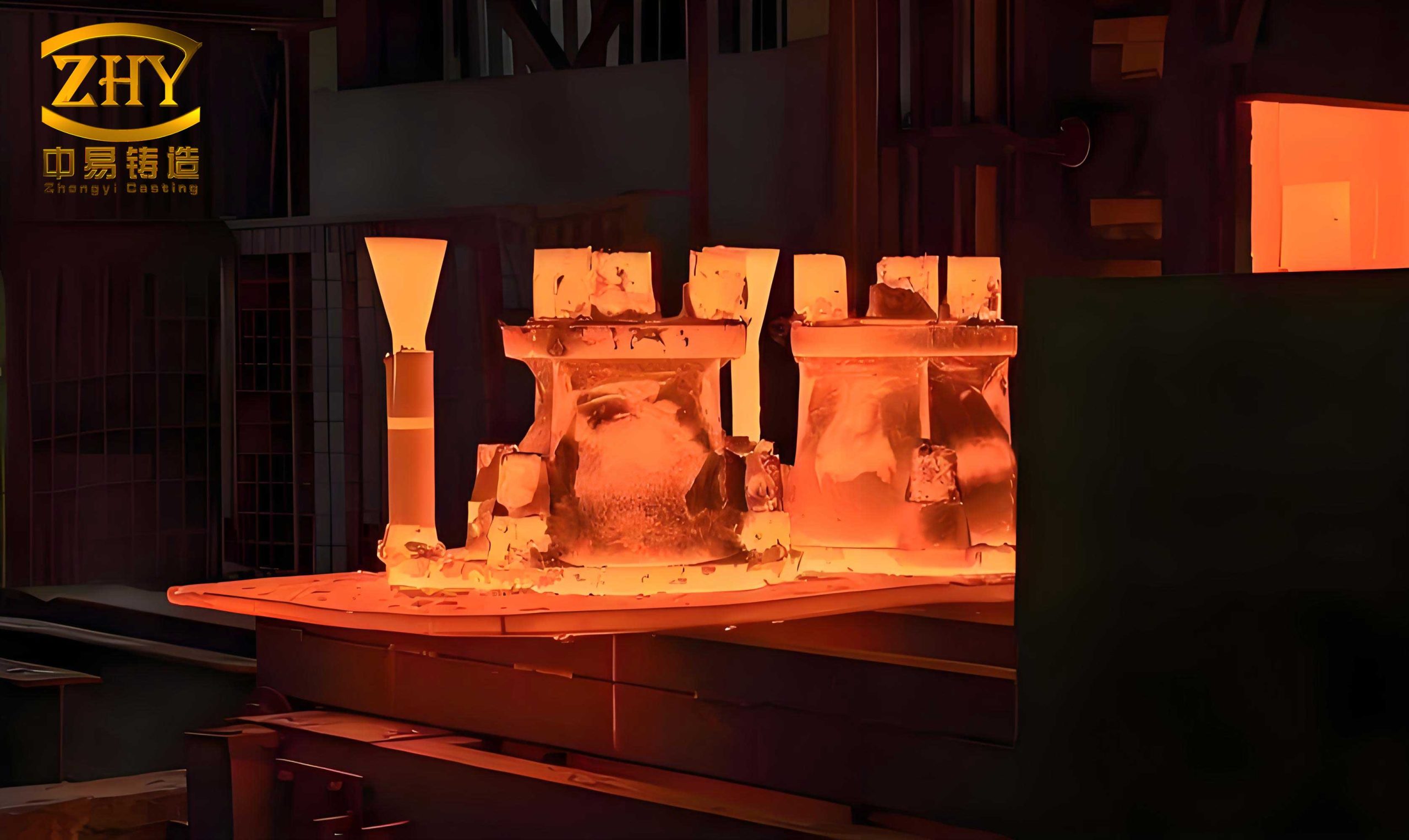
For full-scale castings, practical considerations like furnace load uniformity necessitated a moderate hold time. Comparing 1-hour and 2-hour quenching holds (Processes ⑦ and ⑧), mechanical properties were comparable: $$R_m$$ ranged from 630 to 690 MPa, $$R_{eL}$$ from 470 to 525 MPa, and elongation from 18.5% to 26.5%, with ferrite content below 30%. This confirms that a 1-hour hold suffices, halving the traditional time and mitigating heat treatment defects related to prolonged high-temperature exposure. The success of shortened quenching can be modeled using kinetic equations for austenitization, where the time $$t$$ required for complete transformation depends on temperature $$T$$ and initial microstructure. For GS24Mn6V steel, the process can be approximated by an Arrhenius-type relation: $$t = A \exp\left(\frac{Q}{RT}\right)$$, where $$A$$ is a pre-exponential factor, $$Q$$ is activation energy, and $$R$$ is the gas constant. At 950°C, the high temperature accelerates diffusion, allowing rapid homogenization even with reduced hold times, thus averting heat treatment defects like incomplete transformation.
| Process | Sample ID | $$R_m$$ (MPa) | $$R_{eL}$$ (MPa) | $$A$$ (%) | Ferrite Content (%) |
|---|---|---|---|---|---|
| ④ | 10# | 675 | 530 | 23.0 | <10 |
| 11# | 705 | 570 | 22.5 | 10 | |
| 12# | 695 | 525 | 22.5 | <10 | |
| ⑤ | 13# | 670 | 525 | 24.0 | <10 |
| 14# | 705 | 560 | 24.0 | 10 | |
| 15# | 660 | 495 | 26.5 | <10 | |
| ⑥ | 16# | 650 | 500 | 24.0 | 10 |
| 17# | 675 | 540 | 23.5 | 10 | |
| 18# | 655 | 500 | 24.5 | <10 | |
| ⑦ | 19# | 660 | 500 | 19.0 | 10 |
| 20# | 675 | 510 | 20.5 | 10 | |
| 21# | 690 | 525 | 18.5 | 10 | |
| ⑧ | 22# | 660 | 495 | 21.0 | <10 |
| 23# | 655 | 500 | 19.5 | 10 | |
| 24# | 630 | 470 | 23.5 | 15 |
Tempering optimization targeted another source of heat treatment defects: excessive time leading to productivity losses. Research indicates that tempering is diffusion-controlled, with transformations dependent on both temperature and time, where temperature plays a dominant role. For GS24Mn6V steel, increasing the tempering temperature to 630°C while reducing hold time to 2 hours (Process ⑨) yielded excellent results, as shown in Table 5. Mechanical properties included $$R_m$$ of 645–670 MPa, $$R_{eL}$$ of 470–520 MPa, and $$A$$ of 23.0–26.5%, with ferrite content below 30%. This high-temperature short-time approach aligns with the principle that equivalent tempering effects can be achieved through higher temperatures over shorter durations, described by the Hollomon-Jaffe parameter: $$P = T(\log t + C)$$, where $$T$$ is temperature in Kelvin, $$t$$ is time in hours, and $$C$$ is a material constant. For GS24Mn6V, setting $$P$$ constant ensures similar microstructural outcomes, thereby reducing heat treatment defects like temper embrittlement from prolonged exposure.
| Process | Sample ID | $$R_m$$ (MPa) | $$R_{eL}$$ (MPa) | $$A$$ (%) | Ferrite Content (%) |
|---|---|---|---|---|---|
| ⑨ | 25# | 650 | 490 | 23.0 | 10 |
| 26# | 645 | 470 | 26.5 | <10 | |
| 27# | 670 | 520 | 24.5 | 10 |
Based on these findings, the optimal heat treatment process for GS24Mn6V steel castings in car-bottom furnaces is established as: 950°C × 1 hour brine quench + 630°C × 2 hours brine cool, with a charge weight controlled around 1.5 tons. This refined process eliminates preprocessing, shortens quenching and tempering holds, and addresses numerous heat treatment defects. For instance, reduced high-temperature exposure minimizes oxidation and decarbonization, while optimized cooling rates in brine quench prevent distortion and cracking—common heat treatment defects in complex castings. The improved uniformity also alleviates residual stresses, another critical heat treatment defect that can compromise fatigue life. The microstructural evolution during this process can be described using phase transformation kinetics. During quenching, the cooling rate $$V_c$$ must exceed the critical value to form martensite, approximated by: $$V_c > \frac{M_s – T_q}{t_q}$$, where $$M_s$$ is martensite start temperature, $$T_q$$ is quenchant temperature, and $$t_q$$ is quenching time. For GS24Mn6V, brine quenching ensures $$V_c$$ suffices, while the subsequent tempering allows carbide precipitation, enhancing toughness without introducing heat treatment defects like over-softening.
Production validation of this optimized process demonstrated remarkable benefits. The pass rate for tempered hardness increased from approximately 60% to 98%, mechanical property compliance rose to over 97%, and microstructural acceptability reached 100%. By eliminating preprocessing and shortening cycle times, each heat treatment batch saved about 7 hours, reducing electricity consumption by roughly 1,000 kWh per batch. This translates to cost savings of about 650 USD per batch or 433 USD per ton, amounting to annual savings exceeding 500,000 USD for typical production scales. Moreover, the reduction in energy consumption directly lowers carbon emissions, contributing to sustainable manufacturing. The minimized heat treatment defects also enhance product reliability—for example, fewer oxide scales improve surface quality, reducing post-machining needs and preventing stress concentrators that could initiate fatigue cracks. Additionally, the consistent microstructure across varying wall thicknesses mitigates heat treatment defects like soft spots or hard zones, ensuring uniform performance in demanding automotive applications.
In summary, this study successfully optimized the heat treatment of GS24Mn6V steel castings through systematic experimentation. Key innovations include omitting preprocessing steps, implementing shortened quenching holds akin to “zero-hold” principles, and adopting high-temperature short-time tempering. The final process—950°C × 1 hour brine quench + 630°C × 2 hours brine cool—not only meets all technical specifications for mechanical properties and microstructure but also significantly reduces production cycles, costs, and energy usage. Crucially, it mitigates prevalent heat treatment defects such as oxidation, distortion, residual stresses, and inhomogeneous phases. Future work could explore further refinements, such as adaptive cooling strategies or advanced modeling to predict heat treatment defects under varying geometries. Overall, this approach offers a robust framework for enhancing the efficiency and quality of heat treatment processes for low-alloy steel castings, with potential applications across industries where performance and sustainability are paramount.