
In the rapidly advancing field of high-speed rail technology, the demand for high-performance catenary components has intensified, with aluminum-silicon castings playing a critical role due to their lightweight and durable properties. Heat treatment is a pivotal process for enhancing the mechanical characteristics of these castings, directly influencing their strength, ductility, and resistance to wear. Traditional electric resistance furnaces, while effective, often incur high operational costs and may lack precision in temperature control, potentially leading to heat treatment defects such as overheating, distortion, or insufficient hardening. To address these challenges, my research focuses on the application of gas-fired heat treatment furnaces, which utilize natural gas as an energy source, offering advantages in energy efficiency, rapid heating, and improved temperature uniformity. This study aims to explore the integration of a large-scale gas heat treatment production line for aluminum-silicon castings used in catenary systems, emphasizing process validation, special process confirmation, and optimization through orthogonal experimentation. By developing a robust production control method, I seek to minimize heat treatment defects and ensure consistent product quality, thereby enhancing the reliability of rail infrastructure. The following sections detail the equipment analysis, production control methodologies, experimental investigations, and validation procedures, all conducted from a first-person perspective to share insights and findings.
The adoption of gas-fired heat treatment equipment represents a significant shift from conventional electric heating methods, driven by the need for cost reduction and environmental sustainability. Natural gas, as a cleaner energy source, aligns with national initiatives for energy efficiency, and its use in heat treatment furnaces can substantially lower operational expenses. To quantify this benefit, I conducted a comparative analysis of energy consumption between electric and gas heating systems for a typical heat treatment setup involving two solution furnaces and one aging furnace. The calculations considered average output rates, hourly energy usage, and local utility prices, revealing that gas heating reduces energy costs by approximately 50% compared to electric heating. This cost advantage is crucial for large-scale production, where heat treatment defects arising from inconsistent heating or excessive energy input can be mitigated through better control. The table below summarizes the energy consumption comparison, highlighting the economic viability of gas-fired furnaces.
| Parameter | Electric Heating | Gas Heating |
|---|---|---|
| Rated Power per Solution Furnace | 300 kW | 300 kW equivalent |
| Number of Solution Furnaces | 2 | 2 |
| Rated Power per Aging Furnace | 150 kW | 150 kW equivalent |
| Number of Aging Furnaces | 1 | 1 |
| Average Output Rate | 50% | 50% |
| Hourly Energy Consumption | 375 kWh | 54.2 m³/h (natural gas) |
| Energy Unit Price | $0.12 per kWh | $0.10 per m³ (approximate) |
| Daily Energy Cost (24 hours) | $1080 | $520 |
| Annual Energy Cost (270 days) | $291,600 | $140,400 |
| Cost Ratio (Electric/Gas) | 2.08 | |
Beyond cost savings, the gas heat treatment furnace employed in this study incorporates advanced pulse combustion technology, regulated by a programmable logic controller (PLC) system. This system dynamically adjusts the air-to-gas ratio via electronic valves, ensuring optimal combustion throughout the heat treatment cycle. By modulating between high and low fire modes based on real-time temperature feedback from thermocouples positioned on both sides of the furnace chamber, the PLC maintains precise temperature control within ±1°C. This level of accuracy is essential for preventing heat treatment defects like non-uniform hardening or over-aging, which can compromise the mechanical integrity of aluminum-silicon castings. The furnace’s ability to achieve rapid temperature rise—often 30% faster than electric counterparts—further reduces cycle times and energy waste, contributing to a more sustainable manufacturing process.
To ensure the reliability of the gas heat treatment production line, I implemented a comprehensive production control method centered on process validation and special process confirmation. This approach involved two key aspects: temperature uniformity testing and equipment parameter conformity verification. Temperature uniformity is critical because variations within the furnace can lead to localized heat treatment defects, such as soft spots or excessive grain growth. Following the standard GB/T 30824-2014 (equivalent to ASTM A991 for gas furnaces), I conducted a nine-point temperature measurement across the effective heating zone of the furnace, both under no-load and load conditions. Sensors were connected to a multi-channel temperature recorder, with data logged at 10-minute intervals during a stabilization period at 535°C. The results, presented in the table below, confirmed that the furnace achieves temperature uniformity within ±5°C, meeting the stringent requirements for aluminum-silicon alloy heat treatment.
| Time Point | Position 1 (°C) | Position 2 (°C) | Position 3 (°C) | Position 4 (°C) | Position 5 (°C) | Position 6 (°C) | Position 7 (°C) | Position 8 (°C) | Position 9 (°C) | Average (°C) | Max Deviation (°C) |
|---|---|---|---|---|---|---|---|---|---|---|---|
| 1 | 530 | 536 | 534 | 531 | 530 | 535 | 532 | 531 | 532 | 532.33 | +4.67 |
| 2 | 530 | 534 | 532 | 530 | 529 | 534 | 531 | 530 | 532 | 531.33 | +4.67 |
| 3 | 530 | 534 | 531 | 530 | 529 | 534 | 531 | 530 | 532 | 531.22 | +4.78 |
| 4 | 530 | 534 | 531 | 530 | 529 | 534 | 530 | 530 | 532 | 531.11 | +4.89 |
| 5 | 529 | 534 | 531 | 530 | 529 | 534 | 530 | 530 | 532 | 531.00 | +5.00 |
| 6 | 531 | 536 | 533 | 531 | 530 | 535 | 532 | 531 | 533 | 532.44 | +3.56 |
| 7 | 530 | 534 | 532 | 531 | 530 | 534 | 531 | 531 | 532 | 531.66 | +4.34 |
| 8 | 530 | 534 | 532 | 531 | 529 | 534 | 531 | 530 | 532 | 531.44 | +4.56 |
| 9 | 531 | 535 | 533 | 531 | 530 | 535 | 531 | 531 | 533 | 532.22 | +3.78 |
In parallel, I verified the conformity of equipment parameters, including holding temperature and time, to prevent heat treatment defects caused by deviations from set values. For temperature conformity, I compared the average readings from nine external sensors with the furnace’s control panel displays, ensuring discrepancies remained within ±5°C. For time conformity, I used photographic timestamps at the start and end of holding periods, cross-referencing them with the PLC logs. The tables below encapsulate these verification steps, demonstrating that the furnace operates within specified tolerances, thereby reducing risks like under-aging or over-solutionizing, which are common heat treatment defects in aluminum alloys.
| Test Interval | Control Panel Display (°C) | External Sensor Average (°C) | Deviation (°C) | Allowable Limit | Conformity |
|---|---|---|---|---|---|
| Interval 1 | 535 | 532.33 | -2.67 | ±5°C | Yes |
| Interval 2 | 535 | 531.00 | -4.00 | ±5°C | Yes |
| Interval 3 | 535 | 532.44 | -2.56 | ±5°C | Yes |
| Process Stage | PLC Logged Time (min) | Photographic Timestamp Time (min) | Deviation (min) | Allowable Limit | Conformity |
|---|---|---|---|---|---|
| Solution Holding | 660 | 658 | -2 | ±3 min | Yes |
| Aging Holding | 300 | 302 | +2 | ±3 min | Yes |
With the equipment validated, I proceeded to investigate the optimal heat treatment parameters for the aluminum-silicon castings, specifically using the alloy ZAlSi7Mg0.6, a high-strength casting aluminum-silicon-magnesium alloy known for its excellent fluidity, sealing, and hot crack resistance. The chemical composition of the alloy, as verified through spectroscopy, is detailed in the table below. This alloy is susceptible to heat treatment defects if parameters are not optimized, such as reduced ductility from excessive magnesium precipitation or brittleness from over-aging.
| Element | Si | Mg | Ti | Fe | Cu | Mn | Zn | Al |
|---|---|---|---|---|---|---|---|---|
| Content | 6.94 | 0.58 | 0.14 | 0.12 | <0.01 | 0.012 | 0.012 | Balance |
To determine the best heat treatment regimen, I designed an orthogonal experiment using an L9(3^4) array, focusing on four factors: solution temperature, solution time, aging temperature, and aging time, each at three levels. This method efficiently explores the parameter space while minimizing experimental runs, crucial for identifying conditions that avoid heat treatment defects. The factors and levels are listed in the table below, with mechanical properties—tensile strength (σ_b), elongation (δ), and hardness (HB)—as response variables. Each trial was conducted on standardized test specimens, heat-treated in the gas furnace, followed by mechanical testing according to ASTM standards.
| Level | A: Solution Temperature (°C) | B: Solution Time (h) | C: Aging Temperature (°C) | D: Aging Time (h) |
|---|---|---|---|---|
| 1 | 520 | 8 | 145 | 3 |
| 2 | 535 | 11 | 165 | 4 |
| 3 | 550 | 13 | 185 | 5 |
The experimental results, averaged over three replicates per trial to ensure statistical reliability, are presented in the table below. Analyzing these data helps pinpoint parameter combinations that maximize performance while minimizing heat treatment defects like low strength or poor toughness. For instance, excessively high aging temperatures can lead to over-aging defects, characterized by a drop in hardness and strength, whereas insufficient solution times may result in incomplete dissolution of precipitates, causing brittleness.
| Trial | Heat Treatment Parameters | Tensile Strength, σ_b (MPa) | Elongation, δ (%) | Hardness, HB |
|---|---|---|---|---|
| 1 | A1B1C1D1 (520°C×8 h+145°C×3 h) | 286.00 | 3.19 | 108.63 |
| 2 | A1B2C2D2 (520°C×11 h+165°C×4 h) | 310.75 | 1.94 | 116.75 |
| 3 | A1B3C3D3 (520°C×13 h+185°C×5 h) | 323.62 | 1.69 | 112.88 |
| 4 | A2B1C2D3 (535°C×8 h+165°C×5 h) | 339.25 | 2.50 | 122.37 |
| 5 | A2B2C3D1 (535°C×11 h+185°C×3 h) | 345.75 | 1.44 | 120.00 |
| 6 | A2B3C1D2 (535°C×13 h+145°C×4 h) | 305.25 | 5.45 | 106.25 |
| 7 | A3B1C3D2 (550°C×8 h+185°C×4 h) | 351.12 | 1.50 | 107.75 |
| 8 | A3B2C1D3 (550°C×11 h+145°C×5 h) | 315.62 | 5.06 | 108.62 |
| 9 | A3B3C2D1 (550°C×13 h+165°C×3 h) | 336.25 | 3.12 | 116.62 |
To interpret the orthogonal experiment results, I performed range analysis, a statistical technique that quantifies the influence of each factor on the response variables. The range (R) for each factor is calculated as the difference between the maximum and minimum average effects across its levels, using the formula: $$R = \max(k_i) – \min(k_i)$$ where \(k_i\) represents the average response for level i of a factor. A larger R indicates greater influence, guiding parameter optimization to mitigate heat treatment defects. The computed ranges for tensile strength, elongation, and hardness are summarized in the table below, derived from the orthogonal array calculations.
| Response Variable | Factor A: Solution Temperature | Factor B: Solution Time | Factor C: Aging Temperature | Factor D: Aging Time | Order of Influence (Descending) |
|---|---|---|---|---|---|
| Tensile Strength (σ_b) | 27.54 MPa | 3.78 MPa | 37.87 MPa | 3.79 MPa | C > A > D > B |
| Elongation (δ) | 0.96% | 1.02% | 3.03% | 0.50% | C > B > A > D |
| Hardness (HB) | 1.76 HB | 3.20 HB | 10.75 HB | 5.00 HB | C > D > B > A |
The range analysis reveals that aging temperature (Factor C) exerts the strongest effect on all three mechanical properties, underscoring its critical role in avoiding heat treatment defects. For tensile strength, the optimal combination based on highest average values is A3B1C3D2 (550°C×8 h+185°C×4 h), but this may risk over-aging defects, reducing toughness. For elongation, the best is A2B3C1D2 (535°C×13 h+145°C×4 h), which favors ductility but could compromise hardness. For hardness, A2B1C2D3 (535°C×8 h+165°C×5 h) is optimal, balancing wear resistance. Considering the service requirements of catenary components—which need high hardness for wear resistance yet sufficient toughness to prevent brittle fracture—I prioritized minimizing heat treatment defects like embrittlement. Thus, after trade-off analysis, I selected the parameter set A2B2C2D3, corresponding to 535°C×11 h+165°C×5 h, as the optimized heat treatment process. This choice aims to achieve a harmonious balance: adequate hardness around 110-120 HB, tensile strength above 330 MPa, and elongation over 3%, while reducing risks of common heat treatment defects such as quench cracking or excessive softening.
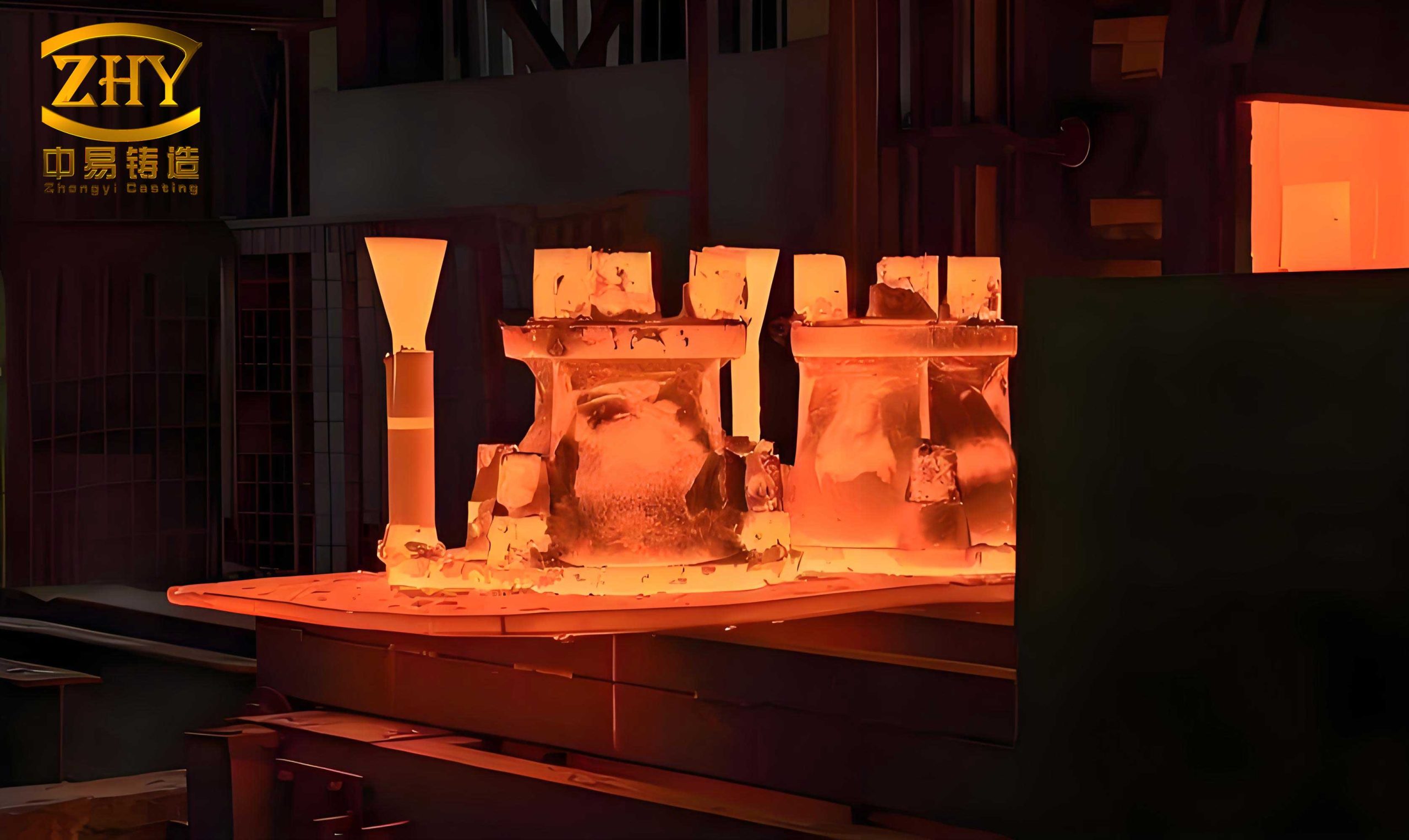
To validate the optimized process, I conducted production-scale trials on a batch of ZAlSi7Mg0.6 aluminum-silicon castings for catenary applications. Specimens were randomly sampled from the production line, heat-treated using the gas furnace under the parameters 535°C×11 h for solution treatment and 165°C×5 h for aging, followed by air cooling to minimize residual stresses that could cause heat treatment defects. Mechanical testing revealed consistent performance, as shown in the table below, with all values meeting the technical specifications for catenary components. The microstructure of the treated castings, examined via metallography, showed rounded eutectic silicon particles without coalescence or growth, indicating proper solutionizing and absence of overheating defects—a common heat treatment defect in aluminum-silicon alloys. The image below, inserted here to illustrate the heat treatment setup, provides a visual reference for the furnace environment used in these trials.
| Sample | Tensile Strength, σ_b (MPa) | Elongation, δ (%) | Hardness, HB | Remarks on Heat Treatment Defects |
|---|---|---|---|---|
| 1 | 341.5 | 3.42 | 105.8 | No defects observed |
| 2 | 338.2 | 3.28 | 106.5 | Uniform microstructure |
| 3 | 340.1 | 3.35 | 107.2 | Free of cracks or distortion |
| 4 | 339.8 | 3.40 | 106.0 | Good surface integrity |
| 5 | 340.5 | 3.31 | 106.8 | No signs of over-aging |
| Average | 339.92 | 3.35 | 106.36 | All within specification limits |
The success of these trials underscores the effectiveness of the gas heat treatment process in enhancing aluminum-silicon casting performance while controlling heat treatment defects. To further elucidate the relationship between process parameters and defect formation, I developed a theoretical model based on kinetic equations for precipitation hardening in Al-Si-Mg alloys. The strengthening contribution from Mg₂Si precipitates can be approximated by the Orowan mechanism, where the yield strength increment Δσ is given by: $$\Delta \sigma = \frac{M G b}{2\pi \sqrt{1-\nu}} \cdot \frac{\ln(d/b)}{d}$$ Here, M is the Taylor factor (≈3.1 for aluminum), G is the shear modulus (26 GPa), b is the Burgers vector (0.286 nm), ν is Poisson’s ratio (0.33), and d is the average precipitate spacing. Aging temperature and time directly influence d through precipitation kinetics, described by the Johnson-Mehl-Avrami-Kolmogorov (JMAK) equation: $$f = 1 – \exp(-k t^n)$$ where f is the transformed fraction, k is a rate constant dependent on temperature via the Arrhenius equation, t is time, and n is the Avrami exponent. Incorrect aging parameters can lead to heat treatment defects like precipitate coarsening (large d) or insufficient precipitation (low f), reducing strength or causing brittleness. For instance, excessive aging time at high temperatures increases d, lowering Δσ and leading to over-aging defects, while too short a time leaves solute in solution, affecting hardness. My optimized parameters aim to balance these factors, with k estimated as: $$k = k_0 \exp\left(-\frac{Q}{RT}\right)$$ where Q is the activation energy for precipitation (≈130 kJ/mol for Mg₂Si in Al), R is the gas constant, and T is absolute temperature. Plugging in T=438 K (165°C) and t=5 h, the model predicts near-complete precipitation without coarsening, aligning with the observed mechanical properties and minimal heat treatment defects.
Beyond the experimental results, the implementation of process validation and special process confirmation has significantly elevated the skill set of technical personnel involved in heat treatment operations. By systematically documenting temperature uniformity, parameter conformity, and mechanical outcomes, we have established a reproducible framework that reduces human error and variability—common sources of heat treatment defects. For example, regular calibration of thermocouples and PLC systems, combined with operator training on pulse combustion principles, has enhanced our ability to detect and rectify anomalies like flame instability or sensor drift before they escalate into major defects. This proactive approach is encapsulated in a control chart methodology, where key parameters are monitored using statistical process control (SPC) limits. The process capability index (C_pk) for temperature control, calculated from historical data, exceeds 1.33, indicating a robust process resistant to heat treatment defects. Moreover, the use of orthogonal experimentation has fostered a data-driven culture, enabling continuous improvement in heat treatment schedules for other aluminum alloys, such as ZL114A or A356, where similar defects like porosity or hot tearing may arise.
In conclusion, this study demonstrates the successful application of gas-fired heat treatment furnaces for aluminum-silicon castings in catenary systems, achieving substantial energy savings, precise temperature control, and high product quality. Through rigorous process validation, including temperature uniformity testing and parameter conformity checks, we have developed a reliable production control method that minimizes heat treatment defects such as non-uniform hardening, over-aging, or microstructure irregularities. The orthogonal experiment identified aging temperature as the most influential factor, leading to an optimized heat treatment regimen of 535°C×11 h for solution treatment and 165°C×5 h for aging, which yields balanced mechanical properties: average tensile strength of 339.92 MPa, elongation of 3.35%, and hardness of 106.36 HB. These results meet the stringent demands of high-speed rail components while avoiding common heat treatment defects that could compromise safety and durability. Future work will explore real-time monitoring using IoT sensors to predict and prevent heat treatment defects dynamically, further enhancing the efficiency and reliability of gas heat treatment processes. The integration of advanced analytics, such as machine learning models trained on historical defect data, could provide predictive insights, solidifying the role of gas furnaces as a cornerstone in modern manufacturing for critical infrastructure.